If you have ever read a sentence like “That was an apt comparison” and paused to wonder what “apt” actually means, you are not alone. The word shows up in books, news articles, and everyday conversation, yet many people only have a fuzzy idea of what it means.
In short, apt means “suitable,” “fitting,” or “exactly right for the situation.” It can also mean that someone has a natural tendency to do something, or that a person is quick to learn.
This word is short, but it carries a lot of meaning. People search for “apt meaning” because they see it in a sentence and want a clear, simple explanation. Maybe a teacher used it in class. Maybe a friend used it in a text message.
Maybe it showed up in a book review or a news headline. Whatever the reason, this article will walk you through the full meaning of “apt,” how to use it correctly, common mistakes to avoid, and real examples that make the word easy to remember.
Quick Answer
“Apt” is an adjective that means something fits well, is suitable, or is exactly right for a certain situation. It can also describe a person who is naturally good at learning or doing something.
For example, “an apt name” means a name that fits perfectly, and “an apt student” means a student who learns quickly.
That is the short answer. Now let’s look closer at where this meaning comes from and how the word works in real sentences.
Meaning or Definition
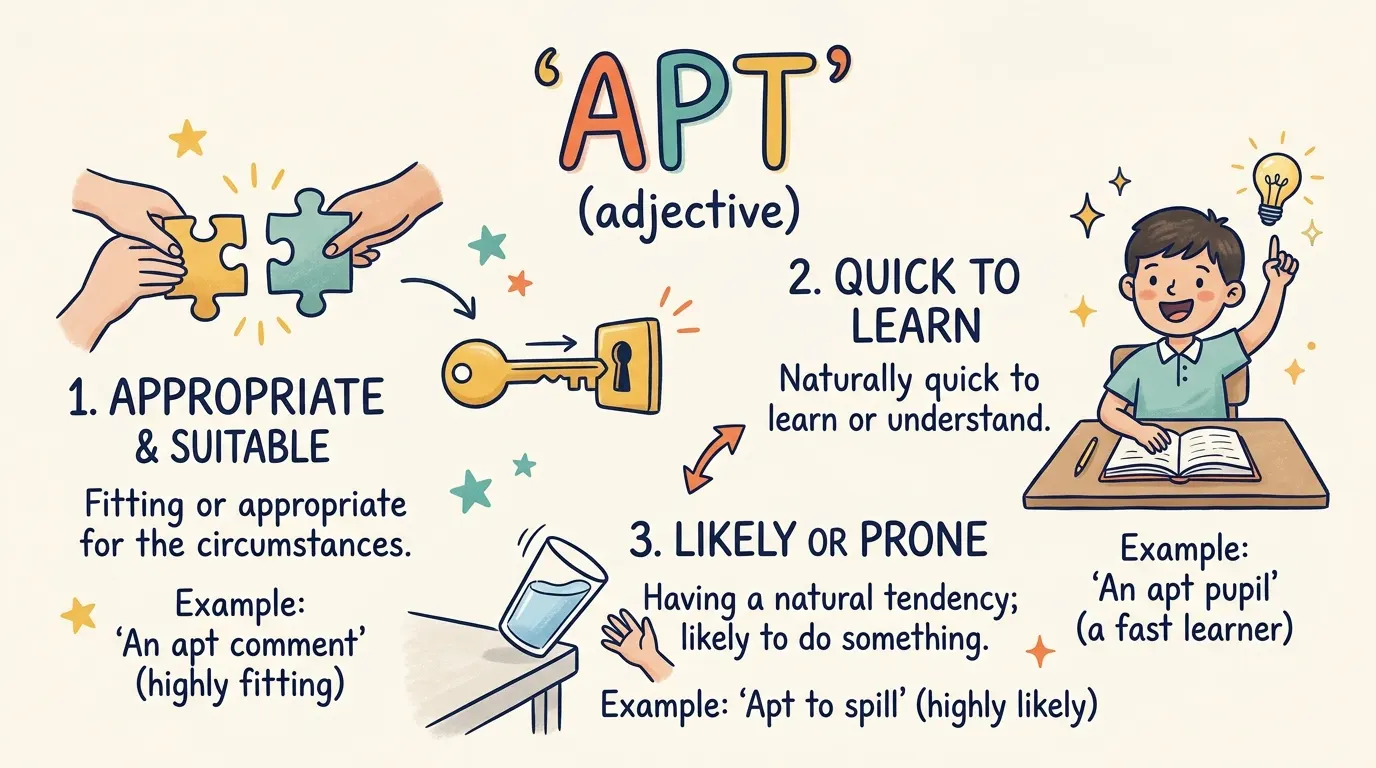
The word “apt” has three main uses in English, and they are all connected by the same basic idea: something that fits well or happens naturally.
- Suitable or fitting – When something matches a situation perfectly. Example: “Her apt description of the storm made everyone laugh.”
- Likely to do something – When something tends to happen in a certain way. Example: “Metal is apt to rust if it stays wet.”
- Quick to learn – When a person picks up new skills or ideas easily. Example: “He is an apt learner and picks up new software fast.”
Here is a simple table that breaks down these three meanings side by side:
| Meaning of “Apt” | Simple Explanation | Example Sentence |
| Suitable or fitting | Matches the situation perfectly | “That was an apt choice of words.” |
| Likely to happen | Has a tendency to do something | “Kids are apt to get tired after a long trip.” |
| Quick to learn | Learns or understands fast | “She is an apt reader for her age.” |
Notice that in each case, “apt” is doing the same basic job: showing that something fits, or naturally leans toward, a certain outcome.
Grammar or Correct Usage
“Apt” is an adjective, which means it describes a noun (a person, place, thing, or idea). It usually appears in one of two patterns.
Pattern 1: Apt + noun This is the simplest use. You place “apt” directly before the noun it describes.
- “That is an apt comparison.”
- “She gave an apt reply.”
Pattern 2: Apt to + verb This pattern shows a tendency or likelihood. You use “apt” followed by “to” and then a base verb.
- “Children are apt to ask a lot of questions.”
- “This fabric is apt to wrinkle in the wash.”
A few grammar notes worth remembering:
- “Apt” is almost always followed by “to,” not “for,” when talking about tendency. Saying “apt for” in this sense is a common mistake.
- The comparative and superlative forms are “apter” and “aptest,” though many writers prefer “more apt” and “most apt” because they sound smoother in modern English.
- The noun form of “apt” is “aptitude,” which means a natural ability or talent. You will often see this word in phrases like “aptitude test.”
- The adverb form is “aptly,” meaning “in a fitting way.” Example: “The movie was aptly named.”
Origin or History
“Apt” comes from the Latin word aptus, which meant “fitted” or “suited.” This Latin root traveled through Old French before settling into English by the late 1300s. From the very beginning, the word carried the idea of two things fitting together well, whether that was a tool fitting a task or a word fitting a meaning.
Over time, English speakers stretched the word to cover tendencies and natural abilities as well, which is why we still use “apt” today to describe both a well-chosen phrase and a fast-learning student. This shared root also explains why “aptitude,” “adapt,” and “apt” all feel connected. They all point back to the same idea of fitting well into a situation.
Common Mistakes
Even confident English speakers sometimes trip up on “apt.” Here are the mistakes to watch for.
- Confusing “apt” with “apt to” for permanent traits. “Apt to” works best for tendencies, not permanent facts. Saying “The sky is apt to be blue” sounds odd because the sky being blue is not a tendency, it is simply a fact.
- Mixing up “apt” and “adept.” These words look similar but mean different things. “Apt” means suitable or naturally likely, while “adept” means highly skilled through practice. “She is adept at painting” is different from “She is apt to paint quickly.”
- Using “apt” and “apropos” interchangeably. “Apropos” means relevant to the current topic, while “apt” means fitting or suitable. They overlap a little, but they are not perfect substitutes.
- Forgetting the preposition “to.” Many learners write “apt for” when talking about likelihood. The correct phrase in that context is “apt to.”
- Overusing “apt” in formal writing. While the word is useful, repeating it too often in one paragraph can make writing sound stiff. Mixing it with words like “fitting,” “suitable,” or “prone to” keeps writing natural.
Real-Life Examples
Seeing “apt” used in different contexts helps the meaning stick. Here are examples from everyday life, school, and work.
- In conversation: “That nickname is so apt, it fits him perfectly.”
- In writing feedback: “Your apt use of examples made the essay stronger.”
- In weather talk: “This time of year, storms are apt to roll in fast.”
- In the workplace: “She made an apt point about the budget during the meeting.”
- In parenting: “Toddlers are apt to lose interest in a toy within minutes.”
- In book or movie reviews: “The director’s apt pacing kept the audience engaged.”
Each of these examples shows the same core idea: something fits the moment, or something tends to happen in a predictable way.
Current Usage or Trends
“Apt” remains common in written English, especially in journalism, book reviews, and formal writing, where a single well-placed word can replace a longer phrase. Instead of writing “this is a comparison that fits the situation well,” a writer can simply say “this is an apt comparison.” That efficiency is part of why the word has stayed popular for centuries.
In casual speech, “apt” shows up less often than in writing, but it has not disappeared. People still use it in phrases like “aptly named” or “apt to happen,” especially when they want to sound precise without using a long explanation.
Tips or Best Practices
Here are a few practical tips for using “apt” with confidence.
| Situation | Best Practice |
| Describing a good word or phrase choice | Use “apt” directly before the noun, like “an apt title.” |
| Talking about a tendency or likelihood | Use “apt to” followed by a verb, like “apt to rain.” |
| Writing formally (essays, reports, reviews) | Use “apt” to sound precise, but do not overuse it. |
| Speaking casually | Simple substitutes like “fitting” or “likely to” often sound more natural. |
| Comparing two things | Say “more apt” instead of “apter” for smoother, modern phrasing. |
Keeping these guidelines in mind will help you use “apt” the way experienced writers do, without sounding forced or repetitive.
FAQs
1. What does “apt” mean in simple words?
“Apt” means something fits well or is exactly right for a situation. It can also mean a person is likely to do something or learn quickly.
2. Is “apt” a formal word?
“Apt” is used in both formal and casual English, but it appears more often in writing, such as articles, reviews, and essays, than in everyday speech.
3. What is the difference between “apt” and “adept”?
“Apt” means fitting or naturally likely, while “adept” means highly skilled through training or practice. A person can be adept at cooking but apt to burn toast if they are distracted.
4. Can “apt” describe a person?
Yes. When “apt” describes a person, it usually means they learn or understand things quickly, as in “an apt student.”
5. What is the noun form of “apt”?
The noun form is “aptitude,” which means a natural talent or ability, often used in phrases like “aptitude test.”
6. How do you use “apt” in a sentence about likelihood?
Use the pattern “apt to” followed by a verb, such as “This road is apt to flood after heavy rain.”
Conclusion
At its core, “apt” is a small word that carries a big, useful meaning: something that fits well, feels natural, or is likely to happen.
If you are describing a well-chosen phrase, a rainy afternoon, or a quick-learning student, “apt” gives you a precise way to say it in just one word. Once you understand its three main uses, suitable, likely, and quick to learn, you will start noticing it everywhere, from books to conversations to news headlines.
The next time you want to describe something that fits a moment perfectly, reach for “apt.” It is short, clear, and, well, apt for the job.

Hassan is a content writer at LinkQuorax, sharing simple and clear meanings of words, slang, phrases, and everyday expressions to help readers understand language easily.