The discernment meaning is the ability to notice important differences, understand what is true or valuable, and make good judgments. In simple terms, discernment means having good judgment and knowing how to choose wisely.
For example, if you can tell that one job offer is better for you than another after carefully comparing the details, you are using discernment.
The word often appears when people talk about choices, people, behavior, quality, or situations that are not easy to understand. It can describe someone who looks beyond the surface before making a decision. Cambridge Dictionary defines discernment as the ability to judge people and things well.
In this guide, you will learn the discernment meaning, pronunciation, word forms, synonyms, examples, differences from related words, common mistakes, and practical ways to use it in everyday English.
Quick Answer
Discernment means the ability to judge something carefully and recognize important differences, especially when the right choice is not obvious.
A person with discernment does not simply accept the first thing they see or hear. They stop, look at the facts, notice details, and think about what those details mean.
For example:
“Her discernment helped her choose the right business partner.”
This means that her good judgment helped her make a wise choice.
The word is usually positive. Calling someone discerning suggests that the person has good judgment, insight, or an ability to recognize quality.
Discernment Meaning in Simple English

In simple English, discernment means knowing the difference between things and using good judgment to choose or understand what matters.
Imagine that you are shopping for a used car. Two cars look almost the same. One is cheaper, but it has many warning signs. The other costs more but has a good history and fewer problems.
If you carefully compare the cars and choose the better one, you are showing discernment.
Discernment is not just about being smart. It is about using what you know in a careful and practical way.
You may use discernment when deciding:
- Which person you can trust
- Which information is reliable
- Which job is right for you
- Which product is worth buying
- Whether an offer is too good to be true
- How to respond to a difficult situation
- Which advice is useful
- Whether someone’s actions match their words
The basic idea is simple: discernment helps you see beyond the obvious.
Cambridge also connects the related verb discern with seeing, recognizing, understanding, or deciding something that may not be clear at first.
What Does Discernment Mean?

The noun discernment refers to a person’s ability to make careful judgments.
It can involve several related skills, such as noticing details, understanding differences, recognizing quality, and thinking before making a choice.
For example:
“Good discernment is important when choosing who to trust.”
Here, discernment means the ability to judge a person’s character or actions carefully.
Another example is:
“She showed excellent discernment when reviewing the contract.”
This means she noticed important details and made a careful judgment before agreeing to the contract.
Discernment does not mean that someone always makes the perfect decision. People can have good judgment and still make mistakes. Instead, the word describes the quality of the thinking and judgment used to make a choice.
This is why discernment is useful in both simple and serious situations.
Discernment Definition and Key Idea
A useful way to understand the word is to break its meaning into four ideas:
| Idea | What it means |
| Notice | Pay attention to important details |
| Compare | See how things are different |
| Understand | Think about what those differences mean |
| Judge | Make a careful decision |
These steps often work together.
For example, suppose you receive an email offering you a job. The salary sounds excellent, but the message asks you to pay money before starting.
With discernment, you would not focus only on the attractive salary. You would notice the unusual request, compare it with normal hiring practices, and think carefully before responding.
That is discernment in action.
How to Pronounce Discernment
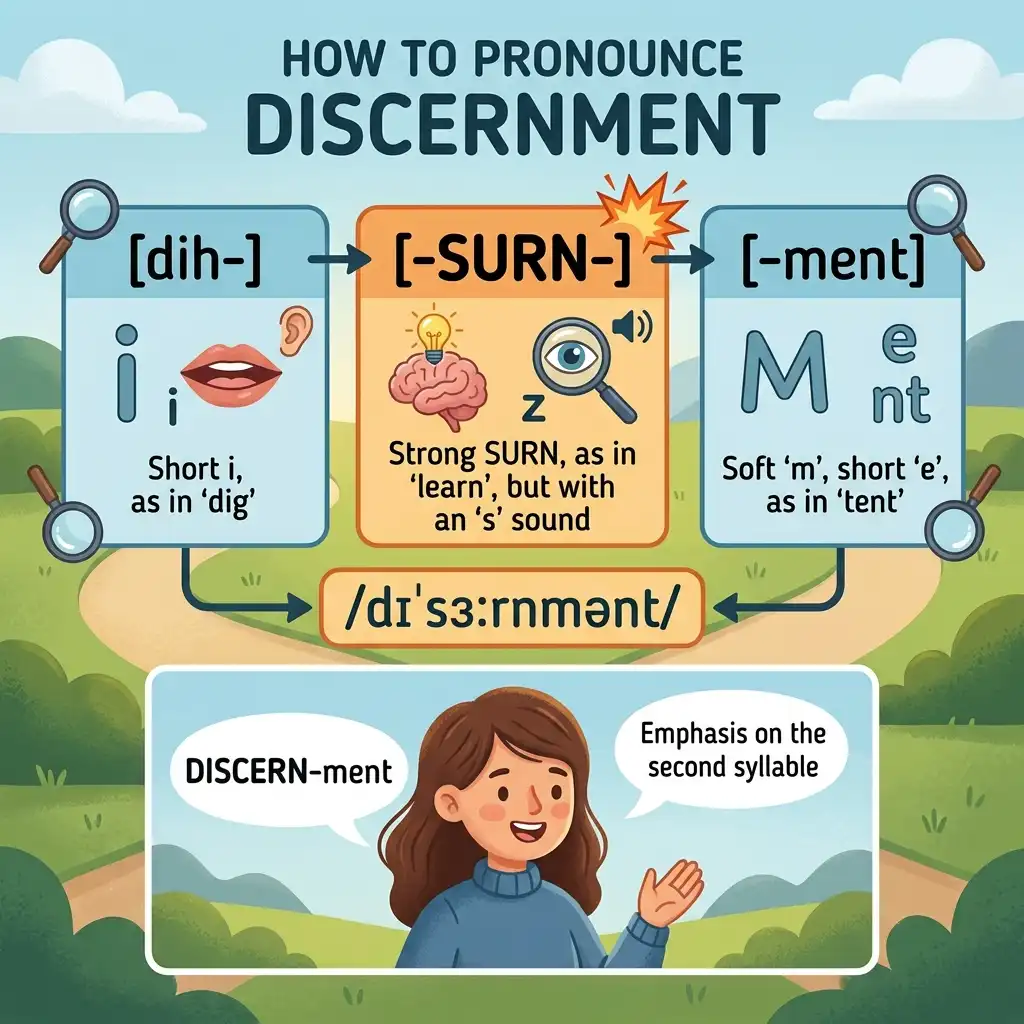
Discernment is pronounced approximately:
di-SURN-ment
The American English pronunciation is commonly represented as /dɪˈsɝːn.mənt/.
The stress falls on the second part of the word: SURN.
The related word discern is pronounced approximately di-SURN.
When speaking naturally, the word may sound like:
“di-SURN-ment”
It is useful to learn the pronunciation because discernment is more common in formal or thoughtful writing than in very casual conversation.
Discernment as a Part of Speech
Discernment is a noun.
It names the ability or quality of making good judgments.
For example:
“His discernment impressed the team.”
The related forms include:
| Word | Part of Speech | Meaning |
| Discernment | Noun | Good judgment or ability to recognize differences |
| Discern | Verb | To recognize, understand, or notice something |
| Discerning | Adjective | Showing good judgment |
| Discerningly | Adverb | In a discerning way |
| Discernible | Adjective | Able to be noticed or recognized |
The most common forms in everyday writing are discernment, discern, and discerning.
For example:
“She has good discernment.
“She is a discerning customer.”
Discernment vs. Discern

The difference between discernment and discern is mainly grammatical.
Discernment is a noun. It describes the ability to recognize or judge something well.
Discern is a verb. It describes the action of recognizing or understanding something.
Compare these sentences:
“His discernment helped him make a good decision.”
“He could discern the difference between the two options.”
In the first sentence, discernment is the ability.
In the second sentence, discern is the action.
A simple rule can help:
Discernment = the ability.
Discern = the action.
Discernment vs. Discerning
Discerning is an adjective used to describe someone who shows good judgment.
For example:
“She is a discerning shopper.”
This means she carefully judges products before buying them.
By contrast:
“She has excellent discernment.”
This focuses on her ability to make good judgments.
Cambridge describes discerning as showing good judgment, especially when judging style or quality.
Both words are positive, but they fit different parts of a sentence.
| Word | Example | Meaning |
| Discernment | “He has good discernment.” | He has good judgment. |
| Discerning | “He is a discerning buyer.” | He carefully judges what he buys. |
| Discern | “He could discern the problem.” | He recognized or understood the problem. |
Synonyms for Discernment
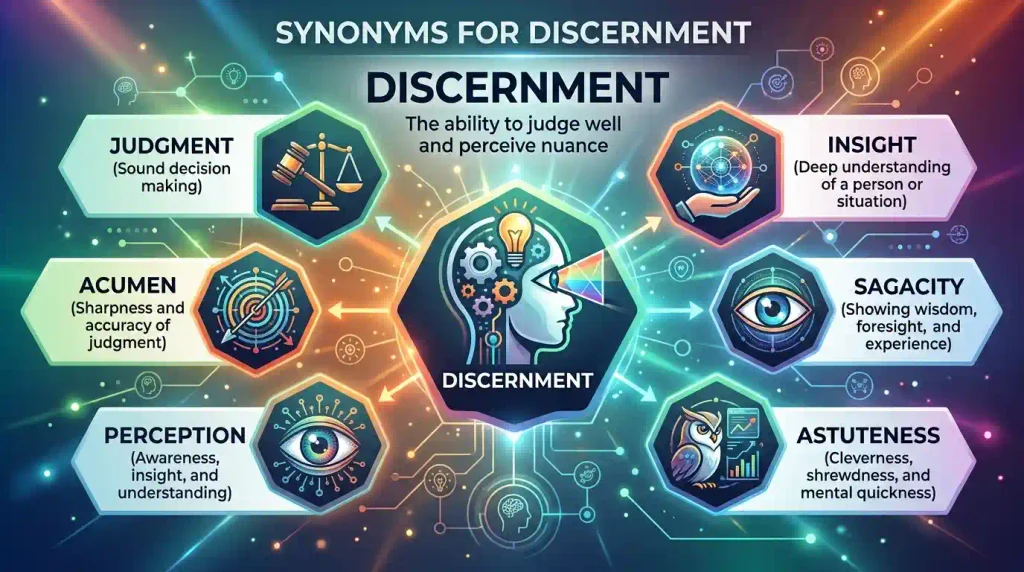
The best synonym depends on the context.
Common synonyms include:
Good judgment: the ability to make sensible choices.
Insight: a deeper understanding of something.
Wisdom: the ability to use knowledge and experience well.
Perception: the ability to notice or understand something.
Awareness: knowing what is happening around you.
Acuity: sharpness in understanding or noticing things.
Judgment: the ability to make a decision after thinking about a situation.
Savvy: practical knowledge and good sense, especially in informal English.
Cambridge lists savvy as a synonym in its entry for discernment.
However, these words are not always interchangeable.
For example, wisdom often suggests experience and long-term understanding, while discernment focuses more closely on recognizing differences and making careful judgments.
Discernment vs. Wisdom
These two words are closely related, but they are not exactly the same.
Wisdom is usually connected with knowledge, experience, and the ability to make good choices over time.
Discernment is more focused on recognizing what is important, true, useful, or appropriate in a particular situation.
For example:
“Her wisdom helped her handle the difficult situation.”
“Her discernment helped her recognize that the offer was not trustworthy.”
Wisdom may help you know what to do. Discernment may help you recognize what is really happening before you decide what to do.
The two qualities often work together.
Discernment vs. Judgment

Judgment and discernment are also very close.
Judgment is the ability to make a decision or form an opinion.
Discernment adds the idea of carefully noticing differences and understanding what is behind them.
For example:
“His judgment was good.”
This tells us that he made a good decision.
“His discernment was excellent.”
This suggests that he noticed important details and understood the situation well.
Discernment can therefore be thought of as a careful form of judgment.
Top Discernment vs. Intuition
Discernment and intuition can sometimes lead to the same decision, but they are different.
Intuition is a feeling or quick sense that something is right or wrong, often without conscious reasoning.
Discernment usually involves closer attention, comparison, thought, and judgment.
For example, you might have an intuition that a person is not being honest. Discernment would encourage you to look at the person’s words, actions, facts, and patterns before deciding.
In real life, people may use both.
A quick feeling can tell you to pay attention. Discernment can help you examine why that feeling may or may not be correct.
Discernment vs. Common Sense
Common sense means practical understanding of everyday situations.
Discernment is more specific. It involves recognizing important differences and making careful judgments.
For example, common sense may tell you not to leave your front door unlocked.
Discernment may help you decide which of two complicated offers is actually better after you examine the details.
Both are useful, but discernment often becomes more important when a situation is unclear or complicated.
Real-Life Examples of Discernment
The easiest way to understand discernment is to see it in everyday situations.
Consider these examples:
“Her discernment helped her choose a reliable doctor.”
The sentence means she carefully judged the available choices before deciding.
“Good discernment is important when reading news online.”
Here, discernment means being able to compare information, notice weak claims, and think carefully before believing or sharing something.
“The manager showed discernment when hiring the new employee.”
This means the manager carefully judged the candidate rather than making a quick decision.
“He has a strong sense of discernment when it comes to art.”
This suggests that he can recognize differences in quality or style.
“Parents often use discernment when making choices for their children.”
This means parents may need to judge what is safe, useful, and appropriate.
These examples show that discernment is not limited to one area of life.
Discernment in Everyday Decisions
You use discernment more often than you may realize.
Imagine that you want to buy a laptop. One model has a low price and impressive advertising. Another costs more but has stronger reviews, better support, and features that fit your needs.
Choosing the second laptop after comparing the facts is an example of discernment.
The same skill can be useful when:
- Choosing friends
- Comparing job offers
- Reading online reviews
- Selecting a school
- Evaluating advice
- Making financial choices
- Deciding what information to trust
- Understanding someone’s behavior
Discernment is especially valuable when two choices look similar but have very different results.
How Discernment Helps With People
Discernment can help you understand people more carefully.
It does not mean judging everyone harshly. Instead, it means paying attention to behavior and patterns.
For example, someone may say they are dependable. Discernment encourages you to notice whether their actions support that claim.
Someone may appear friendly, but you can still take time to learn whether they are trustworthy.
Someone else may be quiet and reserved but prove to be very kind and reliable.
Discernment helps you avoid making quick judgments based only on appearance, popularity, or first impressions.
A discerning person asks:
“What do the facts show?”
“Do this person’s actions match their words?”
“What am I missing?”
“Is there another explanation?”
These questions can lead to better decisions.
How to Use Discernment in a Sentence
The noun discernment is often used after words such as good, great, keen, excellent, or strong.
Common patterns include:
“She showed good discernment.”
“He is known for his keen discernment.”
“The decision required careful discernment.”
“Her discernment helped the company avoid a costly mistake.”
“The job requires discernment and patience.”
The phrase “with discernment” is also possible:
“She chooses her words with discernment.”
This means she carefully considers what she says.
Common Mistakes With Discernment
One common mistake is using discernment as though it simply means “intelligence.”
They are related, but they are not identical.
A person can be highly intelligent but still make poor judgments. Discernment is specifically about recognizing differences and making sound choices.
Another mistake is assuming that discernment means being suspicious of everyone.
It does not.
Discernment is about careful judgment, not automatic distrust.
A third mistake is using discernment when discern is required.
Incorrect:
“She discerns the difference.”
Correct:
“She discerned the difference.”
Or:
“She used discernment to understand the difference.”
The grammar matters because discern is a verb, while discernment is a noun.
Is Discernment a Positive Word?
Yes. Discernment is generally a positive word.
When someone says:
“She has excellent discernment,”
they are usually praising that person’s judgment.
The word can suggest that someone is thoughtful, perceptive, careful, and able to recognize quality.
For example:
“The editor showed great discernment when selecting the articles.”
This is a compliment. It suggests the editor made thoughtful choices.
The word is also somewhat formal, so it may sound more serious than simple phrases such as “good sense” or “good judgment.”
Is Discernment a Formal Word?
Yes, discernment is generally more formal than everyday words such as “good sense.”
It is common in writing about:
- Education
- Leadership
- Art and design
- Business
- Personal decisions
- Ethics
- Religion
- Literature
- Professional judgment
You can use it in everyday conversation, but in casual speech, people may simply say:
“She has good judgment.”
“He knows how to pick good products.”
“She has a good eye for quality.”
“She’s good at reading people.”
All of these can express ideas related to discernment.
Origin and History of Discernment
The word discernment has a long history in English.
Etymology sources trace the noun to the verb discern plus the suffix -ment. The noun is recorded from the 1580s, with early meanings connected to sharp intellectual perception, insight, and judgment.
The verb discern entered English earlier. It came through Old French discerner and ultimately from Latin discernere, meaning to separate, distinguish, or perceive.
This history helps explain the modern meaning. At its heart, discernment involves separating one thing from another so that you can recognize the difference.
The word’s meaning developed from ideas of distinguishing and perceiving toward the modern sense of careful judgment and insight.
Discernment in American English
In American English, discernment has the same basic meaning: the ability to judge people or things well.
The pronunciation is typically represented as /dɪˈsɝːn.mənt/ in American English.
There is no major meaning difference between American and British English.
The word can appear in both formal writing and thoughtful everyday speech.
For a U.S. audience, natural alternatives may include good judgment, good sense, insight, or knowing what to look for, depending on the situation.
Why Discernment Matters
Discernment matters because not every choice has an obvious answer.
Modern life gives people a huge amount of information. Online posts, advertisements, reviews, opinions, advice, and news can all compete for attention.
Simply having more information does not guarantee a better decision.
Discernment helps you ask whether information is useful, reliable, complete, and relevant.
It can also help you slow down when emotions are strong.
For example, if you are angry, excited, or afraid, you may want to make a quick decision. Taking a moment to examine the situation can help you see details that emotion might hide.
Discernment does not remove uncertainty. Instead, it helps you make better choices even when certainty is impossible.
How to Develop Better Discernment
Discernment is a skill that can improve with practice.
Start by slowing down important decisions. You do not need to overthink every small choice, but major decisions deserve careful attention.
Ask questions before accepting a claim. Instead of immediately believing something, consider where the information came from and whether the evidence supports it.
Look for patterns. A single event may not tell you much, but repeated behavior can reveal more.
Separate facts from opinions. Someone can speak confidently and still be wrong.
Consider another point of view. This does not mean every opinion is equally correct. It means you are willing to check your own assumptions.
Learn from experience. Think about decisions that worked well and those that did not. Ask what signs you noticed or missed.
Stay open to correction. Good discernment does not mean believing that you are always right.
A discerning person can say, “I may have missed something. Let me look again.”
Discernment and Critical Thinking
Discernment and critical thinking are closely connected.
Critical thinking involves examining information, evidence, assumptions, and reasoning before reaching a conclusion.
Discernment focuses more on recognizing differences, understanding what matters, and making a sound judgment.
For example, when reading a product review, critical thinking may help you examine whether the review gives evidence. Discernment may help you decide whether the product itself is actually a good fit for your needs.
Together, these skills can lead to stronger decisions.
Discernment in Professional Life
Discernment can be valuable at work.
A manager may use it when choosing between candidates.
An editor may use it when deciding which information belongs in an article.
A designer may use it when selecting between similar styles.
A customer may use it when comparing competing products.
A business owner may use it when deciding which opportunity deserves attention.
In each case, the person must look beyond the surface and decide what has real value.
That is why phrases such as “good business judgment” and “professional discernment” often appear in formal contexts.
Frequently Asked Questions
What is the simple meaning of discernment?
Discernment means having the ability to notice important differences, understand a situation, and make a good judgment. In simple terms, it means knowing how to choose or judge wisely.
What is an example of discernment?
If you compare two job offers carefully and choose the one that better matches your goals, salary needs, and working conditions, you are using discernment.
Is discernment the same as wisdom?
Not exactly. Wisdom often comes from knowledge and experience, while discernment focuses more on recognizing important differences and making careful judgments. They often work together.
What is the difference between discern and discernment?
Discern is a verb that means to recognize, notice, or understand something. Discernment is a noun that describes the ability to do this well.
Is discernment a good quality?
Yes. Discernment is generally considered a positive quality because it suggests careful thinking, good judgment, and the ability to recognize what is valuable or appropriate.
What is another word for discernment?
Depending on the context, synonyms include judgment, insight, wisdom, perception, awareness, acuity, and savvy. The best choice depends on the exact sentence.
Conclusion
The discernment meaning is the ability to recognize important differences, understand what is happening, and make careful judgments. It is more than simply being intelligent or having an opinion. Discernment means looking closely, thinking clearly, and choosing wisely.
You can use discernment when choosing people, products, jobs, information, advice, or opportunities. It is especially useful when a situation is unclear and the best choice is not immediately obvious.
The related verb is discern, while discerning describes someone who shows good judgment. The word is generally positive and somewhat formal, making it useful in both professional and thoughtful writing.
A simple way to remember it is: discernment means seeing the difference and understanding why it matters.
When you slow down, check the facts, notice patterns, and stay open to new information, you give yourself a better chance of making wise decisions.

Hi, I’m Benjamin Dreyer. I enjoy exploring words, phrases, slang, abbreviations, acronyms, and digital communication. At Linkquorax.com, I share simple and accurate explanations to help readers understand unfamiliar terms and popular internet expressions. My goal is to make every meaning clear, useful, and easy to understand. Whether you are curious about a new word or an online phrase, Linkquorax.com provides straightforward information to help you learn quickly and communicate with confidence in everyday conversations.