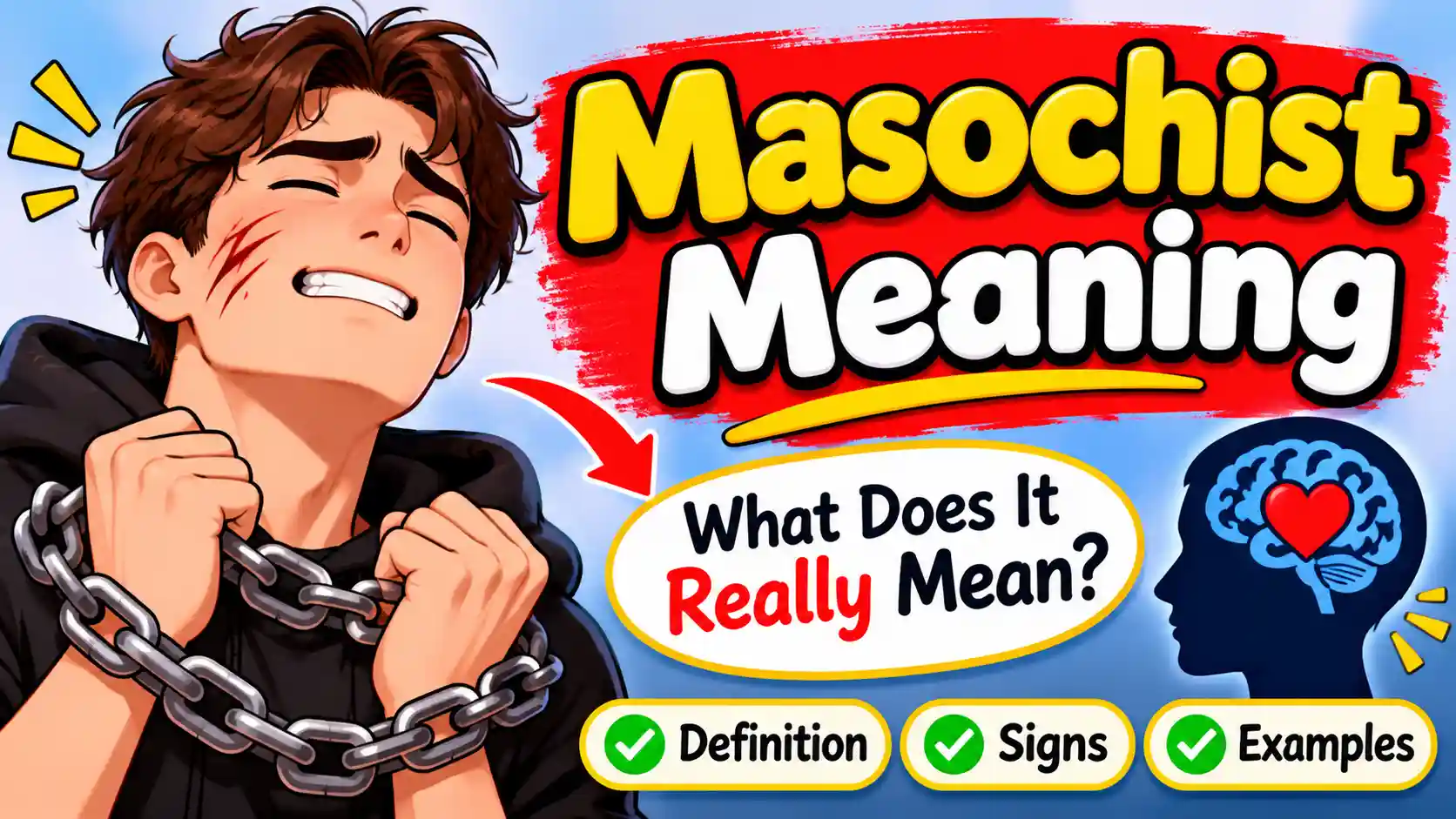
Have you ever heard someone called a “masochist” and wondered what it really means? You’re not alone. This word gets thrown around in movies, books, and everyday conversations.
But the true masochist meaning is more interesting than you might think. Simply put, a masochist is someone who gets pleasure from pain or hard things that most people would avoid.
Some people use it to talk about a serious psychological condition, while others use it as a joke when someone does something tough or unpleasant.
This article will walk you through the full masochist meaning, where the word comes from, and how people use it today. By the end, you’ll fully understand what it means to be a masochist and how to use the word correctly in your own life.
Quick Answer:
A masochist is a person who finds pleasure in their own pain or suffering. This can mean physical pain, like being hurt, or emotional pain, like being humiliated or treated badly . Some people use the word in a joking way to describe someone who does difficult things for fun.
For example, if your friend runs a marathon in the pouring rain, you might call them a masochist as a joke . The official psychiatric meaning is more serious.
It refers to someone who gets sexual pleasure from being hurt or controlled . It’s important to know both meanings so you can use the word correctly.
The Full Masochist Meaning and Definition
The masochist meaning can be broken down into two main parts. The first is the sexual or psychiatric definition. This is a person who gets sexual pleasure from being hurt, controlled, or humiliated .
The pain can be physical, like being whipped or scratched. It can also be emotional, like being called names or treated badly. Usually, the person has control over the situation and can stop it if things get too serious. They might use a “safe word” to tell their partner to stop .
The second definition is the informal one. This is a person who seems to enjoy things that are unpleasant or painful for everyone else . These people don’t get sexual pleasure from it.
They just seem to like challenges that others find hard or scary. Someone who goes jogging for hours in bad weather might be called a masochist .
Examples of Masochist in a Sentence
Understanding a word is easier when you see it used. Here are some simple examples that show the masochist meaning in action.
- “My brother is a real masochist. He spends his whole weekend doing really hard math problems for fun.”
- “According to psychology, a masochist might enjoy being humiliated as part of a controlled and safe experience.”
- “Only a masochist would choose to live in a place with such harsh, freezing winters.”
- “The character in the movie was a masochist who kept going back to a partner who treated him terribly.”
Where Did the Word Masochist Come From?
The word “masochist” has a very specific history. It comes from the name of an Austrian writer named Leopold von Sacher-Masoch, who lived from 1836 to 1895 . He wrote stories that talked about his own enjoyment of being beaten and controlled.
His most famous book is called Venus in Furs . A psychiatrist named Richard von Krafft-Ebing read his work. In 1890, he used the name “masochism” in a big book about sexuality . This is how the word was born. It’s not a word that developed slowly over time. It was created based on one man’s life and writings . The word for someone who enjoys hurting others is a “sadist.” That word comes from another writer, the Marquis de Sade .
Sadist vs. Masochist: What’s the Difference?
People often mix up the words “sadist” and “masochist,” but they mean opposite things. This table shows the difference clearly.
| Term | Definition | Key Action |
| Masochist | Someone who gets pleasure from receiving pain or humiliation . | Receives pain. |
| Sadist | Someone who gets pleasure from inflicting pain or humiliation on others . | Inflicts pain. |
It can be easy to remember the difference if you think about the direction of the action. The masochist is on the receiving end.
The sadist is doing the action. Sometimes, a person can have both traits. This is called being a sadomasochist. They might enjoy giving pain in one situation and receiving it in another .
The Psychology of Masochism: A Deeper Look
Psychology looks at masochism as a complex topic. In a psychiatric context, it is called sexual masochism. This means the person needs pain or humiliation to feel sexually excited. The pain can be mild, like scratching or hair-pulling, or more severe . The person may also enjoy being controlled or dominated. It is important to know that this happens with explicit consent between partners. This means everyone agrees to what is happening and can stop it at any time .
Emotional Masochism
There is also a concept called “emotional masochism.” This is not about sex. It is about how someone acts in their daily life and relationships. An emotional masochist might always find themselves in unhappy situations. They might stay with a partner who treats them badly .
They might choose a job that makes them miserable. This can happen if someone has deep down feelings of not being worthy of love or respect. They might create difficult situations because it feels “normal” to them . It’s important to remember that emotional masochism can be a serious problem. It can lead to a pattern of self-sabotage that stops a person from being happy.
Types of Masochistic Behavior
There are different ways that masochistic behavior can show up in real life. Here is a breakdown of the main types people talk about.
| Type | Description | Common Examples |
| Sexual Masochism | Getting sexual pleasure from pain, humiliation, or being controlled . | Being scratched, having hair pulled, being called degrading names, or being tied up. |
| Emotional Masochism | A pattern of seeking out or staying in situations that cause emotional pain and suffering . | Staying with a cruel partner, being a “martyr” at work, believing you deserve to be unhappy. |
| Joking/Informal Masochism | A casual way to describe someone who enjoys hard or unpleasant tasks . | Running a marathon, eating extremely spicy food, or doing very difficult puzzles for entertainment. |
Common Mistakes People Make
There are a few common mistakes people make when using the word “masochist.”
- Using it to describe someone who enjoys hurting others: This is the most common error. If a person enjoys hurting other people, they are a sadist, not a masochist . Think of the direction of the pain. The masochist takes the pain. The sadist gives it.
- Thinking it is only about sex: Many people think the masochist meaning is only about sexual pleasure. While that is one definition, the informal use is widespread. It’s perfectly fine to call someone a masochist as a joke for doing something tough.
- Confusing it with a simple dislike: Saying “I hate waking up early, I’m such a masochist” is not using the word correctly. Waking up early is unpleasant, but it doesn’t give you pleasure. It just makes you tired. A true masochist would, in some way, enjoy the struggle.
Real-Life Examples of a Masochist
Seeing the word in real-life situations makes the masochist meaning clearer.
Casual Use: “My friend is training for a 100-mile bike race in the middle of summer. It’s so hot and difficult. He must be a masochist!” In this case, the friend isn’t really a masochist. He just has a passion for a difficult sport. The speaker is joking.
Psychological Use: “He kept going back to a partner who was always critical and unkind. It was like a form of emotional masochism.” This example is more serious. It describes a pattern of behavior that causes emotional pain. The person can’t leave the bad situation.
Literary Example: “The character in the book, Venus in Furs, is a classic masochist. He begs his lover to treat him cruelly and humiliate him.” This example refers to the original source of the term. The character is a sexual masochist.
How the Word Is Used Today
Today, the word “masochist” is used in many different ways. On the internet and in everyday talk, people use it humorously.
If someone posts a picture of a huge pile of homework, they might joke “I must be a masochist for taking so many classes.” In the media, you will see the word used in a more clinical way.
Articles and documentaries might use it to explain the psychological condition. It is important to pay attention to the context. If you are reading a psychology textbook, the meaning is serious.
If you are chatting with friends, the meaning is probably light and funny. The meaning of a word is often determined by how it is used in a sentence.
FAQs:
1. Is being a masochist a bad thing?
It depends on the situation. The word can be negative or neutral. In psychology, it describes a condition that doesn’t hurt others and isn’t bad if done safely . In everyday talk, it is often used as a joke to describe someone who takes on tough challenges. It is not usually a mean insult.
2. Is a masochist the same as a sadist?
No, they are opposites. A masochist enjoys receiving pain. A sadist enjoys giving pain to others .
3. Can someone be both a masochist and a sadist?
Yes. Someone who enjoys both giving and receiving pain is called a sadomasochist .
4. Is masochism a mental health condition?
It can be. In psychiatry, it is known as sexual masochism. It is considered a condition when it causes distress or stops a person from living a normal life .
5. What does it mean to be an emotional masochist?
This is someone who always puts themselves in situations that cause them emotional pain, like bad relationships or jobs. They might do this because they don’t think they deserve to be happy .
6. Where does the word “masochist” come from?
It comes from an Austrian writer named Leopold von Sacher-Masoch, who lived in the 1800s. He wrote stories about his own enjoyment of pain and being controlled .
Conclusion
The masochist meaning is clear: it is a person who gets pleasure from pain or hard things. This pleasure can be sexual, like in the psychological definition, or just informal, like when someone enjoys a difficult hobby.
The word has a very clear origin, coming from the writer Leopold von Sacher-Masoch in the 19th century. It is also important to know the difference between a masochist, who likes to receive pain, and a sadist, who likes to give it.
Now you know the true meaning of the word. You can use it correctly and understand it when you see or hear it. If it’s used in a joking way with friends or in a more serious context, you have a full understanding of this interesting word.

Hi, I’m Benjamin Dreyer. I enjoy exploring words, phrases, slang, abbreviations, acronyms, and digital communication. At Linkquorax.com, I share simple and accurate explanations to help readers understand unfamiliar terms and popular internet expressions. My goal is to make every meaning clear, useful, and easy to understand. Whether you are curious about a new word or an online phrase, Linkquorax.com provides straightforward information to help you learn quickly and communicate with confidence in everyday conversations.