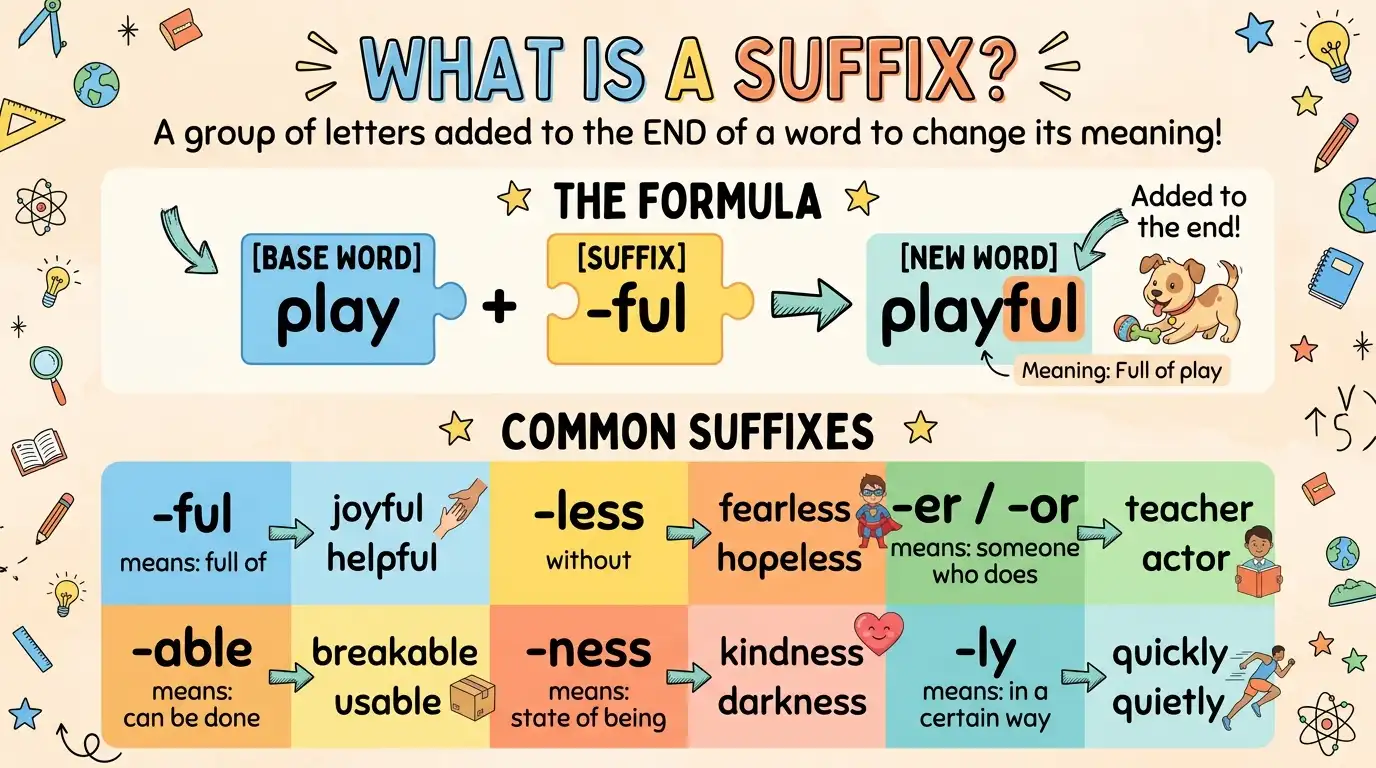
Have you ever looked at a word and wondered how it was made? Maybe you saw the word “quickly” and knew it meant “in a fast way.” The “-ly” at the end tells you that. That tiny piece is called a suffix.
Understanding what a suffix is can help you unlock the meaning of many new words and make you a better reader and writer.
In this article, we will break down the suffix meaning in the simplest way possible. You will learn what suffixes are, why we use them, and how they change words.
We will look at common examples, learn the rules for adding them, and see how they are used in everyday English. You will soon see that English words are like building blocks, and suffixes are some of the most important pieces.
Quick Answer
A suffix is a letter or a group of letters added to the very end of a word. Its purpose is to change the meaning of the original word or to create a whole new word.
For example, adding “-less” to the word “hope” gives you “hopeless,” which means “without hope.” It is a simple but powerful tool in the English language.
Suffix Meaning and Definition
The suffix meaning is simple. It comes from a Latin word that means “to fasten underneath.” In English, a suffix is like a special ending you put on a base word. This ending can change the word’s job in a sentence, how it is used, or what it means.
Think of it like this: you have a plain word like “play.” If you add “-er,” you get “player,” which is a person who plays. Add “-ful” to “joy,” and you get “joyful,” which means full of joy. This is the core of the suffix meaning. It is a word part that creates a new meaning when added to the end of another word.
Grammar and Correct Usage
In grammar, suffixes are like tools that change how a word works. They can do different jobs. Let’s look at the two main types.
Inflectional Suffixes
These suffixes are used for grammar. They don’t create a new word but change a word to fit a sentence’s grammar. For example, you add “-s” to make a noun plural, like “cat” to “cats.” You add “-ed” to a verb to show past tense, like “walk” to “walked”. They are very common and help us understand the grammar of a sentence.
Derivational Suffixes
These suffixes create a brand new word, often changing the word’s part of speech. For example, adding “-tion” to the verb “educate” creates the noun “education.” Adding “-able” to “read” creates the adjective “readable”. This is a powerful way to build vocabulary and express more complex ideas.
Spelling Rules for Adding Suffixes
Sometimes, adding a suffix is simple, like “dark” + “ness” = “darkness.” But there are a few important spelling rules to learn. Here are some of the most important ones.
The “Y” to “I” Rule
When a word ends in a consonant and “y,” you often change the “y” to an “i” before adding a suffix. This happens for suffixes like -ness, -ly, or -er. So “happy” becomes “happiness,” and “ready” becomes “readily”.
The Silent “E” Rule
If a word ends in a silent “e,” you usually drop the “e” when adding a suffix that starts with a vowel. For example, “care” + “ing” = “caring.” However, if the suffix starts with a consonant, you keep the “e,” like “care” + “ful” = “careful”.
Doubling the Final Consonant
This rule can be tricky. If a word has one syllable, ends in a single vowel followed by a single consonant, and you are adding a suffix that starts with a vowel, you double the final consonant. For example, “shop” + “ing” = “shopping.” Or “run” + “er” = “runner”.
Common Suffixes and Their Meanings
There are hundreds of suffixes, but some are used much more often than others. Learning these common ones will help you figure out what a new word means. Here are a few of the most useful ones.
| Suffix | Meaning | Example |
| -er / -or | One who does something | Teacher, actor |
| -ful | Full of | Careful, joyful |
| -less | Without | Hopeless, fearless |
| -ness | State of being | Kindness, sadness |
| -able / -ible | Can be done | Readable, responsible |
This table shows that suffixes are a quick way to understand a new word. If you know “-less” means “without,” then “tireless” makes sense as “without tire.”
Real-Life Examples
Suffixes are everywhere in our language. You hear and read them all the time. Let’s see how they change common words.
| Base Word | Suffix | New Word | Meaning of New Word |
| comfort | -able | comfortable | Able to give comfort |
| act | -ion | action | The process of acting |
| child | -ish | childish | Like a child |
As you can see, a suffix adds something important to a word. Understanding the suffix meaning helps you read more clearly and express your own ideas more precisely.
Tips for Mastering Suffixes
Learning suffixes is a great way to improve your English. Here are a few easy tips to get started.
- Learn one at a time: Instead of trying to memorize a long list, focus on one or two new suffixes each week.
- Look for patterns: When you read, pay attention to the endings of words. See if you can spot a suffix you know.
- Make your own words: Try adding a suffix to a word you know to make a new word. It’s a fun way to practice.
FAQs
What is a suffix in simple words?
It is a letter or group of letters added to the end of a word to change its meaning or how it is used. “Walk” + “-ed” = “walked”.
Is “-ed” a suffix?
Yes, “-ed” is a very common suffix. It is added to verbs to show past tense, like “jump” to “jumped”.
What is the difference between a prefix and a suffix?
A prefix goes at the beginning of a word, like “un-” in “unhappy,” while a suffix goes at the end, like “-ness” in “happiness”.
Can you add more than one suffix to a word?
Yes. For example, you can add “-al” to “derive” to make “derivational” or “-less” to “care” to make “careless”.
What is the most common suffix in English?
Some of the most common are “-ed,” “-ing,” and “-s,” because they are used to show verb tense and plurals.
What does a suffix do to a word?
A suffix can change a word’s meaning, change its part of speech (from a verb to a noun, for example), or make it fit better in a sentence grammatically.
Conclusion
Understanding the suffix meaning is a key step to becoming more confident with English. These small word parts are powerful. They can change a word from a verb to a noun, change its meaning, or make it fit correctly in a sentence.
By learning common suffixes like “-ful,” “-less,” and “-er,” you can unlock the meaning of many new words and improve your vocabulary. Start by paying attention to the endings of words you read every day.
The more you notice them, the easier they become. Keep building your skills one suffix at a time.

Hassan is a content writer at LinkQuorax, sharing simple and clear meanings of words, slang, phrases, and everyday expressions to help readers understand language easily.