If you have ever read a history book about ancient China, the Ottoman Empire, or old royal courts, you have probably seen the word “eunuch.”
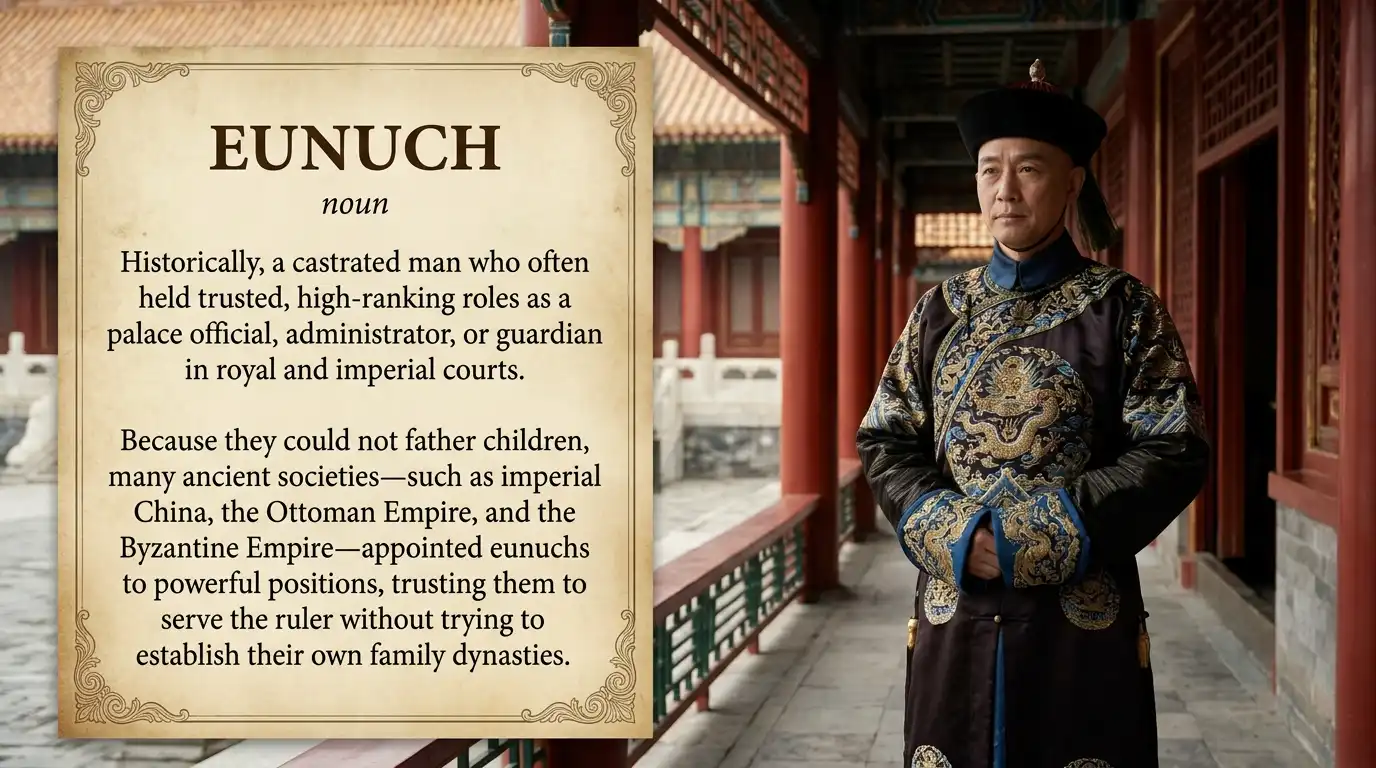
So, what does eunuch mean? A eunuch is a man who has been castrated, usually before he grew up, so he could not father children.
This may sound strange today, but eunuchs played big roles in history. They worked as guards, servants, and even powerful advisors to kings and emperors.
In this article, we will explain the eunuch meaning in simple words. You will also learn where the word came from, how eunuchs lived, and why this word still shows up in books, movies, and everyday talk today.
Quick Answer
The simple eunuch meaning is this: a eunuch is a man or boy who has had his testicles removed, often by force, so he could not have children.
This was usually done to him when he was young, before he could choose for himself. Eunuchs lived in many parts of the world, from ancient Rome to China to the Middle East.
They often worked inside royal palaces, where kings trusted them with special jobs. Today, the word “eunuch” is mostly used in history lessons, but people sometimes use it in other ways too, which we will explain later in this article.
Meaning or Definition
Let’s break down the eunuch meaning even more. The word describes a male person who cannot produce children because of a medical procedure called castration. This procedure removes the testicles, which are the body parts that make sperm and most of the hormone testosterone. Without testosterone, a person’s body and voice often change in noticeable ways.
Here is a simple table to help make the definition clear:
| Term | Simple Meaning |
| Eunuch | A man who has been castrated, usually so he could not father children |
| Castration | The medical act of removing the testicles |
| Harem guard | A common job given to eunuchs in royal courts |
| Court eunuch | A eunuch who worked closely with a king, queen, or emperor |
Eunuchs were not the same as regular servants. Rulers often trusted them more because they had no children of their own to protect or promote. This made eunuchs seem safer to have close to the throne, since they were less likely to try to start their own royal family line.
Not every eunuch was castrated as an adult. Many were changed when they were still boys, sometimes without knowing what was happening to them. This is a sad and difficult part of history, and it is important to remember that real people lived through it, not just characters in old stories.
Origin or History
The word “eunuch” comes from an old Greek word, “eunoukhos.” This Greek word is made of two smaller parts. One part means “bed,” and the other part means “keeper.” So the word originally meant something like “keeper of the bed” or “bed guard.” This makes sense once you know the job many eunuchs actually did.
In ancient times, kings and rich rulers often had many wives or female servants living in a special part of the palace, sometimes called a harem. Rulers wanted trusted guards watching over this part of the palace, but they did not want those guards to be a threat. Because eunuchs could not father children, rulers believed they would not try to start secret relationships with the women in the harem. That is how eunuchs became known as trusted bed and palace guards.
But eunuchs did much more than guard rooms. In ancient China, some eunuchs became very powerful. They worked closely with emperors and sometimes controlled huge amounts of money and information. In the Ottoman Empire, eunuchs managed parts of the royal household and helped run daily palace life. In the Byzantine Empire, some eunuchs even became generals or church leaders.
Here is a table showing where eunuchs were common in history:
| Region or Empire | Common Role of Eunuchs |
| Ancient China | Palace officials, advisors, record keepers |
| Ottoman Empire | Harem guards, household managers |
| Byzantine Empire | Court officials, military leaders, church roles |
| Ancient Rome | Household servants, priests in some religious groups |
| Ancient Persia | Palace guards, trusted royal servants |
This history shows that the eunuch meaning is not just about one job. It changed depending on the time period and the country. In some places, eunuchs held real power. In others, they lived hard lives with very few rights.
Real-Life Examples
Learning about real people can help make the eunuch meaning easier to understand. Here are a few simple examples from history.
In China, a man named Zheng He became one of the most famous eunuchs in history. He was taken from his family as a boy and made a eunuch. Later, he grew up to lead huge sea voyages for the Chinese emperor, sailing to places like Africa and the Middle East. He became a respected explorer, even though his life started in a very painful way.
In the Ottoman Empire, the Chief Black Eunuch was one of the most powerful people in the royal palace. This person managed the harem and often had close access to the sultan, the empire’s ruler. Because of this closeness, some Chief Black Eunuchs gained huge influence over royal decisions.
In the Byzantine Empire, eunuchs sometimes rose through the church and became bishops or other religious leaders. This shows that the role of a eunuch was not limited to guarding rooms. Some eunuchs became well-known scholars, artists, or government workers.
These examples show that while the basic eunuch meaning stayed the same, the lives of eunuchs could look very different depending on where and when they lived.
Current Usage or Trends
Today, castration of this kind is not common practice, and the word “eunuch” is mostly used when talking about history. You will often find it in history class, museum displays, documentaries, and books about ancient empires. Historians use the word to describe a real group of people who lived and worked in royal courts long ago.
Sometimes, the word is also used in a non-literal way. For example, someone might say a person acts “eunuch-like” if they mean the person seems to have no real power or influence, even in an important position. This use is meant to describe weakness or lack of control, not an actual medical condition. It is worth knowing that this kind of use can sound harsh or insulting, so it is best used carefully and respectfully, especially since it refers to real historical experiences that involve suffering.
In some parts of the world today, especially in South Asia, communities sometimes use related terms to describe people whose gender identity does not match the sex they were assigned at birth. These modern communities have their own histories, cultures, and terms, and they are not the same as historical court eunuchs. If you are researching modern gender identity topics, it is best to look for terms and information written by those communities themselves, since language and meaning can be different from the historical eunuch meaning explained in this article.
Common Mistakes
People sometimes confuse a few things when learning about this word. Here are some common mix-ups to avoid.
First, some people think all servants in old palaces were eunuchs. This is not true. Palaces had many kinds of workers, and only some of them were eunuchs.
Second, some people assume eunuchs always had low status. In reality, many eunuchs gained great power and wealth, especially in places like China and the Ottoman Empire.
Third, some people think the word is only used for ancient history. While it is mostly a historical term now, it still appears in books, TV shows, and casual conversation today.
Fourth, people sometimes spell the word incorrectly, writing “eunich” or “unuch.” The correct spelling is “eunuch,” with the letters “e-u-n-u-c-h.”
FAQs
What is the simple eunuch meaning?
A eunuch is a man or boy who has been castrated, meaning his testicles were removed, so he could not father children.
Why were eunuchs used in royal courts?
Rulers often trusted eunuchs because they could not start their own royal family lines, so they seemed less likely to threaten the throne.
Where does the word “eunuch” come from?
It comes from an old Greek word meaning “keeper of the bed,” which described their early role as guards in royal households.
Were all eunuchs treated badly?
No. While many eunuchs faced hard and unfair lives, some became powerful leaders, explorers, or advisors with great influence.
Is the word “eunuch” still used today?
Yes, mostly in history books, documentaries, and educational content. It is rarely used to describe real people in modern times.
Is “eunuch” the same as modern gender identity terms?
No. Historical eunuchs were castrated males who worked in royal courts. Modern gender identity terms describe different, current communities with their own histories.
Conclusion
So, what is the eunuch’s meaning in the end? A eunuch was a castrated man, often trusted with special jobs in royal palaces across history, from China to the Ottoman Empire to ancient Rome.
While the word started as a simple job title meaning “bed keeper,” it grew to describe a wide range of roles, from humble servants to powerful advisors and explorers. Understanding this word helps make sense of many old stories, historical texts, and museum exhibits.
If you come across this word again, you will now know it is about real people who lived complex lives, not just a strange or old-fashioned term. Keep this history in mind, and always use the word thoughtfully and with respect.

Hassan is a content writer at LinkQuorax, sharing simple and clear meanings of words, slang, phrases, and everyday expressions to help readers understand language easily.