You may have come across the word “albeit” while reading a news article, a book, or a formal email, and paused to wonder exactly what it means.
It looks a little old-fashioned, and it is not a word most people use in casual conversation, but it shows up often in writing.
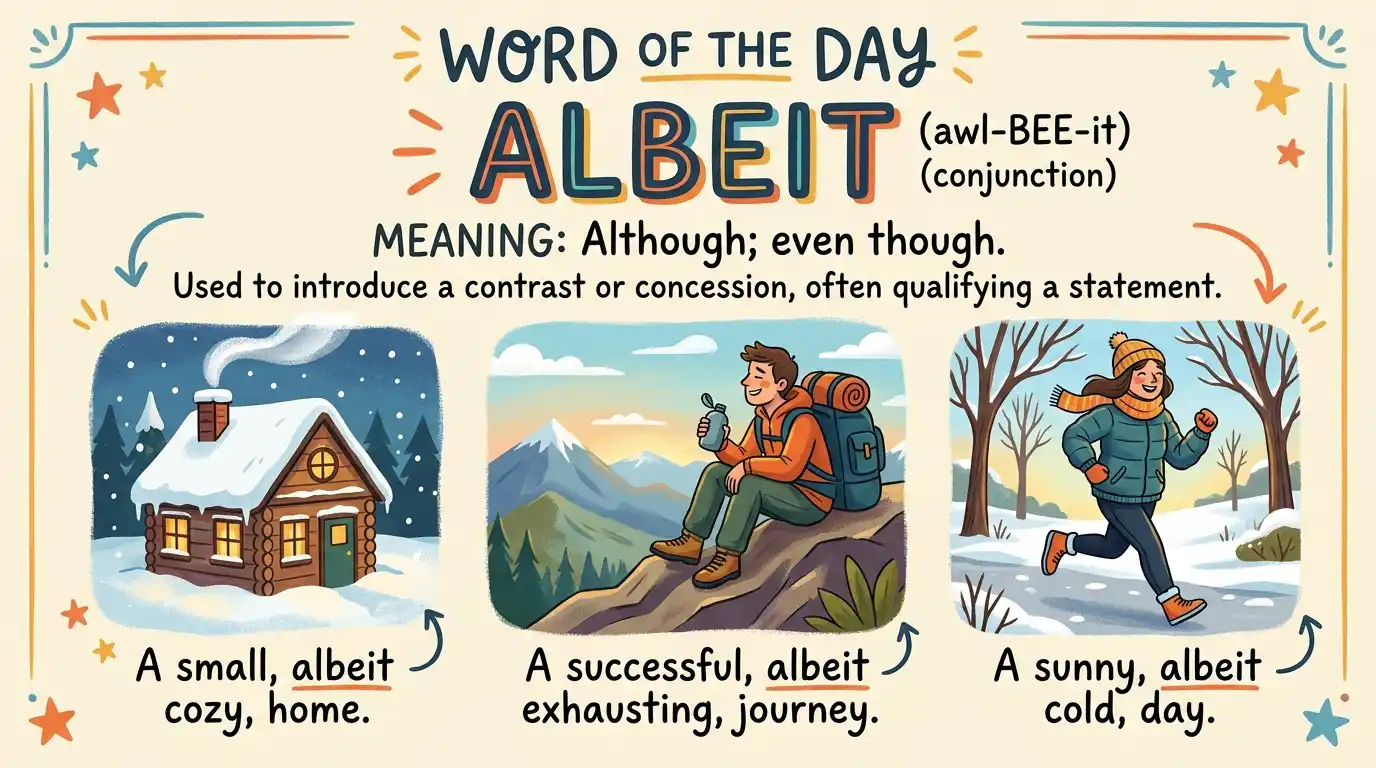
In simple terms, albeit means “although” or “even though.” It is used to add a small exception or contrast to a statement you just made.
This article will explain exactly what albeit means, how to use it correctly in a sentence, where it comes from, and how it compares to similar words like “although” and “even though,” so you can use it confidently in your own writing.
Quick Answer
Albeit means “although” or “even though.” It is used to introduce a small contrast, limitation, or exception to something you just said.
For example, “The trip was fun, albeit tiring,” means the trip was fun, but it was also a little tiring. Albeit is mostly used in formal or written English rather than casual conversation.
Meaning and Definition
Albeit is a conjunction, which means it connects two ideas in a sentence. Specifically, it connects a main idea to a smaller detail that slightly contrasts or limits that idea. It works very similarly to “although,” “even though,” or “though,” but it often sounds a bit more formal or literary.
The word is especially useful when you want to admit a small downside, limitation, or exception without changing the overall positive or main point of your sentence. For example, saying “The plan worked, albeit slowly,” tells the reader that the plan was successful, but it also took longer than expected. The main point, that the plan worked, stays strong, while albeit quietly adds the smaller detail about the slow pace.
Here is a simple breakdown of how albeit functions in a sentence.
| Sentence Part | Example |
| Main statement | “The movie was excellent,” |
| Albeit + contrasting detail | “albeit a little too long.” |
| Full sentence | “The movie was excellent, albeit a little too long.” |
Notice that albeit is usually followed directly by an adjective, adverb, or short phrase, rather than a full sentence with its own subject and verb. This is one of the most important grammar rules to remember when using the word correctly.
Grammar and Correct Usage
One of the trickiest parts of using “albeit” correctly is understanding that it is typically followed by a short phrase, not a complete clause. Unlike “although,” which usually introduces a full sentence with a subject and verb, “albeit” is often followed by just an adjective, adverb, or short descriptive phrase.
For example, you would say, “She finished the marathon, albeit exhausted,” not “She finished the marathon, albeit she was exhausted.” The second version sounds unnatural because albeit is not typically followed by a subject and verb the way “although” is.
Here is a comparison table showing the grammatical difference between albeit and although.
| Word | Typical Structure | Example |
| Albeit | Followed by an adjective, adverb, or short phrase | “The book was interesting, albeit long.” |
| Although | Followed by a full clause (subject + verb) | “The book was interesting, although it was long.” |
Both sentences mean the same thing, but albeit creates a shorter, more compact sentence, while allowing for a fuller explanation. Knowing this difference will help you avoid one of the most common grammar mistakes people make with this word.
Albeit is also almost always placed in the middle or near the end of a sentence, right before the contrasting detail, rather than at the very beginning. This is different from “although,” which can comfortably start a sentence, such as “Although it was raining, we went for a walk.”
Origin and History
The word “albeit” has a long history in the English language, dating back to Middle English. It actually developed from a combination of three separate words: “all,” “be,” and “it,” originally forming the phrase “al be it,” which meant something close to “although it be” or “even though it may be.”
Over time, this phrase became fused into a single word, “albeit,” and its meaning stayed consistent with its origins, still expressing a sense of contrast or concession within a sentence. By the late Middle Ages, “albeit” was commonly used in both spoken and written English.
As the English language evolved, especially with the growth of more casual, modern speech patterns, “albeit” gradually became associated with formal or literary writing rather than everyday conversation. Words like “although” and “though” became the more common, casual choices for spoken English, while “albeit” remained popular in academic writing, journalism, legal documents, and formal essays.
Despite sounding old-fashioned to some, “albeit” has never fallen out of use. It remains a respected and commonly recognized word, especially in professional and educational writing today.
Common Mistakes
There are a few common mistakes people make when using the word albeit. The most frequent mistake is following it with a full clause instead of a short phrase. As explained earlier, saying “albeit it was difficult” is grammatically incorrect. The correct version would simply be “albeit difficult,” without repeating the subject and verb.
Another common mistake is placing albeit awkwardly within a sentence, disrupting its natural flow. Since albeit typically introduces a smaller, secondary detail, it should closely follow the idea it is contrasting, rather than being placed far away from that idea within a long, complicated sentence.
A third mistake is overusing albeit in casual writing or conversation, where simpler words like “but” or “though” might sound more natural. While albeit is not incorrect in casual writing, it can sometimes feel overly formal or stiff if used too often in relaxed, everyday communication.
Real-Life Examples
The word albeit appears frequently in news articles, business writing, and academic papers, where writers want to add a brief contrasting detail without breaking the flow of their main point.
In journalism, a reporter might write, “The company reported strong profits this quarter, albeit slightly lower than analysts expected.” This shows that while the profits were strong, there was a small, notable exception worth mentioning.
In academic writing, a researcher might state, “The results were promising, albeit limited by a small sample size.” Here, albeit briefly acknowledges a weakness in the research without undermining the overall positive results.
In business communication, someone might write in an email, “The project was completed on time, albeit with a few last-minute changes.” This keeps the sentence brief while still being honest about small challenges along the way.
Even in casual writing, especially online articles, blogs, or reviews, albeit sometimes appears to add a touch of formality, such as, “The restaurant was excellent, albeit a bit pricey.”
Tips for Using Albeit Correctly
If you want to use “albeit” naturally and correctly, here are a few simple tips. First, remember that albeit is usually followed by a short phrase, adjective, or adverb, not a full sentence with a subject and verb. Second, use it when you want to briefly acknowledge a small downside or exception without changing your main point. Third, since albeit sounds more formal, it fits especially well in written English, such as essays, articles, emails, and reports, rather than very casual spoken conversation.
If you are ever unsure whether to use albeit or although, try this simple trick: if you can shorten your contrasting idea into just a few words, albeit will likely work well. If your contrasting idea requires a full sentence with its own subject and verb, although is usually the better choice.
FAQs
What does albeit mean in simple words?
Albeit means “although” or “even though.” It introduces a small contrast, limitation, or exception to something you just said in a sentence.
Is it formal or casual?
Albeit is generally considered a formal or literary word. It appears often in writing, such as news articles, essays, and professional communication, rather than casual conversation.
Can albeit be used at the beginning of a sentence?
Albeit is rarely used at the very beginning of a sentence. It usually appears in the middle or toward the end, right before the contrasting detail it introduces.
What is the difference between albeit and although?
Albeit is typically followed by a short phrase, adjective, or adverb, while although is usually followed by a full clause with its own subject and verb.
Can albeit be used in everyday conversation?
Yes, but it is less common in casual speech. Words like “but” or “though” often sound more natural in relaxed, everyday conversation, while albeit fits better in writing.
Where does the word albeit come from?
Albeit comes from Middle English, originally formed from the phrase “al be it,” meaning “although it may be.” Over time, it became fused into the single word we use today.
Conclusion
Albeit is a useful word that means “although” or “even though,” used to introduce a small contrast or exception within a sentence.
While it may sound a bit formal, it is a valuable word for writing clear, concise sentences, especially in essays, articles, emails, and professional communication.
Remembering that albeit is usually followed by a short phrase rather than a full sentence will help you use it correctly and avoid common grammar mistakes.
The next time you want to add a brief, honest exception to a positive statement, albeit is exactly the word you need.

Hi, I’m Benjamin Dreyer. I enjoy exploring words, phrases, slang, abbreviations, acronyms, and digital communication. At Linkquorax.com, I share simple and accurate explanations to help readers understand unfamiliar terms and popular internet expressions. My goal is to make every meaning clear, useful, and easy to understand. Whether you are curious about a new word or an online phrase, Linkquorax.com provides straightforward information to help you learn quickly and communicate with confidence in everyday conversations.