If you have ever seen “PRN” written on a medicine bottle, a doctor’s note, or a job listing, you may have wondered what it means.
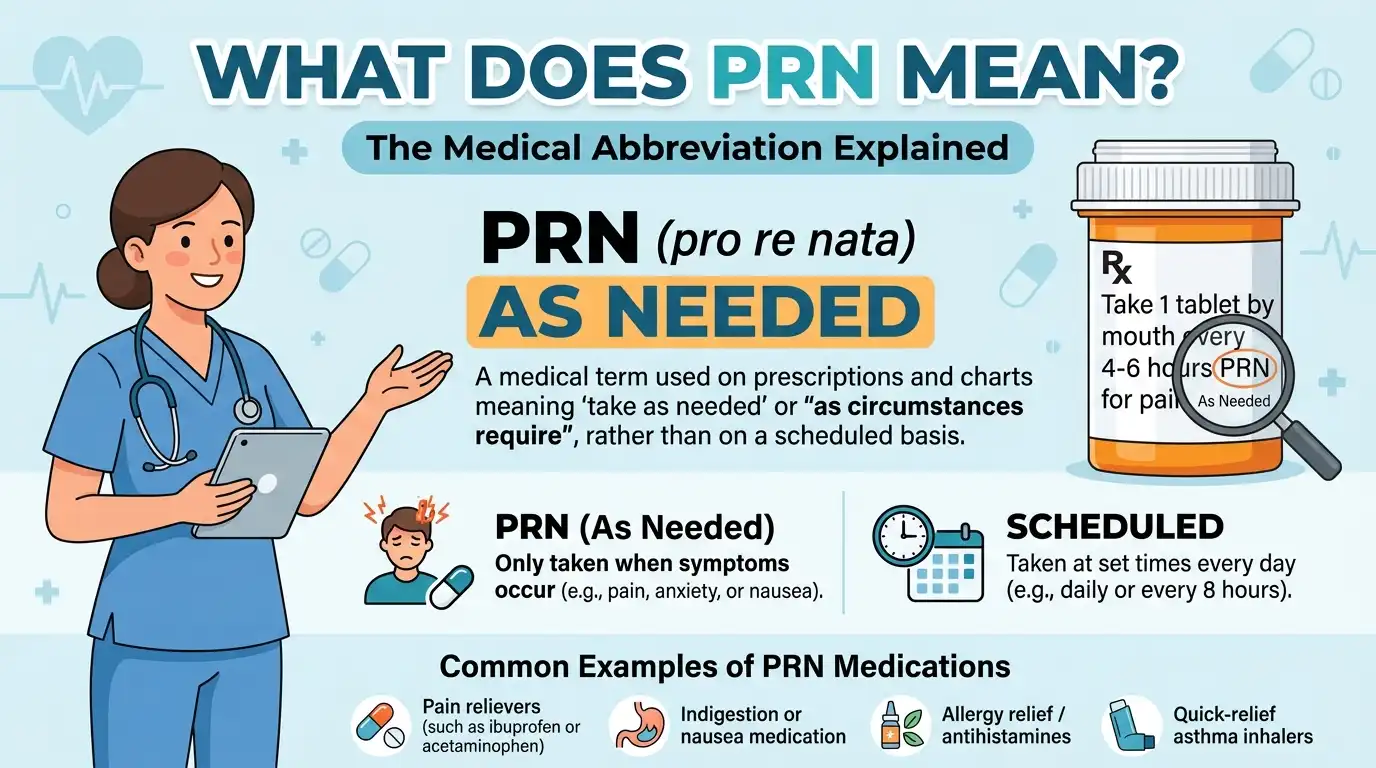
The short answer is this: PRN comes from a Latin phrase, “pro re nata,” which means “as the situation requires” or simply “as needed.” Doctors, nurses, and pharmacists use this term every single day. It tells patients and caregivers exactly when to take a medicine, instead of following a fixed schedule.
In this article, you will learn the full meaning of PRN, where the term comes from, how it is used in medicine and in jobs, common mistakes people make with it, and answers to the most common questions people ask.
By the end, you will understand PRN completely and know how to use it correctly.
Quick Answer
PRN stands for “pro re nata,” a Latin phrase that means “as needed” or “as the circumstance arises.” You will most often see it on prescription labels, such as “Take PRN for pain,” which means you only take the medicine when you actually need it, not on a strict daily schedule.
PRN also appears outside medicine, especially in job titles, where a “PRN employee” works only when they are called in, rather than on a fixed schedule.
Meaning or Definition
PRN is an abbreviation, and it stands for the Latin words “pro re nata.” Word for word, this phrase is a little tricky to translate, but the general idea is “for the thing that has arisen” or “as the situation demands.” Over time, English speakers shortened this idea into one simple phrase: “as needed.”
In everyday language, when something is PRN, it means there is no fixed rule about when it happens. It happens only when a specific need shows up. This makes PRN very different from instructions that say “take twice daily” or “take every 8 hours,” which follow a strict clock.
Here is a simple way to picture it. Imagine a bottle of pain relief medicine. If the label says “Take one tablet every 6 hours,” you follow that schedule no matter how you feel. But if the label says “Take one tablet PRN for pain,” you only take it when the pain actually shows up. You might not need it at all some days, and you might need it more than once on other days.
This flexibility is the whole point of PRN. It puts the decision in the hands of the patient or caregiver, based on real symptoms, rather than a fixed timetable.
Grammar or Correct Usage
PRN is almost always written in capital letters, since it is an abbreviation. You do not need periods between the letters, so “PRN” is correct, while “P.R.N.” is old-fashioned but still sometimes seen on older prescription pads.
PRN usually appears right after the name of a medicine or a task, and before the reason. For example: “Ibuprofen 200mg PRN for headache.” It can also stand alone as a short instruction, such as “Take PRN,” when the reason is already clear from context.
In sentences, PRN can act almost like an adverb, describing how often something should be done. You would not say “a PRN,” using it as a stand-alone noun for the action itself, though you can say “a PRN medication” or “a PRN basis,” using it to describe a noun.
The table below shows some correct and incorrect ways to use PRN in a sentence.
| Correct Usage | Incorrect Usage |
| Take this medicine PRN for pain. | Take this medicine as PRN for pain. |
| She works PRN at the hospital. | She works a PRN. |
| This is a PRN medication. | This is PRN medication as. |
| He is scheduled PRN, not full-time. | He is scheduled with PRN full-time. |
| The nurse gave a PRN dose. | The nurse gave PRN a dose. |
Origin or History
The phrase “pro re nata” comes from Latin, a language that was once the standard for medicine, law, and science across Europe. Doctors have used Latin abbreviations on prescriptions for centuries, partly because Latin was the shared language of medicine long ago, and partly because short abbreviations saved time when writing by hand.
Many other medical abbreviations come from this same Latin tradition. For example, “BID” means twice a day, from the Latin “bis in die.” “TID” means three times a day, from “ter in die.” “PO” means by mouth, from “per os.” PRN fits into this same family of old Latin shorthand that modern medicine still uses today.
Even though most doctors and pharmacists today write instructions in plain English, PRN has stuck around because it is short, clear once you know what it means, and instantly recognizable to anyone working in healthcare, no matter what country they trained in.
Real-Life Examples
Seeing PRN in real situations makes the meaning much clearer. Below are some common examples from daily life.
In a pharmacy, a bottle of allergy medicine might say “Take one tablet PRN for itching, up to 3 times daily.” This tells the patient they do not need to take it every day, only when their allergy symptoms actually bother them, and never more than three times in one day.
In a hospital, a nurse’s chart might list “Acetaminophen 500mg PRN, every 4 hours as needed for fever above 100.4°F.” This gives the nurse clear boundaries: give the medicine only when the fever reaches that specific number, and wait at least 4 hours between doses.
In a workplace, a hospital or clinic might advertise a “PRN nursing position.” This means the nurse is not on a fixed weekly schedule. Instead, they get called in when the facility is short-staffed or busy, such as during flu season or when full-time staff are on vacation.
In veterinary care, a vet might tell a pet owner to give their dog pain medicine “PRN for limping.” This means the owner should only give the medicine on days when the dog is actually limping, not every single day.
Common Mistakes
People sometimes misunderstand or misuse PRN, and this can actually cause real problems, especially with medicine. Here are the most common mistakes.
The first mistake is assuming PRN means “unlimited.” Many PRN instructions still have limits, such as a maximum number of doses per day or a minimum number of hours between doses. Ignoring those limits can be dangerous, especially with medicines like pain relievers.
The second mistake is confusing PRN with “optional.” PRN does not mean a medicine is unimportant or that skipping it is always fine. It simply means the timing depends on symptoms, not the clock. Some PRN medicines, like rescue inhalers for asthma, are very important when the need arises.
The third mistake happens in job settings, where people confuse “PRN” with “part-time.” A part-time worker usually has a set, predictable schedule with fewer hours than full-time. A PRN worker, on the other hand, has no fixed schedule at all and is called in only as needed, which can mean working a lot some weeks and not at all in others.
The fourth mistake is forgetting to check the full instructions. PRN is only one part of a direction. The full instruction usually includes the reason (like “for pain” or “for nausea”), the amount, and any limits. Reading only the word “PRN” without the rest of the label can lead to taking the wrong amount or taking it for the wrong reason.
The table below compares PRN with two terms people often confuse it with.
| Term | What It Means | Key Difference from PRN |
| PRN | Taken or done only when needed | No fixed schedule at all |
| Scheduled dosing | Taken at fixed times, like every 8 hours | Follows the clock, not symptoms |
| Part-time work | Set, regular hours, just fewer than full-time | Has a predictable schedule |
Current Usage or Trends
PRN is still very common in medicine today, but its use has grown in a few interesting directions. In hospitals across the United States, “PRN staffing” has become a popular way to fill gaps in scheduling. Many nurses and healthcare workers now choose PRN positions on purpose because they offer flexibility, often with higher hourly pay in exchange for less job security and fewer benefits.
Electronic health records have also changed how PRN is used. Instead of handwritten notes, most PRN orders are now typed directly into hospital computer systems, with clear dropdown menus for the reason, the dose, and the time limits. This has actually made PRN orders safer, since computers can flag it if a patient is given a PRN medicine too soon after the last dose.
Outside of medicine, the word “PRN” has slowly moved into general job culture, especially in healthcare-related fields like home care, physical therapy, and dentistry. Job search websites now use “PRN” as a filter, so people looking for flexible, as-needed work can search using that exact term.
Tips or Best Practices
If you are a patient or caregiver dealing with a PRN medicine, always read the full instructions, not just the word PRN. Pay close attention to the reason listed, the maximum dose allowed, and how many hours you must wait between doses.
Keep a simple log if you are taking more than one PRN medicine. Write down the time and reason each time you take a dose. This helps you avoid taking medicine too often and gives your doctor useful information at your next appointment.
Always ask your pharmacist or doctor if you are unsure what “as needed” means for your specific medicine. Some medicines are safe to take fairly often, while others, especially strong pain medicines, have strict limits that should never be crossed.
If you are considering a PRN job, ask clear questions before accepting the position. Find out how much notice you will typically get before a shift, whether there is a minimum number of hours per month, and whether the job offers any benefits, since PRN roles often do not include health insurance or paid time off.
FAQs
What does PRN stand for on a prescription?
PRN stands for the Latin phrase “pro re nata,” which means “as needed.” On a prescription, it tells you to take the medicine only when a specific symptom, like pain or nausea, actually appears, instead of on a fixed schedule.
Is PRN the same as “as needed”?
Yes, PRN and “as needed” mean exactly the same thing. Many prescription labels now use “as needed” instead of “PRN” so patients do not have to guess what the Latin abbreviation means.
Can you take PRN medicine every day?
It depends on the medicine and your symptoms. If you need it every day, that is allowed, as long as you stay within the maximum dose listed in your instructions. If you find yourself needing a PRN medicine daily for a long time, it is a good idea to tell your doctor, since this could mean your condition needs a different treatment plan.
What is a PRN job?
A PRN job is a work arrangement where an employee, often in healthcare, is called in only when the workplace needs extra help. Unlike part-time work, a PRN job has no fixed weekly schedule, and hours can change a lot from week to week.
Is PRN good or bad for nurses?
Neither, really; it depends on personal needs. PRN nursing offers more flexibility and often higher pay per hour, but it usually comes with fewer benefits and less predictable income, so it works well for some nurses and not for others.
How do you say PRN out loud?
Most people simply say the letters one at a time, like “P-R-N.” It is not usually pronounced as one word, and you rarely need to say the full Latin phrase “pro re nata” out loud in everyday conversation.
Conclusion
PRN is a small abbreviation with a simple, useful meaning: as needed. If you see it on a medicine label, a hospital chart, or a job posting, it always points to the same basic idea, flexibility based on real need rather than a fixed schedule.
Understanding PRN helps you take medicine safely, follow your doctor’s instructions correctly, and even make smarter choices if you are exploring a flexible PRN job.
The most important takeaway is this: PRN never means unlimited or optional, so always check the full instructions, including the dose limits and the specific reason, before you rely on it.

Hassan is a content writer at LinkQuorax, sharing simple and clear meanings of words, slang, phrases, and everyday expressions to help readers understand language easily.