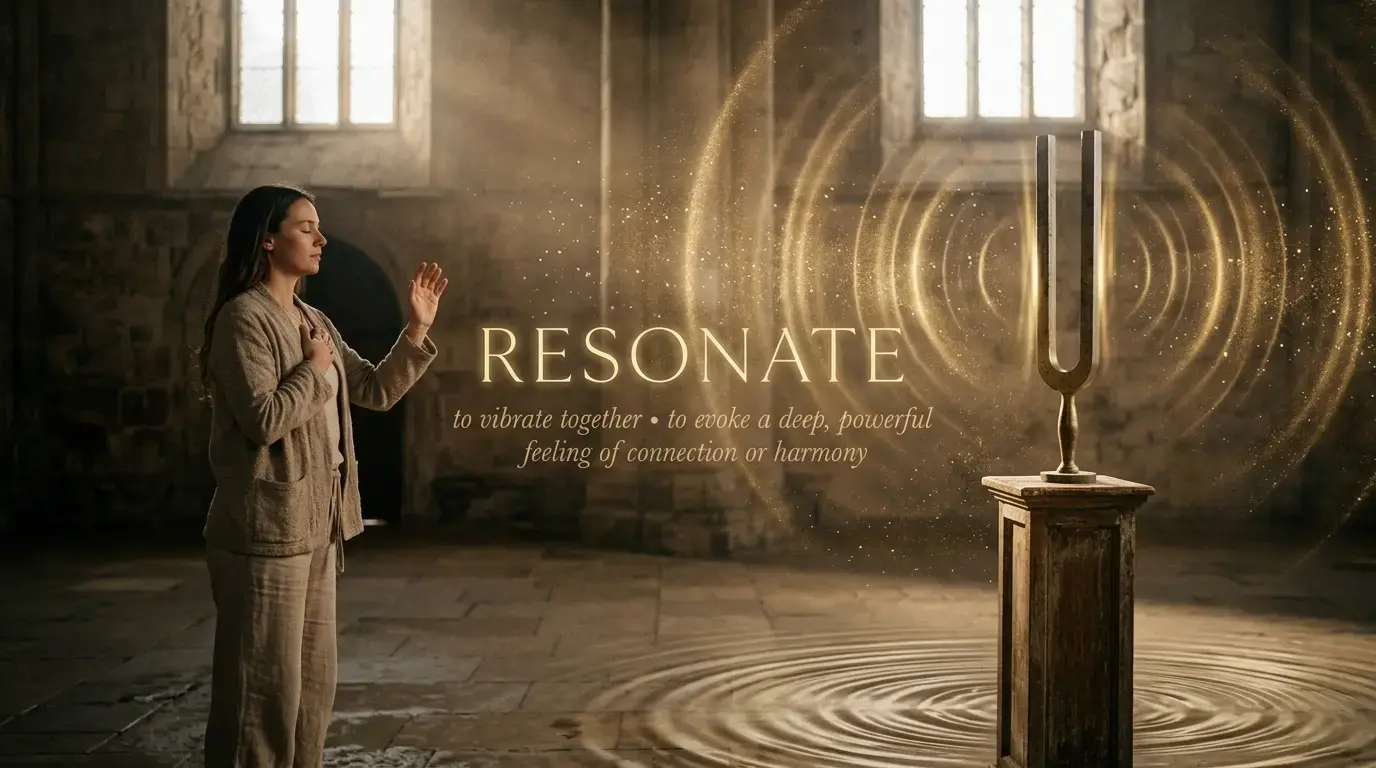
Have you ever heard a song that gave you chills, or read a quote that felt like it was written just for you? That feeling has a name: it means something resonates with you.
The word resonate meaning centers on a deep connection when something matches your feelings, beliefs, or experience so well that it sticks with you.
People search for this word because they hear it in songs, speeches, and everyday conversation, but they aren’t always sure what it means or how to use it correctly.
In this article, you’ll learn the true meaning of resonate, where the word comes from, how to use it in a sentence, and the mistakes most people make when they use it.
Quick Answer
To resonate means to strike a chord with someone to feel true, meaningful, or emotionally powerful to a person. If a song, idea, or story resonates with you, it connects with your feelings or beliefs in a strong and lasting way.
The word also has a scientific meaning: it can describe sound that vibrates and grows louder, like a guitar string humming after it’s plucked.
Meaning or Definition
The word “resonate” has two main meanings, and both are useful to know.
The first meaning is about sound. In physics and music, resonance means to vibrate at a certain speed, which makes a sound louder or richer. Think about a bell. When you strike it, the metal shakes, and that shaking creates a sound that fills the room. That resonates in action.
The second meaning is about emotion and connection, and it’s the one people use most often today. When something resonates with you, it feels true or important to your own life. A movie might resonate with you because the main character reminds you of yourself. A speech might resonate with a crowd because it puts their own thoughts into words.
Here’s a simple way to remember it: sound resonates through the air, and ideas resonate through the heart and mind.
| Type of Resonance | What It Means | Example |
| Physical (Sound) | Vibration that creates or amplifies sound | A guitar string resonates when plucked |
| Emotional (Feeling) | Something feels true or meaningful | Her story resonated with the whole audience |
| Social (Shared Idea) | An idea connects with a group of people | The campaign’s message resonated with young voters |
Grammar or Correct Usage
“Resonate” is a verb, and it usually pairs with the word “with.” You resonate with something or someone, not just resonate with something. Here’s how the word changes based on tense.
| Form | Example Sentence |
| Base form: resonate | This message will resonate with many readers. |
| Present tense: resonates | Her honesty resonates with everyone she meets. |
| Past tense: resonated | The speech resonated deeply with the crowd. |
| -ing form: resonating | His words are still resonating with fans today. |
A common structure is: [Subject] + resonates + with + [person or group]. For example: “The book resonates with people who love adventure stories.” You can also use “resonate” without an object, as in “The room resonated with laughter,” which uses the sound-based meaning.
Origin or History
The word “resonate” comes from the Latin word resonare, which means “to sound again” or “to echo.” It’s built from two parts: re-, meaning “again,” and sonare, meaning “to sound.” For centuries, the word was mostly used to describe physical sound and echoes, especially in music and science.
Over time, English speakers began using “resonate” in a broader, more emotional way. Instead of only describing an echo bouncing off a wall, people started using it to describe an idea “echoing” inside a person’s mind or heart. This shift happened gradually, and by the late 20th century, “resonate” had become common in everyday speech to describe feelings, beliefs, and shared experiences, not just sound.
Common Mistakes
Many English learners and even native speakers misuse this word in small ways. Here are the most common mistakes people make.
- Forgetting “with”: Saying “This resonates with me” instead of “This resonates with me.” The word almost always needs “with” when talking about a person’s feelings.
- Using it for simple liking: “Resonate” means more than just “I like it.” It should describe something that feels deeply true or meaningful, not just something enjoyable.
- Overusing it in writing: Because “resonate” sounds smart and emotional, people use it too often. This makes writing feel repetitive instead of powerful.
- Confusing it with “relate”: “Relate” means you understand or share an experience. “Resonate” means it moves you emotionally. They’re close, but not identical.
Real-Life Examples
Seeing the word in real sentences makes it easier to understand and use correctly.
- “That song about losing a loved one really resonated with me after my grandmother passed away.”
- “The teacher’s advice about hard work resonated with every student in the room.”
- “Her painting resonates with anyone who has ever felt lonely in a big city.”
- “The old church bells resonated across the quiet valley every morning.”
- “His apology felt honest, and it resonated with fans who had been angry for years.”
Notice how the first four examples use the emotional meaning, while the last one about church bells uses the sound-based meaning. Both are correct, but the emotional use is far more common in daily conversation.
Current Usage or Trends
Today, “resonate” shows up everywhere in marketing, social media, music reviews, and everyday chats. Brands often say their message “resonates with customers,” meaning it feels authentic and connects emotionally instead of feeling like a sales pitch. On social media, people describe posts, quotes, or videos as “resonating” when the content mirrors their own thoughts or struggles.
This word has become popular because people crave connection. In a world full of information, something that “resonates” stands out because it feels personal and true, not generic. That’s also why writers, teachers, and public speakers try to create messages that resonate, content that truly connects tends to be remembered and shared far more than content that simply informs.
Tips or Best Practices
If you want to use “resonate” naturally and correctly, keep these tips in mind.
- Use it when something creates a real emotional reaction, not just mild interest.
- Always pair it with “with” when describing a personal connection.
- Avoid using it in every paragraph of an essay or article save it for moments that truly matter.
- Choose simpler words like “connect,” “match,” or “feel true” if you’re writing for beginners or young readers.
- Read your sentence aloud. If “resonate” sounds forced, try “struck a chord” or “felt personal” instead.
FAQs
What does it mean when someone says something “resonates” with them?
It means the thing a song, idea, or story feels deeply true or meaningful to their own life or feelings.
Is “resonate” a positive word?
Usually yes. It’s almost always used to describe a strong, positive, and meaningful connection, though the feeling behind it can sometimes be sad or serious.
Can you resonate with a person, not just an idea?
Yes. You can say someone’s story, personality, or words resonate with you, meaning you feel a strong personal connection to them.
What’s the difference between “resonate” and “relate”?
“Relate” means you understand or share a similar experience. “Resonate” means it touches you emotionally and feels deeply true.
Is “resonate” formal or casual English?
It works in both. It’s common in everyday conversation, but it also sounds thoughtful and polished, which is why it’s popular in writing and speeches.
What is a simple synonym for “resonate”?
Simple alternatives include “connect with,” “strike a chord with,” or “feel true to.”
Conclusion
At its heart, resonate meaning is all about a connection sound that vibrates through the air, or an idea that vibrates through your heart and mind.
If you’re talking about a humming guitar string or a story that brought tears to your eyes, the word describes something powerful: a match between an outside message and your own inner world.
Now that you know its meaning, grammar, and common mistakes, you can use “resonate” with confidence in writing, conversation, or everyday speech. Next time something truly moves you, you’ll know exactly the right word to describe it.

Hi, I’m Benjamin Dreyer. I enjoy exploring words, phrases, slang, abbreviations, acronyms, and digital communication. At Linkquorax.com, I share simple and accurate explanations to help readers understand unfamiliar terms and popular internet expressions. My goal is to make every meaning clear, useful, and easy to understand. Whether you are curious about a new word or an online phrase, Linkquorax.com provides straightforward information to help you learn quickly and communicate with confidence in everyday conversations.