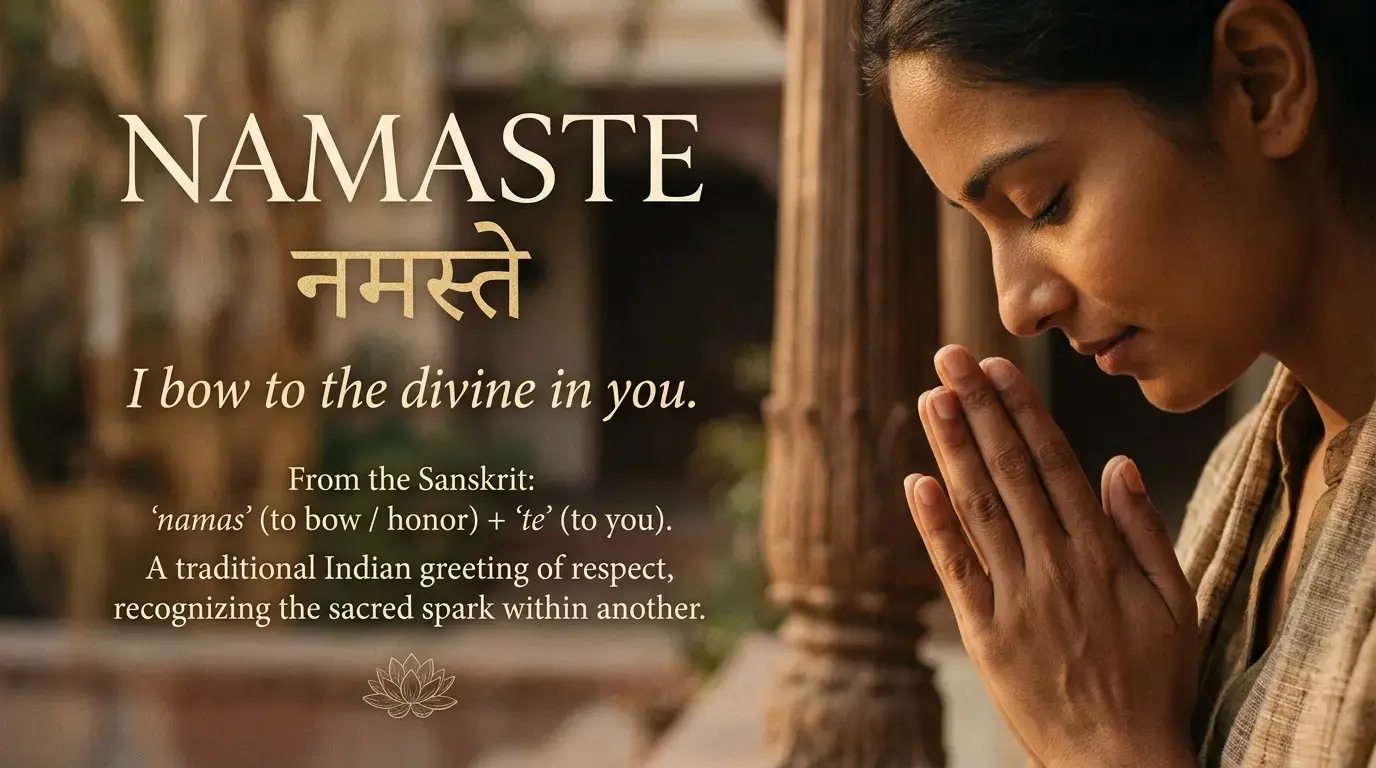
If you’ve ever taken a yoga class or seen someone press their palms together with a small bow, you’ve probably heard the word “namaste.”
But what does namaste actually mean? In simple terms, namaste is a respectful greeting from India that means “I bow to you” or “the divine in me honors the divine in you.” It’s more than just a fancy way to say hello.
This word carries deep meaning about respect, humility, and connection between people. In this article, you’ll learn where namaste comes from, how to say it correctly, what it means in yoga, and how people use it today around the world.
Quick Answer
Namaste is a Sanskrit word used as a greeting or a way to say goodbye, especially in India and Nepal. It means “I bow to you.” People say it while pressing their palms together in front of their chest, with fingers pointing up, and giving a slight bow of the head.
This gesture, called the “anjali mudra” or “namaskar mudra,” shows respect and gratitude toward the other person.
Meaning or Definition
The word namaste comes from two Sanskrit words. The first part, “namah,” means “bow” or “salutation.” The second part, “te,” means “to you.” Put them together, and you get “I bow to you” or “greetings to you.”
But namaste carries a deeper meaning than just a simple hello. Many people translate it as “the light in me honors the light in you” or “the divine in me sees the divine in you.” This idea comes from ancient Indian philosophy, which teaches that every person has a spark of something sacred inside them. When you say namaste to someone, you are recognizing that spark in them, no matter who they are or where they come from.
This is why namaste feels different from a regular “hi” or “hello.” It’s a small act of respect. It says, “I see you as a person of worth, and I honor that.” That’s a powerful message to send with just one word and a simple hand gesture.
Origin or History
Namaste has roots that stretch back thousands of years. It comes from Sanskrit, one of the oldest languages in the world and the sacred language of many Hindu texts. Scholars believe the greeting has been used in India since ancient times, long before it became known outside the country.
In Hindu culture, the gesture that goes with namaste has spiritual meaning. Pressing the palms together is thought to bring the left and right sides of the brain into balance. Some also see it as a way of quieting the mind and showing humility before another person.
Namaste isn’t only a Hindu tradition. It’s also used in Buddhism, Jainism, and Sikhism, and it’s common across South Asia, including Nepal, where it’s often heard as “namaskar” or “namaste” in daily life. Over the centuries, this greeting has stayed a normal part of everyday conversation between family, friends, and strangers alike.
In the last few decades, namaste has traveled far beyond South Asia. As yoga became popular around the world, especially in the United States and Europe, the word namaste came along with it. Today, many people in Western countries know the word mainly from the end of a yoga class, even though its roots go back much further and mean much more.
Grammar or Correct Usage
Namaste is easy to use because it doesn’t change based on grammar rules like many English words do. You don’t need to add “s” for plural or change it for tense. It stays the same no matter who you’re talking to or how many people are in the room.
Here’s a simple table to show how namaste is typically used:
| Situation | How to Use It | Example |
| Greeting someone | Say it when you meet | “Namaste! It’s nice to see you.” |
| Saying goodbye | Say it when you leave | “Namaste, take care.” |
| In a yoga class | Said at the start or end | “Namaste, everyone. Great practice today.” |
| Showing respect | Paired with a slight bow | Palms together, head bows slightly |
| Written greeting | Used in cards or messages | “Namaste, wishing you a peaceful day.” |
One common question is whether namaste should be capitalized. In most everyday writing, it’s fine as a lowercase word, similar to “hello” or “goodbye.” It’s only capitalized if it starts a sentence.
As for pronunciation, namaste is said as “nuh-muh-STAY.” The stress falls on the last part of the word. Some people say it slightly differently depending on the region, but this pronunciation is the most common one used in the United States.
Namaste in Yoga
Many people in the United States first hear the word namaste at the end of a yoga class. The teacher often presses their palms together, bows slightly, and says “namaste” to the class. Students usually respond by doing the same gesture back.
In this setting, namaste is used as a way to close the practice with a moment of respect and gratitude. It’s a way for the teacher to honor the students, and for the students to honor the teacher and each other. Some yoga teachers explain the deeper meaning to their classes, while others simply use it as a peaceful way to end the session.
It’s worth knowing that in India, namaste is not specifically a yoga word. It’s used constantly in daily life, from greeting a neighbor to welcoming a guest into your home. The strong connection between namaste and yoga is really a Western habit that grew as yoga studios spread across the U.S. and other countries. Understanding this history helps explain why the word can feel both familiar and a little mysterious to many English speakers.
Common Mistakes
Because namaste comes from another language and culture, English speakers sometimes misuse it without realizing it. Here are a few common mistakes to watch for.
One mistake is using namaste as a casual joke or a punchline, especially in memes or sarcastic comments. Since the word carries real spiritual and cultural weight for millions of people, using it carelessly can come across as disrespectful, even if that’s not the intention.
Another mistake is mispronouncing it as “NAH-mas-tay” with the stress on the first part. The correct pronunciation puts the emphasis on the last syllable: “nuh-muh-STAY.”
Some people also think namaste is only a yoga term, which isn’t accurate. As explained earlier, it’s a daily greeting across India, Nepal, and other parts of South Asia, used by millions of people who have never set foot in a yoga studio.
Lastly, some folks say “namaste” while placing their hands incorrectly, like clasping fingers together instead of pressing the palms flat with fingers pointing upward. While this isn’t a huge issue, learning the correct gesture shows more genuine respect for where the tradition comes from.
Real-Life Examples
Seeing namaste used in different situations can help make its meaning clearer. Here are a few examples of how it shows up in daily life:
A yoga instructor in California ends class by saying, “Namaste, thank you all for your energy today.” A family in New Delhi greets their grandmother with a namaste and a small bow when she arrives for a visit. A hotel employee in Nepal welcomes tourists with hands pressed together, saying, “Namaste, welcome to our country.” A wellness app sends a notification that reads, “Namaste. Take a deep breath and start your day with peace.” A greeting card for a friend’s new home includes the message, “Namaste, may your new house be filled with light and warmth.”
These examples show that namaste fits many settings, from spiritual practice to simple hospitality. It’s flexible enough to use in formal and informal moments.
Current Usage or Trends
Today, namaste is recognized by people all over the world, even those who don’t know Sanskrit or have never visited India. It appears on T-shirts, coffee mugs, wall art, and social media posts. Wellness brands often use the word to suggest peace, mindfulness, and balance.
This wide use has both good and tricky sides. On one hand, it shows how much people appreciate the message behind namaste: respect, calmness, and connection. On the other hand, some people from South Asian communities feel that the word’s deeper meaning gets lost when it’s printed on products or used without understanding its background.
A respectful way to use namaste is to remember it as more than a trendy word. When you say it, or see it, try to think about its real meaning: honoring another person’s worth. That small shift in thinking can make the word feel more genuine, whether you’re in a yoga class or greeting a friend from another culture.
Tips or Best Practices
If you want to use namaste correctly and respectfully, a few simple tips can help.
| Tip | Why It Matters |
| Learn the correct pronunciation | Shows respect for the word’s origin |
| Use it as a genuine greeting, not a joke | Honors its cultural and spiritual meaning |
| Pair it with the palm gesture when appropriate | Matches the traditional way it’s used |
| Understand its meaning beyond yoga | Avoids limiting the word to one context |
| Use it sincerely, not just for style | Keeps the greeting meaningful |
Following these small steps can help you use namaste in a way that feels respectful and thoughtful, whether you’re speaking to a friend, ending a workout class, or writing a kind note to someone.
FAQs
What does namaste literally mean?
Namaste literally means “I bow to you.” It comes from the Sanskrit words “namah” (bow) and “te” (to you).
Is namaste a greeting or a goodbye?
It can be both. Namaste is used to say hello when meeting someone and can also be said when parting ways, similar to how “aloha” works in Hawaiian.
Why do people press their palms together when saying namaste?
Pressing the palms together, called the anjali mudra, is a gesture of respect and humility. It’s traditionally believed to bring balance and show honor to the other person.
Is it disrespectful to say namaste if you’re not Indian?
Saying namaste respectfully and with understanding is generally welcomed. It becomes disrespectful mainly when it’s used as a joke, mocked, or stripped of its meaning for humor or marketing without care.
Why is namaste used at the end of yoga classes?
Yoga teachers use namaste to close the class with a moment of gratitude and respect between teacher and students. It reflects the word’s traditional meaning of honoring another person.
How do you correctly pronounce namaste?
The correct pronunciation is “nuh-muh-STAY,” with the stress on the final syllable.
Conclusion
Namaste is a simple word with a powerful meaning. At its core, it means “I bow to you,” but its true spirit goes deeper, honoring the dignity and light within every person you meet.
From its ancient roots in Sanskrit to its modern use in yoga studios and everyday greetings, namaste continues to carry a message of respect and connection across cultures.
The next time you hear or say namaste, take a moment to remember what it truly represents. Using it thoughtfully, rather than casually, helps keep its meaning alive and shows genuine appreciation for the culture it comes from.

Hassan is a content writer at LinkQuorax, sharing simple and clear meanings of words, slang, phrases, and everyday expressions to help readers understand language easily.