Have you ever met someone you just could not figure out, no matter how hard you tried? Or maybe you have read a mystery novel with a puzzle so tricky it kept you guessing until the very last page.
That feeling of confusion mixed with curiosity is exactly what the word “enigma” describes. People search for the enigma meaning because they hear it in books, movies, and everyday conversation, and want to know exactly how to use it.
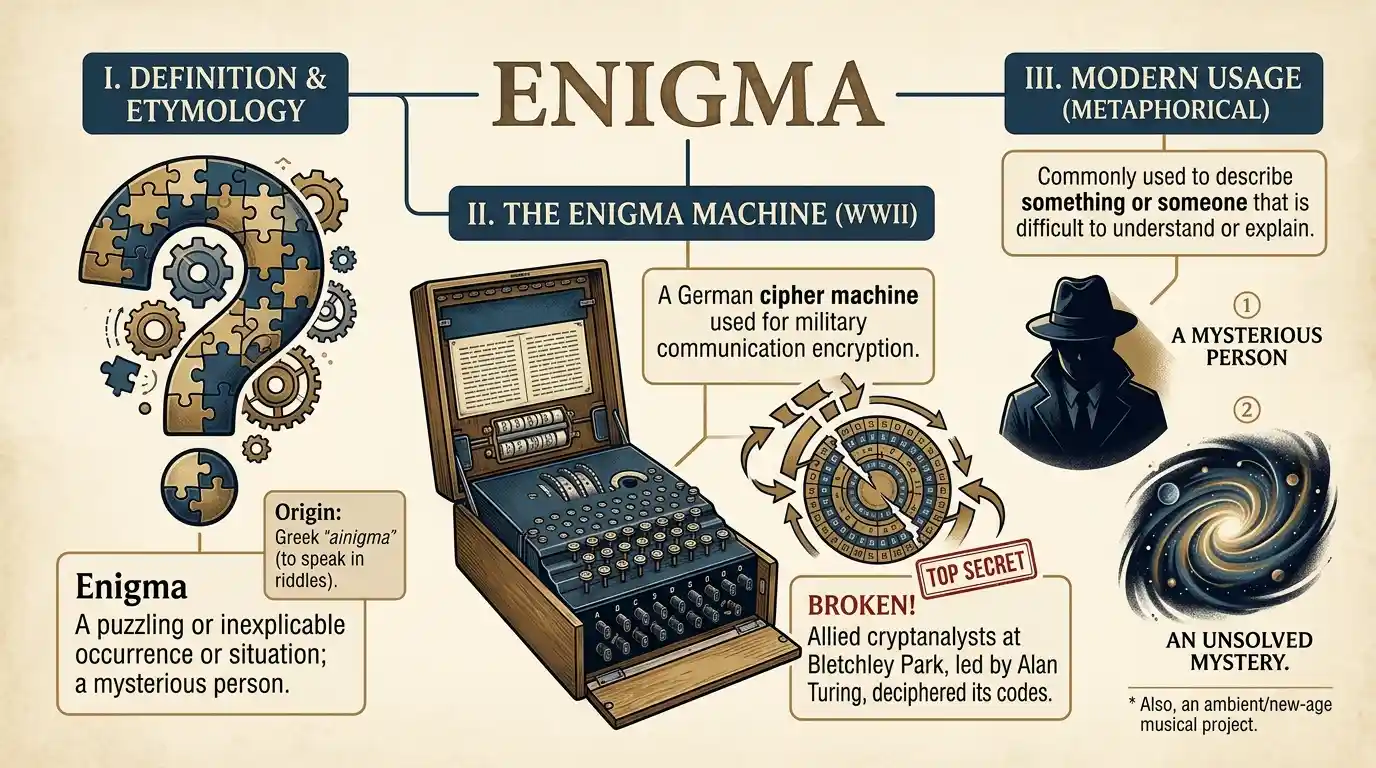
In simple terms, an enigma is something or someone that is very mysterious, confusing, or hard to understand or explain.
This article will walk you through the full meaning of enigma, where the word comes from, how to use it correctly, and real examples that make it easy to remember.
Quick Answer
An enigma is a person, thing, or situation that is mysterious, puzzling, or very hard to understand or explain.
The word is often used to describe someone whose personality or behavior is confusing, or a situation that seems impossible to figure out. It comes from a Greek word meaning “riddle.”
Meaning and Definition
The word “enigma” describes anything that is difficult to explain, understand, or predict. It carries a sense of mystery and often a little bit of fascination too. When something is called an enigma, it usually means people have tried to understand it but still find it confusing or puzzling in some way.
Enigma can describe people, events, objects, or even entire situations. For example, a very private celebrity who rarely gives interviews might be called an enigma, because the public knows very little about their real personality or life. A strange historical event with no clear explanation might also be called an enigma, because experts still cannot fully explain what happened or why.
The word is a noun, and its adjective form is “enigmatic.” Someone who is hard to read or mysterious in the way they act is described as enigmatic. Below is a simple breakdown of how the noun and adjective forms are used.
| Word Form | Part of Speech | Example Sentence |
| Enigma | Noun | “The old house at the end of the street is a real enigma to the neighbors.” |
| Enigmatic | Adjective | “She gave an enigmatic smile, and no one knew what she was thinking.” |
Understanding both forms helps you use the word correctly in different types of sentences, whether you are naming something as a mystery or describing something as mysterious.
Origin and History
The word “enigma” comes from the Greek word “ainigma,” which means “riddle” or “dark saying.” This Greek word came from the verb “ainissesthai,” meaning “to speak in riddles” or “to hint darkly.” The term eventually passed into Latin as “aenigma,” keeping a similar meaning of something puzzling or hidden.
From Latin, the word made its way into English by the 16th century, where it kept its original meaning of a puzzling statement, question, or situation. Over the centuries, English speakers expanded the word beyond just riddles and questions. It began to describe people, objects, historical mysteries, and unexplainable situations as well.
One of the most famous uses of the word in modern history is the “Enigma machine,” a coding device used by Germany during World War II to send secret military messages. The machine scrambled messages into complex codes that were extremely difficult to break. British codebreakers, including mathematician Alan Turing, eventually cracked the Enigma code, which played a major role in helping the Allies during the war. This historical connection helped make the word “enigma” even more associated with deep mystery and puzzles that seem nearly impossible to solve.
Common Mistakes
There are a few common mistakes people make when using the word enigma. The first mistake is confusing “enigma” with “mystery.” While the two words are related and often used interchangeably, “mystery” is a broader term that can apply to almost anything unexplained, including crimes, unknown events, or unsolved questions. “Enigma” tends to carry a stronger sense of complexity or deep confusion, often applied to people or highly puzzling situations, rather than simple unknowns.
The second mistake is misusing the adjective form. Some people mistakenly say “enigma” when they mean “enigmatic.” For example, saying “He is very enigma” is incorrect. The correct sentence would be, “He is very enigmatic,” since an adjective is needed to describe a person’s quality.
The third mistake is overusing the word in casual conversation where a simpler word might fit better. While “enigma” is a great word for describing deep mystery, using it constantly for small, everyday confusion, like forgetting where you put your keys, can feel exaggerated or out of place.
Real-Life Examples
The word enigma appears often in books, movies, and everyday conversations, especially when describing something puzzling or someone hard to understand.
In literature, mystery novels often describe their villains or plots as enigmas, keeping readers guessing until the final pages. A classic line might read, “The killer remained an enigma throughout the investigation,” highlighting how little the characters and readers knew.
In pop culture, celebrities who avoid the spotlight or rarely explain their personal lives are often called enigmas by fans and media. For example, journalists might write, “The reclusive author has remained an enigma for decades, giving almost no interviews.”
In science and history, unexplained phenomena are frequently labeled enigmas. Historians might describe an ancient structure with an unknown purpose as “one of history’s greatest enigmas,” since experts still debate its true use.
In daily life, you might use it casually too. For example, “My cat is such an enigma; I never know what she wants,” playfully describes confusing but harmless behavior.
Current Usage and Trends
Today, “enigma” remains a popular word in writing, journalism, and everyday speech, especially when describing complex personalities or unsolved mysteries. It appears often in movie reviews, book descriptions, biography titles, and even song lyrics, usually to build a sense of intrigue or curiosity around a subject.
The word is also common in branding and marketing. Companies sometimes use “enigma” in product names or advertising slogans to suggest sophistication, mystery, or exclusivity. This shows how the word has grown beyond formal writing and become part of creative and commercial language as well.
Online, especially on social media and in video content, people often use “enigma” to describe unpredictable public figures, viral unsolved mysteries, or unexplained internet trends. Its long history combined with its strong, dramatic sound has helped it stay relevant across many types of modern communication.
Below is a quick comparison of enigma with a few similar words, to help you choose the right word for the right situation.
| Word | Meaning | Best Used For |
| Enigma | Something deeply mysterious or hard to understand | Complex people, unexplained situations |
| Mystery | Something unknown or unexplained | General unknowns, crimes, unsolved questions |
| Puzzle | Something confusing that requires solving | Games, riddles, logical problems |
| Riddle | A tricky question with a clever answer | Word games, brain teasers |
Tips for Using Enigma Correctly
If you want to use the word enigma naturally, keep a few simple tips in mind. First, remember that it works best for describing something genuinely complex or mysterious, not everyday confusion. Second, use “enigmatic” instead of “enigma” when you need an adjective to describe a person’s behavior or personality. Third, enigma tends to sound more formal or literary, so it fits well in writing, storytelling, or thoughtful conversation, rather than very casual texting.
Reading books, watching documentaries about historical mysteries, or paying attention to how journalists use the word can also help you get a natural feel for when it fits best.
FAQs
What does enigma mean in simple words?
Enigma means something or someone that is very mysterious, confusing, or hard to understand or explain.
Is enigma a good word to describe a person?
Yes. Enigma is often used to describe a person whose personality, thoughts, or actions are difficult for others to understand or predict.
What is the difference between enigma and enigmatic?
Enigma is a noun that names something mysterious, while enigmatic is an adjective used to describe something or someone as mysterious or puzzling.
Where does the word enigma come from?
The word comes from the Greek word “ainigma,” meaning “riddle,” which later became “aenigma” in Latin before entering the English language around the 16th century.
What was the Enigma machine?
The Enigma machine was a coding device used by Germany during World War II to send secret messages. It was famously decoded by Allied codebreakers, including Alan Turing.
Can enigma be used to describe objects or events, not just people?
Yes. Enigma can describe puzzling objects, unexplained historical events, or confusing situations, not just people.
Conclusion
The word enigma describes something or someone that is deeply mysterious, puzzling, or hard to fully understand.
With roots in an ancient Greek word for “riddle,” it has grown from describing simple puzzles to representing complex people, unsolved mysteries, and unexplained events throughout history, including its famous connection to the World War II Enigma machine.
If you are describing a mysterious character in a book, an unpredictable friend, or an unsolved historical event, the word enigma adds depth and intrigue to your language. Next time you come across something truly puzzling, you will know exactly the right word to describe it.

Hassan is a content writer at LinkQuorax, sharing simple and clear meanings of words, slang, phrases, and everyday expressions to help readers understand language easily.