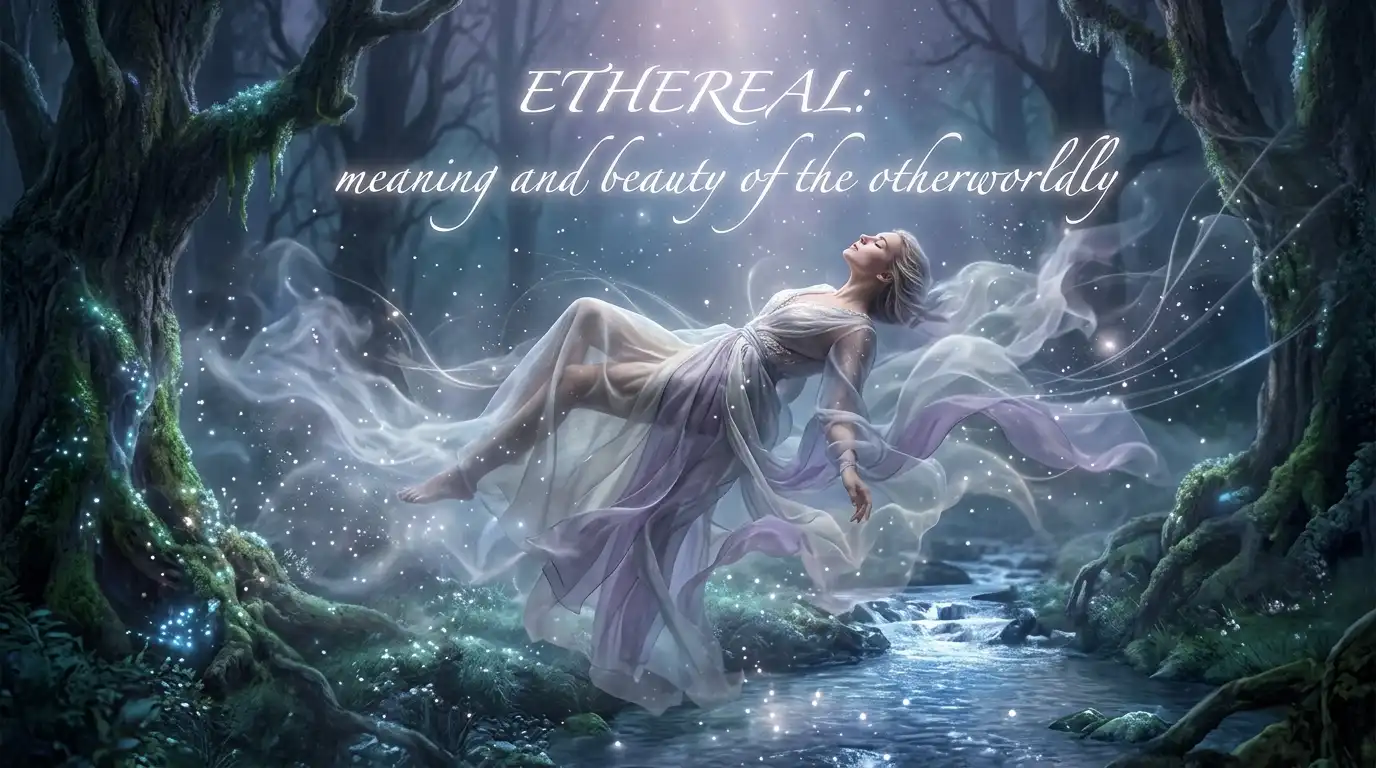
Have you ever seen something so light, delicate, or dreamy that it almost didn’t feel real? That feeling has a name: ethereal.
The ethereal meaning points to something so light, airy, and delicate that it seems to belong to another world, almost too beautiful or fragile to be real.
People search for this word when they read it in a poem, a book, or a fancy product description and want to understand exactly what it means and how to use it the right way.
This word shows up a lot in beauty, fashion, music, and nature writing. It describes things like soft morning fog, glowing skin, quiet music, or a gentle dress that seems to float.
In this article, you will learn the full meaning of ethereal, where it came from, how to use it correctly in a sentence, common mistakes people make, and real examples from everyday life. By the end, you will feel confident using this word yourself.
Quick Answer
Ethereal (say it: ih-THEER-ee-uhl) is an adjective that means something is extremely light, delicate, and airy, almost as if it does not belong to the normal, physical world.
It often describes things that feel dreamlike, heavenly, or magical, such as soft light, quiet music, or a graceful movement. The word is used to praise beauty that feels gentle and almost unreal, not something loud or heavy.
Meaning or Definition
At its core, ethereal describes something delicate, light, and almost magical. It is often used for things that seem too perfect or too soft to be fully part of our everyday world. Think of morning mist floating over a lake, a whisper-soft song, or a bride’s flowing veil catching the wind. All of these could be called ethereal.
The word carries a sense of wonder. It is not just “pretty” or “nice.” It suggests something dreamlike, almost spiritual, and gentle in a way that feels rare. Writers often use it to describe:
- Light: soft, glowing, or misty light, like sunrise through clouds
- Sound: soft, floating music or singing that feels calming
- Beauty: a look or style that feels soft, glowing, and delicate
- Nature: fog, snowfall, or clouds that seem to drift gently
- Emotion: a peaceful, dreamy feeling that is hard to put into words
Because the word feels so soft and poetic, it fits best with gentle, graceful subjects. Calling a loud rock concert “ethereal” would feel strange, but calling a quiet piano melody ethereal makes perfect sense.
Grammar or Correct Usage
Ethereal is an adjective, which means it describes a noun. It usually comes right before the noun it is describing, or after a linking verb like “is,” “was,” or “seems.”
Here are simple sentence patterns you can follow:
- Adjective before noun: “She wore an ethereal white gown.”
- Adjective after linking verb: “The music sounded ethereal.”
- With an adverb: “The forest looked almost ethereal in the fog.”
The adverb form is ethereally, used to describe an action or another adjective, as in “she moved ethereally across the stage.” The noun form, ethereality, is rare but sometimes used in more formal or poetic writing.
| Word Form | Type | Example Sentence |
| Ethereal | Adjective | The sunset had an ethereal glow. |
| Ethereally | Adverb | The dancer moved ethereally across the floor. |
| Ethereality | Noun (rare) | The painting captured a sense of ethereality. |
Since ethereal already describes something extremely light or delicate, avoid pairing it with words that mean the opposite, like “heavy” or “solid.” Doing so can confuse readers because the word naturally leans toward softness and lightness.
Origin or History
The word ethereal comes from the Latin word “aetherius” and the Greek word “aither,” which referred to the clear, upper sky or the pure air that the ancient Greeks believed the gods breathed. In old science and philosophy, “ether” was thought to be a special substance that filled the space beyond Earth’s air, a finer, purer version of air itself.
Over time, English writers borrowed this idea to describe anything that felt light, pure, and almost heavenly, not just the literal sky. By the 1600s and 1700s, poets were already using “ethereal” to describe delicate beauty, soft light, and spiritual or dreamlike qualities. That poetic sense is the one we still use today, even though most people no longer think about ancient Greek sky-gods when they say it.
Common Mistakes
Many learners misuse ethereal because it sounds similar to other words or because they are not sure exactly how “light” or “delicate” something needs to be to earn this label. Here are the most common mix-ups.
| Mistake | Why It’s Wrong | Correct Version |
| Confusing it with “ethnic” | Different word, different meaning entirely | Use “ethereal” only for light, dreamy qualities |
| Using it for heavy or loud things | Ethereal means light and gentle, not strong | “The thunder was loud” (not ethereal) |
| Spelling it “etheral” or “etherial” | Common typo that drops or moves a letter | Correct spelling: e-t-h-e-r-e-a-l |
| Overusing it in casual writing | It’s a poetic word, so too much use feels forced | Save it for truly delicate or dreamy descriptions |
| Treating it as a noun | It is an adjective, not a thing itself | Say “an ethereal glow,” not “an ethereal” |
A simple way to check yourself: if the thing you are describing is soft, light, glowing, or dreamlike, ethereal probably fits. If it is loud, heavy, or ordinary, it likely does not.
Real-Life Examples
Seeing the word in real sentences makes it much easier to use correctly. Here are examples from different areas of everyday life.
In beauty and fashion, people often say things like, “The model had an ethereal glow, with soft, glowing skin and flowing hair that caught the light.” A wedding blog might describe a dress by saying, “The lace gown gave her an ethereal look, as if she had stepped out of a fairy tale.”
In music, a reviewer might write, “The singer’s soft, floating voice created an ethereal sound that filled the quiet room.” Ambient and dream-pop music is often described this way because it feels light and spacious rather than sharp or aggressive.
In nature writing, you might read, “Fog drifted over the valley, giving the whole scene an ethereal, almost otherworldly feel.” Photographers often chase ethereal light at sunrise or sunset because it is soft, golden, and gentle rather than harsh.
In everyday conversation, someone might simply say, “That painting has such an ethereal quality, it feels calming just to look at it.” This shows how the word works well even outside formal or poetic writing, as long as the subject truly feels soft and dreamlike.
Current Usage or Trends
Ethereal has become especially popular in beauty, wellness, and lifestyle content over the past several years. Skincare brands use it to describe glowing, “glass skin” looks. Home decor writers use it for soft, airy rooms filled with natural light and pale colors. Wedding and fashion industries lean on it heavily to describe flowing fabrics, soft makeup, and dreamy photography styles.
Social media has also boosted the word’s popularity. Aesthetic trends like “ethereal core” or “fairycore” use soft pastels, flowing fabrics, natural light, and dreamy music to capture that same light, magical feeling the word has always described. This shows the word’s meaning has stayed remarkably consistent, even as new generations discover and use it in fresh, visual ways.
Tips or Best Practices
Using ethereal well is less about memorizing rules and more about matching the feeling of your sentence to the feeling of the word. Keep these tips in mind.
- Save it for genuinely soft, light, or dreamlike subjects, not everyday objects.
- Pair it with gentle imagery like mist, glow, whisper, float, or drift for a natural feel.
- Avoid using it more than once or twice in the same piece of writing, so it keeps its impact.
- Double-check the spelling, since “etherial” and “etheral” are common errors.
- Read your sentence aloud. If it sounds poetic and calm, ethereal likely fits.
Writers who use this word sparingly and thoughtfully tend to create a much stronger, more elegant impression than those who overuse it.
FAQs
What does ethereal mean in simple words?
It means something is extremely light, delicate, and dreamlike, almost as if it is too soft or beautiful to be fully real.
How do you pronounce ethereal?
It is pronounced ih-THEER-ee-uhl, with the stress on the second syllable, “theer.”
Is ethereal a good word to describe a person?
Yes, it is often used as a compliment to describe someone with a soft, graceful, glowing, or dreamlike appearance or presence.
What is the opposite of ethereal?
Words like heavy, solid, harsh, or earthly work as opposites, since they describe something firm, physical, and grounded rather than light and dreamlike.
Can ethereal describe sound as well as looks?
Yes, it is commonly used for soft, floating music or voices that feel calming and light, not just visual beauty.
Is ethereal used in everyday conversation or only in writing?
It appears mostly in descriptive or creative writing, such as beauty, fashion, and nature content, but it can also work naturally in everyday speech when describing something truly delicate or dreamy.
Conclusion
The ethereal meaning centers on lightness, delicacy, and a dreamlike quality that feels almost too soft or beautiful for the ordinary world. From glowing sunsets and floating fog to soft music and flowing gowns, this word helps writers capture a very specific kind of gentle, magical beauty.
Now that you understand its meaning, grammar, history, and common mistakes, you can use it with confidence in your own writing. Just remember to save it for moments that truly feel light, soft, and dreamy, and it will always add a touch of elegance to your words.

Hi, I’m Benjamin Dreyer. I enjoy exploring words, phrases, slang, abbreviations, acronyms, and digital communication. At Linkquorax.com, I share simple and accurate explanations to help readers understand unfamiliar terms and popular internet expressions. My goal is to make every meaning clear, useful, and easy to understand. Whether you are curious about a new word or an online phrase, Linkquorax.com provides straightforward information to help you learn quickly and communicate with confidence in everyday conversations.