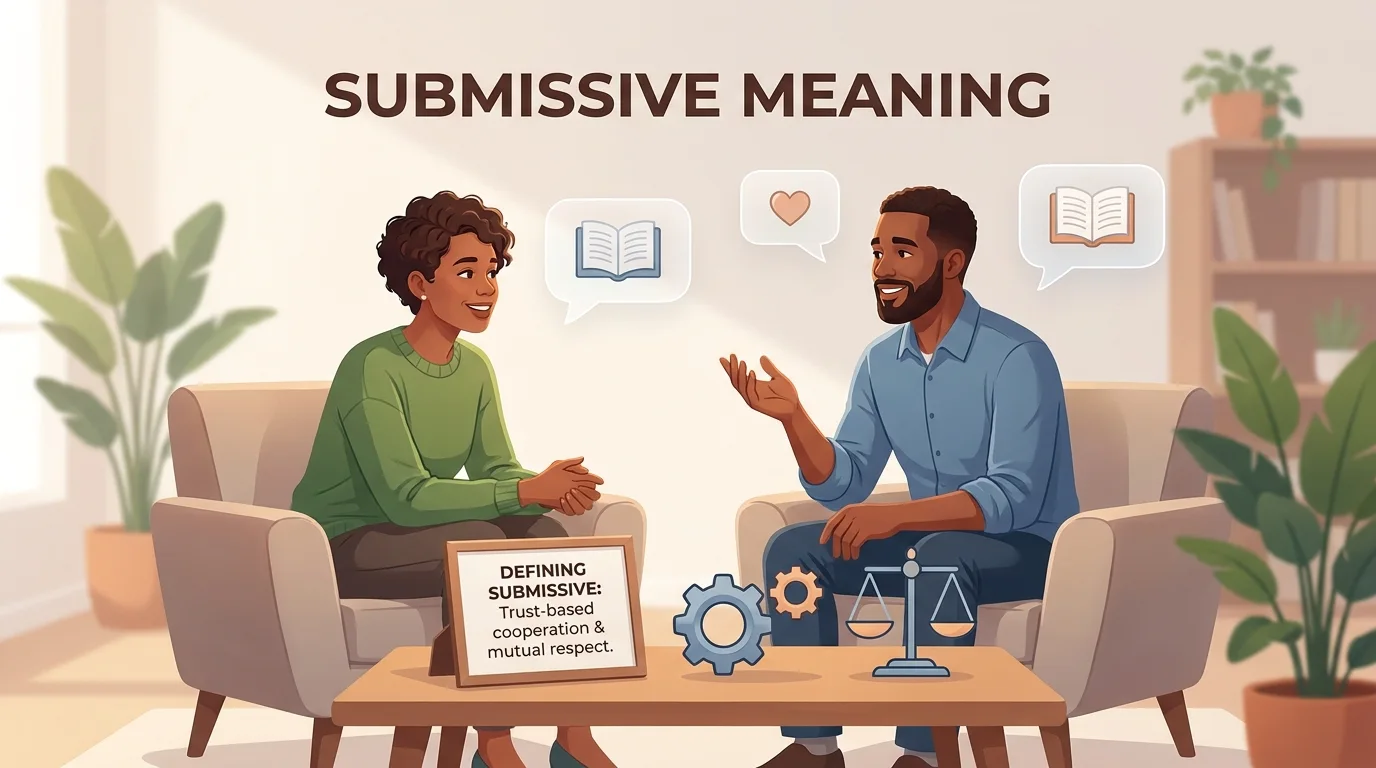
If you are wondering about the submissive meaning, it generally describes someone who is willing to accept another person’s authority, direction, or control instead of trying to lead.
Depending on the situation, a submissive can describe behavior that is polite and cooperative, a personality style that avoids conflict, or a relationship dynamic where one person willingly takes a less controlling role. The word can have either a neutral, positive, or negative meaning depending on context.
Understanding the word is important because submissive does not always mean weak, powerless, or afraid.
A person can choose to be cooperative or allow someone else to lead while still having strong opinions and personal boundaries.
In this guide, you will learn the simple definition, pronunciation, examples, synonyms, opposites, grammar, relationship meaning, and common ways the word is used.
Quick Answer: What Does Submissive Mean?
Submissive means willing to accept another person’s authority, control, or direction rather than taking charge.
For example:
“The employee was submissive during the meeting and agreed with every decision.”
Here, submissive suggests that the employee did not challenge the person in authority.
The exact meaning changes with context. It can describe behavior at work, in social situations, in relationships, or in discussions about personality.
| Word | Simple meaning | Example |
| Submissive | Willing to accept another person’s control or direction | She was submissive during the argument. |
| Submissively | In a submissive way | He nodded submissively. |
| Submission | The act of accepting authority or control | His submission was voluntary. |
| Submit | To accept or give in to authority | She refused to submit to unfair pressure. |
Submissive Definition in Simple English
The simplest definition of submissive is willing to obey, follow, or accept the wishes of someone who has more authority or control.
A submissive person may not argue, compete for control, or insist on getting their own way. They may prefer to follow another person’s decisions.
For example:
“Mark has a submissive personality and usually lets his friends choose where to go.”
This does not automatically mean Mark is weak. It may simply mean that he does not care about being the person who makes every decision.
However, the word can become negative when it suggests that someone gives up their rights, opinions, or freedom because they are afraid or pressured.
That distinction matters.
Voluntary cooperation and forced obedience are not the same thing.
What Does Submissive Mean in a Relationship?
In relationships, submissive can describe a person who prefers to let their partner take the lead in certain areas of the relationship.
For some couples, this may simply mean one partner naturally makes more decisions. In other contexts, particularly discussions of relationship dynamics, the word can describe a mutually agreed role in which one partner takes a more yielding position.
The important point is consent and personal choice.
Being submissive does not automatically mean:
- Having no opinions
- Being unable to make decisions
- Being less intelligent
- Accepting disrespect
- Allowing abuse
- Giving up all personal boundaries
A healthy relationship can include different roles while both people still have a voice.
For example:
“She prefers a submissive role in their relationship, but they discuss important decisions together.”
Here, submissive describes a preferred relationship dynamic rather than automatically suggesting weakness.
If someone is being controlled through fear, threats, manipulation, or force, that is a different situation. The word submissive should not be used to make unhealthy or abusive behavior sound acceptable.
What Does Submissive Mean in Personality?
When people talk about a submissive personality, they usually mean someone who tends to avoid conflict, follow other people’s decisions, or let others take the lead.
Such a person may be:
- Quiet during disagreements
- Uncomfortable with confrontation
- Quick to agree with others
- More comfortable following than leading
- Careful about expressing strong opinions
- Highly cooperative
For example:
“Because she has a quiet and submissive personality, she rarely argues with her coworkers.”
But personality is not always fixed. Someone can be confident in one setting and more yielding in another.
A person might confidently lead at work but prefer to let their partner make decisions at home. That does not necessarily create a contradiction.
Is Submissive a Positive or Negative Word?
Submissive can be positive, neutral, or negative depending on how it is used.
In some situations, being cooperative and willing to follow another person’s lead can be useful. In other situations, excessive submission may suggest that someone is unable to stand up for themselves.
| Context | Possible meaning | Tone |
| Teamwork | Willing to follow a leader | Neutral |
| Personality | Quiet or yielding | Neutral to negative |
| Relationship | Prefers a less controlling role | Depends on context |
| Workplace | Accepts authority without resistance | Neutral or negative |
| Conflict | Avoids confrontation | Often negative |
| Forced situation | Gives in because of pressure | Negative |
The surrounding words usually tell you how the speaker intends the term.
Compare these sentences:
“He has a submissive nature and is easy to work with.”
This may sound relatively positive.
“She became submissive because she was afraid of him.”
This clearly has a more negative meaning.
Submissive vs. Obedient: What’s the Difference?
Submissive and obedient are related, but they are not exactly the same.
Obedient usually means following rules, instructions, or orders.
Submissive often suggests yielding to another person’s authority, control, or wishes.
For example:
“The child was obedient and followed the teacher’s instructions.”
This simply describes the following instructions.
But:
“The employee was submissive and never questioned the manager.”
This suggests a broader pattern of yielding or not challenging authority.
| Word | Main idea | Example |
| Obedient | Follows instructions or rules | The dog is obedient. |
| Submissive | Yields to another person’s authority or wishes | He has a submissive nature. |
| Cooperative | Willingly works with others | She is cooperative. |
| Compliant | Accepts or follows a request, rule, or demand | The company was compliant with the law. |
| Passive | Does not actively respond or take control | He remained passive during the discussion. |
These words can overlap, but replacing one with another can change the meaning.
Submissive vs. Passive: Are They the Same?
No. Submissive and passive are connected ideas, but they describe different things.
A passive person may avoid taking action or expressing an opinion.
A submissive person may actively accept another person’s authority or direction.
For example:
“He stayed passive during the discussion.”
This tells us he did not participate actively.
“He was submissive and accepted whatever decision his supervisor made.”
This suggests that he accepted another person’s control or decision.
Someone can be passive without being submissive, and someone can be submissive without being completely passive.
Synonyms for Submissive
The best synonym depends on the sentence.
Common synonyms include:
- Yielding
- Compliant
- Obedient
- Docile
- Meek
- Accommodating
- Agreeable
- Deferential
- Unassertive
- Passive
However, these words are not perfect replacements in every situation.
For example, accommodating often has a positive meaning because it describes someone willing to adjust for others.
Meek can suggest a lack of confidence or assertiveness.
Docile often describes someone or something that is easy to control.
Compliance focuses more on following a rule, request, or demand.
So, always consider the context before choosing a synonym.
Opposite of Submissive
The most common opposites of submissive include assertive, dominant, independent, confident, resistant, and self-confident.
| Submissive | Opposite |
| Yielding | Assertive |
| Compliant | Resistant |
| Passive | Active |
| Meek | Confident |
| Dependent | Independent |
| Submissive | Dominant |
The best opposite depends on what submissive means in the original sentence.
For example, if submissive means “not confident about expressing opinions,” assertive is a strong opposite.
If it means “willing to follow another person’s control,” dominant may be a closer contrast.
Submissive Meaning in a Sentence
Seeing the word in different sentences makes its meaning easier to understand.
“The submissive employee rarely disagreed with his supervisor.”
Here, the word suggests that the employee readily accepted the supervisor’s authority.
“The dog has a submissive posture around unfamiliar dogs.”
Here, the word describes behavior rather than a human personality.
“She was submissive during the negotiation and accepted the other side’s demands.”
This suggests that she yielded instead of strongly defending her position.
“He prefers a submissive role in their relationship.”
Here, the word refers to a relationship preference.
“The student became less submissive and started expressing her own ideas.”
This suggests a change toward greater confidence and independence.
These examples show why context matters so much.
Grammar and Correct Usage of Submissive
Submissive is an adjective.
It describes a person, animal, behavior, attitude, or role.
Common sentence patterns include:
Submissive + noun
“He has a submissive personality.”
Be + submissive
“She was submissive during the argument.”
Seem + submissive
“The employee seemed submissive.”
More + submissive
“He became more submissive around his older brother.”
The related adverb is submissively:
“She nodded submissively.”
The related noun is submission:
“His submission to the authorities was unexpected.”
The verb is submit:
“They refused to submit to unreasonable demands.”
Origin and History of the Word Submissive
The word submissive is related to the verb submit, which comes through French and Latin roots associated with the idea of placing or yielding oneself under something.
The English word has been used for centuries to describe people who yield to authority or accept another person’s control.
Over time, its use expanded into many areas, including social behavior, personality descriptions, work, relationships, and descriptions of animals.
Because its meaning has developed across different contexts, modern readers should pay attention to the sentence around it rather than assuming it always means weakness or obedience.
Common Mistakes When Using Submissive
One common mistake is assuming that submissive always means weak.
That is not necessarily true.
A person can willingly choose to follow another person’s lead while remaining confident and capable.
Another mistake is treating submissive and obedient as exact synonyms. They overlap, but submissiveness often carries a stronger sense of yielding or accepting another person’s control.
It is also important not to confuse submissiveness with respect. Someone can respect another person while still expressing disagreement.
For example:
“I respect your opinion, but I disagree.”
That is not necessarily submissive. It can actually be an example of healthy assertiveness.
How to Use Submissive in Everyday Conversation
The word is most useful when you need to describe someone who tends to yield to another person’s authority, wishes, or decisions.
You might hear it in conversations about:
- Personality
- Family relationships
- Romantic relationships
- Workplace behavior
- Leadership
- Social behavior
- Animals
- Conflict
- Communication styles
However, because submissive can sound judgmental, choose it carefully when describing a real person.
Instead of saying:
“She is submissive.”
you could sometimes say:
“She prefers to let others take the lead.”
The second version may be clearer and less negative.
When Is Being Submissive Healthy?
Being willing to follow someone else’s lead is not automatically unhealthy.
In everyday life, people naturally take different roles. One partner may handle travel planning while another manages household finances. One employee may lead a project while another follows the project plan.
Healthy cooperation usually includes choice, communication, respect, and boundaries.
Problems can arise when someone feels unable to disagree, express their needs, or make independent choices.
A useful distinction is:
Choosing to yield is different from being forced to yield.
This distinction is especially important when discussing romantic relationships or situations involving power differences.
How Submissive Is Used in Modern Language
Today, submissive is used in both everyday and specialized contexts.
In casual conversation, it may describe someone who is quiet, yielding, or unlikely to challenge others.
In psychology and relationship discussions, people may use it when talking about interpersonal behavior, communication styles, or consensual relationship dynamics.
In descriptions of animals, the word may refer to behavior that signals a lack of aggression or a willingness to yield.
Because the word has several uses, online definitions can sometimes look contradictory. They are often describing different contexts rather than giving completely different definitions.
Frequently Asked Questions About Submissive Meaning
What is the simple meaning of submissive?
Submissive means willing to accept another person’s authority, direction, or control rather than taking the lead. The exact tone can be positive, neutral, or negative depending on the situation.
Does submissive mean weak?
No. Submissive does not automatically mean weak. Someone may willingly prefer to follow another person’s lead while still being confident, capable, and aware of their own boundaries.
What is an example of a submissive person?
A person who regularly lets others make decisions, avoids confrontation, and readily accepts another person’s authority may be described as submissive.
What is the opposite of submissive?
Common opposites include assertive, dominant, independent, confident, and resistant. The best opposite depends on the context in which submissive is being used.
Is submissive the same as obedient?
Not exactly. Obedient usually means following instructions or rules, while submissive often suggests yielding to another person’s authority, wishes, or control.
What does submissive mean in a relationship?
In a relationship, submissive can describe someone who prefers to let their partner take the lead in certain areas. The meaning depends on the couple’s agreed dynamic, and healthy relationships should include consent, communication, respect, and boundaries.
Conclusion
The submissive meaning is fairly simple: it describes someone who is willing to yield to another person’s authority, direction, or wishes. But the word can carry different feelings depending on the context. It may describe cooperation, a quiet personality, relationship dynamics, or behavior that comes from fear or pressure.
The most important thing is not to assume that being submissive automatically means being weak. A person can willingly follow another person’s lead while still having confidence, opinions, and boundaries. When you see or use this word, look at the surrounding sentence to understand its intended meaning.
Whether you encounter submissiveness in a conversation, relationship discussion, workplace setting, or dictionary definition, context is the key to understanding it correctly.

Hi, I’m Benjamin Dreyer. I enjoy exploring words, phrases, slang, abbreviations, acronyms, and digital communication. At Linkquorax.com, I share simple and accurate explanations to help readers understand unfamiliar terms and popular internet expressions. My goal is to make every meaning clear, useful, and easy to understand. Whether you are curious about a new word or an online phrase, Linkquorax.com provides straightforward information to help you learn quickly and communicate with confidence in everyday conversations.