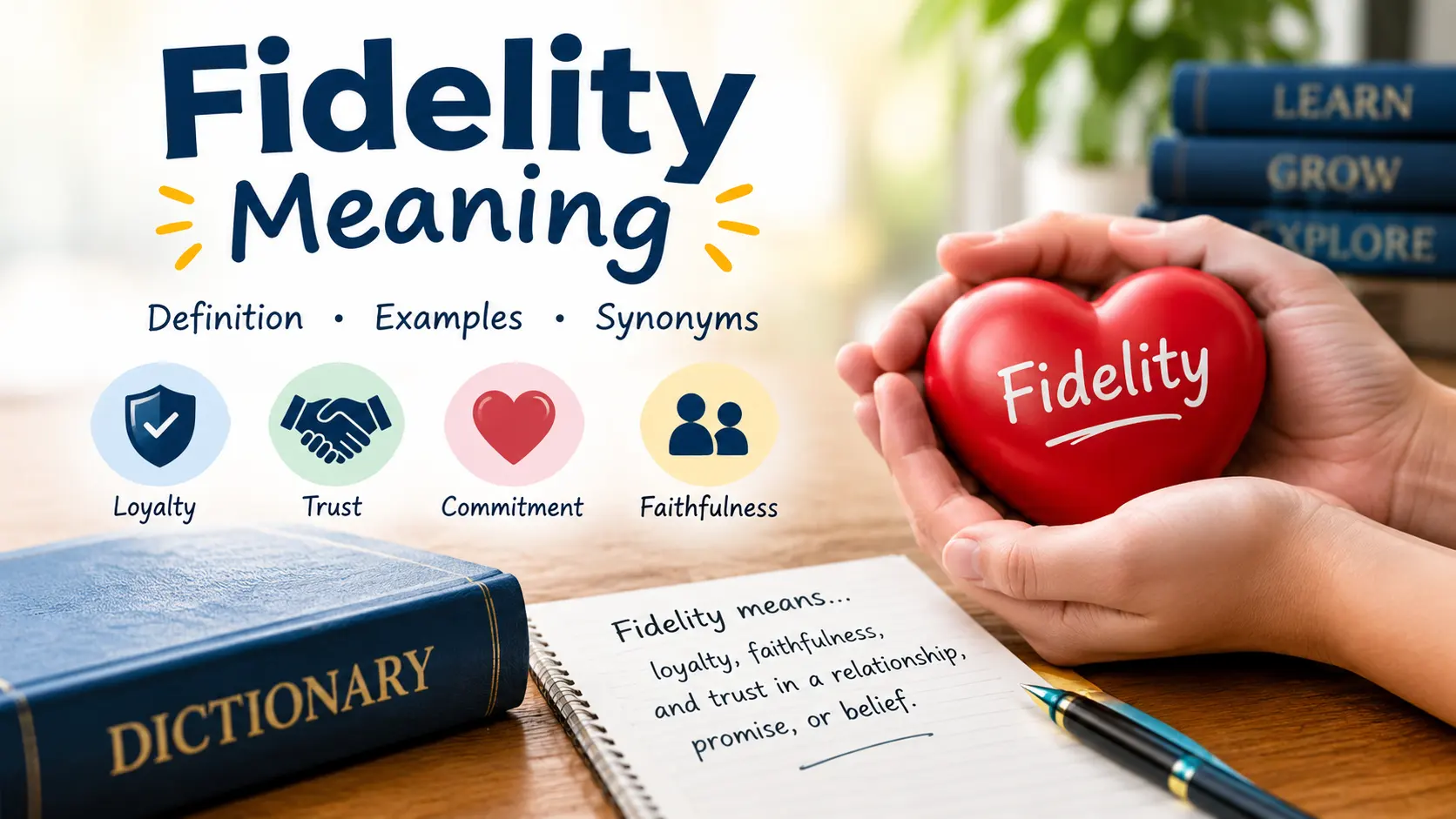
Fidelity meaning, in the simplest terms, is about being loyal, faithful, and true to a person, promise, or duty. It also means how accurate or exact something is, like a copy or a sound recording.
This word shows up in relationships, technology, and even in work life.
If you’ve ever wondered what “fidelity” really means and how to use it correctly, this guide will walk you through everything in plain, easy language.
Quick Answer
Fidelity means being loyal and faithful, especially to a partner, promise, belief, or duty. It can also describe how closely something matches the original, such as a high-fidelity speaker that reproduces sound almost perfectly.
The word comes from the Latin word “fidelitas,” which means faithfulness or trustworthiness. People use it most often when talking about marriage, relationships, and audio or data quality.
Meaning or Definition
At its core, fidelity means staying true to someone or something. It’s about keeping your word and not letting people down.
There are two main ways people use this word today.
The first meaning is about loyalty in relationships. When someone talks about fidelity in a marriage, they mean being faithful to their partner. This includes emotional loyalty and physical faithfulness. It means you don’t betray the trust of the person you promised to be true to.
The second meaning is technical. In this sense, fidelity describes accuracy or exactness. For example, “high fidelity” audio equipment plays music that sounds almost exactly like the original recording. Nothing is lost or distorted along the way.
Both meanings share the same root idea: staying true to something without changing it or breaking a promise.
Here’s a simple breakdown of both meanings side by side.
| Type of Fidelity | What It Means | Example |
| Relationship fidelity | Being loyal and faithful to a partner | “He valued fidelity above all else in his marriage.” |
| Technical fidelity | Accuracy or closeness to the original | “The speakers offer amazing high fidelity sound.” |
| Fidelity to a cause | Staying committed to a belief or duty | “She showed fidelity to her country during hard times.” |
| Fidelity in data | How closely a copy matches the original file | “The scanned document has high fidelity to the printed page.” |
Grammar or Correct Usage
Fidelity is a noun. It does not have a verb form, but it does have a common adjective form: “faithful.” You cannot say “fidel” as a verb, but you can say someone acts “faithfully.”
Here’s how it fits into a sentence naturally: “Fidelity is important in any long-term relationship.” Notice that it usually follows words like “with,” “to,” or “in.” You might say “fidelity to a promise” or “fidelity in marriage.”
The word is often paired with adjectives like “high,” “low,” “complete,” or “unwavering.” For example, “unwavering fidelity” means someone never wavers or gives up on their loyalty, no matter what happens.
One small grammar note: fidelity is almost always singular. You won’t see “fidelities” used often, since it describes a quality, not a countable object.
Common Mistakes
Many people confuse fidelity with similar-sounding or similar-meaning words. Let’s clear up the most common mix-ups.
Some people mistake fidelity for “infidelity.” These are actually opposites. Fidelity means being loyal, while infidelity means being unfaithful or cheating. Adding the prefix “in-” flips the entire meaning.
Another mistake is confusing fidelity with “trust.” While the two are related, they’re not identical. Trust is the belief that someone will act honestly. Fidelity is the actual act of staying loyal. You can trust someone without knowing for certain they’ll show fidelity, and someone can show fidelity even if trust hasn’t fully been earned yet.
People also sometimes use “Fidelity” thinking only of the investment company. Fidelity Investments is a real financial company, but that’s a brand name, not the general meaning of the word. Context makes it clear which one is meant.
Lastly, some writers overuse the word in casual conversation when a simpler word like “loyalty” or “honesty” would fit better. Fidelity often sounds more formal, so it works best in serious or emotional contexts.
Real-Life Examples
Seeing the word in action helps make the meaning stick. Here are a few natural examples from everyday life.
In a marriage, a husband might say, “I promised fidelity to my wife on our wedding day.” This means he vowed to stay faithful to her.
In technology, someone shopping for headphones might read a review that says, “These headphones offer incredible fidelity, capturing every note clearly.” This means the sound quality is very accurate and true to the original recording.
In a workplace setting, a manager might praise an employee by saying, “She has shown great fidelity to this company for over ten years.” This means she has remained loyal and dedicated during her time there.
In politics or law, you might hear, “The soldier swore fidelity to his country.” This shows loyalty to a cause bigger than oneself.
Even in science and data work, researchers might say, “The model has high fidelity to real-world results,” meaning the model’s predictions closely match what actually happens.
Current Usage or Trends
Today, fidelity is used in more places than just relationships. With streaming services and digital audio becoming so common, the term “high fidelity” or simply “hi-fi” has become popular again. Many companies market their headphones, speakers, and music apps using this exact word.
In the world of virtual reality and gaming, fidelity often describes how realistic graphics look. A “high-fidelity simulation” means the visuals and physics closely match real life. Game reviewers and tech writers use this term constantly when comparing graphics quality.
The word also appears often in discussions about artificial intelligence and data science. When people train AI models, they talk about “fidelity to the training data,” meaning how well the AI’s answers match real, accurate information.
Even outside tech, fidelity remains a meaningful word in relationships, especially in marriage counseling and psychology, where trust and loyalty are core topics of conversation.
Tips or Best Practices
If you want to use the word “fidelity” correctly and naturally, keep a few simple tips in mind.
Use fidelity when you want to sound more formal or serious. It works well in writing about relationships, values, technology, or commitment. Avoid using it in very casual conversation, since words like “loyal” or “true” often sound more natural in everyday talk.
When writing about technology, pair fidelity with clear comparisons. Instead of just saying “high fidelity,” explain what that means for the reader, such as clearer sound or sharper graphics.
When writing about relationships, be specific about what kind of fidelity you mean. Emotional fidelity and physical fidelity are sometimes discussed separately in psychology, so context matters.
Finally, always double check you’re not confusing fidelity with infidelity. Since they mean opposite things, mixing them up can completely change the meaning of a sentence.
FAQs
What does fidelity mean in a relationship?
It means being loyal and faithful to your partner, both emotionally and physically, and keeping the promises you made to them.
What is the difference between fidelity and infidelity?
Fidelity means staying loyal, while infidelity means being unfaithful or breaking that promise, often through cheating.
What does high fidelity mean in audio?
It means the sound quality is very close to the original recording, with little to no distortion or loss of detail.
Is fidelity always about romantic relationships?
No. Fidelity can also describe loyalty to a job, country, belief, or even how accurate a copy or recording is compared to the original.
What part of speech is the word fidelity?
Fidelity is a noun. The related adjective form is “faithful,” and the related adverb is “faithfully.”
Is Fidelity Investments related to the word’s meaning?
Not directly. Fidelity Investments is simply a company name. It likely chose the word because it suggests trust and reliability, but it’s a separate use from the general definition.
Conclusion
Fidelity meaning comes down to one simple idea: staying true. If it’s loyalty in a relationship, accuracy in a sound recording, or dedication to a job or cause, fidelity always points back to faithfulness and trustworthiness. Now that you understand both the emotional and technical sides of this word, you can use it confidently in writing or conversation.
Next time you hear “fidelity,” think about what kind of trust or accuracy is being described, and you’ll always understand the message clearly.

Hi, I’m Benjamin Dreyer. I enjoy exploring words, phrases, slang, abbreviations, acronyms, and digital communication. At Linkquorax.com, I share simple and accurate explanations to help readers understand unfamiliar terms and popular internet expressions. My goal is to make every meaning clear, useful, and easy to understand. Whether you are curious about a new word or an online phrase, Linkquorax.com provides straightforward information to help you learn quickly and communicate with confidence in everyday conversations.