If you have ever seen the letters POS and wondered what they mean, you are not alone. This short word shows up in stores, in grammar class, and even in text messages between friends. The tricky part is that POS does not mean just one thing. Its meaning changes depending on where you see it.
In simple terms, POS most often means “Point of Sale,” which is the place or system where a customer pays for something in a store. But POS can also mean “Parts of Speech” in grammar, or it can be internet slang with a very different meaning.
In this article, you will learn every common meaning of POS, how each one is used, real examples, and how to tell them apart. By the end, you will never be confused by this little acronym again.
Quick Answer
POS most commonly stands for “Point of Sale.” This is the system or location where a business completes a sales transaction, such as a cash register or a checkout counter.
However, POS also stands for “Parts of Speech” in grammar and is sometimes used as slang online. The correct meaning always depends on the context of the sentence.
Meaning or Definition
Let’s break down the three most common meanings of POS one at a time. Knowing all three will help you figure out which one applies when you come across the letters.
1. Point of Sale (the most common meaning)
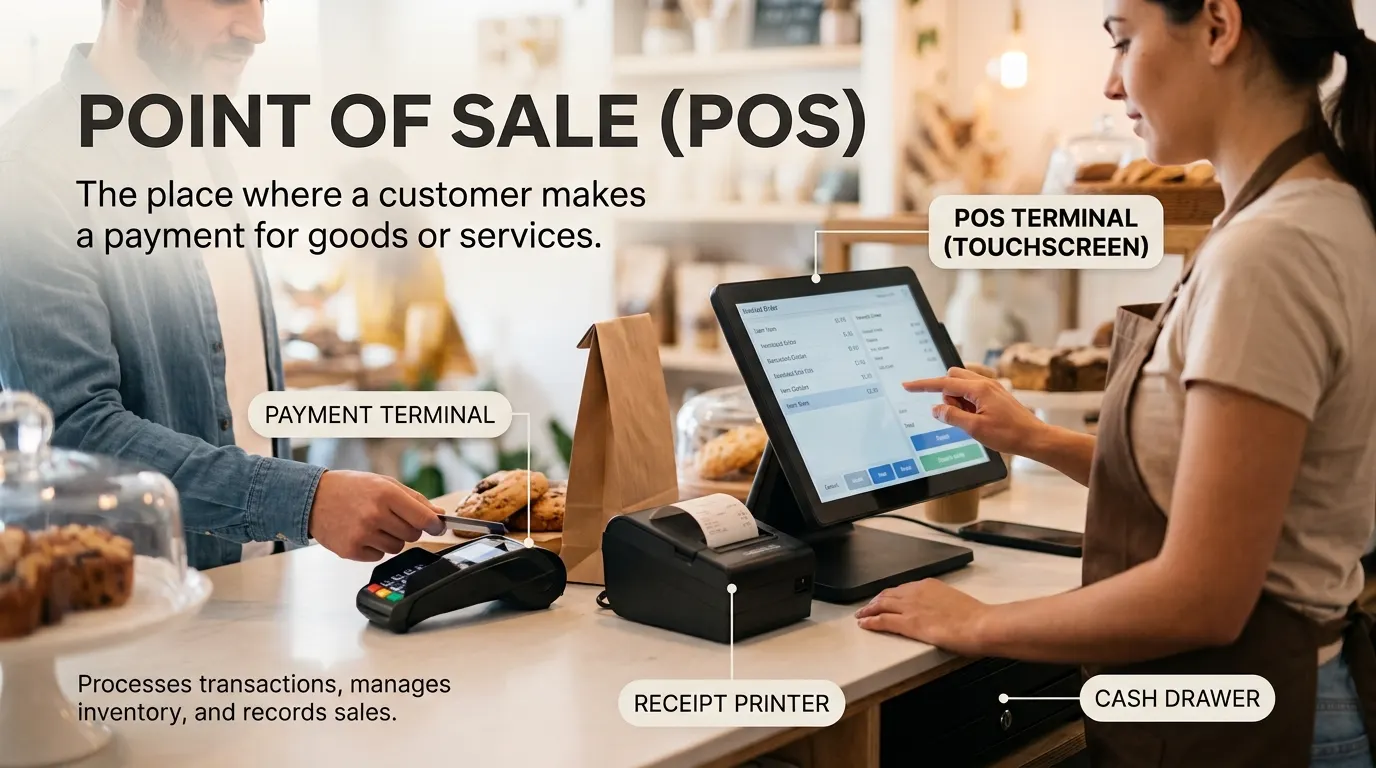
This is the meaning you will see most often, especially in business, shopping, and technology. A point of sale is the exact moment and place where a customer buys a product or service. It also refers to the equipment used to make that sale happen, like a cash register, a card reader, or a computer system.
For example, when you check out at a grocery store, the counter with the register and card machine is the “point of sale.” Many businesses now use software called a POS system to track sales, manage inventory, and accept payments all in one place.
2. Parts of Speech
In grammar class, POS often stands for parts of speech. These are the categories that words fall into based on their job in a sentence. The eight main parts of speech are nouns, pronouns, verbs, adjectives, adverbs, prepositions, conjunctions, and interjections.
Teachers and grammar tools use “POS tagging” to label each word in a sentence with its correct part of speech. This helps students understand sentence structure and helps computer programs understand human language.
3. Slang or Informal Use
Online, especially in texting or gaming, POS can be used as slang. It is sometimes short for a rude or mildly insulting phrase, so it should be used carefully or avoided in formal writing. Because slang meanings change often and can be inappropriate, it is smart to rely on context clues from the conversation to understand what someone means.
The table below gives you a quick side-by-side comparison of the top meanings.
| Meaning of POS | Common Setting | Example Use |
| Point of Sale | Business, retail, technology | “Our store just upgraded its POS system.” |
| Parts of Speech | School, grammar, writing | “Our teacher gave us a worksheet on POS tagging.” |
| Internet slang | Texting, social media, gaming | Used informally; meaning depends on context |
Grammar or Correct Usage
Since POS is an acronym, it is written in all capital letters. You do not need periods between the letters (POS, not P.O.S.), though you may still see the older style in some formal or older documents.
When you use POS in a sentence, make sure the context makes the meaning clear. If you are writing about a business, most readers will assume you mean “Point of Sale.” If you are writing about grammar, most readers will understand “Parts of Speech.” When in doubt, it is good practice to spell out the full term the first time you use it, then use POS afterward.
For example: “Our restaurant installed a new point of sale (POS) system last month. The new POS lets us accept mobile payments.”
This method, called “define first, then abbreviate,” is a common trick in clear writing. It removes any confusion for the reader right from the start.
Real-Life Examples
Seeing POS used in real sentences can make its meaning even clearer. Here are some examples from everyday situations.
A business setting:
- “The bakery’s POS system crashed during the morning rush, so they had to use a paper receipt book.”
- “Small business owners often choose a POS system that also tracks inventory and sales reports.”
- “The new POS terminal accepts tap-to-pay, chip cards, and mobile wallets.”
In a classroom setting:
- “Our homework was to identify the POS of every word in the paragraph.”
- “Understanding parts of speech, or POS, is one of the first steps in learning English grammar.”
- “The app uses POS tagging to check if a sentence uses the correct verb tense.”
Technology:
- “Many POS systems today run on tablets instead of large machines.”
- “Cloud-based POS software lets store owners check sales numbers from their phone.”
As you can see, the setting of the sentence almost always tells you which meaning of POS is being used.
Origin or History
The term “point of sale” has been used in business since at least the mid-1900s, when stores began using mechanical cash registers to record purchases. As technology advanced, point-of-sale systems grew from simple cash registers into full computer systems that handle payments, inventory, and customer data.
The grammar term “parts of speech” is much older. It comes from ancient language studies, including work by Greek scholars who first grouped words into categories based on how they function in a sentence. Modern English teaching still uses this same basic idea today, just with updated terms and tools.
Common Mistakes
Even though POS is a short acronym, people mix it up in a few common ways. Here are mistakes to watch out for.
| Common Mistake | Why It’s Wrong | Correct Approach |
| Assuming POS always means “Point of Sale” | The meaning changes by context, especially in school or online settings | Check the topic of the conversation first |
| Using POS in formal writing without explaining it | Readers unfamiliar with the term may get confused | Spell out the full term the first time you use it |
| Confusing POS with POS Tagging software features | POS tagging is a grammar tool, not the same as retail software | Use context to separate the technology from the grammar meaning |
| Using the slang meaning in professional messages | It can come across as rude or unprofessional | Avoid slang meanings in business or school writing |
Avoiding these small mistakes will make your writing clearer and more professional.
Current Usage or Trends
Today, “Point of Sale” is by far the most searched and most commonly used meaning of POS, especially as more businesses move toward digital and mobile payment systems. Modern POS systems do much more than just take payments. Many now include tools for tracking inventory, managing employee schedules, analyzing sales trends, and connecting to online stores.
Small businesses, restaurants, and retail shops increasingly choose cloud-based POS systems because they are easier to update, more affordable, and often work on everyday devices like tablets and smartphones. This shift has made the term POS even more common in everyday business conversations.
Meanwhile, “Parts of Speech” remains a steady, well-known term in education. It has not changed much over time, but it is now often taught alongside computer tools, since many writing and grammar-checking apps use POS tagging behind the scenes to catch errors.
Tips or Best Practices
If you want to use POS correctly and clearly, keep these simple tips in mind.
- Always think about the topic of your conversation or document before assuming which meaning of POS applies.
- Spell out the full phrase the first time you use POS in an article, email, or report.
- Avoid using slang meanings of POS in school, work, or formal writing.
- If you run a business, look for a POS system that fits your specific needs, such as inventory tracking or mobile payments.
- If you are a student, practice identifying parts of speech with simple sentences before moving to more complex ones.
Following these tips will help you both understand and use POS the right way, no matter the setting.
FAQs
1. What does POS stand for?
POS most commonly stands for “Point of Sale,” which refers to where a business completes a sale. It can also mean “Parts of Speech” in grammar, depending on the context.
2. What is a POS system used for?
A POS system is used by businesses to accept payments, track sales, manage inventory, and sometimes handle customer information, all from one place.
3. Is POS always about money or shopping?
No. While “Point of Sale” is a business term, POS can also refer to “Parts of Speech” in grammar or be used as informal slang online.
4. What are the 8 parts of speech in grammar?
The eight parts of speech are nouns, pronouns, verbs, adjectives, adverbs, prepositions, conjunctions, and interjections.
5. How do I know which meaning of POS someone is using?
Look at the context. Business or shopping topics usually mean “Point of Sale,” while school or writing topics usually mean “Parts of Speech.”
6. Should I use POS in formal writing?
Yes, but only after spelling out the full term the first time, such as writing “point of sale (POS)” before using the short form later in your document.
Conclusion
POS is a small acronym with several possible meanings, but context makes it easy to understand. In business, POS almost always means “Point of Sale,” the system used to complete a purchase.
In grammar and education, it usually means “Parts of Speech,” a way to categorize words in a sentence. It can also appear as informal slang in casual online conversations.
The key takeaway is simple: always look at the surrounding topic before deciding what POS means. When writing for others, it is best to spell out the full term the first time you use it, so your readers never have to guess.
With this guide, you now have a clear, complete understanding of what POS means in every common situation.

Hassan is a content writer at LinkQuorax, sharing simple and clear meanings of words, slang, phrases, and everyday expressions to help readers understand language easily.