The celibate meaning is simple: a celibate person chooses not to have sex, often because of personal, religious, or spiritual reasons.
The word can describe a person who lives without sexual relationships, and it is often used when talking about religious commitments.
You may see “celibate” in books, conversations, religious discussions, or online posts and wonder if it means the same thing as being single.
Not always. A person can be single without being celibate, while someone who is celibate may choose to avoid sexual relationships for a specific reason.
In this guide, you will learn the celibate meaning, pronunciation, grammar, difference between celibate and celibacy, examples in everyday English, common mistakes, and answers to common questions. The goal is to make the word easy to understand and use correctly.
Quick Answer
Celibate means not having sex, usually because a person has made a personal, religious, or spiritual choice to avoid sexual relationships. Cambridge Dictionary also uses the word as a noun for a person who does not have sex.
For example:
“He decided to remain celibate for religious reasons.”
This means that he chose not to have sex because of his religious beliefs.
The word celibate can be used as an adjective:
“She lives a celibate life.”
It can also be used as a noun:
“He is a celibate.”
The related noun celibacy refers to the state or practice of living without sex. In American English, Cambridge also defines celibacy as intentionally not being married or having a sexual relationship.
| Word | Simple meaning | Example |
| Celibate | A person who does not have sex or a life without sexual activity | “He chose to be celibate.” |
| Celibacy | The state or practice of being celibate | “She chose celibacy.” |
| Single | Not married or not currently in a relationship | “He is single.” |
| Abstinent | Choosing to avoid something, often sex or alcohol | “She is abstinent from sex.” |
The key point is that celibate is about sexual activity, while single mainly describes relationship or marital status.
Celibate Meaning and Definition
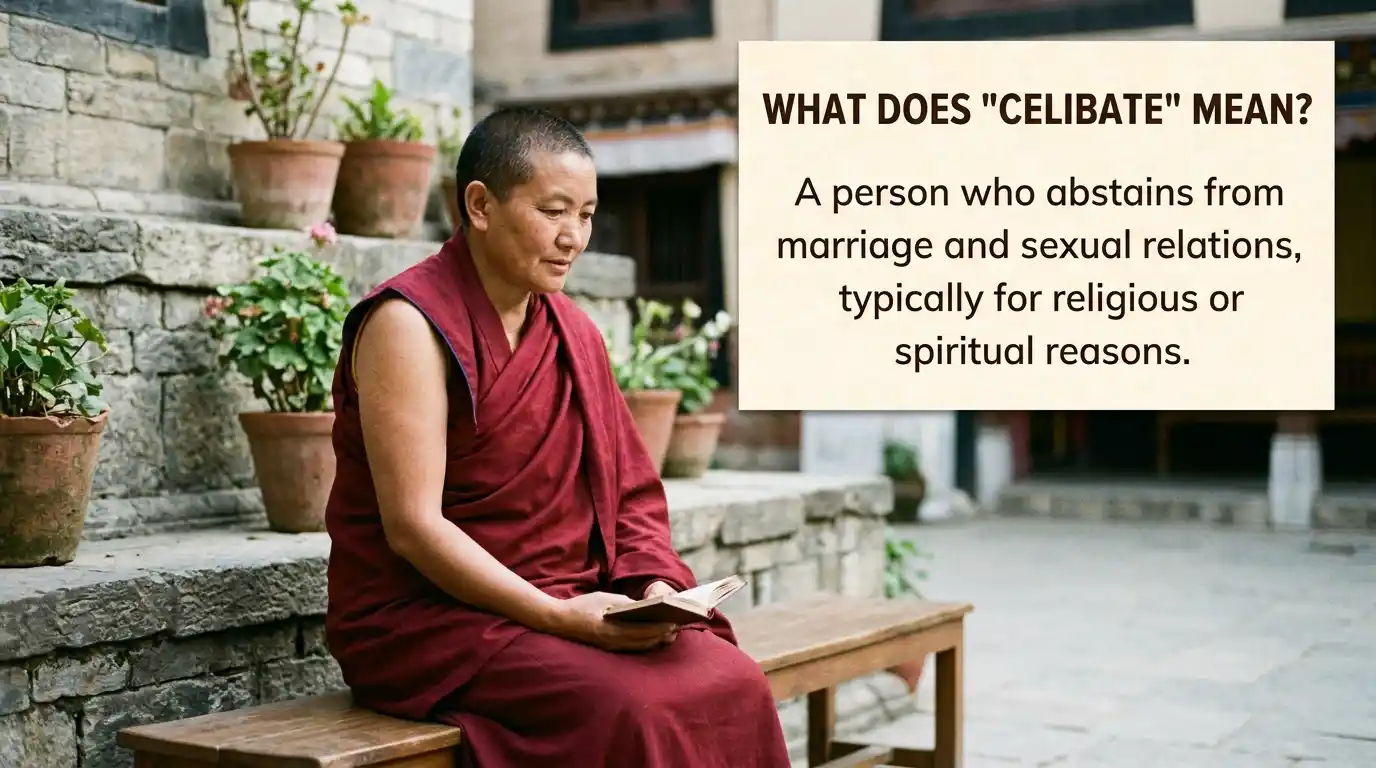
The most common meaning of celibate is a person who does not have sex. The word is especially associated with people who make a deliberate choice to avoid sex because of religious or spiritual beliefs.
In simple English, you can think of it this way:
Celibate = choosing not to have sex.
The reason can vary from person to person. Someone may choose celibacy because of religious beliefs. Another person may make the choice for personal reasons. The word itself does not tell you exactly why someone is celibate unless the sentence gives more information.
For example:
“Maria is celibate because of her religious beliefs.”
Here, the sentence clearly explains the reason.
Another example is:
“After his divorce, he decided to live a celibate life.”
In this sentence, the person has chosen not to have sex after his marriage ended.
It is also important not to assume that every celibate person has the same beliefs. Celibacy is a personal or religious practice, and people may understand or practice it in different ways.
The term is often used in serious, formal, religious, or educational discussions. In casual conversation, people may use simpler phrases such as “not having sex” or “choosing to abstain.”
What Does Celibate Mean in Simple Words?
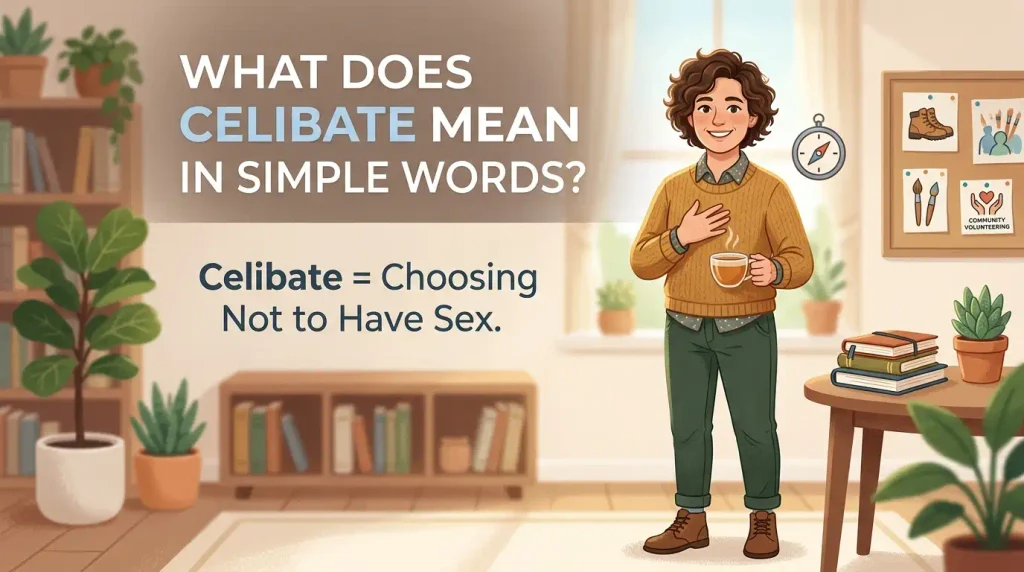
In the simplest possible words, celibate means choosing not to have sex.
Imagine someone says:
“I am celibate.”
They are saying that they do not have sex.
If they say:
“He has chosen a celibate lifestyle.”
It means he has chosen to live without sexual relationships.
The word does not automatically mean that the person dislikes dating, relationships, love, or companionship. Someone can have close friendships and meaningful relationships while remaining celibate.
The exact meaning depends on the context.
| Phrase | What it means |
| Celibate person | A person who does not have sex |
| Celibate lifestyle | A way of life that avoids sexual activity |
| Celibate life | A life lived without sex |
| Choose to be celibate | Decide not to have sex |
| Remain celibate | Continue not having sex |
| Practice celibacy | Live according to a choice or commitment to celibacy |
This is why context matters when you see the word in a sentence.
How Do You Pronounce Celibate?
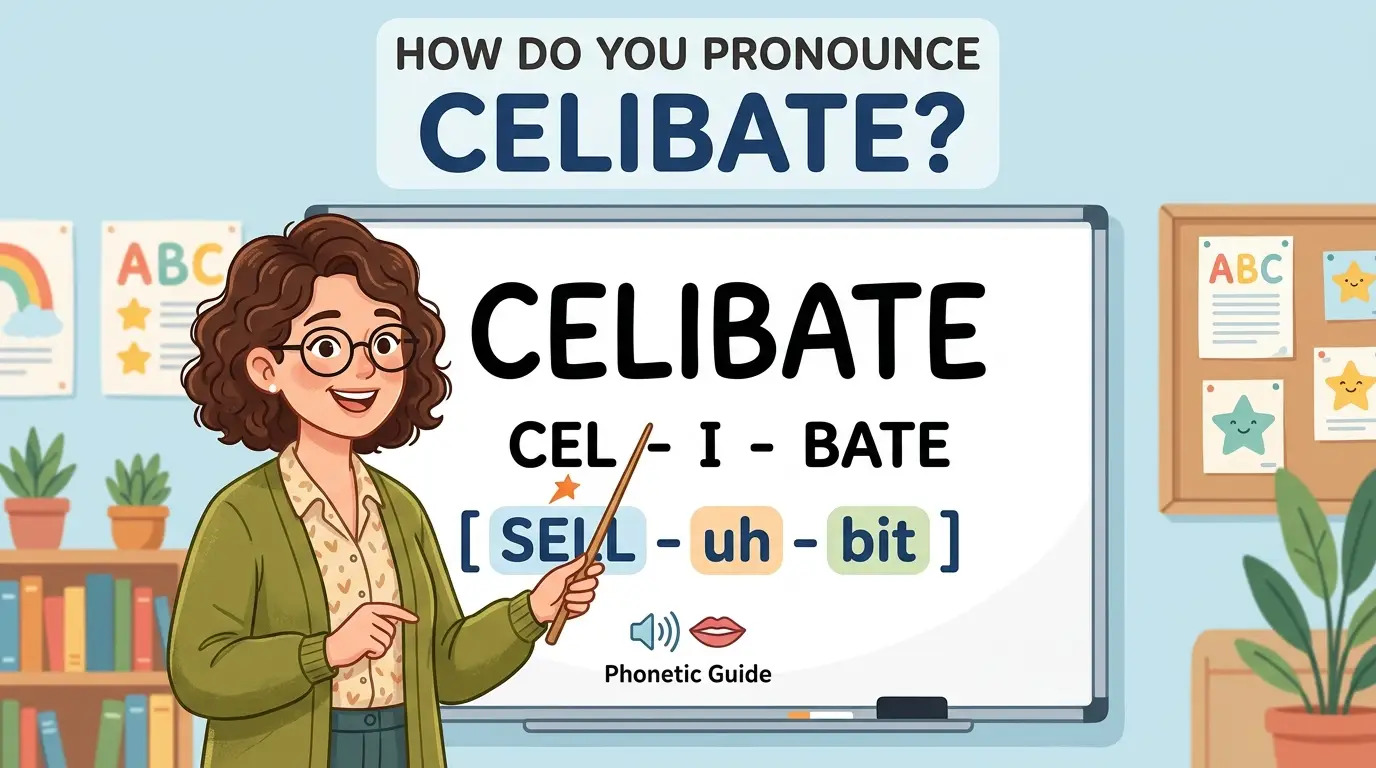
Celibate is pronounced approximately:
SEL-uh-bet
Cambridge gives the US pronunciation as /ˈsel.ə.bət/.
The first part sounds like “sel,” the middle sounds like “uh,” and the final part sounds like “bet.”
Try saying it slowly:
SEL – uh – bet
Then say it naturally:
CELIBATE
Do not confuse celibate with celibacy.
Celibate sounds like “SEL-uh-bet.”
Celibacy sounds like “SEL-uh-buh-see.” Cambridge lists the US pronunciation of celibacy as /ˈsel.ə.bə.si/.
Celibate vs. Celibacy
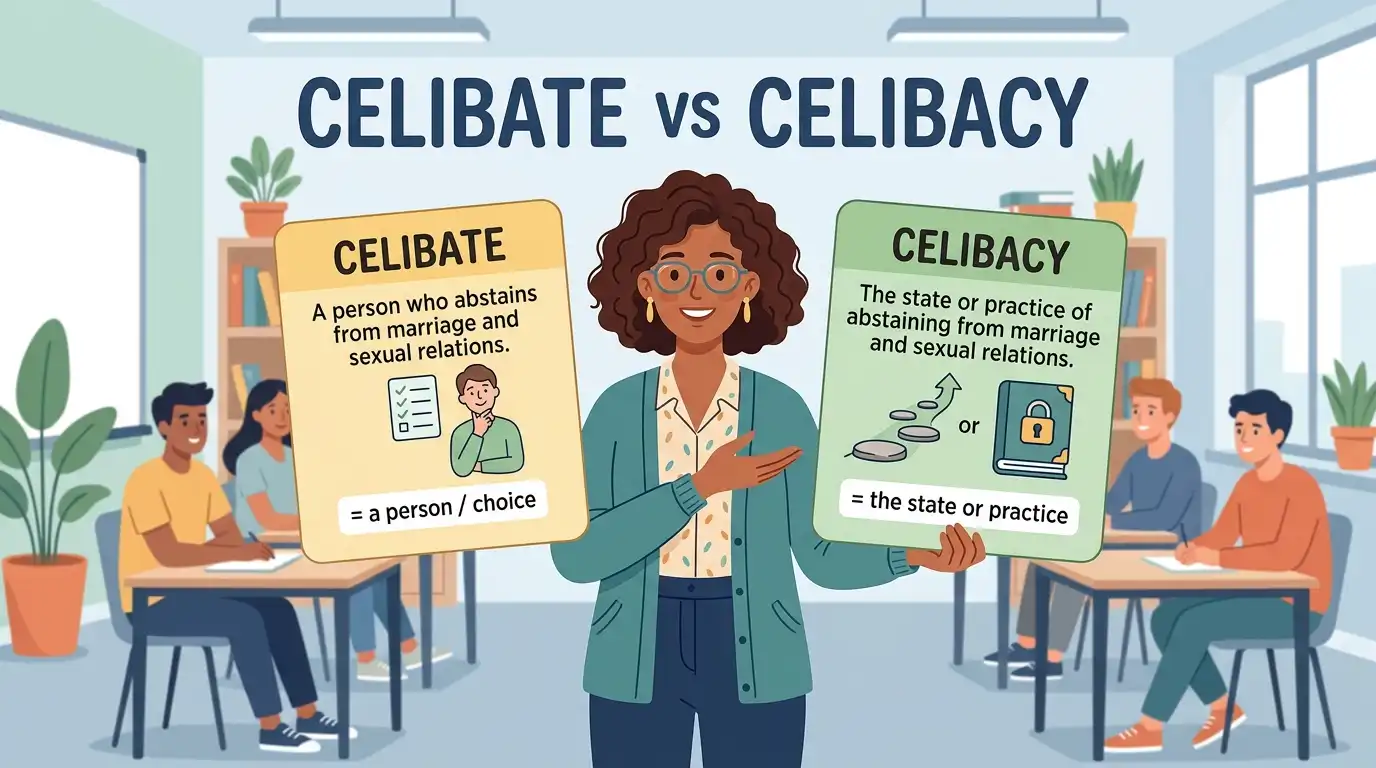
These two words are closely related, but they have different grammatical jobs.
Celibate usually describes a person or their way of life.
Celibacy is the noun for the state or practice itself.
For example:
“John is celibate.”
Here, celibate describes John.
“John practices celibacy.”
Here, celibacy is the practice.
A simple way to remember the difference is:
Celibate = person or description
Celibacy = state or practice
| Word | Part of speech | Meaning | Example |
| Celibate | Adjective | Not having sex | “He lives a celibate life.” |
| Celibate | Noun | A person who does not have sex | “He is a celibate.” |
| Celibacy | Noun | The state or practice of being celibate | “Celibacy is important to his beliefs.” |
Cambridge lists celibate as both an adjective and, in formal usage, a noun.
Is Celibate the Same as Single?

No. Celibate and single do not mean exactly the same thing.
Being single usually means a person is not married or does not currently have a romantic partner. A single person may or may not be sexually active.
Being celibate refers specifically to avoiding sex.
For example, imagine two people.
Person A is single and dates several people. This person is single but is not necessarily celibate.
Person B is single and has chosen not to have sex because of personal beliefs. This person may be both single and celibate.
So:
Single = relationship or marital status
Celibate = sexual choice or practice
This difference is one of the most important things to understand about the word.
Someone can be:
- Single but not celibate.
- Single and celibate.
- Married but temporarily abstaining from sex.
- Celibate for religious reasons.
- Celibate for personal reasons.
The word “single” alone does not tell you whether someone is celibate.
Celibate vs. Abstinent
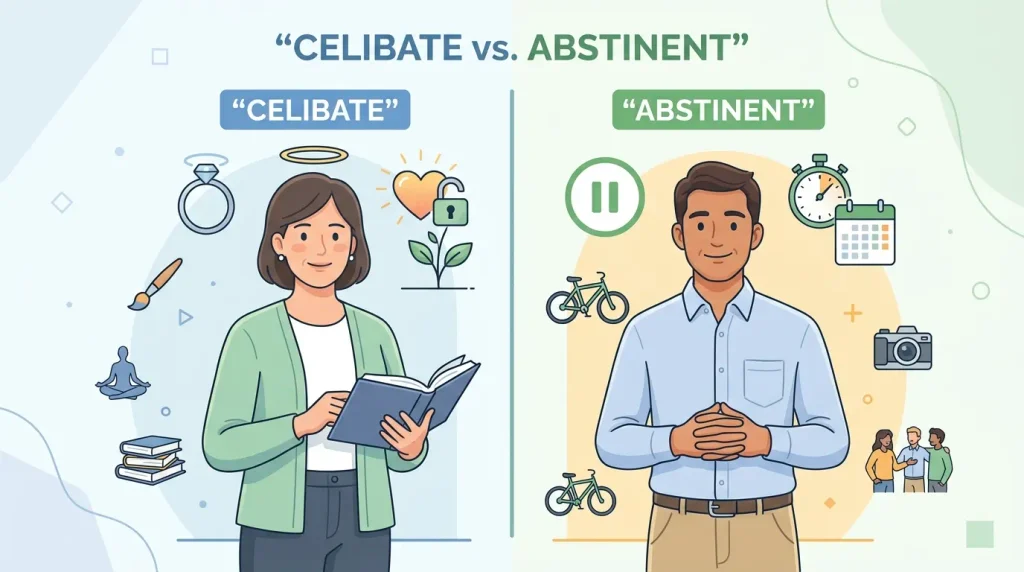
Celibate and abstinent can overlap, but they are not always interchangeable.
To be abstinent means to deliberately avoid something. In discussions about sex, sexual abstinence means choosing not to have sex.
Celibacy, however, often suggests a broader or more lasting commitment, especially in religious contexts.
For example:
“She is abstinent while waiting for marriage.”
This describes a decision to avoid sex during a particular period.
“He has chosen a celibate life.”
This can suggest a long-term lifestyle or commitment.
The difference is not always strict in everyday English, so context matters.
| Term | Main idea | Often suggests |
| Celibate | Not having sex | A chosen lifestyle or commitment |
| Abstinent | Deliberately avoiding something | A period or specific decision |
| Single | Not married or not in a relationship | Relationship status |
| Chaste | Avoiding sexual activity considered improper in a moral or religious context | Moral or religious values |
These words can describe similar situations, but they focus on different ideas.
Why Do People Choose Celibacy?

People may choose celibacy for many different reasons. There is no single reason that applies to everyone.
Religion is one well-known reason. Some religious traditions or individuals view celibacy as a way to devote more attention to spiritual life, religious service, or personal faith.
Personal values can also play a role. Someone may decide that avoiding sex fits their personal beliefs or goals.
Life choices can matter as well. A person may choose to focus on education, work, family, personal growth, or other priorities.
Some people may also choose celibacy for a period of time rather than for their entire lives.
It is important not to assume someone’s reason. If a person says they are celibate, the word tells you about their choice regarding sex, but it does not automatically explain their motivation.
A respectful response is to accept the person’s stated choice rather than guessing why they made it.
Celibacy in Religious Contexts
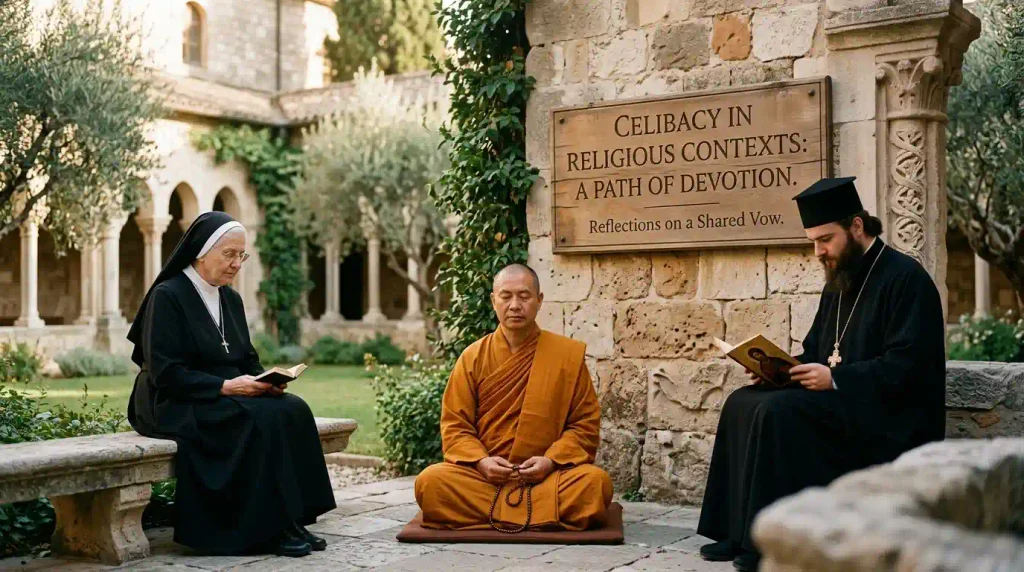
The word celibacy often appears in discussions about religion.
In some religious traditions, certain religious leaders or members may make commitments involving celibacy. The exact rules and meaning vary among religions, denominations, and communities.
For example, the phrase “clerical celibacy” may be used when discussing rules or traditions concerning religious clergy. Cambridge specifically gives “priestly celibacy” and “clerical celibacy” as examples of how the term appears in religious discussions.
However, it would be incorrect to assume that celibacy belongs only to one religion or one type of religious person.
Cambridge notes that celibacy is not exclusive to Catholic priests.
The broader idea of voluntarily avoiding sexual relationships can appear in different religious and spiritual settings.
When reading about celibacy in religion, it helps to look at the specific tradition being discussed instead of treating every religious practice as identical.
Celibate Meaning in a Relationship

The word can seem confusing when it appears in discussions about dating or relationships.
A person can have a romantic relationship and still choose celibacy. Being emotionally close to someone does not automatically mean that the couple has a sexual relationship.
For example:
“They are dating, but he has chosen to remain celibate.”
This means that he is in a romantic relationship but has decided not to have sex.
Another example:
“She wants a relationship that respects her celibate lifestyle.”
This means she wants a romantic relationship that fits her choice not to have sex.
Therefore, celibacy does not always mean avoiding love, dating, friendship, or emotional closeness.
The details depend on the person’s own beliefs and boundaries.
Real-Life Examples of Celibate
Here are some natural examples that show how celibate is used in everyday English.
“He decided to remain celibate for personal reasons.”
This means he chose not to have sex because of his personal beliefs or goals.
“She has lived a celibate life for several years.”
This means she has chosen a lifestyle without sex.
“The monk follows a celibate way of life.”
Here, the word is used in a religious setting.
“Being single does not necessarily mean being celibate.”
This example shows the difference between the two terms.
“He explained that his decision to be celibate was connected to his faith.”
The sentence gives the reason for his choice.
“She chose celibacy while focusing on her spiritual life.”
Here, celibacy is used as a noun.
“The book discusses celibate religious communities.”
Here, celibate works as an adjective describing the communities.
These examples show that the word can appear in personal, social, educational, and religious contexts.
Common Mistakes With the Word Celibate
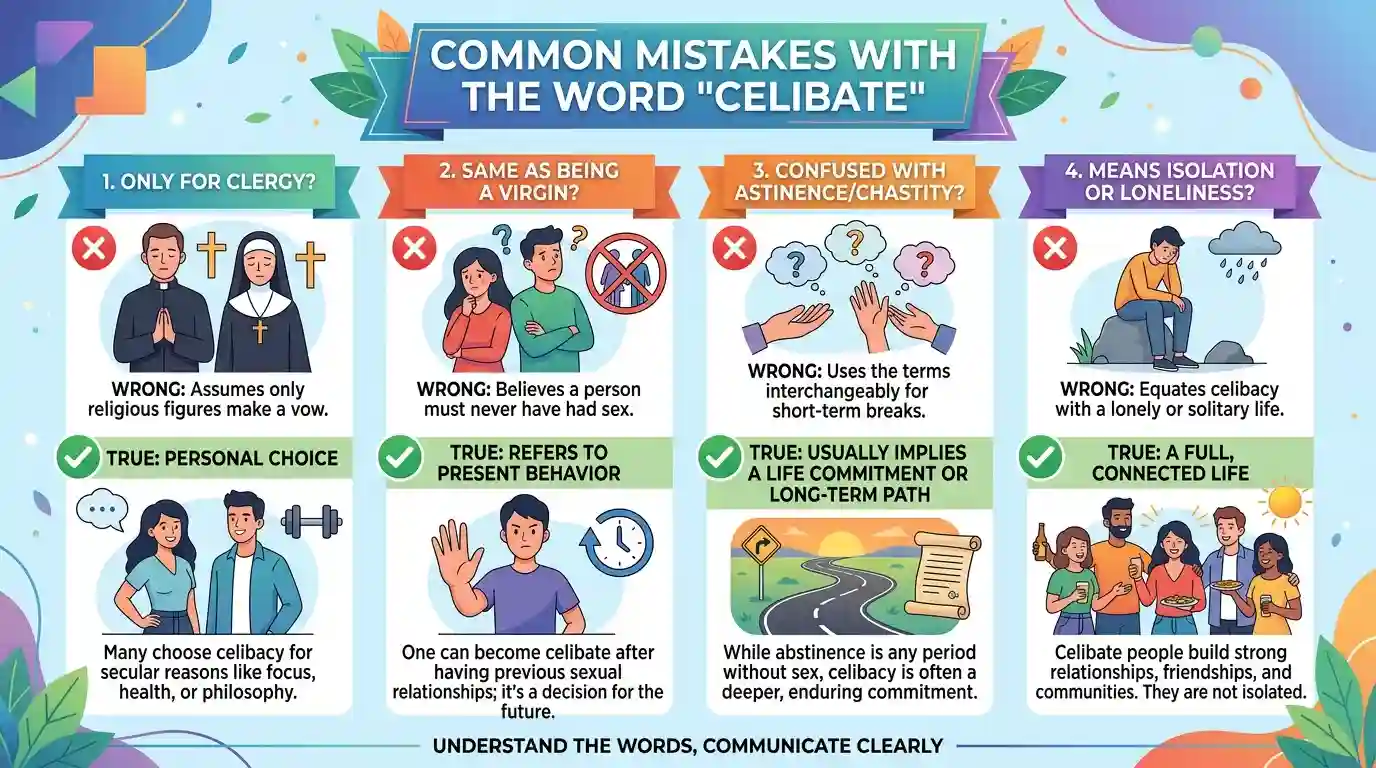
One common mistake is assuming that celibate means unmarried.
That is not always correct. A person can be unmarried without being celibate, and the meaning of celibate focuses on sexual activity.
Another mistake is thinking that every celibate person is a religious person. Religion is an important context for the word, but people may choose celibacy for personal reasons too.
A third mistake is using celibacy when you need an adjective.
For example:
Incorrect:
“She is celibacy.”
Correct:
“She is celibate.”
Or:
“She practices celibacy.”
Another mistake is treating celibacy as exactly the same as being alone. Celibacy concerns sexual activity; it does not automatically mean someone has no friends, family, or emotional connections.
Using the word carefully helps prevent misunderstandings.
Celibate as an Adjective and Noun
Celibate can work as both an adjective and a noun.
As an adjective:
“He leads a celibate life.”
Here, celibate describes the person’s life.
“She made a celibate commitment.”
Here, it describes the type of commitment.
As a noun:
“He is a celibate.”
Here, the word refers to the person.
The noun form is more formal. Cambridge identifies the noun use as formal and defines it as a person who does not have sex.
In everyday writing, it is often clearer to say “a person who is celibate” when you want a simple and neutral phrase.
Is Celibate a Positive or Negative Word?
Celibate is generally a neutral word.
It describes a person’s sexual choice or lifestyle. The word itself does not say that the choice is good or bad.
The tone depends on the sentence and the speaker.
For example:
“She chose a celibate life because it fits her values.”
This sounds respectful and neutral.
But a sentence can make almost any neutral word sound judgmental if it adds negative language around it.
When discussing someone’s celibacy, it is best to use respectful language and avoid making assumptions about their reasons or personal life.
Celibate in American English
The word celibate is used in American English and British English with essentially the same core meaning.
It is pronounced similarly in both varieties. Cambridge lists the US and UK pronunciation as /ˈsel.ə.bət/.
There is also no major difference in the basic meaning between American and British English.
The word may appear more often in formal, religious, academic, or serious conversations than in casual everyday speech.
For casual writing, a speaker might simply say:
“He doesn’t have sex.”
For more formal writing, they may say:
“He is celibate.”
Both communicate the general idea, but the second is more concise and formal.
Celibate Meaning in Texting and Social Media
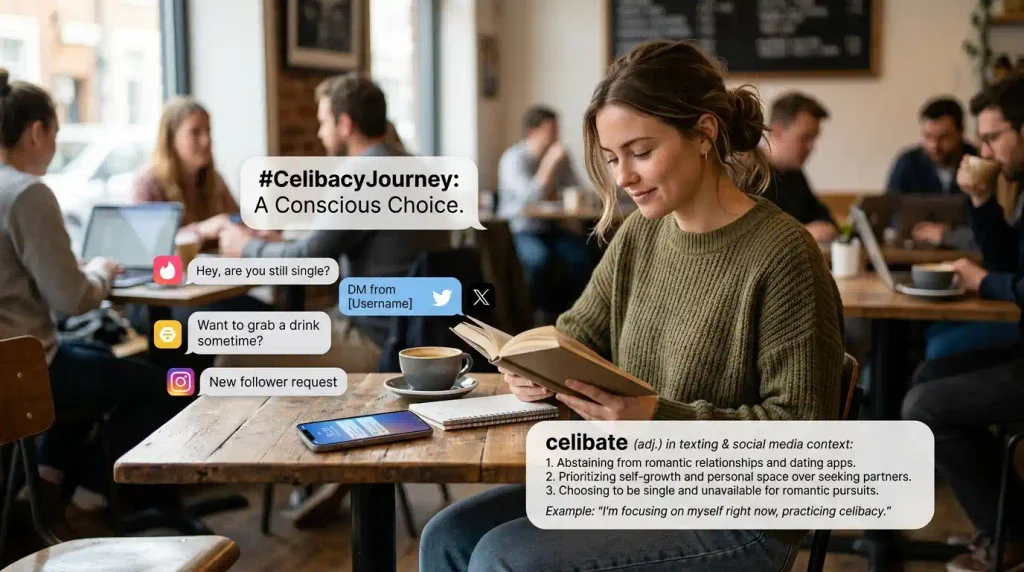
People do use celibate online, but it is not usually considered a common texting abbreviation or slang term.
If someone writes:
“I’m celibate.”
They usually mean they have chosen not to have sex.
Online conversations can sometimes use the word jokingly or casually, but the basic dictionary meaning remains the same.
Be careful with short social media posts because context may be missing. Someone may use “celibate” to describe a temporary decision, a long-term lifestyle, or a religious commitment.
If you are unsure what a person means, the safest approach is not to assume.
Related Words You May See
Understanding related words can make celibate meaning easier to remember.
Celibacy is the state or practice of being celibate.
Abstinence means deliberately avoiding something, including sex in some contexts.
Abstinent describes someone who is practicing abstinence.
Chaste is a related word that can have moral, religious, or sexual meanings depending on context.
Single refers mainly to relationship or marital status.
These words are connected, but they should not automatically be treated as exact synonyms.
| Word | Basic meaning | Exact same as celibate? |
| Celibate | Not having sex, often by choice | Yes, for the core idea |
| Celibacy | The state or practice of being celibate | No; it is a noun |
| Abstinent | Avoiding something, including sex | Not always |
| Chaste | Sexually restrained or morally pure, depending on context | No |
| Single | Not married or not in a relationship | No |
Knowing these differences is especially useful when writing essays, articles, messages, or formal documents.
Tips for Using Celibate Correctly
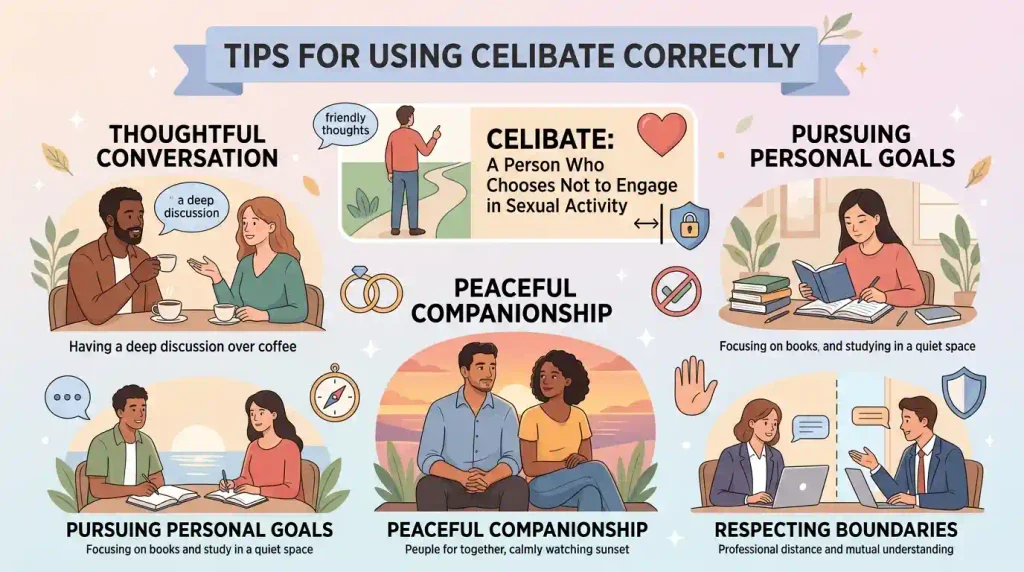
Use celibate when you are describing a person or lifestyle involving a choice not to have sex.
Use celibacy when you are talking about the state or practice itself.
For example:
“He is celibate.”
and:
“He practices celibacy.”
Both are correct.
If you are writing for a general audience, keep the explanation simple and avoid assuming why someone is celibate.
Also remember that celibate does not simply mean single.
A good memory trick is:
Celibate describes the choice. Single describes the relationship status.
That one distinction can help you avoid most common mistakes.
Frequently Asked Questions
What does celibate mean?
Celibate means not having sex, usually because a person has chosen to avoid sexual relationships. The choice may be connected to religion, spirituality, personal values, or other reasons.
Does celibate mean single?
No. Celibate does not simply mean single. Single usually describes someone’s relationship or marital status, while celibate describes a choice not to have sex. A single person may or may not be celibate.
What is the difference between celibate and celibacy?
Celibate describes a person or lifestyle, while celibacy is the state or practice of not having sex. For example, “He is celibate” and “He practices celibacy” are both correct uses.
Can a married person be celibate?
The word is most often used for people who are not having sex, but its use can depend on context. A married person’s situation may be described as celibate if they are intentionally living without sexual activity, although this is less common in everyday conversation.
Is celibacy only related to religion?
No. Religion is an important context for celibacy, but people can choose celibacy for personal or other reasons. The word itself does not require a religious reason.
How do you pronounce celibate?
Celibate is pronounced approximately SEL-uh-bet. Cambridge gives the US pronunciation as /ˈsel.ə.bət/.
Conclusion
The celibate meaning is straightforward: a celibate person chooses not to have sex, often because of personal, spiritual, or religious reasons. The word can describe a person as an adjective or noun, while celibacy describes the state or practice itself.
The most important distinction to remember is that celibate does not simply mean single. A person can be single without being celibate, or they can be both single and celibate.
When you see the word in a sentence, look at the context to understand the reason or length of the person’s choice. If you use the word yourself, choose celibate to describe a person or lifestyle and celibacy to name the practice.
Once you understand that simple difference, the word becomes much easier to recognize, explain, and use correctly.
Discover More Article

Hi, I’m Benjamin Dreyer. I enjoy exploring words, phrases, slang, abbreviations, acronyms, and digital communication. At Linkquorax.com, I share simple and accurate explanations to help readers understand unfamiliar terms and popular internet expressions. My goal is to make every meaning clear, useful, and easy to understand. Whether you are curious about a new word or an online phrase, Linkquorax.com provides straightforward information to help you learn quickly and communicate with confidence in everyday conversations.