
Platonic meaning usually refers to a close relationship, feeling, or connection that is not romantic or sexual.
For example, two people can care deeply about each other, spend a lot of time together, and have a strong emotional bond while still being only friends. That is a platonic relationship.
The word can be confusing because “platonic” can describe more than friendship. It can also describe love, affection, relationships, and even ideas connected with the philosopher Plato.
In everyday English, however, people most often use it to explain that a relationship has deep care without romantic or sexual attraction.
This guide explains what platonic means, where the word comes from, how it differs from romantic love, and how people use it in real conversations.
Quick Answer: What Does Platonic Mean?
Platonic means a close connection or relationship that does not involve romantic or sexual feelings. The most common example is a strong friendship between two people.
For example:
“They have a platonic relationship.”
This means they are close, care about each other, and may share emotional support, but they are not romantically involved.
The word can describe:
- Platonic friendship
- Platonic love
- Platonic relationships
- Platonic affection
- Platonic attraction
- Platonic connections
A simple way to remember the meaning is:
Platonic = close and caring, but not romantic or sexual.
Platonic Meaning in Simple English
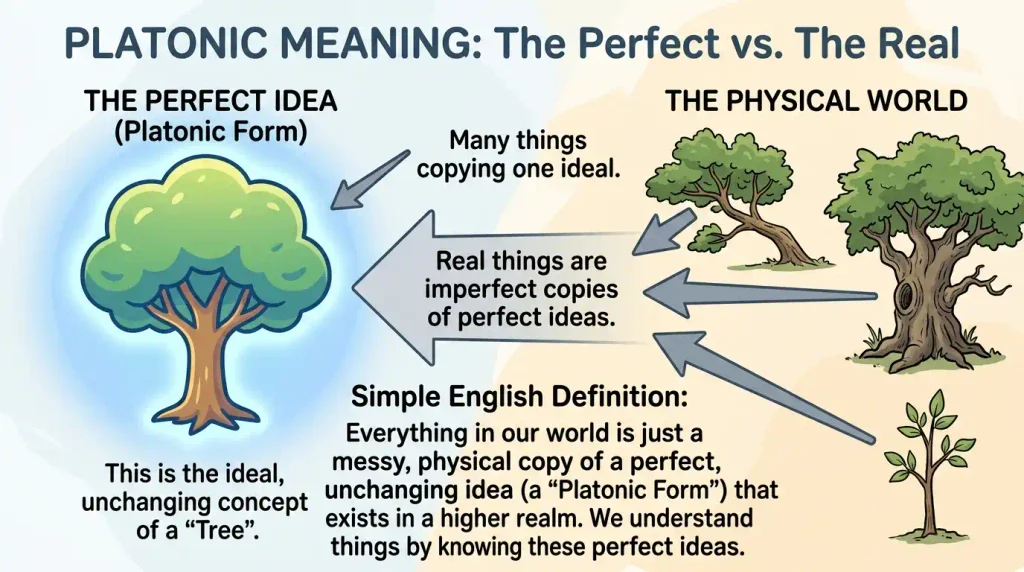
In simple English, platonic describes a relationship where people have a strong bond without being romantically involved.
Imagine two best friends. They talk every day, trust each other with personal problems, celebrate each other’s achievements, and support each other during hard times. They may even say, “I love you,” but they do not mean romantic love.
That can be a platonic relationship.
The word does not mean that the relationship is cold or distant. In fact, a platonic friendship can be extremely meaningful. Friends can have deep emotional connections without wanting to date or become romantic partners.
For example:
“Sarah and Mike are very close, but their relationship is completely platonic.”
This tells us that their friendship is strong, but there is no romantic relationship between them.
Platonic Definition and Meaning
The exact meaning of platonic depends somewhat on context.
| Use | Meaning |
| Platonic friendship | A close friendship without romance or sex |
| Platonic relationship | A non-romantic relationship |
| Platonic love | Deep affection without romantic or sexual desire |
| Platonic affection | Caring or loving feelings without romance |
| Platonic connection | A meaningful non-romantic bond |
In everyday conversations, platonic is usually used to make the type of relationship clear.
For instance, someone might say:
“She’s my best friend, but our relationship is platonic.”
The speaker is making it clear that their closeness should not be understood as dating or romantic interest.
What Is a Platonic Relationship?
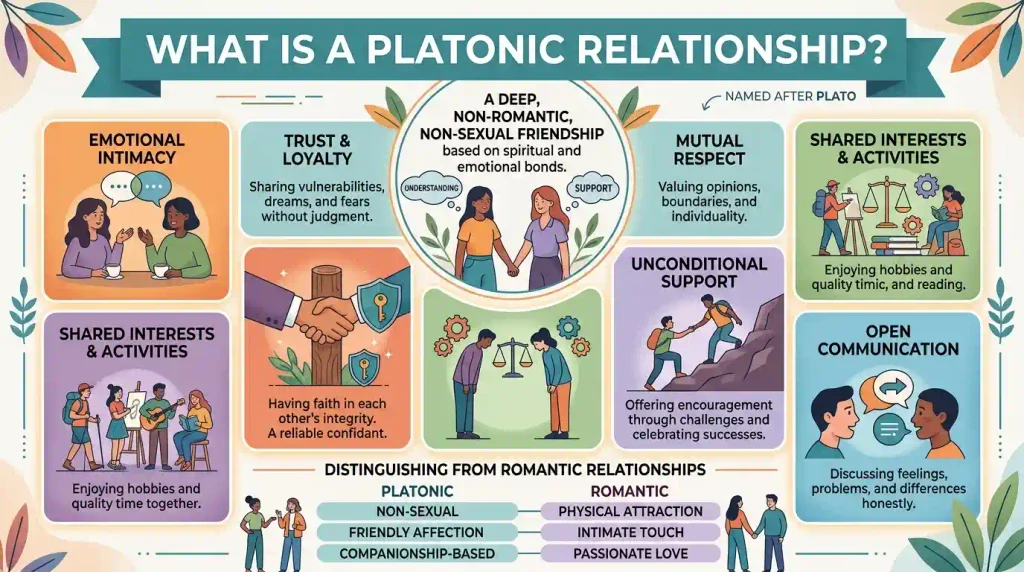
A platonic relationship is a close relationship between people who care about one another without having a romantic or sexual relationship.
Platonic relationships can exist between:
- Two best friends
- Coworkers
- Classmates
- Family friends
- Former romantic partners who remain friends
- People who share a hobby or interest
- Friends of different genders
- Long-distance friends
A platonic relationship can include trust, emotional support, affection, humor, shared experiences, and loyalty.
For example, two friends might call each other when they have a bad day, go on trips together, exchange gifts, or spend weekends together. None of those things automatically makes the relationship romantic.
What matters is the nature of the connection and the feelings involved.
What Is Platonic Love?
Platonic love is deep affection or love without romantic or sexual desire.
People sometimes assume that love must be romantic, but that is not true. You can love your closest friends, siblings, parents, or other important people in your life without being romantically attracted to them.
Platonic love may involve:
- Trust
- Respect
- Emotional closeness
- Loyalty
- Care
- Support
- Understanding
- Shared memories
For example:
“I have a lot of platonic love for my best friend.”
This means the person feels deep love and affection for the friend but does not have romantic feelings toward them.
Platonic vs. Romantic: What Is the Difference?

The main difference between platonic and romantic relationships is romantic attraction and intention.
A romantic relationship often includes romantic attraction, while a platonic relationship does not.
| Platonic | Romantic |
| No romantic attraction | Romantic attraction is present |
| Often based on friendship | Often based on romantic partnership |
| Emotional closeness can be strong | Emotional closeness can be strong |
| May include affection | Often includes romantic affection |
| Usually no romantic commitment | May include dating or romantic commitment |
| Friendship is often central | Romantic partnership is often central |
There can be some overlap. For example, romantic partners can also be best friends. A romantic relationship may contain many qualities found in a platonic friendship.
The important difference is the romantic or sexual element, not simply how close two people are.
Can a Platonic Relationship Be Very Close?
Yes. A platonic relationship can be extremely close.
Some people have friendships that last for decades. They may know each other’s families, personal history, goals, fears, and habits. They may depend on each other emotionally and consider each other part of their chosen family.
Closeness does not automatically mean romance.
For example:
“My best friend and I are inseparable, but our relationship is completely platonic.”
This means the friendship is very strong without romantic involvement.
This distinction is useful because people sometimes confuse emotional intimacy with romantic attraction. The two can exist separately.
Examples of Platonic Relationships

Understanding the word becomes easier when you see it in everyday situations.
Consider two college friends who study together, eat lunch together, and talk about their personal lives. They care about each other but have no romantic interest. Their friendship is platonic.
Another example could be two coworkers who become close friends. They support each other through stressful projects and occasionally meet outside work. Their connection can remain completely platonic.
A third example is two former partners who no longer have romantic feelings but continue to care about each other as friends. If both people are comfortable with the arrangement, their current relationship may be platonic.
Platonic relationships can look different from person to person. There is no single set of rules that every friendship must follow.
Platonic Meaning in a Sentence
Here are some natural examples of how platonic is used:
“We have a strong platonic friendship.”
“Their relationship is strictly platonic.”
“I care about him deeply, but my feelings are platonic.”
“She is one of my closest platonic friends.”
“They share a platonic bond built on years of trust.”
“He made it clear that he wanted to keep their relationship platonic.”
“Their friendship started online and developed into a strong platonic connection.”
These examples show that the word is usually used to clarify that affection or closeness is not romantic.
Platonic Grammar and Correct Usage

Platonic is an adjective.
It describes a noun, such as relationship, friendship, love, bond, or connection.
Correct examples include:
- “They have a platonic friendship.”
- “Their relationship is platonic.”
- “She feels platonic affection for him.”
- “We share a strong platonic bond.”
You would not normally use “platonic” as a noun in standard English.
The word can also appear with adverbs or other descriptive language:
“They are strictly platonic.”
“Their friendship is deeply platonic.”
However, “strictly platonic” is especially common when someone wants to remove any possible romantic misunderstanding.
Platonic vs. Friendly: Are They the Same?
Not exactly.
Friendly is a broad word. It can describe someone’s behavior, personality, or attitude.
Platonic is more specific. It usually describes a relationship or affection that is not romantic or sexual.
For example:
“He was friendly to everyone.”
This simply means he behaved in a kind or pleasant way.
But:
“They have a platonic relationship.”
This tells us something specific about the nature of their relationship.
A person can be friendly with someone without being close friends. A platonic relationship usually suggests a deeper personal connection.
Platonic vs. Non-Romantic

The words platonic and non-romantic are closely related, but they are not always used in exactly the same way.
“Non-romantic” directly means that romance is not involved.
“Platonic” often suggests a meaningful relationship based on friendship, care, or emotional connection.
For example:
“We have a non-romantic relationship.”
is clear and neutral.
But:
“We have a platonic relationship.”
often suggests that the two people are close and care about each other.
In everyday conversation, either phrase can work depending on what you want to emphasize.
What Does “Strictly Platonic” Mean?
Strictly platonic means a relationship is completely non-romantic and non-sexual.
People often use this phrase when there might be confusion about their relationship.
For example:
“We’re going on vacation together, but we’re strictly platonic.”
The speaker is clearly telling others that the trip does not involve dating or romance.
Similarly:
“He’s my strictly platonic best friend.”
This makes the relationship boundary very clear.
Can Individuals Have a Platonic Relationship?

Yes. People of any gender can have a platonic friendship.
A friendship between a man and a woman does not automatically mean that one or both people have romantic feelings. Two people can share a strong emotional connection while remaining friends.
Of course, feelings can change over time. A friendship that begins as platonic can sometimes become romantic if both people develop romantic attraction. But that does not mean every close friendship has romantic intentions.
The word platonic describes the relationship as it exists in the context being discussed.
Can Exes Have a Platonic Relationship?
Yes, former romantic partners can sometimes develop a platonic relationship after a breakup.
This usually works best when:
- Both people have moved on romantically.
- They respect each other’s boundaries.
- Neither person expects the relationship to return to romance.
- They are comfortable with the friendship.
- Their contact does not create ongoing emotional pain.
Not every former couple can or should remain friends. A platonic relationship after dating depends on the people involved and their circumstances.
Can Platonic Friends Say “I Love You”?

Yes.
“I love you” does not always mean romantic love.
Friends can say it to express:
- Deep care
- Gratitude
- Loyalty
- Emotional support
- Appreciation
- Long-term friendship
Context matters.
For example, a friend might say:
“I love you. Thank you for always being there for me.”
This can be completely platonic.
If the meaning is unclear, the people involved can communicate openly about what they mean and what boundaries they are comfortable with.
The Origin of the Word Platonic
The modern use of platonic is connected to the Greek philosopher Plato, who lived in ancient Athens.
The word comes from the Latin form of Plato’s name, Platonicus. The meaning developed through discussions of Plato’s ideas about love, beauty, and higher forms of connection.
The modern expression “platonic love” became especially associated with a form of affection that was not based on physical desire.
It is important to note that the everyday meaning of “platonic” is not simply a direct definition of everything Plato taught. Modern English uses the word in a more specific way, especially when talking about non-romantic relationships.
What Did Plato Mean by Love?

Plato explored love and beauty in several philosophical works, most famously in discussions connected with The Symposium.
In those discussions, love can be understood as something that may begin with attraction to an individual but can lead toward appreciation of beauty, wisdom, and higher ideas.
The modern phrase “platonic love” developed from later interpretations of these ideas.
So, when someone today says, “Our relationship is platonic,” they usually are not making a philosophical statement about Plato. They simply mean the relationship is close but not romantic or sexual.
Common Misunderstandings About Platonic Relationships
One common misunderstanding is that platonic relationships must be emotionally distant. They do not.
Another is that people cannot have physical affection in a platonic friendship. That also is not universally true. Friends may hug, hold hands in certain cultures or situations, or show other forms of affection without making the relationship romantic.
However, boundaries vary from person to person.
A gesture that feels normal to one friendship may feel romantic to another. That is why communication matters more than trying to follow one universal rule.
The word platonic describes the general nature of the relationship, but every relationship still has its own boundaries.
Why Do People Use the Word “Platonic”?

People often use “platonic” because it gives a clear label to a relationship that might otherwise be misunderstood.
For example, saying:
“She’s my friend.”
does not tell us how close they are or whether romance is involved.
Saying:
“She’s my platonic best friend.”
makes the intended relationship clearer.
The word can therefore be useful when someone wants to explain emotional closeness while separating it from romantic attraction.
Platonic Meaning on Social Media and in Texting
On social media, people often use platonic in casual phrases such as:
- “Platonic besties”
- “My platonic soulmate”
- “Strictly platonic”
- “Platonic friendship”
- “Platonic love”
- “My platonic life partner”
The phrase “platonic soulmate” is especially interesting. It usually refers to a friend with whom someone shares an unusually strong emotional bond, not a romantic partner.
Social media usage can be playful, but the basic idea remains the same: a powerful connection without romantic involvement.
What Is a Platonic Soulmate?

A platonic soulmate is an informal phrase for someone who feels like an exceptionally important friend or life companion without being a romantic partner.
People may use it for a friend who:
- Understands them deeply
- Shares their values
- Supports them through major life events
- Knows them extremely well
- Feels like family
- Has been present for many years
The term is not a formal psychological category. It is a popular way to describe an unusually meaningful friendship.
Platonic Meaning vs. Aromantic
If Platonic and aromantic are not the same thing.
Platonic describes a relationship or type of affection that is not romantic.
Aromantic is a term used to describe a person’s experience of little or no romantic attraction.
Someone can have many platonic relationships regardless of whether they experience romantic attraction.
So, you should not use “platonic” as a replacement for “aromantic.” They describe different things.
When Should You Use “Platonic”?

Use platonic when you want to explain that a relationship is close but does not involve romance or sexual attraction.
It can be useful when:
- Someone misunderstands a friendship.
- You want to describe a close friend.
- You are explaining a relationship to someone else.
- You want to set a clear romantic boundary.
- You are talking about friendship-based love.
For everyday conversations, you do not always need the word. If everyone understands that two people are simply friends, “friendship” may be enough.
Frequently Asked Questions
What does platonic mean in simple words?
Platonic means a close relationship or feeling that is not romantic or sexual. A strong friendship is one of the most common examples of a platonic relationship.
Does platonic mean no feelings?
No. A platonic relationship can involve very strong feelings, including love, care, trust, and emotional attachment. The key difference is that the feelings are not romantic or sexual.
What is a platonic relationship between a man and a woman?
It is a friendship or close relationship between a man and a woman without romantic or sexual involvement. Like any friendship, it can include trust, emotional support, humor, and shared experiences.
Can platonic friends fall in love?
People can develop romantic feelings after having a platonic friendship, but this does not happen in every friendship. A relationship can remain completely platonic if both people have no romantic interest.
What does strictly platonic mean?
“Strictly platonic” means the relationship is clearly non-romantic and non-sexual. People often use the phrase to avoid confusion about the nature of their connection.
Is platonic love real love?
Yes. Platonic love can be a deep and meaningful form of love based on friendship, care, trust, respect, and emotional connection. Love does not have to be romantic to be genuine.
Conclusion
The simplest platonic meaning is a close connection without romantic or sexual involvement. Most often, the word describes friendship, but it can also describe love, affection, and strong emotional bonds.
A platonic relationship can be casual or incredibly deep. Friends can support each other, share personal struggles, celebrate important moments, and remain part of each other’s lives for decades without becoming romantic partners.
If you see the word “platonic” in a text, message, or social media post, look at the context. In most everyday situations, it is being used to make one thing clear: the connection may be meaningful and loving, but it is not romantic.

Hi, I’m Benjamin Dreyer. I enjoy exploring words, phrases, slang, abbreviations, acronyms, and digital communication. At Linkquorax.com, I share simple and accurate explanations to help readers understand unfamiliar terms and popular internet expressions. My goal is to make every meaning clear, useful, and easy to understand. Whether you are curious about a new word or an online phrase, Linkquorax.com provides straightforward information to help you learn quickly and communicate with confidence in everyday conversations.