Surreal meaning is something that feels strange, dreamlike, unreal, or difficult to believe. We often use surreal when a real situation seems so unusual that it feels like a dream rather than normal life.
For example, if you unexpectedly meet your favorite celebrity, you might say, “It was a surreal experience.”
The word can describe a feeling, place, event, image, conversation, or moment. It can be positive, negative, exciting, confusing, or simply strange depending on the situation.
In this guide, you will learn the surreal definition, pronunciation, word origin, synonyms, antonyms, examples, grammar, and common ways people use the word in everyday American English.
Quick Answer: What Does Surreal Mean?
Surreal means strangely unreal, dreamlike, or very unusual. It describes something that feels outside normal reality, even though it may actually be happening.
For example:
“Standing on stage in front of thousands of people felt surreal.”
The speaker is not saying the event was literally a dream. They mean the experience felt so extraordinary or hard to believe that it did not seem real.
Here is a quick overview:
| Word | Meaning |
| Surreal | Strange, dreamlike, or seemingly unreal |
| Part of speech | Adjective |
| Pronunciation | suh-REEL |
| Simple example | “The whole experience felt surreal.” |
| Opposite ideas | Realistic, ordinary, normal, familiar |
The word is especially common when people describe unexpected success, emotional moments, strange situations, major life events, or unusual scenes.
Surreal Definition in Simple English
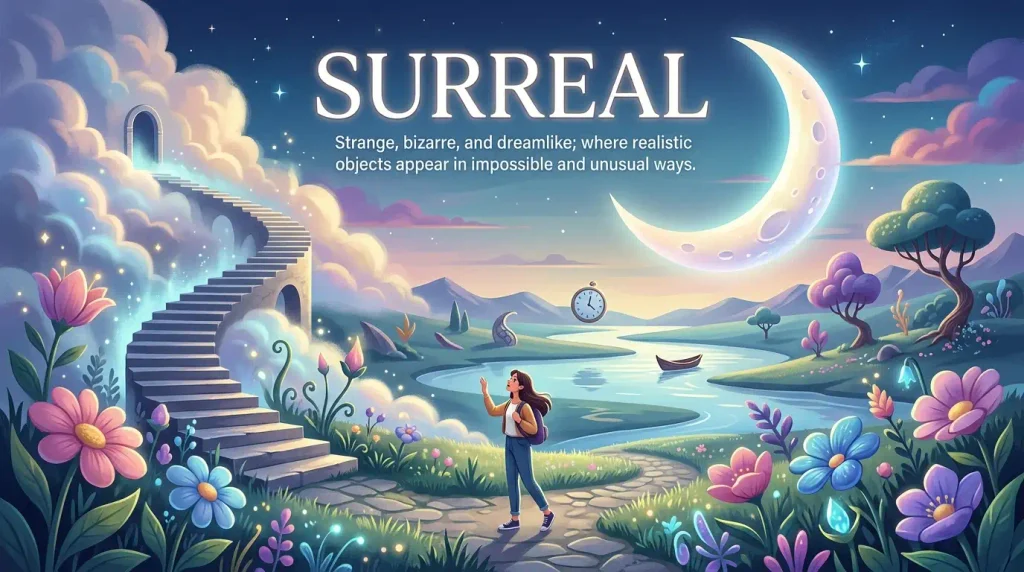
In simple English, surreal means something feels like a dream because it is so strange, unusual, or difficult to believe.
Imagine receiving an award you never expected to win. You are standing on a stage while hundreds of people applaud you. Everything is real, but you may still think, Is this really happening?
You could describe that feeling as surreal.
The word does not always mean something bad. In fact, it is often used for wonderful or exciting experiences.
For example:
“Getting my first book published was a surreal moment.”
This means publishing the book felt incredibly special and almost impossible to believe.
It can also describe something uncomfortable or strange:
“It was surreal walking through the empty city after the storm.”
Here, the empty streets created an unusual scene that felt unlike normal life.
So, the central idea behind surreal is a gap between what is happening in reality and how unusual or dreamlike it feels.
What Does Surreal Mean in Everyday Conversation?

In everyday conversation, people often use surreal to describe a moment that feels too unusual, emotional, exciting, or strange to fully process.
You might hear someone say:
“It still feels surreal.”
This usually means, “I know this is really happening, but it does not feel real to me yet.”
For example, a person may say this after getting married, moving to another country, meeting a famous person, graduating from college, buying their first home, or reaching an important career goal.
The word can also describe strange surroundings.
“The hotel looked surreal at night.”
That might mean the hotel looked so unusual or dreamlike that it did not seem like an ordinary place.
Here are several common situations where surreal fits naturally:
| Situation | Example |
| Major achievement | “Winning the award felt surreal.” |
| Unexpected event | “Seeing snow here was surreal.” |
| Emotional moment | “Hearing everyone sing was surreal.” |
| Strange setting | “The empty streets looked surreal.” |
| Dreamlike image | “The painting has a surreal quality.” |
| Difficult-to-believe experience | “It was surreal meeting her in person.” |
The meaning changes slightly with the context, but the basic idea remains the same: something feels unusually unreal or dreamlike.
Surreal as an Adjective
Surreal is an adjective, which means it is used to describe a person, thing, place, event, feeling, or experience.
You can place it before a noun:
“It was a surreal experience.”
You can also use it after a linking verb:
“The experience was surreal.”
Both sentences are grammatically correct.
Common combinations include:
- surreal experience
- surreal moment
- surreal feeling
- surreal scene
- surreal atmosphere
- surreal situation
- surreal image
- surreal dream
- surreal world
- surreal experience
The phrase “surreal experience” is especially common because unusual events often create the feeling that reality has temporarily become strange.
Surreal Meaning in a Sentence
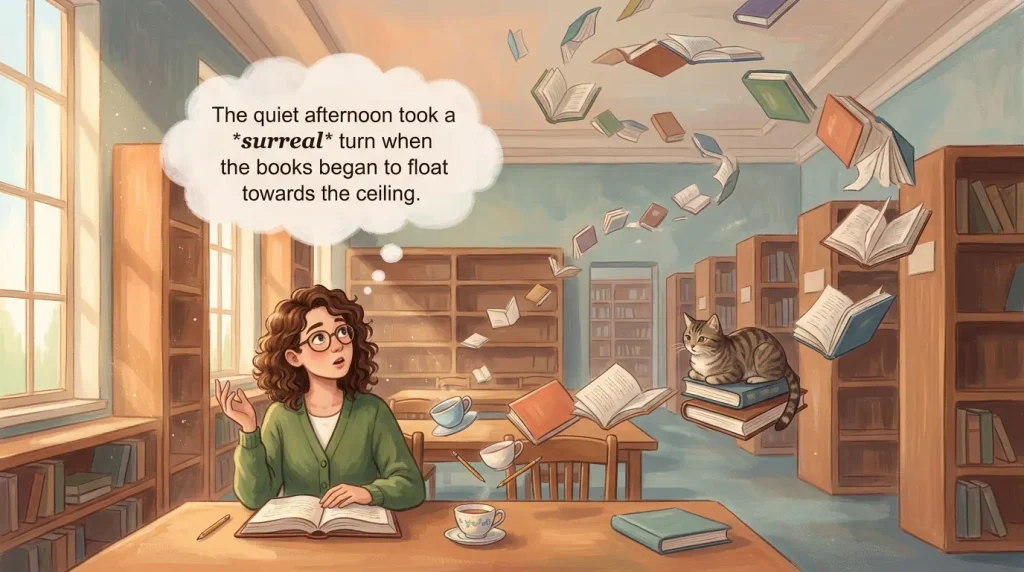
Understanding the word through real sentences is often easier than memorizing a dictionary definition.
“Watching my favorite team win the championship was surreal.”
The person was so excited that the event felt almost unreal.
“The mountain view looked surreal in the morning fog.”
The scene looked unusually beautiful or dreamlike.
“It felt surreal to return to my childhood home after twenty years.”
The familiar place may have created a strange mix of memories and present reality.
“Getting a message from someone I had admired for years was surreal.”
The unexpected contact felt difficult to believe.
“The silence inside the normally busy airport was surreal.”
The unusual silence made the familiar place feel strange.
Notice that surreal does not mean exactly the same thing in every sentence. Sometimes it focuses on excitement, sometimes beauty, and sometimes an unsettling feeling.
Surreal vs. Unreal: What Is the Difference?
Surreal and unreal are related, but they are not always interchangeable.
Unreal can mean something is not real or does not actually exist.
“The creature in the movie is unreal.”
It can also be used informally to mean extremely impressive:
“That concert was unreal!”
Surreal, however, usually describes something that is real but feels strange, dreamlike, or difficult to process.
| Word | Main idea | Example |
| Unreal | Not real or extremely impressive | “The special effects looked unreal.” |
| Surreal | Real but strangely dreamlike | “Seeing the finished building felt surreal.” |
A useful way to remember the difference is:
Unreal = not real.
Surreal = real, but it feels unreal or dreamlike.
This distinction is important because calling a real event “surreal” does not mean you believe it actually happened in a dream.
Surreal vs. Weird, Strange, and Bizarre
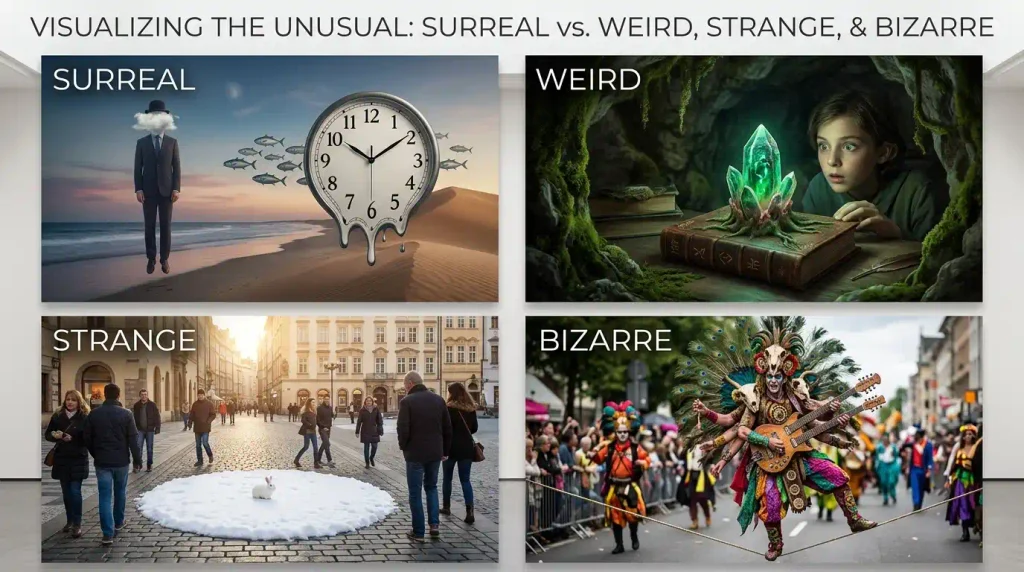
Several words can describe unusual things, but they carry different shades of meaning.
Weird is common and informal. It simply means unusual or strange.
“That was a weird conversation.”
Strange is broader and can be neutral, negative, or curious.
“There was a strange sound outside.”
Bizarre usually suggests something very unusual or unexpected.
“The story took a bizarre turn.”
Surreal often adds a feeling that the situation is dreamlike or difficult to believe.
“The whole conversation felt surreal.”
Here is a simple comparison:
| Word | Main feeling | Typical use |
| Weird | Unusual | Everyday situations |
| Strange | Different from normal | General description |
| Bizarre | Extremely unusual | Odd or shocking events |
| Surreal | Dreamlike or unreal-feeling | Emotional or extraordinary moments |
So, if you want to describe something as strange and dreamlike, “surreal” is often the strongest choice.
Surreal Synonyms
The best synonym depends on what you are trying to say.
Some useful synonyms and related expressions include:
- dreamlike
- unreal
- otherworldly
- strange
- bizarre
- unusual
- extraordinary
- fantastic
- incredible
- mysterious
- uncanny
- dreamlike
- fantastical
However, these words are not perfect replacements in every sentence.
For example, dreamlike is close to surreal when describing an unusual visual scene:
“The landscape looked dreamlike.”
Unusual is much broader:
“It was an unusual experience.”
Bizarre usually sounds stronger and stranger:
“The situation was bizarre.”
Otherworldly can suggest something that seems beyond ordinary human experience:
“The landscape had an otherworldly beauty.”
Therefore, choose the synonym based on the exact feeling you want to express.
Surreal Antonyms
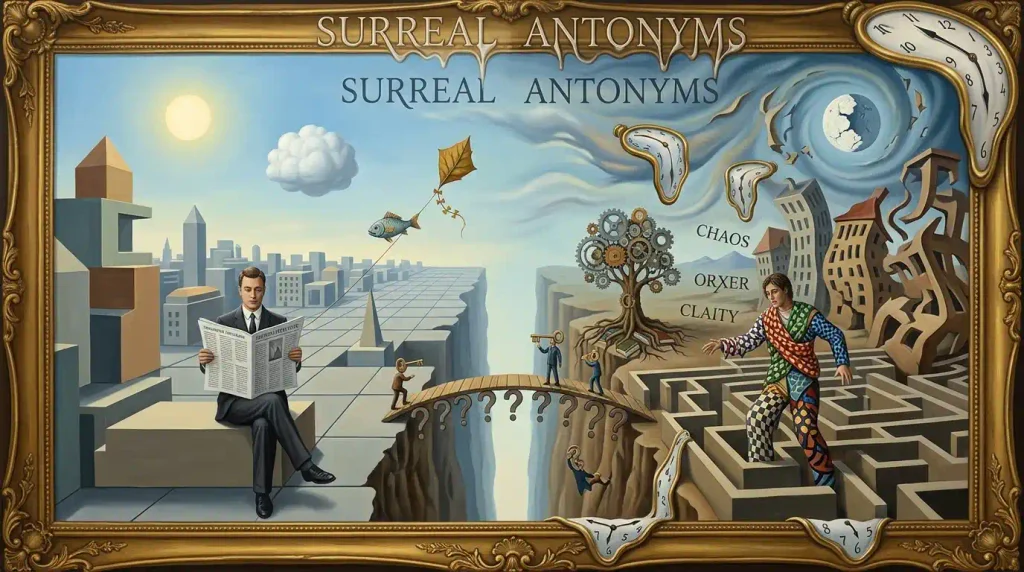
An antonym is a word with an opposite or contrasting meaning.
Possible opposites of surreal include:
- realistic
- ordinary
- normal
- familiar
- natural
- believable
- typical
- practical
- conventional
For example:
“The scene looked surreal.”
A contrasting sentence could be:
“The scene looked completely ordinary.”
Another example:
“The experience felt surreal.”
Compared with:
“The experience felt normal and familiar.”
There is not always one perfect opposite because surreal can describe different kinds of unusual feelings.
Where Did the Word Surreal Come From?
The word surreal has a connection to the French word surréaliste, which relates to Surrealism, an artistic and literary movement that developed in the early 20th century.
Surrealism became especially influential in Europe during the 1920s. Artists and writers explored dreams, imagination, unexpected combinations, and ideas that moved beyond ordinary logical reality.
The movement is strongly associated with artists such as Salvador Dalí, whose unusual paintings often combine realistic objects with dreamlike scenes.
Over time, the broader English word surreal moved beyond art criticism. Today, ordinary speakers use it to describe real-life experiences that seem dreamlike or difficult to believe.
This history helps explain why the modern word still carries a connection to dreams, unusual images, imagination, and reality that seems strangely altered.
What Does Surreal Mean in Art?
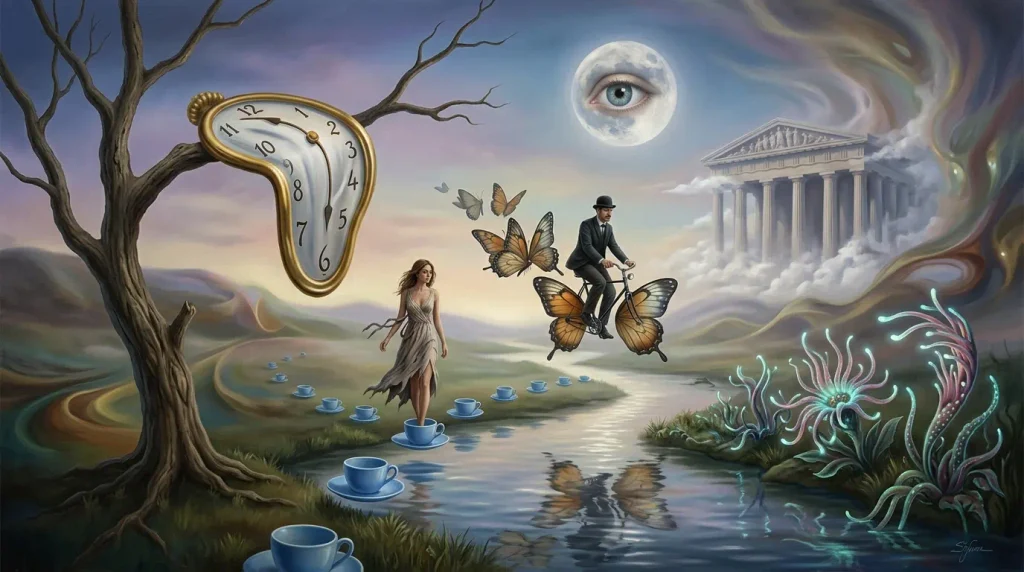
In art, surreal can have a more specific meaning.
A surreal artwork may place familiar objects into impossible, strange, or dreamlike situations. Objects may appear in unusual locations, change shape, or interact in ways that would not happen in everyday life.
For example, an artwork might show:
- A clock melting over a tree branch
- A person walking through a sky-filled room
- A fish floating through a city street
- A giant object placed in an ordinary landscape
These images can feel confusing but meaningful.
This is closely connected to Surrealism, the artistic movement that explored dreams, imagination, and unexpected ideas.
In everyday speech, however, you do not need to be talking about art to use the word surreal.
What Does Surreal Mean on Social Media?
On social media, surreal is often used as a short reaction to an exciting, emotional, unexpected, or unusual moment.
For example, someone might post a photo from a graduation ceremony with the caption:
“This feels surreal.”
They are saying that reaching graduation feels so significant that it has not fully sunk in yet.
People may use the word when sharing:
- Graduation photos
- Wedding moments
- Concert experiences
- Travel memories
- Career achievements
- Celebrity meetings
- Major personal milestones
- Unexpected reunions
In these situations, surreal often means “I know this is real, but it is hard to believe that it is happening to me.”
Is Surreal a Positive or Negative Word?
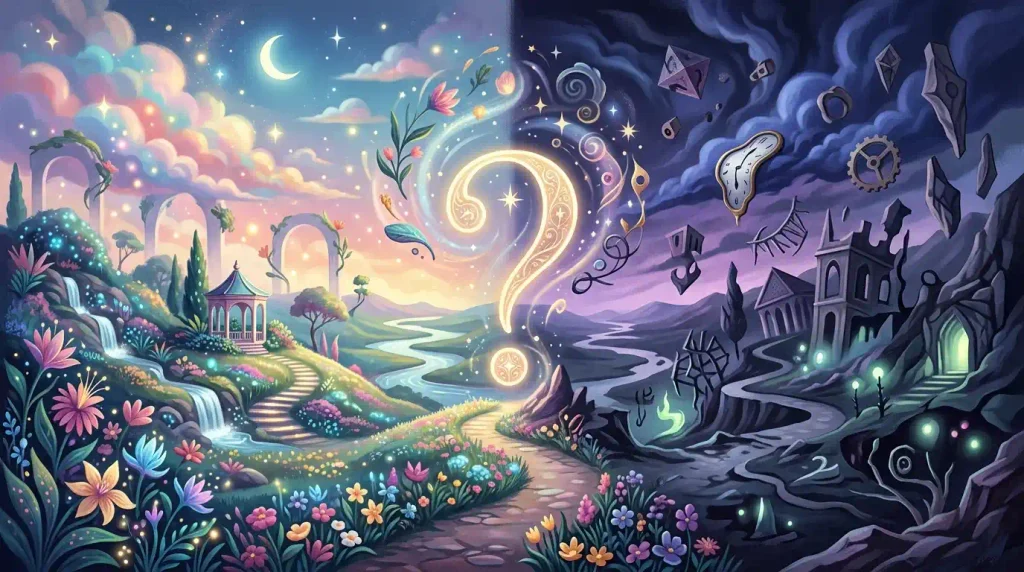
Surreal can be positive, negative, or neutral.
It depends on the situation.
A positive example is:
“Standing on the stage with my family was surreal.”
The speaker feels amazed and emotional.
A negative example is:
“Walking through the damaged neighborhood was surreal.”
The speaker may feel shocked, uncomfortable, or confused.
A neutral example is:
“The empty school looked surreal during the summer break.”
The unusual appearance creates a dreamlike feeling without being clearly good or bad.
So you should not assume that surreal always means beautiful or positive. The surrounding words and context tell you how the speaker feels.
Common Mistakes When Using Surreal
One common mistake is using surreal simply as a fancy replacement for “good” or “amazing.”
For example:
“The pizza was surreal.”
This could sound odd unless the pizza created an unusually strange or dreamlike experience.
Another mistake is assuming that surreal means fake.
If someone says:
“The moment felt surreal,”
they usually accept that the moment was real. They are describing their emotional reaction to it.
A third mistake is using “surreal” for every strange situation. If something is simply unusual, strange, weird, or unusual may be clearer.
Good writing depends on choosing the word that matches the exact idea.
How to Use Surreal Correctly
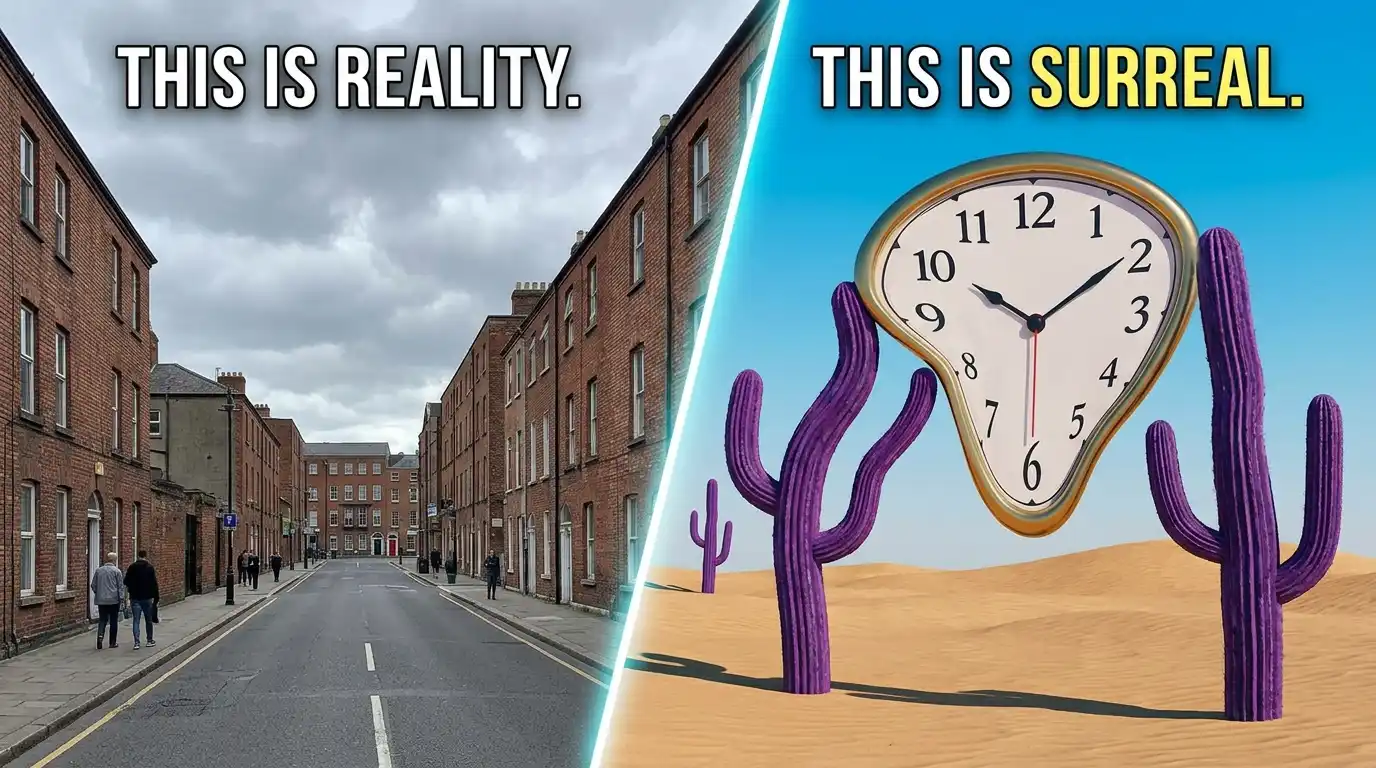
A simple way to use surreal correctly is to ask yourself:
Does this real situation feel unusually strange, dreamlike, extraordinary, or difficult to believe?
If the answer is yes, “surreal” may be a natural choice.
Compare these examples:
“I saw a dog at the park.”
This is ordinary, so surreal does not fit.
“I saw a dog calmly sitting at a piano in the middle of a crowded shopping mall.”
That unusual scene might reasonably be described as surreal.
Another example:
“I graduated from college.”
This is a normal statement.
“Walking across the stage and hearing my name announced after years of studying felt surreal.”
Here, surreal describes the emotional experience.
Surreal in American English
Surreal is common in American English and is widely understood in everyday speech and writing.
Americans may use it in conversations about personal achievements, entertainment, travel, sports, news, art, and emotional experiences.
For example:
“It was surreal seeing my name on the big screen.”
“The whole weekend felt surreal.”
“Being back in that city after so many years was surreal.”
The pronunciation is commonly written as suh-REEL, with the main stress on the second syllable.
The adjective can also form related words:
Surreally is an adverb, although it is less common in everyday speech.
“The buildings were surreally bright against the dark sky.”
Surrealism refers to the artistic and literary movement.
Surrealists can describe a person, style, or work connected to Surrealism.
Why Do People Say “It Feels Surreal”?
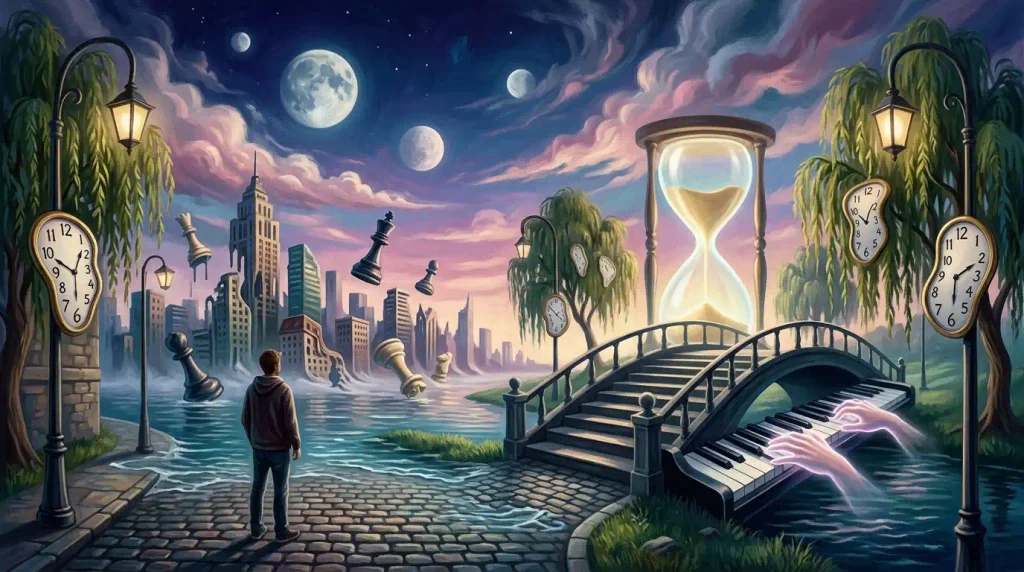
The expression “it feels surreal” is popular because it captures a specific emotional experience.
Sometimes an event is so important that your mind needs time to catch up with reality.
Imagine working toward a goal for ten years and finally achieving it. You know exactly what happened, but the emotional impact may make the moment feel almost dreamlike.
That is why people often say:
“It feels surreal.”
They are not necessarily confused about reality. Instead, they are expressing amazement, disbelief, emotional overload, or a sense that the moment is much bigger than an ordinary day.
This phrase is especially common after major life events.
Surreal Meaning in Different Contexts
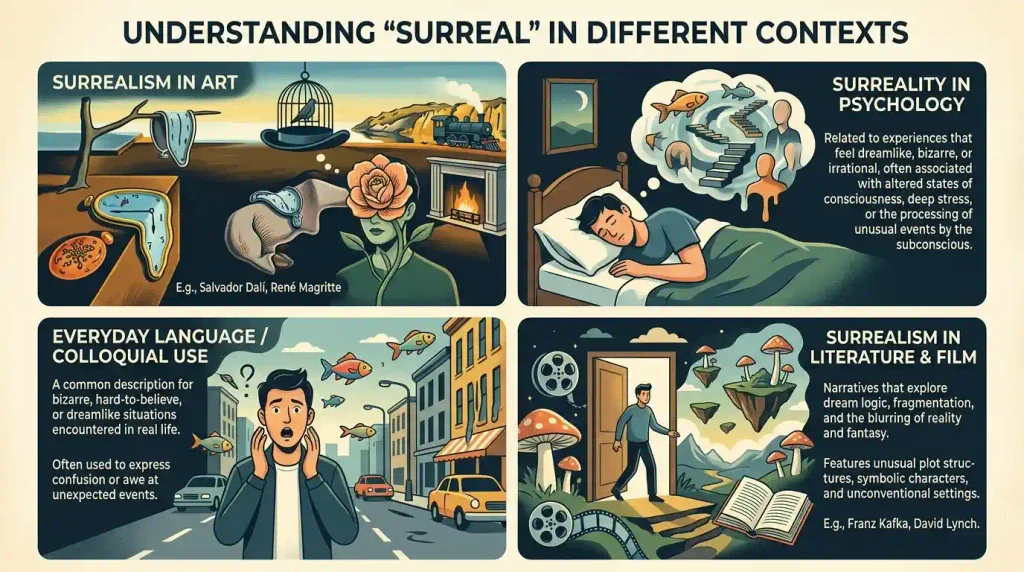
The meaning can shift slightly depending on where the word appears.
In daily conversation, surreal often means an unusual experience that feels hard to believe.
In art, it can describe dreamlike imagery influenced by Surrealism.
Social media, it often expresses amazement after a major personal event.
In literature, it may describe scenes that mix ordinary reality with strange or impossible elements.
In film and photography, it can describe visual scenes that feel dreamlike, unnatural, or disconnected from everyday life.
The common thread is always the same: normal reality is being presented or experienced in an unusual, dreamlike way.
Frequently Asked Questions
What does surreal mean in simple words?
Surreal means strange, dreamlike, or unreal-feeling. It usually describes something that is real but feels so unusual or extraordinary that it seems like a dream.
Does surreal mean fake?
No. Surreal does not necessarily mean fake. A real event can feel surreal when it is unexpected, extraordinary, emotional, or difficult to believe.
What is an example of surrealism?
An example is watching your favorite musician perform live after years of listening to their music and thinking, “This feels surreal.” The event is real, but it feels almost like a dream.
Is surreal positive or negative?
Surreal can be positive, negative, or neutral. It can describe an amazing achievement, a frightening situation, or simply a strange and unusual scene.
What is the difference between surreal and weird?
Weird simply means unusual or strange. Surreal often suggests something that feels dreamlike or strangely disconnected from normal reality.
What is a synonym for surreal?
Common related words include dreamlike, unreal, bizarre, strange, unusual, otherworldly, and uncanny. The best choice depends on the context.
Conclusion:
The easiest way to remember surreal meaning is this: surreal describes something that is real but feels strangely unreal, dreamlike, or difficult to believe.
You can use the word for an extraordinary personal moment, a strange scene, a beautiful landscape, an emotional experience, or artwork inspired by dreams and imagination.
In everyday American English, phrases such as “It felt surreal” and “That was surreal” are natural ways to express amazement or disbelief.
When using the word, focus on the feeling behind the situation. If something is merely unusual, “strange” may be enough. If it feels like reality has briefly turned into a dream, surreal is a much better fit.

Hi, I’m Benjamin Dreyer. I enjoy exploring words, phrases, slang, abbreviations, acronyms, and digital communication. At Linkquorax.com, I share simple and accurate explanations to help readers understand unfamiliar terms and popular internet expressions. My goal is to make every meaning clear, useful, and easy to understand. Whether you are curious about a new word or an online phrase, Linkquorax.com provides straightforward information to help you learn quickly and communicate with confidence in everyday conversations.