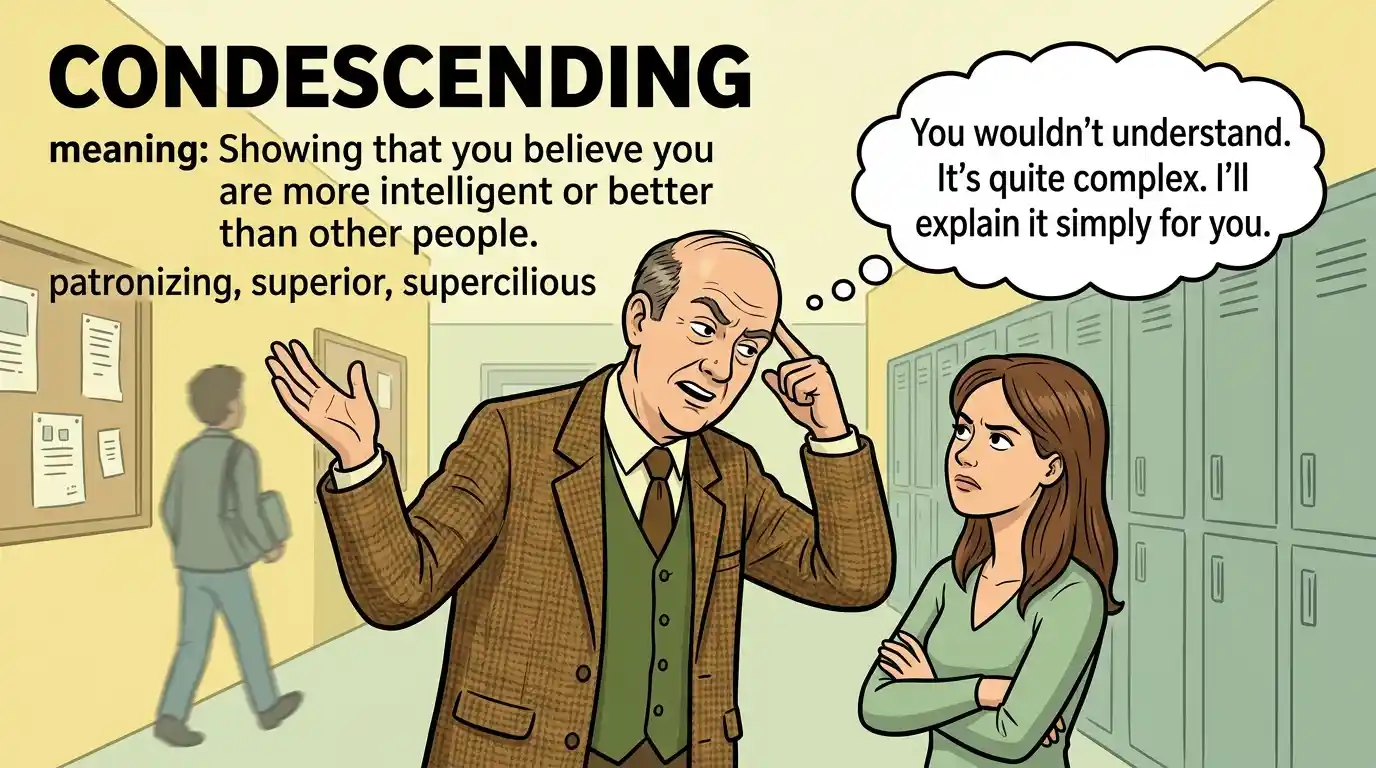
Have you ever talked to someone who explained something to you in a way that made you feel like a child? Maybe they used a slow, overly simple tone, rolled their eyes when you asked a question, or acted as if your opinion did not matter. That behavior may be described as condescending.
People often search for the condescending meaning because the word appears in conversations, books, workplace discussions, social media posts, and everyday relationships.
It can be easy to confuse condescending with words such as arrogant, rude, patronizing, or disrespectful. Although these words are related, they do not always mean exactly the same thing.
This guide explains the meaning of condescending in simple English. You will learn how to recognize it, how to use it correctly, what examples look like, how it differs from similar words, and how to respond when someone speaks to you in a condescending way.
Quick Answer
Condescending means behaving or speaking as though you are more important, intelligent, experienced, or capable than another person.
For example, if an experienced employee says to a new worker, “Let me explain this very simple task to you because I know you probably won’t understand it,” the tone may be condescending.
The word is usually negative or disapproving. Cambridge Dictionary defines condescending as treating someone as though you are more important or intelligent than them.
Here is a quick overview:
| Word | Simple meaning | Example |
| Condescending | Acting as if you are better or smarter | “He gave me a condescending smile.” |
| Arrogant | Having an exaggerated sense of your own importance | “She is too arrogant to admit a mistake.” |
| Rude | Not showing good manners | “That was a rude comment.” |
| Patronizing | Acting as if you are helping someone who is beneath you | “His patronizing tone annoyed everyone.” |
| Disrespectful | Showing a lack of respect | “His disrespectful behavior hurt her feelings.” |
A person does not have to openly insult someone to sound condescending. Sometimes the attitude, tone, facial expression, or choice of words creates the feeling.
Condescending Meaning and Definition
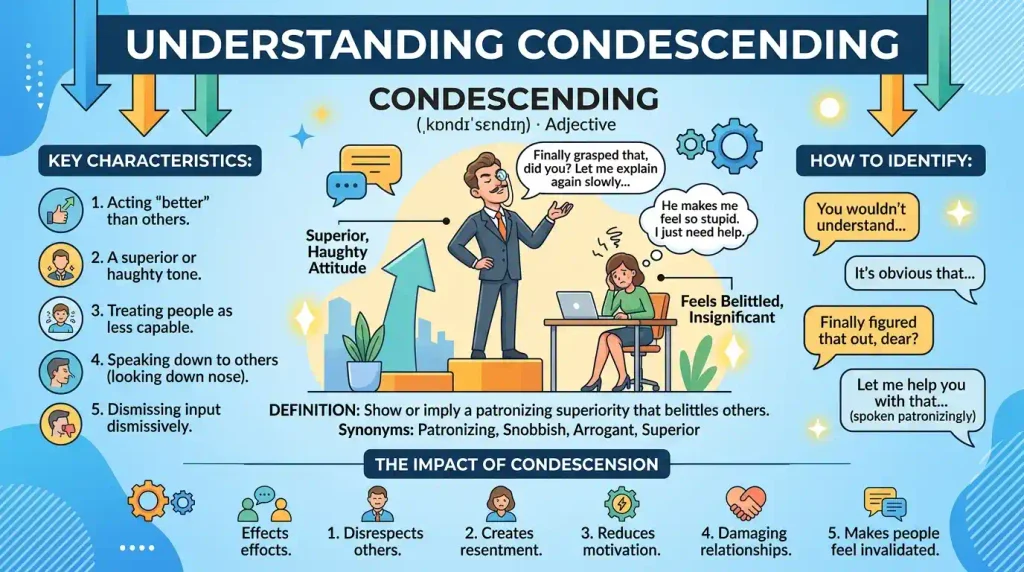
The adjective condescending is used to describe a person, comment, voice, attitude, smile, or behavior that suggests superiority.
In simple terms, it can mean:
“I think I am above you, so I will talk to you as if you are less capable or less intelligent.”
For example:
“Don’t use that condescending tone with me.”
This means:
“Don’t speak to me as if you are smarter or better than me.”
Another example is:
“She gave him a condescending look.”
This suggests that her facial expression showed that she thought she was superior to him.
The important idea is superiority. A condescending person may believe they know more, understand more, have more experience, or deserve more respect than the person they are talking to.
Condescending behavior can happen between coworkers, friends, family members, teachers and students, managers and employees, or even strangers.
It is also important to remember that a person can sound condescending without intending to be. Tone is affected by the situation, relationship, culture, and personal communication style. Therefore, one sentence alone does not always prove that someone is being condescending.
What Does Condescending Mean in Simple English?
A very simple way to understand condescending is:
Talking down to someone.
When someone “talks down” to another person, they speak as if the other person is not smart enough, experienced enough, or important enough to be treated as an equal.
Imagine an adult explaining how to use a spoon to another adult who clearly knows how to use one. The explanation may feel unnecessary and insulting because it suggests the listener cannot understand a very basic task.
For example:
“You just put the paper in the printer. It’s really easy. Even you should be able to do it.”
The problem is not the information itself. The problem is the attitude behind the words.
A helpful explanation could be:
“If you haven’t used this printer before, I can show you how it works.”
That version gives assistance without making the other person feel inferior.
This difference is useful because being helpful is not the same as being condescending.
Signs of Condescending Behavior
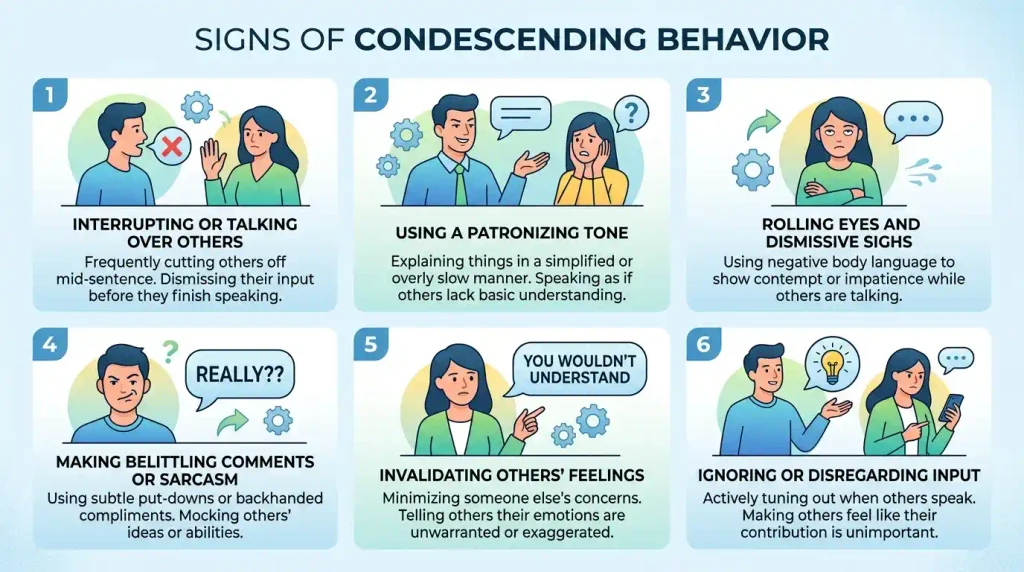
Condescending behavior can appear in many forms. It is not always obvious because some people use polite words while still communicating a sense of superiority.
One common sign is an overly simple explanation. Someone may explain something you already understand as if you have no knowledge of the subject.
Another sign is an exaggerated tone of voice. A person might speak unusually slowly, use a childish tone, or emphasize basic words in a way that makes the listener feel small.
A third sign is dismissing someone’s ideas. For example, saying, “You’ll understand when you’re older,” avoids discussing the person’s actual point.
Some people also use phrases such as “Obviously,” “It’s not that hard,” or “Let me make this simple for you.” These expressions are not automatically condescending, but they can sound that way depending on the situation and tone.
Other possible signs include:
- Interrupting someone repeatedly.
- Rolling the eyes during a conversation.
- Smiling in a way that suggests superiority.
- Giving unwanted lessons instead of listening.
- Treating another person’s question as foolish.
- Acting surprised that someone knows something.
- Using a fake or exaggerated polite tone.
- Correcting small mistakes mainly to show superiority.
- Ignoring someone’s experience or knowledge.
The key is the overall message: “I am above you.”
Condescending Examples in Everyday Life
Real-life examples make the word easier to understand.
Imagine a coworker asks a simple question about a new computer program. Instead of answering normally, another employee says:
“Wow, you really don’t know how to do that? Okay, let me explain it to you slowly.”
The words may contain useful information, but the tone is insulting. That is a possible example of condescending behavior.
Another example:
“Aw, that’s cute. You actually think that will work?”
The speaker is not seriously considering the other person’s idea. They are making the person feel foolish.
A teacher might also sound condescending by saying:
“This is very basic. I’m surprised you don’t understand it.”
A more respectful version would be:
“Let’s go over the basic idea again and see which part is confusing.”
In a workplace, a manager might say:
“Let me handle this. This is probably too complicated for you.”
A respectful alternative would be:
“I’ve handled this type of issue before. Would you like me to take the lead?”
The difference is important. The respectful version focuses on the task. The condescending version puts the other person down.
Condescending Meaning in a Sentence
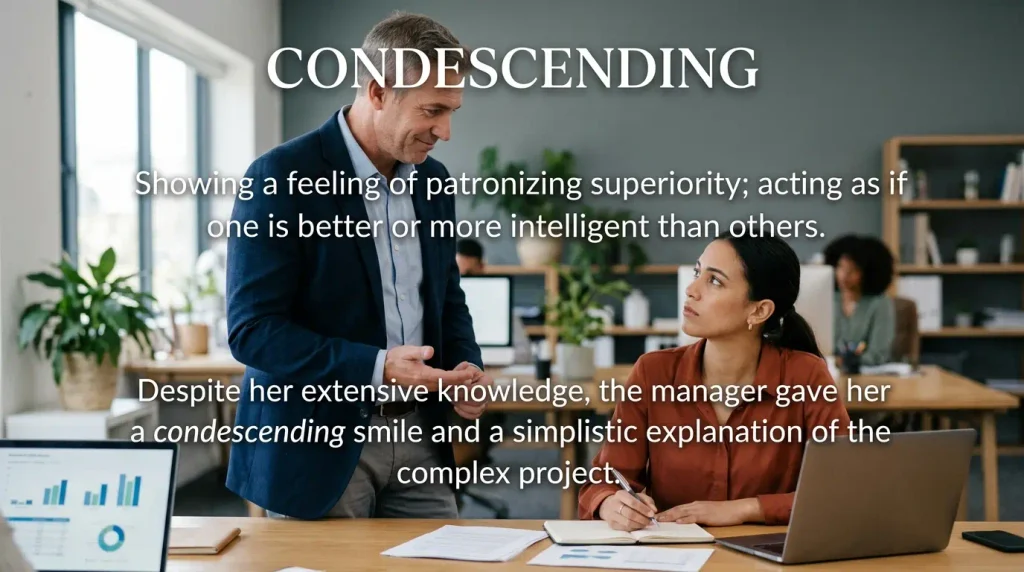
The word condescending is an adjective, so it normally describes a person, action, attitude, tone, expression, comment, or style of communication.
Here are natural examples:
“His condescending tone made the meeting uncomfortable.”
“She gave me a condescending smile when I asked a question.”
“I don’t like the way he talks to people in such a condescending manner.”
“Her response sounded condescending, even though she may not have meant it that way.”
“The customer complained about the employee’s condescending attitude.”
“He wasn’t trying to be helpful; his explanation sounded condescending.”
“The coach’s condescending comments made the players lose confidence.”
“Please don’t be condescending. I understand what you’re saying.”
These examples show that condescending often describes the way something is communicated rather than only the information being communicated.
How to Use “Condescending” Correctly
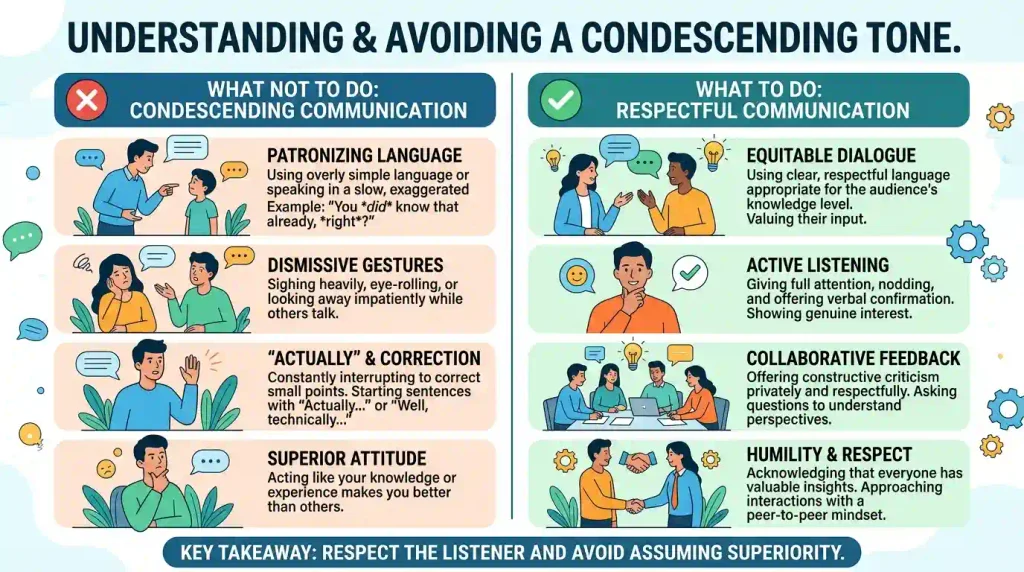
The most common grammatical use is:
condescending + noun
For example:
“a condescending attitude”
“a condescending tone”
“a condescending comment”
“a condescending smile”
“a condescending person”
You can also use it after a linking verb:
“His tone was condescending.”
“She sounded condescending.”
“The manager seemed condescending.”
You can use condescendingly when you need an adverb:
“He spoke condescendingly to the new employee.”
This means he spoke in a way that suggested he thought he was superior.
The related noun is condescension:
“Her condescension was obvious.”
This refers to the attitude or behavior of treating someone as inferior.
The verb is condescend. In modern American English, it can mean behaving as though you are superior to others. Cambridge also lists another use in which someone agrees to do something they consider beneath their social position.
| Form | Part of speech | Example |
| Condescending | Adjective | “His tone was condescending.” |
| Condescendingly | Adverb | “She spoke condescendingly.” |
| Condescension | Noun | “I disliked his condescension.” |
| Condescend | Verb | “He never condescends to his coworkers.” |
One useful point is that condescending is the form people commonly use when describing someone’s behavior or tone.
Condescending vs. Arrogant

Condescending and arrogant are closely related, but they focus on different things.
Arrogant usually describes someone who has an inflated opinion of themselves. They may believe they are better, smarter, or more important than others.
Condescending focuses more on how that sense of superiority is directed toward another person.
For example:
“He is arrogant.”
This tells us something about his attitude toward himself.
“He is condescending to his employees.”
This tells us how he treats other people.
A person can be arrogant without directly speaking down to anyone. A person can also make one condescending comment without being generally arrogant.
Condescending vs. Patronizing
Patronizing is probably one of the closest words to condescending.
Both can describe behavior that treats someone as though they are less important, capable, or intelligent.
For example:
“Don’t use that patronizing tone.”
“Don’t use that condescending tone.”
In many everyday situations, these sentences have almost the same meaning.
However, patronizing can sometimes carry the idea of pretending to be helpful or kind while actually treating someone as inferior. Cambridge lists patronizing among the related words for condescending.
Condescending vs. Rude
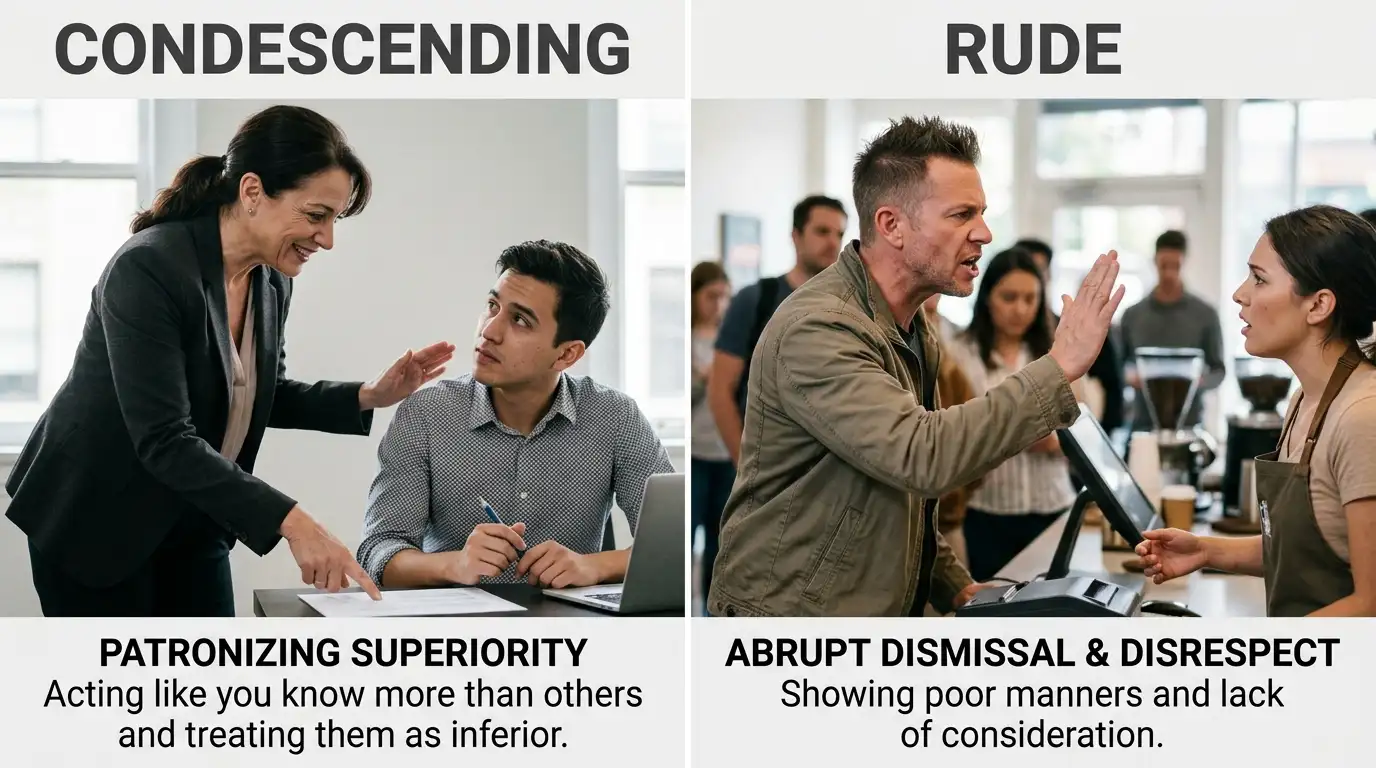
Not every rude person is condescending.
Rude means lacking politeness or good manners.
Condescending means showing or suggesting superiority toward another person.
For example:
“Go away. I don’t want to talk to you.”
This is rude, but it is not necessarily condescending.
“Don’t worry about it. You probably wouldn’t understand anyway.”
This can be both rude and condescending because the speaker suggests that the other person is not intelligent enough to understand.
This distinction helps you choose the right word.
Condescending vs. Condescension
These two words come from the same family.
Condescending is an adjective.
Example:
“His condescending attitude annoyed me.”
Condescension is a noun.
Example:
“I couldn’t stand his condescension.”
The first describes the attitude. The second names the behavior or attitude itself.
There is also condescend, which is the verb.
Example:
“He never condescends to his coworkers.”
The related adverb is condescendingly.
Example:
“She spoke condescendingly to the customer.”
Understanding these forms makes it easier to use the word correctly in writing and conversation.
Where Did the Word “Condescending” Come From?
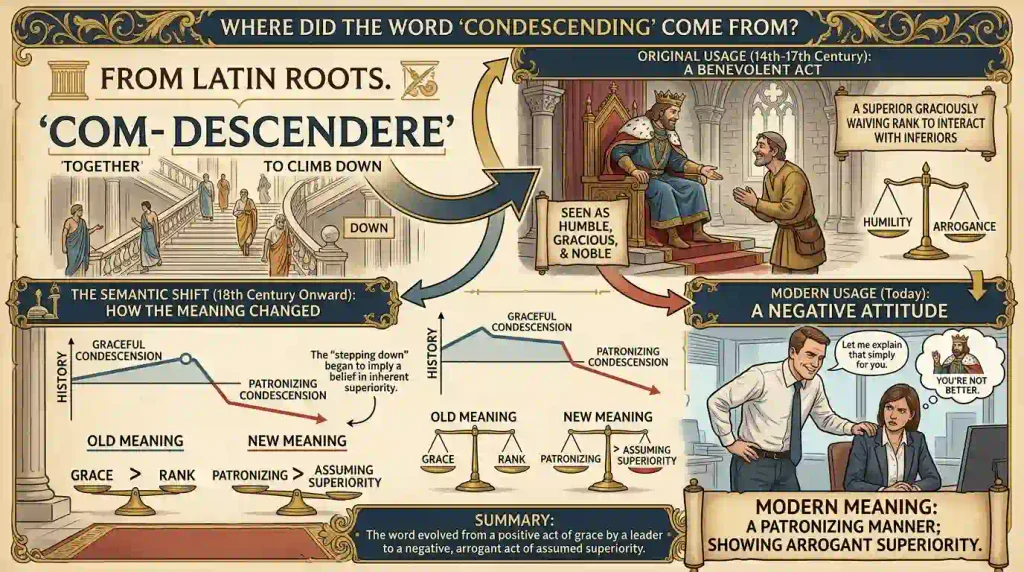
The history of condescending is interesting because the word did not always have its modern negative meaning.
The verb condescend comes from Medieval Latin condescendere, meaning roughly “to let oneself down” or “stoop.” It entered English in the Middle English period. Etymological sources trace it through Old French and Late Latin, with the Latin parts connected to the ideas of “with” and “descend.”
In earlier English, condescending could have a more positive meaning. It could describe someone of high rank willingly lowering formal barriers and showing kindness or consideration toward people of lower rank.
Over time, the word developed a negative sense. The modern use focuses on someone appearing to treat others as inferior. Etymonline notes that the negative sense developed from the idea of a person merely showing or assuming an attitude of superiority.
The adjective condescending is recorded from the early 18th century, while its modern negative use became established later.
This history explains why the word can sometimes seem confusing. Its older meaning was not always negative, while its common modern meaning usually is.
Is “Condescending” Always an Insult?
Usually, condescending is a negative or disapproving word. Cambridge labels the adjective as disapproving.
However, calling something condescending does not necessarily mean the speaker intended to insult someone.
For example, a manager might say:
“Let me explain this process to you.”
That sentence is not automatically condescending.
But if the manager says it with an exaggerated tone and adds:
“It’s really simple, so I’m sure you’ll understand it.”
the message may feel very different.
This is why context matters.
A person may also sound condescending by accident. Someone with years of experience might forget that a beginner has never seen a certain process before. They may use simple language because they are trying to help, not because they think the other person is inconsiderate.
Instead of judging only one sentence, consider the person’s tone, wording, facial expression, and behavior during the whole conversation.
How to Respond to Someone Who Is Condescending
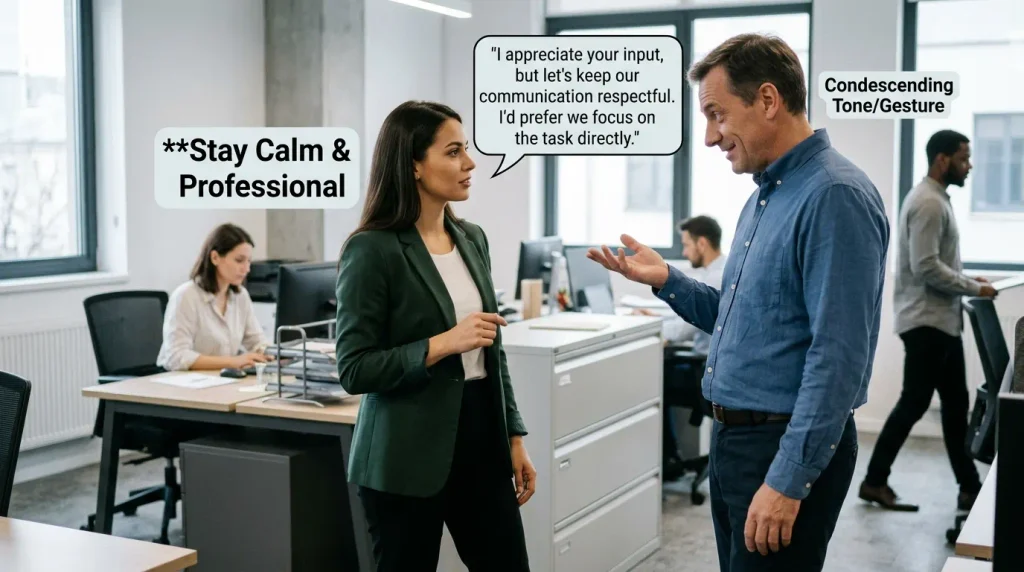
When someone speaks to you in a condescending way, you do not always need to respond aggressively.
A calm answer can make your point clearly.
You could say:
“I understand the explanation. You don’t need to speak to me that way.”
Or:
“I’d appreciate it if you spoke to me as an equal.”
If you think the person may not realize how they sound, you can say:
“I’m sure you are trying to help, but your tone feels a little condescending.”
At work, a more professional response might be:
“I understand your point. Could we focus on the issue rather than how you think I should understand it?”
Sometimes the best response is simply to ask a direct question:
“What makes you think I don’t understand?”
This gives the other person a chance to explain their assumption.
The goal is not always to win the conversation. The goal is to protect respectful communication.
How to Avoid Sounding Condescending
You can explain something clearly without making another person feel small.
Start by assuming the other person is capable. If they ask a question, answer the question instead of judging why they asked it.
Instead of saying:
“You don’t know that?”
try:
“Sure, here’s how it works.”
Instead of:
“This is really easy.”
try:
“Here’s the basic process.”
Instead of:
“Let me make this simple for you.”
try:
“Would you like me to explain it another way?”
Instead of:
“Obviously, that’s wrong.”
try:
“I see it differently because…”
Small changes in language can make conversations much more respectful.
Listening is also important. A person may know more than you realize. Avoid assuming that someone is inexperienced simply because they ask a question.
Common Mistakes With “Condescending”
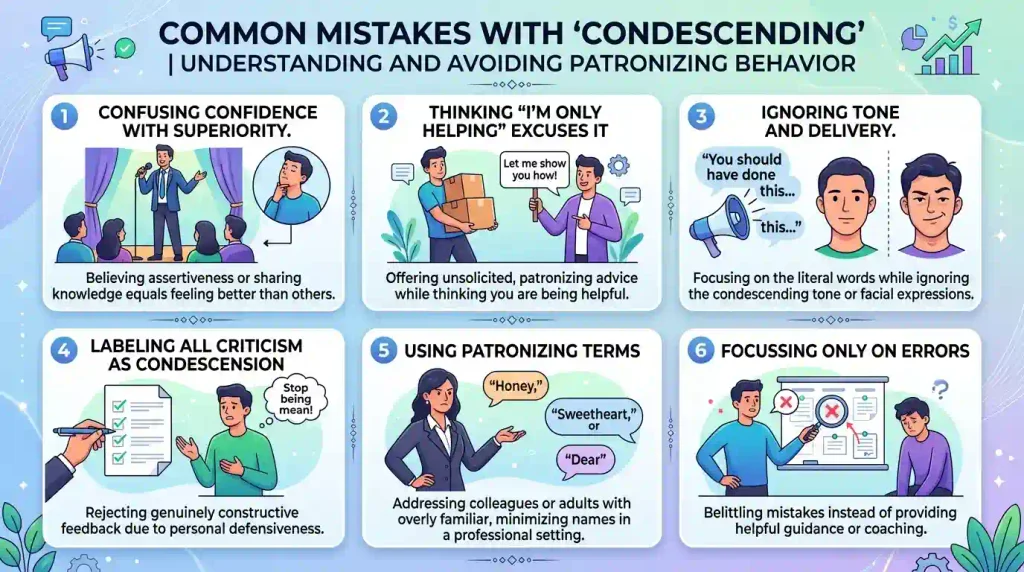
One common mistake is using condescending as a direct synonym for every kind of rude behavior.
A rude comment may be insulting without showing superiority. A condescending comment normally has an element of looking down on someone.
Another mistake is confusing condescending with condescension.
You would say:
“His tone was condescending.”
Not:
“His tone was condescension.”
You could say:
“His tone showed condescension.”
Another mistake is assuming that any simple explanation is condescending. It is not.
A simple explanation can be kind, useful, and respectful. It becomes condescending when the way it is delivered suggests that the listener is beneath the speaker.
Common Synonyms for Condescending
Several words can be used in similar situations, but each has a slightly different focus.
Patronizing is very close to condescending and often suggests fake kindness or a superior attitude.
Arrogant describes someone who thinks too highly of themselves.
Haughty describes an openly proud or superior attitude.
Snobbish often suggests looking down on people because of social status, taste, money, education, or background.
Supercilious describes a proud attitude that treats other people as inferior.
Overbearing focuses more on controlling or dominating behavior.
Dismissive means treating an idea, concern, or person as unimportant.
Rude is broader and simply means lacking politeness.
Cambridge includes several of these words among the related vocabulary for condescending.
| Synonym | Main idea | Simple example |
| Patronizing | Acting superior while seeming helpful | “Her patronizing advice annoyed him.” |
| Arrogant | Thinking too highly of yourself | “He is arrogant about his skills.” |
| Haughty | Proud and superior | “She gave him a haughty look.” |
| Snobbish | Looking down on others based on status or taste | “His snobbish behavior was obvious.” |
| Dismissive | Treating something as unimportant | “Her dismissive answer ended the discussion.” |
| Rude | Not polite | “His rude comment upset her.” |
Condescending in the Workplace

Condescending behavior can create problems at work because people need to communicate and cooperate.
For example, an experienced employee might constantly explain basic tasks to a coworker who already knows how to do them. Another employee might interrupt meetings and correct small details simply to show authority.
This can make coworkers feel ignored or disrespected.
A better workplace habit is to focus on the problem rather than the person’s intelligence.
Instead of:
“You clearly don’t understand how this works.”
say:
“Let’s review the process and see where the issue is.”
Instead of:
“I already explained this to you.”
say:
“I can go over that part again.”
Professional communication does not mean avoiding disagreement. You can strongly disagree with someone while still treating them as an equal.
Condescending in Relationships and Friendships
Condescending behavior can also appear between friends, partners, siblings, or family members.
For example, one person might constantly say:
“You wouldn’t understand.”
or:
“That’s cute, but you don’t know enough about this.”
Repeated comments like these can damage trust because the other person may begin to feel that their opinions are not valued.
Healthy communication allows people to disagree without treating one another as inferior.
If someone you care about sounds condescending, it can help to explain the effect of their words rather than attacking their personality.
For example:
“When you explain things that way, I feel like you think I’m not capable of understanding.”
This approach opens the door to a better conversation.
Is Condescending the Same as Talking Down to Someone?
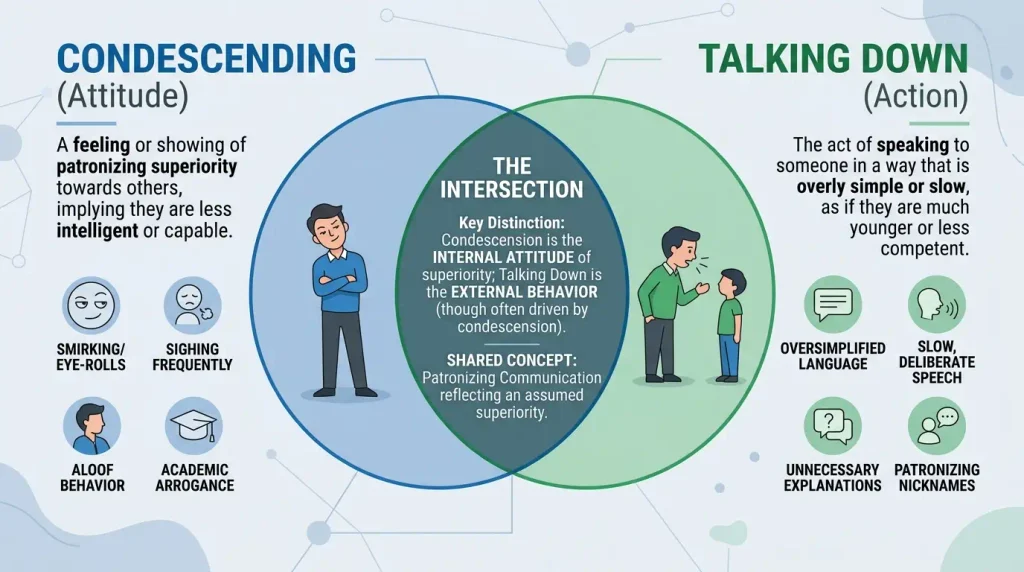
In everyday English, condescending and talking down to someone are very close.
If someone talks down to you, they speak as if they are smarter, more experienced, or more important than you.
For example:
“Don’t talk down to me.”
can mean:
“Don’t speak to me as if I am less intelligent or less important than you.”
The phrase talk down to is informal and common in conversation. Condescending is more useful when describing the behavior in writing.
For example:
“His manager spoke to him in a condescending way.”
This sounds more formal than:
“His manager talked down to him.”
Both can communicate a similar idea.
FAQs
What does condescending mean in simple words?
Condescending means treating someone as if you are smarter, better, more important, or more capable than they are. A condescending person may talk down to others or use a superior tone.
Is condescending a bad word?
Yes. In modern everyday English, condescending is usually negative or disapproving. It describes behavior that makes another person seem inferior. Cambridge also labels the adjective as disapproving.
What is an example of a condescending person?
A person who says, “Let me explain this very simple idea because you probably won’t understand it,” may be acting condescendingly. The problem is the suggestion that the other person is not intelligent enough to understand.
What is the difference between condescending and arrogant?
Arrogant usually describes an overly high opinion of yourself. Condescending focuses more on how you treat other people as though they are below you. Someone can be arrogant without directly talking down to another person.
Is condescending the same as patronizing?
They are very similar and are often used interchangeably. Both can describe treating someone as inferior. Patronizing can carry an extra sense of pretending to be helpful or kind while maintaining a superior attitude.
How do you pronounce condescending?
In American English, it is commonly pronounced roughly like “kon-duh-SEN-ding.” The stress falls on the “sen” sound. Cambridge gives the American pronunciation as /ˌkɑn.dəˈsen.dɪŋ/.
Conclusion
The condescending meaning is simple: it describes speaking or behaving toward someone as if you are better, smarter, more important, or more capable than they are. It often appears through a superior tone, unnecessary explanations, dismissive comments, or behavior that makes another person feel small.
Condescending and arrogant are related, but they are not identical. Arrogance is mainly about how highly someone thinks of themselves, while condescension is often seen in how they treat other people.
If you want to avoid sounding condescending, focus on respectful language, listen before explaining, and treat people as equals. If someone is condescending toward you, a calm and direct response can help set a boundary.
In short, condescending means talking down to someone or treating them as though they are beneath you. Understanding that difference can help you recognize the word and use it correctly in everyday English.

Hi, I’m Benjamin Dreyer. I enjoy exploring words, phrases, slang, abbreviations, acronyms, and digital communication. At Linkquorax.com, I share simple and accurate explanations to help readers understand unfamiliar terms and popular internet expressions. My goal is to make every meaning clear, useful, and easy to understand. Whether you are curious about a new word or an online phrase, Linkquorax.com provides straightforward information to help you learn quickly and communicate with confidence in everyday conversations.