Have you ever come across the word “smut” and wondered exactly what it means? You are not alone. Many people search for this word because they hear it in conversation, read it online, or see it used in a book review, and they want a clear, simple answer.
In short, “smut” usually means content that is rude, dirty, or sexual in a low or offensive way. But that is not the only meaning of this word, and understanding all of its uses can help you use it correctly and confidently.
In this article, we will break down the true meaning of “smut,” how it is used in everyday English, where the word came from, and how it differs from similar words. We will also look at common mistakes people make with this word and answer some frequently asked questions.
By the end, you will fully understand how and when to use “smut” the right way.
Quick Answer
“Smut” is a noun that mainly means indecent or obscene talk, writing, or pictures, especially those dealing with sex in a crude way. It can also mean a black, sooty mark or stain, or a type of plant disease that turns crops black.
The most common modern use, though, relates to obscene or sexual content, such as in books, magazines, or online stories.
Meaning or Definition
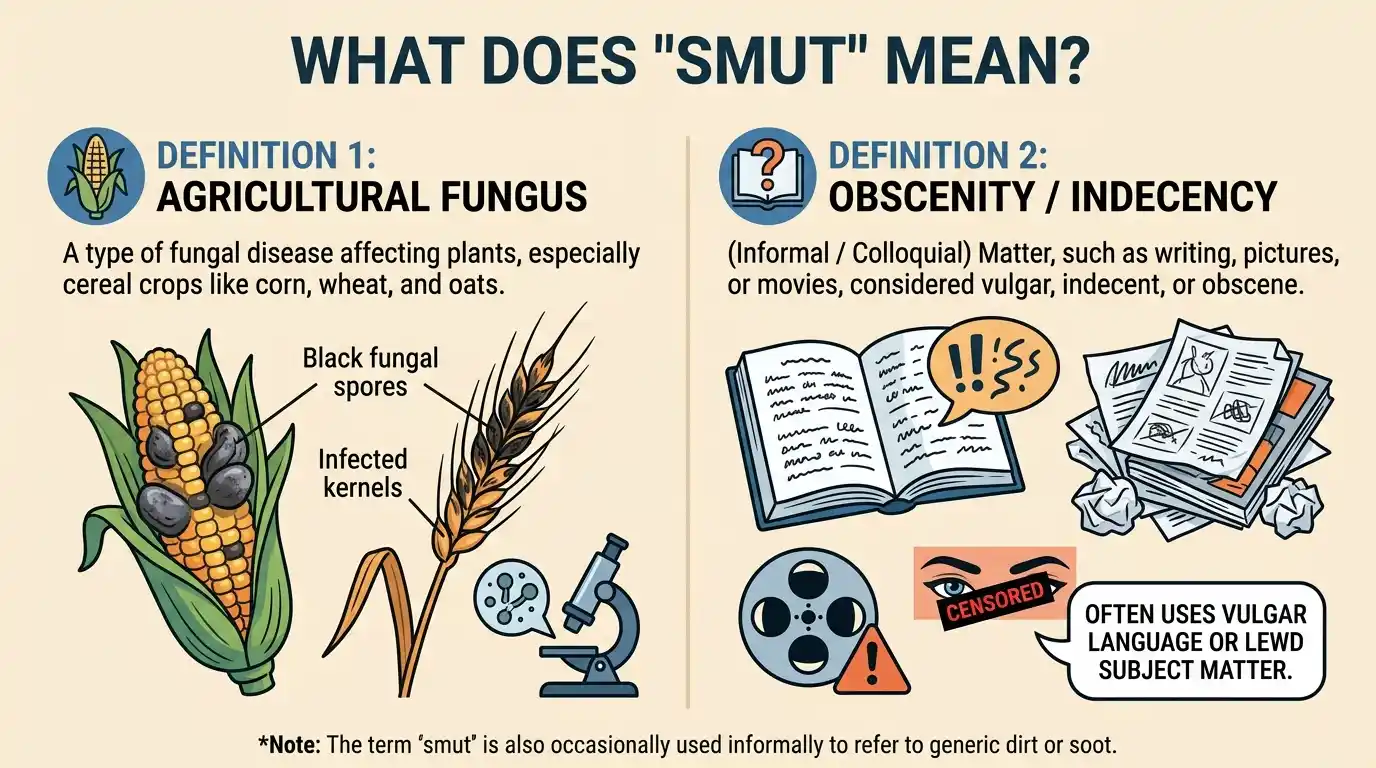
The word “smut” has three main meanings in English, and knowing all three helps you understand the word fully depending on where you see it.
The first and most common meaning is obscene or indecent material. This usually refers to writing, images, movies, or talk that focuses on sex in a crude or vulgar way, rather than a tasteful or artistic one. For example, someone might say, “That magazine is full of smut,” meaning it contains explicit or dirty content.
The second meaning is a small black mark or smudge, usually caused by soot, coal, or dirt. This is an older use of the word but still appears sometimes. For instance, “He wiped a smut of coal dust from his cheek.”
The third meaning is more technical and relates to farming. Smut is also the name of a fungal disease that affects crops like corn, wheat, and barley. This disease turns parts of the plant black and powdery, which is where the word’s connection to “black soot” comes from in the first place.
Here is a simple table to show these three meanings side by side.
| Meaning | Simple Explanation | Example Sentence |
| Obscene content | Rude or sexual writing, talk, or images | “The website was blocked for hosting smut.” |
| Black mark or soot | A small dirty smudge, often from coal or dirt | “There was a smut of ash on his shirt.” |
| Plant disease | A fungus that turns crops black and damaged | “Smut destroyed part of the corn harvest.” |
Most people today use “smut” to talk about obscene or sexual content, especially in books, fan fiction, or online writing communities. This is the meaning you are most likely to run into in daily conversation or on the internet.
Grammar or Correct Usage
“Smut” is a noun, and it is usually uncountable when talking about content in general. This means you typically do not say “a smut” or “many smuts” when referring to obscene material. Instead, you say things like “a lot of smut” or “some smut.”
However, when “smut” refers to a small black mark, it can be countable. In that case, you can say “a smut” or “several smuts of dirt” on a surface.
There is also an adjective form of the word, “smutty,” which means containing or related to smut. For example, “That joke was pretty smutty,” means the joke was rude or sexual in nature.
Here are a few correct usage examples to make this clearer.
- “The book was criticized for being full of smut.” (correct, uncountable)
- “His comedy show had a lot of smutty jokes.” (correct, adjective form)
- “There is a smut of dirt on the window.” (correct, countable, referring to a mark)
A common grammar mistake is treating “smut” as if it always needs “the” or an article before it, like “the smut,” when talking about it in general. In most cases, when speaking generally about obscene content, no article is needed.
Origin or History
The word “smut” has been part of the English language for centuries. It is believed to come from a Germanic root related to words meaning “dirt” or “grime,” similar to the German word “Schmutz,” which also means dirt or filth.
Originally, “smut” referred only to dirt, soot, or a black stain, which is why the plant disease got its name too, since it leaves crops looking blackened and dirty. Over time, especially by the 17th and 18th centuries, English speakers began using “smut” in a figurative sense to describe talk or writing that was seen as “dirty” in a moral sense, meaning indecent or obscene.
This shift from a literal meaning of dirt to a figurative meaning of obscenity is a common pattern in language. Many words that describe physical uncleanliness later get used to describe things that are seen as morally impure or inappropriate, and “smut” is a clear example of that pattern.
Common Mistakes
People often confuse “smut” with a few similar words, so it helps to understand the differences clearly.
Some readers mix up “smut” with “smog,” but these words are unrelated. “Smog” refers to polluted air, a mix of smoke and fog, while “smut” refers to dirt, disease, or obscene content.
Another common mix-up is between “smut” and “smear.” A “smear” is a mark made by rubbing something, and while it can sometimes overlap with the “dirt mark” meaning of smut, “smear” is also used to describe spreading false and damaging information about someone, which “smut” does not typically mean.
People also sometimes assume “smut” always refers to something illegal. This is not accurate. Smut usually means content that is crude, vulgar, or explicit, but it is not automatically against the law. Many countries allow adult content that could be labeled “smut,” as long as it follows local laws about consent and age restrictions.
Here is a table showing these words side by side to avoid confusion.
| Word | Main Meaning | Different From Smut Because |
| Smog | Polluted, hazy air | Refers to air pollution, not dirt or obscene content |
| Smear | A rubbed mark, or false accusations | Focuses on spreading or rubbing, not on obscenity |
| Smut | Obscene content, dirt, or plant disease | Broader meaning covering three different areas |
Real-Life Examples
Seeing the word used in real sentences can help make its meaning even clearer. Below are examples that show the different ways “smut” appears in everyday English.
In a conversation about books: “I like romance novels, but I try to avoid the ones that are mostly smut with no real story.”
With In a farming context: “The farmer noticed smut on several corn stalks and had to remove the infected plants.”
In casual conversation about jokes: “Grandpa’s jokes got a little smutty after a few drinks.”
In an online context: “Some fan fiction websites have tags to warn readers about smut content in a story.”
These examples show that while the sexual or obscene meaning is the most common one people search for, the word still has real uses connected to dirt and plant disease, especially in farming or gardening conversations.
Current Usage or Trends
In recent years, “smut” has become especially popular in online reading communities, particularly around fan fiction, romance novels, and self-published books. Many readers use the word casually and without much shame, often as a playful or joking term rather than a harsh insult.
For example, on social media platforms and book review sites, readers often say things like “This book is 90% plot and 10% smut,” to describe a story that has both a real plot and some explicit romantic scenes. In these spaces, the word has taken on a lighter, more accepted tone compared to its older, more judgmental use.
At the same time, “smut” can still be used in a negative or critical way, especially by people who are talking about content they think is inappropriate or low quality. The tone of the word really depends on who is using it and in what setting, so context matters a lot when figuring out whether it is meant as a joke, a warning, or a criticism.
Tips or Best Practices
If you want to use the word “smut” correctly and naturally, keep a few simple tips in mind.
First, always consider your audience and setting. In casual conversations with friends or in online book communities, “smut” is often used lightly and without any real judgment. In more formal writing or professional settings, it may come across as a stronger or more critical word.
Second, remember that “smut” is not the same as “erotica” in tone. Erotica is often treated as a more polished or literary term, while “smut” can be more informal, either as a lighthearted label or a critical one.
Third, if you are using “smut” to describe content online, such as tagging a story or review, check if the platform has specific guidelines for using content warnings, since many websites have their own systems for labeling explicit material.
FAQs
What does “smut” mean in simple words?
It usually means rude or sexual content, like writing or pictures that are seen as indecent or explicit.
Is “smut” a bad word?
It is not considered a swear word, but it can sound negative or judgmental depending on how it is used. In many online communities, it is used casually.
Can “smut” mean something other than sexual content?
Yes. It can also mean a black dirt mark, often from soot, or a plant disease that turns crops black.
Is “smut” the same as “erotica”?They are related but not identical. “Erotica” often sounds more polished or literary, while “smut” is more casual and sometimes used humorously.
Is it okay to use the word “smut” in writing
Yes, especially in casual or informal writing. In formal or academic writing, a more neutral term like “explicit content” may fit better.
Where does the word “smut” come from?
It likely comes from an old Germanic word related to dirt or grime, and its meaning later expanded to include obscene content.
Conclusion
To sum up, “smut” mainly means content that is rude, explicit, or sexual, especially in books, stories, or online writing. It can also describe a black dirt mark or a type of plant disease, though these uses are less common today.
The word’s meaning has shifted over time from simple dirt and grime to a broader idea of things seen as inappropriate or indecent.
Understanding the different meanings of “smut” helps you use it correctly, whether you are chatting casually about a book, warning others about content, or just building your vocabulary.
As with many words, context is everything, so pay attention to how and where it is used before deciding what it really means at that moment.

Hi, I’m Benjamin Dreyer. I enjoy exploring words, phrases, slang, abbreviations, acronyms, and digital communication. At Linkquorax.com, I share simple and accurate explanations to help readers understand unfamiliar terms and popular internet expressions. My goal is to make every meaning clear, useful, and easy to understand. Whether you are curious about a new word or an online phrase, Linkquorax.com provides straightforward information to help you learn quickly and communicate with confidence in everyday conversations.