If you have seen NGL in a text, TikTok comment, Snapchat message, Instagram caption, or online conversation, you may be wondering what it means.
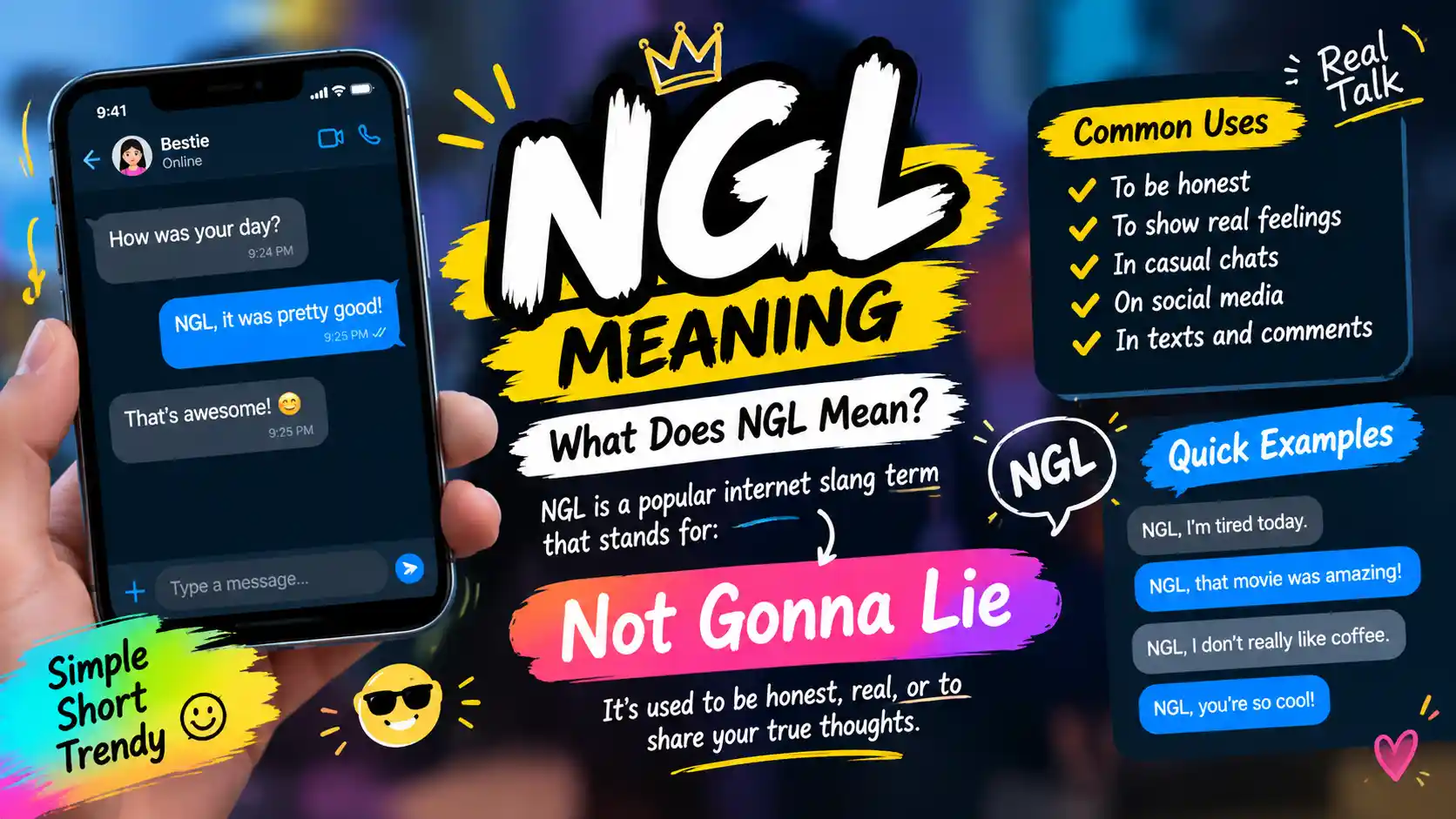
NGL means “not gonna lie.” It is an informal internet abbreviation people use before saying something honest, personal, surprising, or slightly blunt.
For example, “NGL, that movie was really good” simply means, “Not gonna lie, that movie was really good.”
The abbreviation is common in casual digital communication, especially texting and social media. In this guide, you will learn the NGL meaning, how people use it, what it means in different contexts, examples, common mistakes, and when you should avoid using it.
Quick Answer:
NGL stands for “not gonna lie.” It is used in texts and online conversations to introduce an honest opinion, feeling, reaction, or confession.
For example:
“NGL, I was nervous before the interview.”
This means:
“Not gonna lie, I was nervous before the interview.”
NGL is usually casual. It is fine for texting friends, social media, gaming chats, and informal conversations, but it is generally not suitable for formal emails, school assignments, or professional writing.
The abbreviation can appear at the beginning, middle, or sometimes near the end of a sentence. Its main purpose is to signal that the speaker is about to be honest or direct.
NGL Meaning in Texting
In texting, NGL means “not gonna lie.” People often use it when they want to make a statement sound more honest or personal.
For example, someone might text:
“NGL, I miss high school sometimes.”
The person is not literally announcing that they usually lie. Instead, NGL adds a casual tone to the statement and signals that the speaker is sharing a genuine feeling.
Here are some common texting examples:
| Text | Meaning |
| “NGL, I’m tired.” | “Not gonna lie, I’m tired.” |
| “NGL, that was funny.” | “Honestly, that was funny.” |
| “NGL, I expected more.” | “To be honest, I expected more.” |
| “NGL, you look great.” | “Honestly, you look great.” |
| “NGL, I was scared.” | “I’m being honest; I was scared.” |
NGL can make a message feel relaxed and conversational. It is especially useful when someone wants to express an opinion without making the statement sound too formal.
What Does NGL Mean on Social Media?
On social media, NGL has the same basic meaning: “not gonna lie.”
You may see it on Instagram, TikTok, Snapchat, X, Facebook, Reddit, Discord, and other online platforms.
For example:
“NGL, this outfit is perfect.”
The phrase can introduce praise, criticism, surprise, disappointment, humor, or a personal opinion.
Social media users often prefer short expressions because they make posts and comments quick to read. NGL fits that style well.
It can also make a comment sound more spontaneous:
“NGL, I did not expect you to win.”
This sounds more casual than:
“I honestly did not expect you to win.”
Both sentences communicate nearly the same idea, but NGL gives the first one a more internet-friendly tone.
What Does NGL Mean on Snapchat?
On Snapchat, NGL means “not gonna lie.” It is commonly used in snaps, chats, captions, and replies.
Someone might send:
“NGL, that was the best part of the trip.”
Or:
“NGL, you looked really good today.”
In both cases, NGL signals honesty or a personal reaction.
Snapchat conversations are usually informal, so abbreviations such as NGL fit naturally. The person using it is generally trying to sound casual rather than formal.
NGL can also be used before a confession:
“NGL, I was jealous.”
Here, the abbreviation helps introduce something the speaker may feel slightly uncomfortable admitting.
What Does NGL Mean on TikTok?
On TikTok, NGL is often used in comments, captions, direct messages, and video text.
For example:
“NGL, this is the best recipe I’ve seen all week.”
“I NGL, I watched this five times.”
“NGL, the first outfit was better.”
The abbreviation works well with TikTok’s fast, casual communication style. It can be used for both positive and negative opinions.
It may also appear with humor:
“NGL, I thought this was going to be terrible 😂.”
The exact tone depends on the surrounding words, punctuation, emojis, and conversation.
What Does NGL Mean in Instagram Messages?
In Instagram DMs and comments, NGL usually means “not gonna lie.”
For example:
“NGL, your vacation photos are beautiful.”
This is a casual way of saying:
“Honestly, your vacation photos are beautiful.”
It can also be used before constructive criticism:
“NGL, I liked your old logo better.”
That does not necessarily mean the person is being rude. It simply signals that they are giving their honest opinion.
However, context matters. NGL does not automatically make criticism kind. The rest of the message determines whether it sounds supportive, playful, or harsh.
NGL Meaning in Different Contexts
Although the basic definition does not change, the feeling behind NGL can change depending on the situation.
| Context | Example | Likely tone |
| Compliment | “NGL, you look amazing.” | Honest praise |
| Opinion | “NGL, I prefer the first one.” | Personal preference |
| Confession | “NGL, I was nervous.” | Personal honesty |
| Surprise | “NGL, that shocked me.” | Genuine reaction |
| Criticism | “NGL, I didn’t like it.” | Direct opinion |
| Humor | “NGL, I thought I was going to fall.” | Playful |
This is why you should read the whole message instead of interpreting NGL by itself.
How to Use NGL Correctly in a Sentence
NGL is usually placed near the beginning of a sentence.
A common pattern is:
NGL + comma + statement
Examples:
“NGL, I really enjoyed that show.”
It can also appear after another word or phrase:
“That was, NGL, one of the funniest things I’ve seen.”
However, this style is less common in everyday texting.
Because NGL is an abbreviation for an informal phrase, it works best in casual communication. It does not need to follow formal grammar rules used in professional writing.
NGL vs. “Not Gonna Lie”
NGL and “not gonna lie” mean the same thing.
The main difference is style.
| Expression | Style | Example |
| NGL | Very casual, internet-friendly | “NGL, I love this.” |
| Not gonna lie | Casual and conversational | “Not gonna lie, I love this.” |
| Honestly | Casual to neutral | “Honestly, I love this.” |
| To be honest | Neutral and widely understood | “To be honest, I love this.” |
| Frankly | More formal | “Frankly, I love this.” |
If you are chatting with friends, NGL is perfectly natural.
If you are writing a formal email, “to be honest” or another appropriate phrase may be better.
Is NGL a Word or an Acronym?
NGL is commonly described as an initialism or internet abbreviation formed from the first letters of “not gonna lie.”
N = Not
G = Gonna
L = Lie
Unlike some abbreviations that are pronounced as words, NGL is normally read letter by letter: “en-jee-el.”
The phrase “not gonna lie” itself is an informal version of “not going to lie.” In everyday American English, “gonna” is common in speech and casual writing, but it is generally avoided in formal writing.
Is NGL Rude?
NGL is not inherently rude. Its tone depends on what comes after it.
For example:
“NGL, you did a great job.”
This sounds positive.
But:
“NGL, your idea makes no sense.”
This can sound harsh.
The abbreviation simply introduces the speaker’s honest reaction. It does not automatically make the statement polite or impolite.
If you are using NGL before criticism, think about how the other person may receive your words. Honesty and kindness can exist together.
Instead of:
“NGL, that outfit looks bad.”
You could say:
“NGL, I think the other outfit suited you better.”
The second version still gives an honest opinion but sounds more considerate.
Why Do People Say NGL?
People use NGL for several reasons.
First, it can signal honesty. The speaker wants the reader to know that the next statement is their genuine opinion.
Second, it creates a casual tone. “NGL” feels more relaxed than a formal phrase such as “I would like to be honest.”
Third, it can introduce a confession. Someone may use it before admitting a feeling they normally would not say directly.
For example:
“NGL, I was really nervous about meeting everyone.”
Finally, NGL can soften or frame an opinion. It tells the reader that what follows is personal rather than an objective fact.
NGL Examples in Everyday Conversations
Understanding NGL becomes easier when you see how it works in natural conversations.
Friend: “Did you like the new restaurant?”
Reply: “NGL, the food was amazing.”
Here, NGL introduces a positive opinion.
Another example:
Friend: “Are you ready for tomorrow?”
Reply: “NGL, I’m kind of nervous.”
Here, NGL introduces an honest feeling.
It can also be playful:
Friend: “Are you really going to watch another episode?”
Reply: “NGL, probably five more.”
Or supportive:
Friend: “Do you think I made the right choice?”
Reply: “NGL, I think you did.”
The abbreviation works because the conversation is informal.
Common NGL Mistakes to Avoid
One common mistake is assuming that NGL always means something negative. It does not.
NGL can introduce a compliment:
“NGL, you crushed that presentation.”
It can introduce disappointment:
“NGL, I expected a better ending.”
It can introduce a confession:
“NGL, I was nervous.”
Another mistake is using NGL in formal writing. A college essay, business proposal, resume, or professional report is usually not the right place for internet slang.
You should also avoid using NGL simply because it is popular. If the sentence sounds natural without it, you do not always need to add it.
Good communication is more important than using slang.
NGL vs. Similar Internet Slang
NGL is only one of many abbreviations used online. Knowing the difference between them can make digital conversations easier to understand.
| Slang | Meaning | Typical use |
| NGL | Not gonna lie | Honesty or opinion |
| TBH | To be honest | Honest opinion |
| IMO | In my opinion | Personal viewpoint |
| IMHO | In my humble opinion | Personal viewpoint |
| IDK | I don’t know | Uncertainty |
| FR | For real | Agreement or emphasis |
| BTW | By the way | Adding information |
| TMI | Too much information | Oversharing |
NGL and TBH are especially similar. Both can introduce an honest opinion.
For example:
“NGL, that was fun.”
and
“TBH, that was fun.”
Both are natural in casual online communication.
Is NGL Still Used Today?
Yes. NGL remains recognizable as casual internet slang and is commonly understood in digital conversations.
Its exact popularity can vary by platform, age group, and online community. Internet slang also changes quickly, so some abbreviations become more or less common over time.
Even when people do not use NGL often themselves, many regular internet users can understand it from context.
The safest approach is to treat NGL as casual slang, not as a formal English expression.
Should You Use NGL in Professional Communication?
Usually, no.
If you are sending a message to a close coworker in a casual chat, NGL may be understood. But in formal communication, it is better to write the full idea.
For example, instead of:
“NGL, I think we need more time.”
A professional message could say:
“To be honest, I think we need more time to complete the project.”
For a formal email, you might simply write:
“I believe we need additional time to complete the project.”
The choice depends on your audience. When in doubt, use standard English.
Frequently Asked Questions About NGL Meaning
What does NGL stand for?
NGL stands for “not gonna lie.” It is a casual internet abbreviation used to introduce an honest opinion, feeling, reaction, or confession.
What does NGL mean in texting?
In texting, NGL means “not gonna lie.” Someone may use it before sharing a genuine opinion, such as “NGL, I really liked that movie.”
What does NGL mean on Snapchat and TikTok?
On Snapchat and TikTok, NGL generally means “not gonna lie.” It is used in chats, comments, captions, and other casual interactions to introduce an honest reaction or opinion.
Is NGL positive or negative?
NGL can be either positive or negative. For example, “NGL, you look great” is positive, while “NGL, I didn’t like it” expresses a negative opinion.
Is NGL appropriate for formal writing?
Usually not. NGL is informal internet slang. Use standard phrases such as “to be honest,” “honestly,” or “I believe” in professional, academic, or formal writing.
What is the difference between NGL and TBH?
Both NGL and TBH can introduce an honest opinion. NGL means “not gonna lie,” while TBH means “to be honest.” They are often interchangeable in casual online conversations.
Conclusion
The NGL meaning is simple: “not gonna lie.” It is a casual internet abbreviation people use before sharing an honest opinion, feeling, reaction, compliment, or confession. You may see NGL in texts, Snapchat chats, TikTok comments, Instagram messages, gaming conversations, and other social media spaces.
The important thing is context. NGL itself is not rude or negative. The words that follow it determine the real tone of the message. It is useful in casual conversations but usually does not belong in formal writing.
So, if someone texts “NGL, I really miss you,” they are simply saying, “Not gonna lie, I really miss you.” Once you know that, this common piece of internet slang is easy to understand and use.

Hi, I’m Benjamin Dreyer. I enjoy exploring words, phrases, slang, abbreviations, acronyms, and digital communication. At Linkquorax.com, I share simple and accurate explanations to help readers understand unfamiliar terms and popular internet expressions. My goal is to make every meaning clear, useful, and easy to understand. Whether you are curious about a new word or an online phrase, Linkquorax.com provides straightforward information to help you learn quickly and communicate with confidence in everyday conversations.