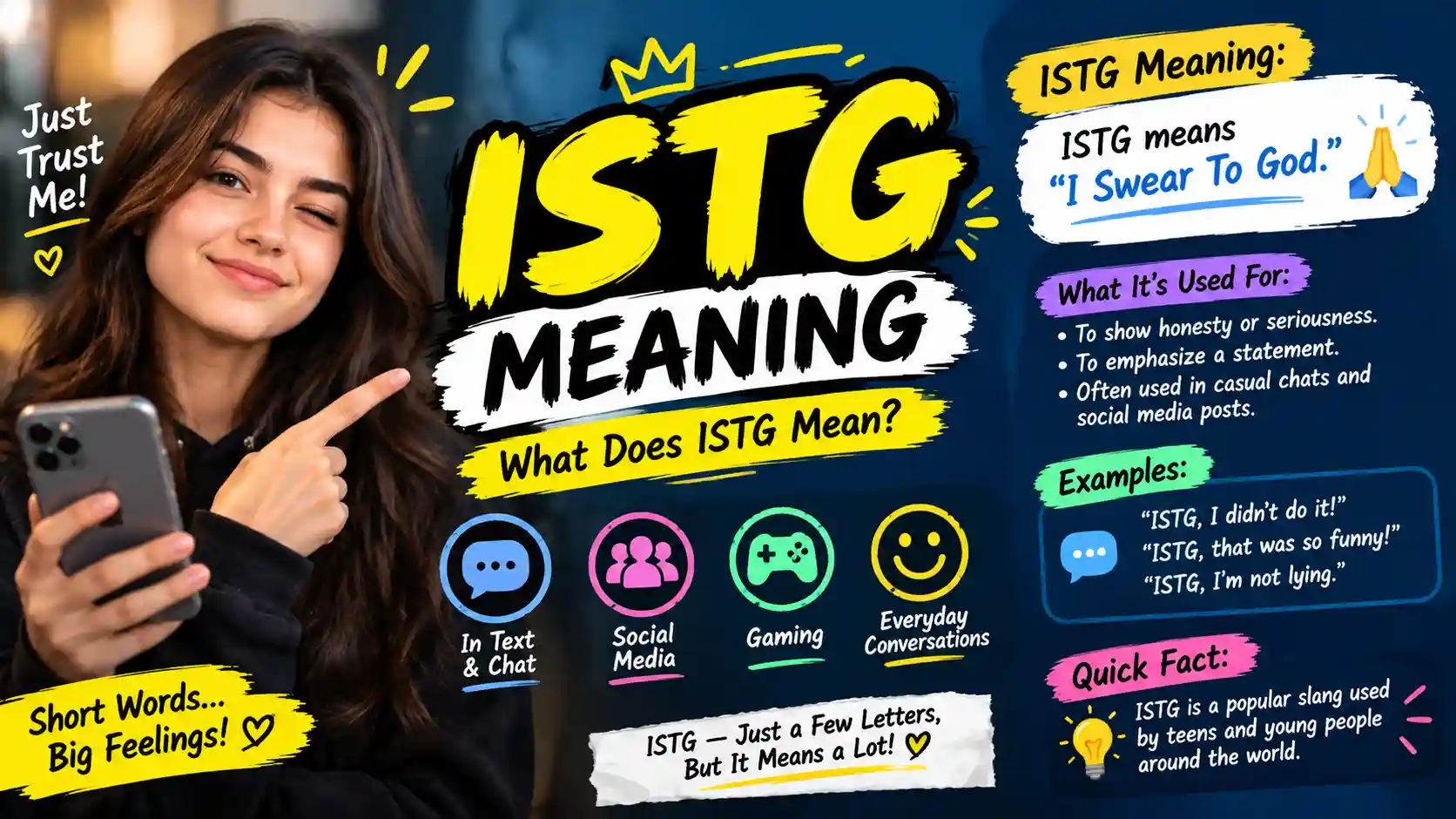
ISTG means “I swear to God.” It is a common informal abbreviation used in texts, chats, comments, and social media.
People usually use ISTG to show that they are being serious, frustrated, surprised, excited, or strongly convinced about something. The exact feeling depends on the context and the words around it.
If someone texts, “ISTG, you have to see this!”, they are not usually making a formal religious statement. They are using the phrase to add strong emotion or emphasis.
In this guide, you will learn the ISTG meaning, how people use it, what it means in different situations, how to reply, and how it compares with similar slang such as ONG, OMG, FR, and I swear.
Quick Answer:
ISTG stands for “I swear to God.” In modern texting and online slang, it is mainly used to emphasize a statement or show a strong emotion.
For example:
“ISTG, this is the funniest video I’ve ever seen.”
Here, ISTG means something like “I seriously mean this” or “I swear, this is true.”
The meaning can change slightly depending on the situation. Someone might use ISTG because they are:
- Serious about what they are saying
- Annoyed or frustrated
- Surprised
- Excited
- Trying to convince someone
- Emphasizing a strong opinion
- Reacting dramatically to something funny or unexpected
Dictionary.com defines ISTG as an acronym for “I swear to God” and notes that it can express seriousness, exasperation, or surprise.
ISTG Meaning in Texting
In texting, ISTG is usually an emotional shortcut. Instead of typing the full phrase “I swear to God,” a person can type four letters and get the same basic effect.
For example:
Person 1: “Did you really finish the whole pizza?”
Person 2: “ISTG, I did.”
In this conversation, ISTG adds emphasis. The person wants the other person to believe them.
It can also appear at the beginning or end of a sentence:
“ISTG, my phone always dies when I need it.”
“You are the funniest person ever, ISTG.”
The abbreviation is especially useful in casual digital conversations because texting often favors short forms. Slang is generally informal language connected with particular groups or social settings, so ISTG is best treated as casual rather than formal English.
| ISTG | Basic meaning | Common feeling |
| I swear to God | Strong emphasis | Serious |
| I swear to God | Strong reaction | Frustrated |
| I swear to God | Strong belief | Certain |
| I swear to God | Emotional reaction | Surprised |
| I swear to God | Dramatic emphasis | Excited or amused |
What Does ISTG Stand For?
ISTG stands for “I swear to God.”
The original phrase has a much more serious history than its modern internet use. “I swear” can be used as an oath of honesty, while everyday speakers also use it simply for emphasis or strong emotion.
When people use ISTG online, they often are not making a formal oath. Instead, the phrase has become a casual way to make a statement sound stronger.
Compare these two sentences:
“This movie is really good.”
“ISTG, this movie is so good.”
The second version sounds much more emotional. The speaker wants to show that they feel strongly about the movie.
This is one reason internet abbreviations can be confusing. The literal meaning of an abbreviation may sound more serious than the way people actually use it in casual conversation.
What Does ISTG Mean on Snapchat, Instagram, TikTok, and Text?
On platforms such as Snapchat, Instagram, TikTok, and regular text messages, ISTG generally has the same meaning: “I swear to God.”
However, the emotion behind it can change.
On TikTok, someone might write:
“ISTG this trend gets funnier every time.”
They are expressing amusement or excitement.
On Instagram, someone might comment:
“ISTG, your dog is adorable.”
Here, the phrase adds strong emphasis.
In a text message, someone might say:
“ISTG, if my alarm goes off one more time…”
This sounds frustrated and may even be playful depending on the conversation.
The important point is that ISTG does not have one fixed emotional tone. The surrounding sentence, punctuation, emojis, and relationship between the people can change how it sounds.
| Example | Likely meaning |
| “ISTG I’m telling the truth.” | Serious / convincing |
| “ISTG this is hilarious 😂” | Amused |
| “ISTG, I can’t deal with this.” | Frustrated |
| “ISTG I thought I saw him.” | Surprised / uncertain |
| “You look amazing ISTG.” | Strong compliment |
| “ISTG, stop doing that.” | Annoyed |
Why Do People Say ISTG?
People use ISTG because it adds emotional weight to a sentence without requiring a long explanation.
Imagine someone says:
“I have told you three times.”
That sounds direct.
Now imagine:
“ISTG, I have told you three times.”
The second sentence sounds more emotional and frustrated.
Likewise:
“That was the best concert.”
compared with:
“ISTG, that was the best concert.”
The second sentence shows stronger excitement.
So, the main purpose of ISTG is emphasis.
It can make a message sound more intense, dramatic, funny, annoyed, or sincere. The phrase “I swear” has also long been used outside formal settings to emphasize statements involving excitement, disbelief, or frustration.
ISTG Meaning in Different Situations
The same abbreviation can communicate different emotions depending on the context.
When someone is trying to prove something, ISTG can mean “I promise I am telling the truth.”
Example:
“ISTG, I didn’t take your charger.”
When someone is frustrated, it can mean something closer to “I am seriously getting annoyed.”
Example:
“ISTG, my internet stops working every time I have a meeting.”
When someone is excited, it can add enthusiasm.
Example:
“ISTG, that was the best meal ever.”
When someone is surprised, it can introduce a strong reaction.
Example:
“ISTG, I thought that was your brother!”
And when someone is joking, ISTG can make the joke more dramatic.
Example:
“ISTG, my cat thinks she pays the rent.”
This flexibility is one reason the abbreviation works so well in casual online conversations.
ISTG Examples in Real Conversations
Seeing ISTG in complete conversations makes its meaning easier to understand.
Example 1: Serious
Friend: “Are you really going to help me move?”
You: “ISTG, I’ll be there Saturday.”
Meaning: I swear I will be there.
Example 2: Frustrated
Friend: “Did the website crash again?”
You: “ISTG, it crashes every time I try to submit something.”
Meaning: I’m seriously frustrated because this keeps happening.
Example 3: Excited
Friend: “How was the new restaurant?”
You: “ISTG, the food was incredible.”
Meaning: I strongly believe the food was incredible.
Example 4: Funny
Friend: “Why is your dog sitting in the bathtub?”
You: “ISTG, he thinks it’s his new bed.”
Meaning: I’m dramatically emphasizing this funny situation.
Example 5: Surprise
Friend: “Guess who I saw at the store?”
You: “ISTG, if you say Taylor…”
Meaning: I am reacting with strong surprise or anticipation.
How to Use ISTG Correctly
ISTG is easy to use, but context matters. Since it is casual slang, it works best when you are talking to friends, family members, or people who regularly use internet language.
Good examples include:
“ISTG, you need to watch this.”
“ISTG, I almost missed my flight.”
“That was so funny, ISTG 😂.”
“ISTG, I thought today was Friday.”
You generally should not use ISTG in a formal email, job application, academic paper, business report, or professional message.
Instead, use clear phrases such as:
- I sincerely mean this.
- I promise.
- I am serious.
- I can assure you.
- I strongly believe this.
This distinction matters because slang is highly informal and can be inappropriate outside familiar social settings.
Is ISTG Rude or Offensive?
ISTG is not automatically rude or offensive, but it can sound aggressive in some situations.
For example:
“ISTG, leave me alone.”
This sounds angry.
But:
“ISTG, you are hilarious 😂.”
sounds friendly and playful.
The phrase also includes the word God, so some people may avoid it for personal or religious reasons. Others use it casually without intending any religious meaning.
If you are unsure how someone feels about the phrase, a simpler expression such as “I swear”, “seriously,” or “I promise” may be safer.
The key is to consider both the situation and the person receiving the message.
ISTG vs. I Swear
ISTG and “I swear” have essentially the same core meaning, but they feel different because of the way they are written.
I swear it is the normal phrase and can be used in both speech and informal writing.
ISTG is the abbreviated internet version.
For example:
“I swear, I didn’t do it.”
and
“ISTG, I didn’t do it.”
mean almost the same thing.
The second version feels more like texting or social media language.
The phrase “I swear” itself can also be used for emphasis rather than as a literal oath.
ISTG vs. ONG
ONG means “on God.” It is another informal expression used to show strong belief, honesty, or emotion. Dictionary.com describes ONG as similar to “I swear to God” and notes that it is commonly used in texting and social media.
For example:
“ISTG, this song is amazing.”
“ONG, this song is amazing.”
Both can communicate strong agreement or emphasis.
There can be small differences in style, but both are casual internet expressions.
| Slang | Full form | Main use |
| ISTG | I swear to God | Emphasis, seriousness, emotion |
| ONG | On God | Strong belief or agreement |
| OMG | Oh my God | Surprise or excitement |
| FR | For real | Agreement or sincerity |
| TBH | To be honest | Giving an honest opinion |
| NGL | Not gonna lie | Introducing an honest statement |
ISTG vs. OMG
ISTG and OMG are easy to confuse because both can involve strong emotions, but they serve different purposes.
OMG means “Oh my God.” It is commonly used to react to something surprising, exciting, shocking, or unbelievable.
ISTG means “I swear to God.” It is usually used to emphasize what the speaker is saying.
For example:
“OMG, you won!”
This expresses surprise or excitement.
“ISTG, I knew you would win.”
This emphasizes the speaker’s confidence or previous belief.
They can also appear together:
“OMG, ISTG, I can’t believe this happened!”
In that sentence, OMG introduces the emotional reaction, while ISTG adds emphasis.
ISTG vs. FR
FR stands for “for real.”
It is often used to show agreement, sincerity, or emphasis.
For example:
“That movie was amazing.”
“FR.”
Here, FR means “for real” or “I agree.”
ISTG is different because it comes from “I swear to God.”
Compare:
“ISTG, this is the best pizza ever.”
This sounds like a strong personal statement.
“FR, this is the best pizza ever.”
This can sound more like agreement or confirmation.
Both are informal, but their conversational roles are slightly different.
Common Mistakes When Using ISTG
One common mistake is assuming that ISTG always means the person is angry. It does not.
Someone can use ISTG while laughing, complimenting someone, expressing excitement, or making a joke.
Another mistake is using it in formal communication. Because ISTG is internet slang, it is better suited to casual conversations.
People also sometimes read too much into the religious wording. In modern slang, the phrase often functions as an emotional intensifier rather than a formal religious oath. Dictionary.com specifically notes that ISTG is usually used outside a serious religious context.
Finally, remember that tone is difficult to judge from text alone. A message such as “ISTG” may sound playful between close friends but harsh between people who do not know each other well.
Is ISTG Still Used?
Yes. ISTG remains recognizable as informal internet and texting slang. Its use fits a broader pattern in which online communication shortens familiar phrases into compact abbreviations.
However, slang changes quickly. Some abbreviations become less common, while others remain popular for years. Cambridge notes that slang can change quickly and that expressions can disappear from use over time.
That means there is no need to treat every slang abbreviation as permanent vocabulary. ISTG is best understood as the current informal digital language, rather than standard English.
Its meaning is still easy to understand when it appears in texts, comments, memes, and casual social media conversations.
How to Reply When Someone Says ISTG
Your response depends on what the person means.
If they are making a serious statement, you might reply:
“Okay, I believe you.”
If they are frustrated:
“I know, that sounds annoying.”
If they are excited:
“Right? I felt the same way!”
If they are joking:
“😂 Seriously?”
If someone sends only “ISTG”, look at the messages before it. The surrounding conversation usually tells you whether they are serious, annoyed, excited, or joking.
You do not need to respond with another abbreviation. A natural reply is often better.
Can You Use ISTG in a Formal Message?
Usually, no.
ISTG is casual slang, so avoid it in professional emails, school assignments, cover letters, official documents, and other formal writing.
Instead of:
“ISTG, I completed the report.”
write:
“I confirm that I completed the report.”
Instead of:
“ISTG, I will be there.”
write:
“I promise I will be there.”
The formal version is clearer and more appropriate for professional communication.
Frequently Asked Questions
What does ISTG mean in texting?
ISTG means “I swear to God.” In texting, it is usually used to emphasize a statement or show a strong emotion such as seriousness, frustration, surprise, or excitement.
What does ISTG mean on Snapchat?
On Snapchat, ISTG generally means “I swear to God.” It can be used to emphasize something the person is saying, whether they are being serious, excited, annoyed, or playful.
What does ISTG mean on Instagram?
ISTG means “I swear to God” on Instagram. You may see it in captions, comments, direct messages, or replies when someone wants to add strong emphasis to a statement.
Is ISTG a bad word?
ISTG is not a swear word by itself, but it contains a religious reference and may sound strong or inappropriate to some people. It is also informal, so use it mainly in casual conversations.
What is the difference between ISTG and ONG?
ISTG means “I swear to God,” while ONG means “on God.” Both are informal expressions used to show strong belief or emotion, especially in texting and social media.
What should I reply to ISTG?
Your reply should match the context. You can say “I believe you,” “Seriously?”, “I know 😂,” or another natural response. First, check whether the person is being serious, frustrated, excited, or joking.
Conclusion
The ISTG meaning is simple: it stands for “I swear to God.” In modern texting and social media, however, it is usually used as an informal way to add emphasis rather than as a formal oath. It can express seriousness, frustration, excitement, surprise, or even humor.
If you see ISTG in a message, do not judge its tone from the abbreviation alone. Look at the sentence around it and the relationship between the people talking. That context tells you what the person really means.
For casual texting, ISTG is easy to understand and widely recognizable. For school, work, or formal communication, it is better to use standard phrases such as “I promise,” “I am serious,” or “I sincerely mean this.” Understanding that difference will help you read internet slang more naturally and use it in the right setting.

Hi, I’m Benjamin Dreyer. I enjoy exploring words, phrases, slang, abbreviations, acronyms, and digital communication. At Linkquorax.com, I share simple and accurate explanations to help readers understand unfamiliar terms and popular internet expressions. My goal is to make every meaning clear, useful, and easy to understand. Whether you are curious about a new word or an online phrase, Linkquorax.com provides straightforward information to help you learn quickly and communicate with confidence in everyday conversations.