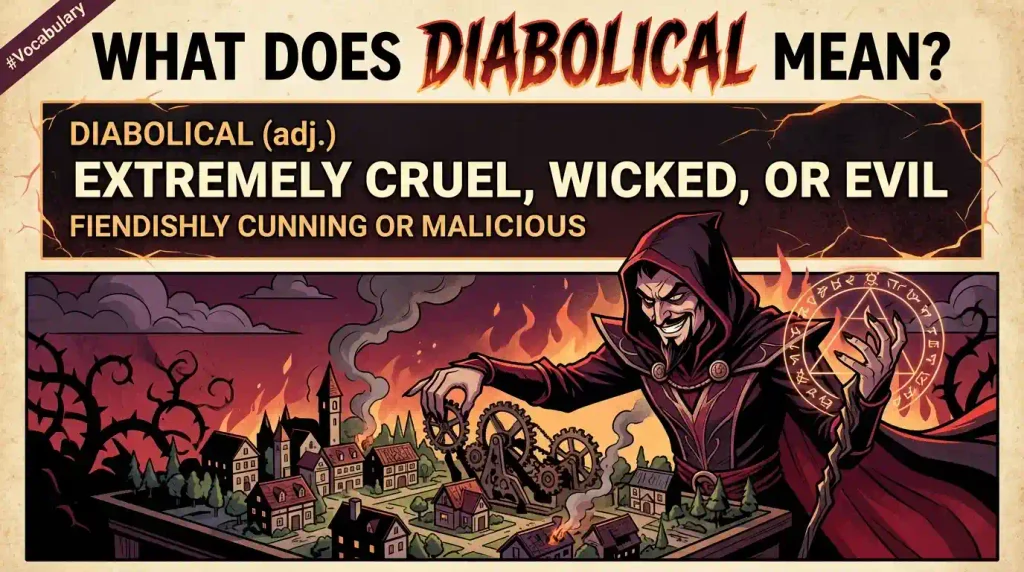
The diabolical meaning is usually “extremely evil, cruel, or shocking.” It can also mean something is extremely bad, unpleasant, or annoying.
For example, “a diabolical plan” means a very evil or harmful plan, while “the service was diabolical” means the service was extremely bad.
The word diabolical can sound strong because it is connected with the idea of the devil. However, English speakers do not always use it in a religious sense. In everyday speech, it can simply describe something terrible, shocking, or very poor.
If you saw the word in a book, movie, text message, news story, or social media post, the exact meaning depends on the sentence.
This guide explains diabolical meaning, pronunciation, synonyms, examples, grammar, differences from similar words, and common mistakes in simple American English.
Quick Answer: What Does Diabolical Mean?
Diabolical is an adjective that usually describes something extremely evil, cruel, shocking, or terrible.
Here are a few simple examples:
It has two main uses. The first is serious: something is evil or devil-like. The second is more informal: something is extremely bad or unpleasant. Oxford gives both meanings, while Cambridge also notes that the word can describe something very evil but sometimes clever or intelligent.
| Example | Meaning |
| “He created a diabolical plan.” | He created a very evil or harmful plan. |
| “That was a diabolical crime.” | The crime was extremely cruel or evil. |
| “The weather was diabolical.” | The weather was extremely bad. |
| “Her driving was diabolical.” | Her driving was extremely poor or dangerous. |
| “He is a diabolical genius.” | He is extremely clever, but his ideas may be harmful or evil. |
So, in simple terms, diabolical can mean “devil-like,” “extremely evil,” or “extremely bad.”
Diabolical Meaning and Definition
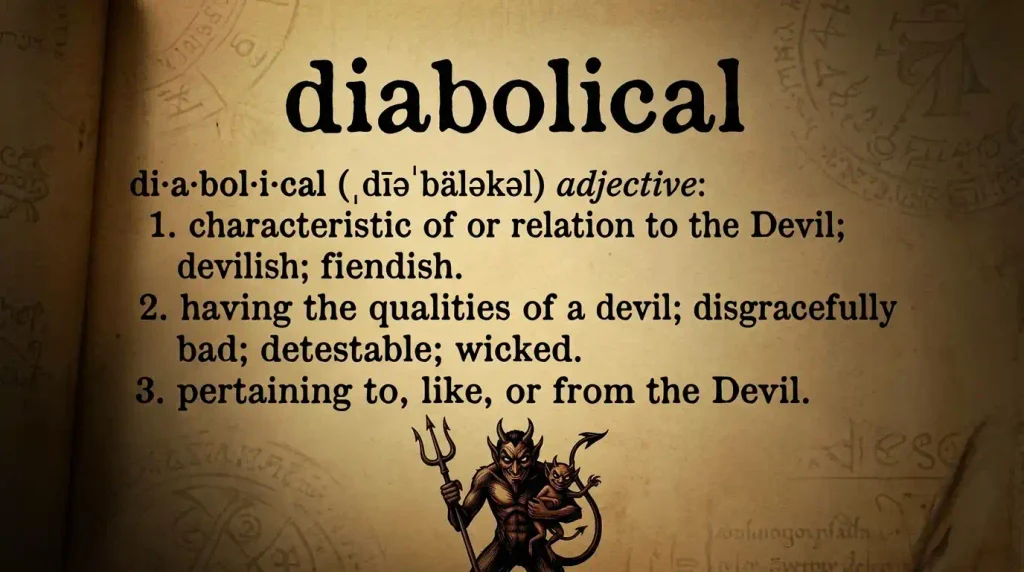
The most important thing to understand about diabolical is that it has more than one sense.
In its stronger and more literal sense, diabolical means evil, cruel, or like a devil. It may describe a person, action, plan, idea, crime, or force that seems deeply wicked.
For example:
“Someone created a diabolical plan to hurt innocent people.”
Here, diabolical means extremely evil and cruel.
But the word can also be used in a less serious way. In informal English, someone may call a situation diabolical simply because it is extremely bad or annoying. Oxford specifically lists this informal meaning and gives the example of traffic being diabolical.
For example:
“The traffic was diabolical this morning.”
This sentence does not mean the traffic was literally connected to the devil. It means the traffic was terrible.
That difference is important because the word can sound dramatic. The surrounding words and situation tell you whether diabolical means “evil” or simply “extremely bad.”
What Does Diabolical Mean in Simple English?
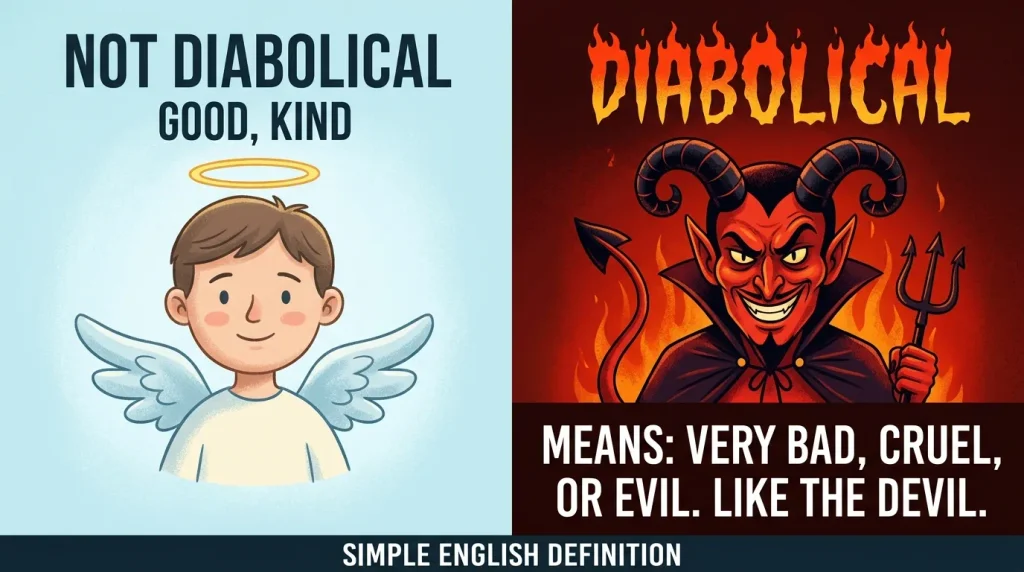
In simple English, diabolical can mean:
Very evil: something morally wrong or cruel.
Devil-like: something that seems connected with or resembles the devil.
Extremely bad: something that is terrible, unpleasant, or shocking.
Extremely clever in a harmful way: a person or plan can be described as diabolical when it is very clever but also wicked.
For example, imagine a character in a movie who creates a clever plan to harm an entire city. You might call the plan diabolical because it is both clever and evil.
On the other hand, if your friend says, “The customer service at that store was diabolical,” they probably mean the service was terrible, not supernatural.
This flexible meaning is one reason people sometimes become confused when they first encounter the word.
Diabolical Pronunciation
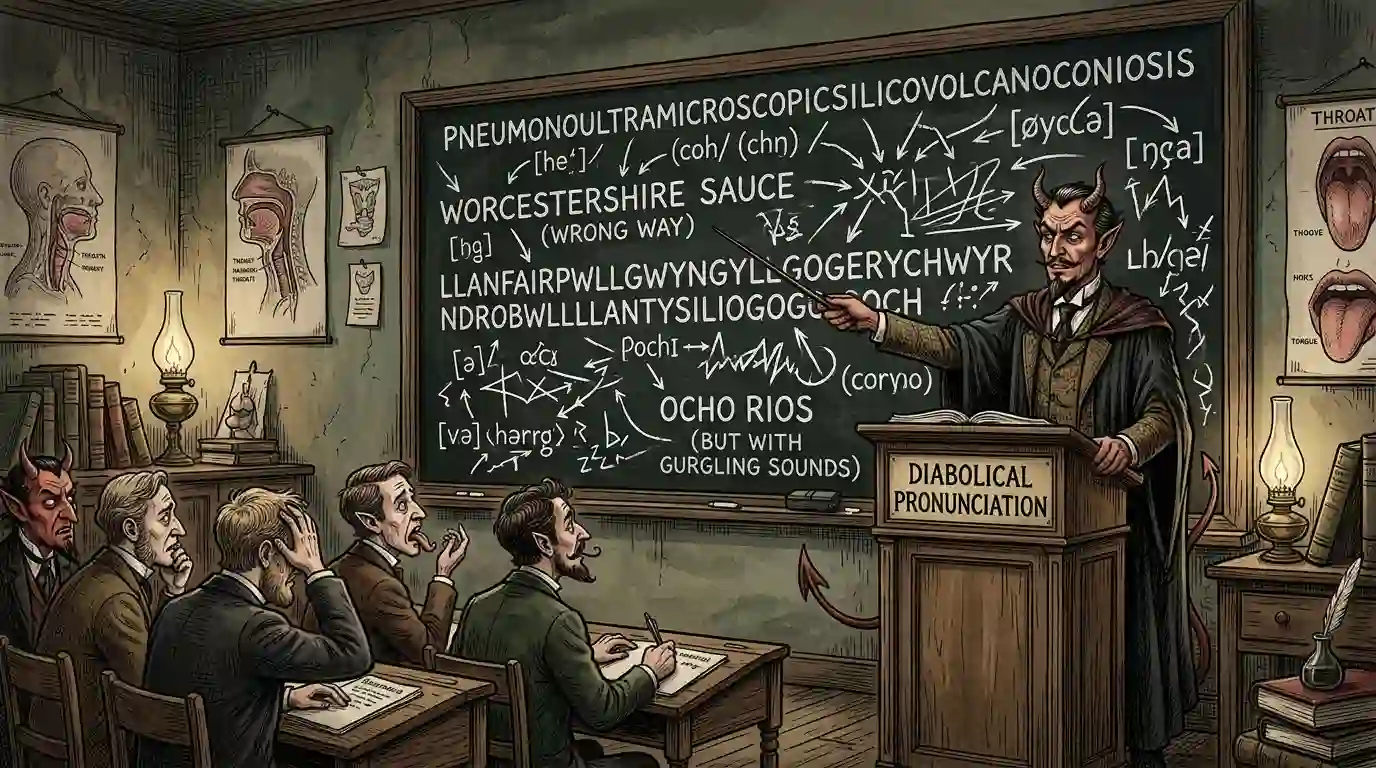
In American English, diabolical is pronounced roughly like:
dye-uh-BAH-lih-kul
The stress falls on the middle part of the word.
Cambridge gives the U.S. pronunciation as /ˌdaɪ.əˈbɑː.lɪ.kəl/. Oxford also provides an American pronunciation for the word.
The pronunciation may look difficult at first, but breaking the word into smaller parts can help:
di-a-bol-i-cal
Try saying it slowly first, then naturally:
“dye-uh-BAH-lih-kul.”
The related word diabolically is an adverb. It means something happens in an extremely bad, shocking, or unpleasant way.
Is Diabolical a Positive or Negative Word?
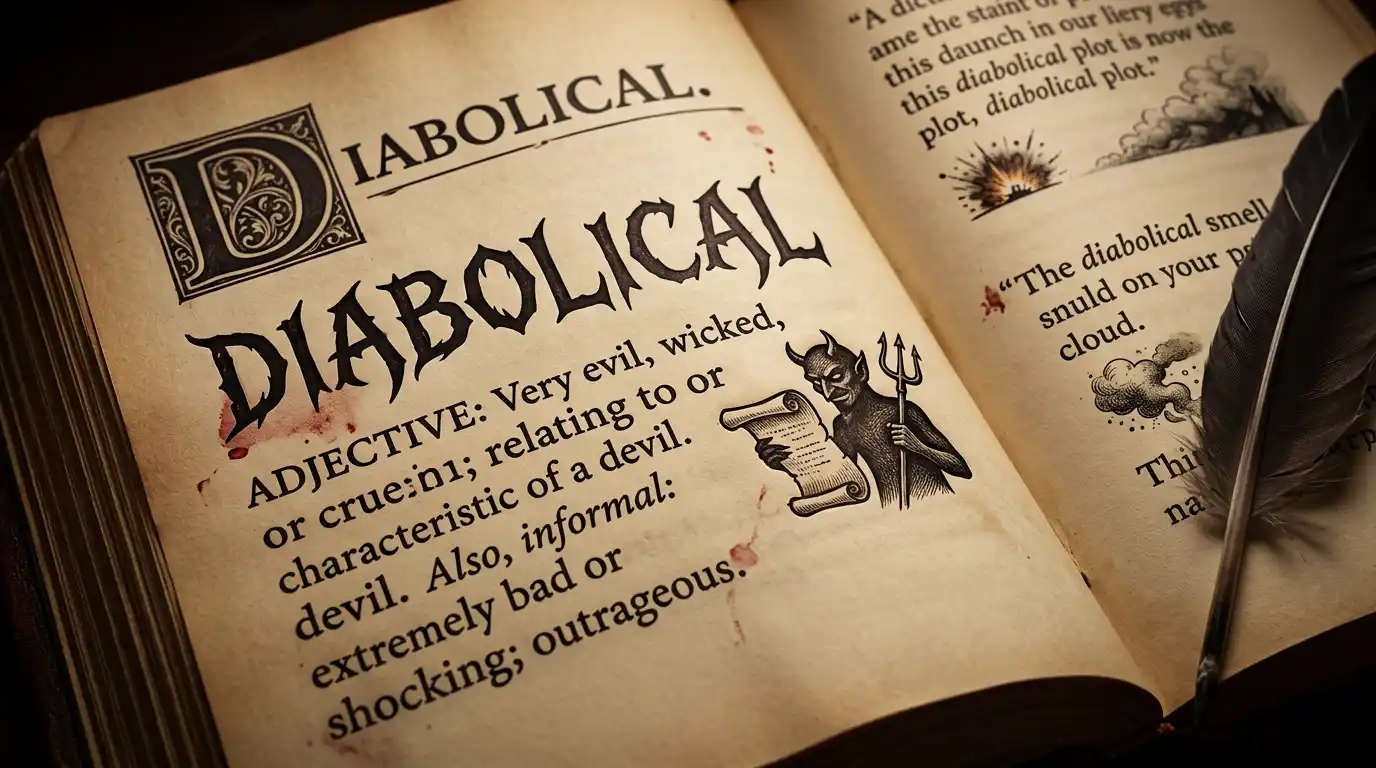
Diabolical is usually a negative word.
It normally suggests something evil, cruel, terrible, or unpleasant. You would not normally use it to give ordinary praise.
For example:
“The villain had a diabolical plan.”
This is clearly negative.
However, there is an interesting exception. Sometimes writers use diabolical to describe something that is extremely clever, especially when the cleverness is connected to a harmful or tricky plan.
For example:
“That was a diabolical trick.”
The speaker may mean the trick was wicked and clever at the same time.
Cambridge’s American Dictionary includes the idea of being “very evil but often intelligent,” which helps explain expressions such as diabolical genius.
So, while the word is strongly negative overall, context can add the idea of cleverness.
Diabolical as an Adjective
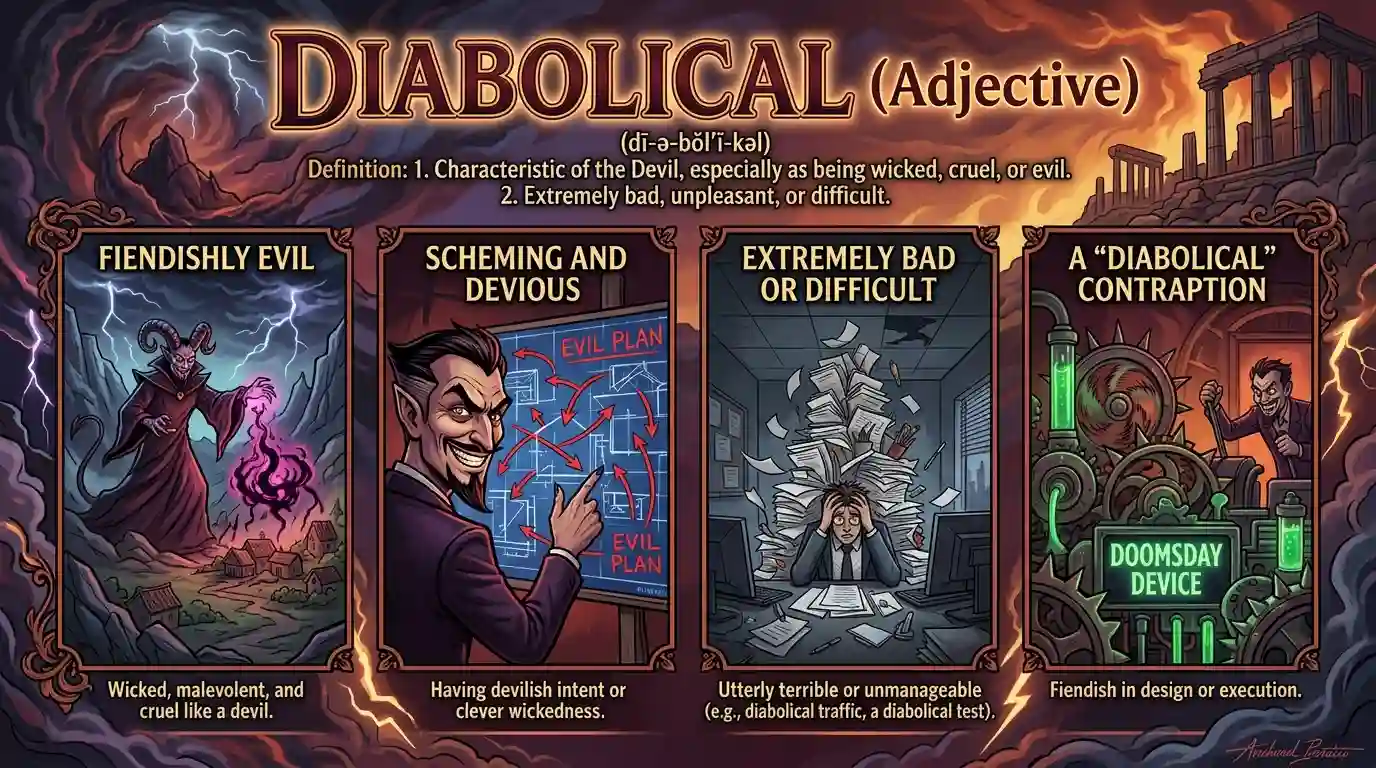
Diabolical is an adjective. An adjective describes a person, place, thing, action, idea, or situation.
You can place diabolical before a noun:
“a diabolical plan”
“a diabolical crime”
“a diabolical villain”
“a diabolical scheme”
“a diabolical act”
You can also use it after a linking verb:
“The plan was diabolical.”
“The conditions were diabolical.”
“His behavior was diabolical.”
Because it is an adjective, it does not normally act as the main noun in a sentence.
The related forms are useful to know:
| Word | Part of speech | Simple meaning |
| Diabolical | Adjective | Extremely evil or extremely bad |
| Diabolically | Adverb | In an extremely bad, evil, or shocking way |
| Diabolic | Adjective | Evil or devil-like; less common than diabolical |
| Devilish | Adjective | Cruel, evil, or sometimes playfully mischievous |
| Devil | Noun | A supernatural figure associated with evil |
Oxford notes that diabolic is a less frequent form of diabolical.
How to Use Diabolical in a Sentence

The easiest way to use diabolical correctly is to think about what you are describing.
If you are talking about serious evil, use it for something cruel or morally wrong.
“The criminal carried out a diabolical attack.”
If you are using the informal meaning, use it for something extremely bad.
“The traffic was diabolical after the accident.”
You can also use it for clever but harmful behavior.
“She came up with a diabolical plan to trick her competitors.”
Here are more natural examples:
“The movie’s villain had a diabolical plan.”
“That was a diabolical thing to do.”
“The conditions in the building were diabolical.”
“His excuse was diabolical.”
“The company faced criticism over its diabolical treatment of workers.”
“The puzzle was diabolically difficult.”
Notice that the meaning changes slightly based on the noun or situation. A diabolical crime sounds evil. Diabolical traffic means terrible traffic. Diabolically difficult means extremely difficult.
Diabolical Examples in Real-Life English
Real-life context makes this word much easier to understand.
Imagine someone has waited two hours for a delayed flight. They might say:
“The service at the airport was diabolical.”
They are probably not talking about supernatural evil. They mean the service was extremely poor.
Now imagine a detective describing a carefully planned crime:
“The killer carried out a diabolical plan.”
Here, diabolical has a much darker meaning. It suggests the plan was cruel, evil, and shocking.
Consider another example:
“He was a diabolical genius.”
This could describe a fictional villain who is extremely intelligent but uses his intelligence for harmful purposes.
The following table shows how context changes the meaning:
| Sentence | Likely meaning of diabolical |
| “The villain had a diabolical plan.” | Evil and harmful |
| “The crime was diabolical.” | Extremely cruel or shocking |
| “The weather was diabolical.” | Extremely bad |
| “The service was diabolical.” | Terrible or unacceptable |
| “He was a diabolical genius.” | Extremely clever and possibly evil |
| “The puzzle was diabolically hard.” | Extremely difficult |
This is why you should not translate diabolical into only one word every time. Context matters.
Diabolical vs Evil

Diabolical and evil are close in meaning, but they do not always sound the same.
Evil is the more common and direct word. It simply describes something morally bad or harmful.
Diabolical is stronger and more dramatic. It can suggest something especially cruel, shocking, clever, or devil-like.
Compare these sentences:
“He committed an evil act.”
“He committed a diabolical act.”
Both sentences are negative, but diabolical makes the action sound more extreme and shocking.
Oxford defines evil as something harmful or morally bad and also includes a sense connected with the devil or what is bad in the world.
So, if you want a simple everyday word, evil is often enough. If you want a stronger, more dramatic description, diabolical may fit better.
Diabolical vs Devilish
Diabolical and devilish are related, but they are not always interchangeable.
Diabolical usually sounds more serious. It can describe cruel, evil, shocking, or terrible things.
Devilish can also mean cruel or evil, but it may have a lighter or playful meaning.
For example:
“He created a devilish conspiracy.”
This can mean a cruel or clever plan.
But:
“He had a devilish smile.”
This may describe someone who looks mischievous or playfully naughty rather than truly evil.
Oxford lists both cruel or evil and a more attractive, mischievous sense for devilish.
Because of this, diabolical is usually the better choice when you want to emphasize serious evil or extreme badness.
Diabolical vs Demonic

These two words are also closely related.
Demonic means connected with or resembling a demon. It can describe something wild, evil, or frightening.
Diabolical can mean devil-like or extremely evil, but it also has a common informal meaning of “extremely bad.”
For example:
“The character had a demonic appearance.”
This focuses on the character looking or seeming like a demon.
“The character had a diabolical plan.”
This focuses on the evil nature of the plan.
You can remember the difference this way:
Demonic = like a demon
Diabolical = like the devil, extremely evil, or extremely bad
There is some overlap, but they are not identical in every situation.
Diabolical vs Terrible
In everyday American English, terrible is much more common.
You might say:
“The weather was terrible.”
You could also say:
“The weather was diabolical.”
The second sentence sounds stronger, more dramatic, or more colorful.
Cambridge lists diabolical as an informal word meaning extremely bad or shocking and gives examples involving poor conditions and bad driving.
This means that diabolical can sometimes work as an intense synonym for:
terrible
awful
horrible
abysmal
dreadful
very bad
Still, these words are not perfect substitutes in every sentence. Diabolical often adds a dramatic or unusual tone.
Synonyms for Diabolical

The best synonym depends on what you mean.
If diabolical means evil, you could use wicked, demonic, devilish, satanic, malicious, cruel, vile, or evil.
If it means extremely bad, you could use terrible, awful, horrible, dreadful, abysmal, or atrocious.
If it describes clever but harmful behavior, cunning, devious, or scheming may sometimes fit.
Here is a simple comparison:
| Diabolical meaning | Useful synonyms |
| Extremely evil | Evil, wicked, vile, cruel |
| Devil-like | Demonic, devilish |
| Extremely bad | Terrible, awful, horrible |
| Clever in a harmful way | Devious, cunning, scheming |
| Shocking or unacceptable | Atrocious, appalling, outrageous |
The safest approach is to choose a synonym based on the sentence rather than treating all of them as exact replacements.
Common Mistakes With the Word Diabolical
One common mistake is assuming that diabolical always means literally related to the devil.
That is not true.
Someone may say:
“Traffic was diabolical.”
They simply mean the traffic was terrible. Oxford and Cambridge both recognize this informal use.
Another mistake is using diabolical as if it always means “smart.”
It can suggest cleverness in phrases such as diabolical genius, but cleverness is not the basic meaning of the word.
A third mistake is using it in a positive sentence without clear context.
For example:
“Her presentation was diabolical.”
Most readers will understand this as strong criticism, not praise.
If you mean the presentation was brilliant, use words such as excellent, impressive, outstanding, or brilliant instead.
Finally, do not assume that diabolical and demonic are always identical. They overlap when describing evil or devil-like ideas, but their normal uses are different.
Is Diabolical a Bad Word?
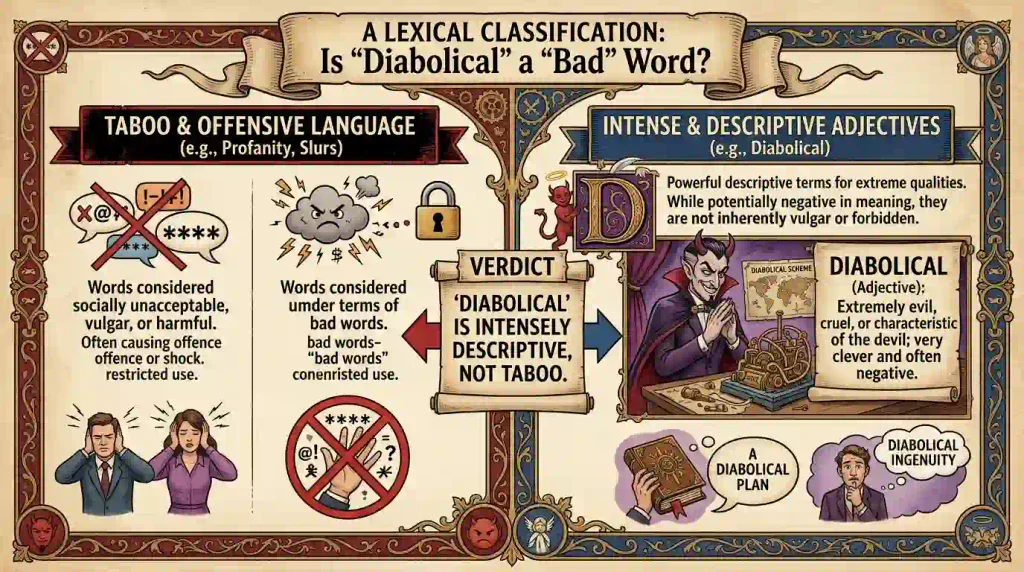
Diabolical is not a swear word. It is a standard English adjective.
However, it is a strong negative word. Calling a person, action, or plan diabolical can be a serious insult or accusation because the word can suggest extreme evil.
For example:
“His decision was diabolical.”
This is much stronger than:
“His decision was poor.”
The word is also common in fictional writing. Villains, evil plans, dangerous schemes, and frightening events are often described as diabolical.
In casual conversation, it can be less serious:
“That was a diabolical parking job.”
Here, the speaker is simply saying the parking was extremely bad.
So the word itself is not profanity, but its emotional strength depends on context.
Is Diabolical Formal or Informal?
Diabolical can be used in both formal and informal English.
The serious meaning can appear in books, journalism, formal discussions, and other serious writing.
The informal meaning “extremely bad” is especially common in casual speech and conversational writing. Oxford labels this second sense informal.
For example, in a serious context:
“The attack was described as a diabolical act of cruelty.”
In casual conversation:
“That restaurant’s service was diabolical.”
Both are grammatically correct, but they have different tones.
If you are writing for school or work, make sure the word fits the tone. Diabolical is useful when you want a strong description, but it can sound dramatic if a simple word such as bad or poor would be enough.
British vs American English: Is Diabolical Different?
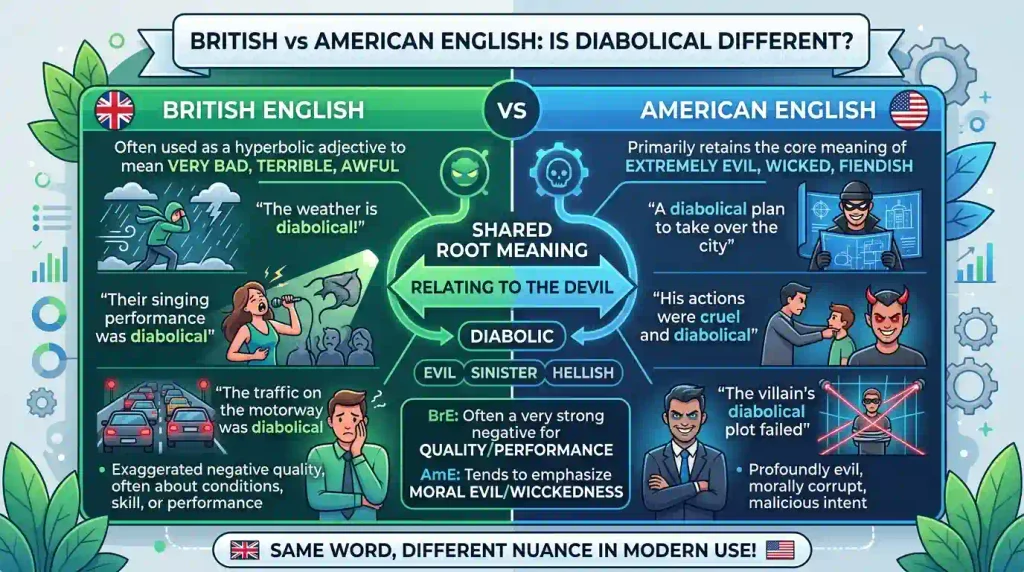
The word diabolical is used in both British and American English.
The main difference is not the core meaning but how often the informal “extremely bad” sense may appear in different contexts.
Cambridge lists the American pronunciation and notes that diabolic is also used in American English.
Oxford’s American dictionary also gives both the serious meaning and the informal “extremely bad or annoying” meaning.
So an American reader can understand:
“The traffic was diabolical.”
to mean:
“The traffic was absolutely terrible.”
You do not need to treat diabolical as a British-only word.
Origin and History of Diabolical

The history of diabolical is connected with the word devil and older words associated with the devil.
The word has a long history in English and comes through forms related to Latin and Greek terms for the devil or slanderer. This older connection helps explain why the word carries a strong sense of evil or wickedness.
Over time, English expanded the word beyond its most literal religious sense. Today, people can use diabolical to describe something extremely bad or annoying without making a religious statement.
That change is important when reading modern English. A sentence such as:
“The traffic was diabolical.”
is normally an exaggerated complaint, not a claim about supernatural forces.
The modern dictionary definitions from Oxford and Cambridge reflect both major uses: the serious sense connected with evil and the informal sense meaning extremely bad or shocking.
When Should You Use Diabolical?
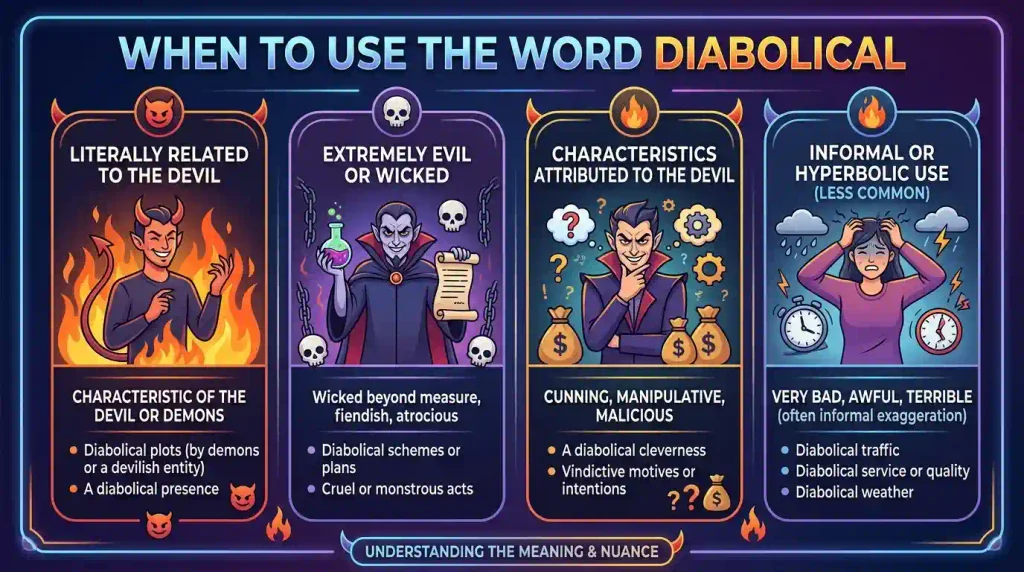
Use diabolical when you want to make a strong point.
It works especially well when something is:
Extremely evil.
Very cruel.
Shockingly bad.
Terrible or unacceptable.
Clever but harmful.
Dramatically unpleasant.
For example:
“The villain’s diabolical scheme fooled everyone.”
“The conditions at the old building were diabolical.”
“That was a diabolical thing to do.”
“The team faced diabolical weather during the trip.”
“The detective uncovered a diabolical plan.”
The word is most effective when you do not overuse it. If everything is described as diabolical, the word loses some of its impact.
FAQs
What is the simple meaning of diabolical?
Diabolical means extremely evil, cruel, shocking, or terrible. It can also describe something that is extremely bad or unpleasant. The exact meaning depends on context.
Does diabolical mean evil?
Yes. One of its main meanings is evil, cruel, or devil-like. However, it can also mean extremely bad in informal English.
Is diabolical a negative word?
Yes. Diabolical is normally negative. It describes something very evil, unpleasant, shocking, or terrible. It can sometimes suggest cleverness when describing a harmful plan or person.
What is another word for diabolical?
Depending on the sentence, synonyms include evil, wicked, devilish, demonic, terrible, awful, horrible, dreadful, and atrocious. No synonym works perfectly in every situation.
Is diabolical a swear word?
No. Diabolical is a normal English adjective, not profanity. However, it is a strong negative word and can sound harsh when used about a person or serious action.
What is the difference between diabolical and demonic?
Demonic mainly means connected with or resembling a demon. Diabolical can mean devil-like or extremely evil, but it can also mean extremely bad or shocking in informal English.
Conclusion
The diabolical meaning is usually extremely evil, cruel, shocking, or terrible. The word can describe an evil person, cruel action, harmful plan, or frightening situation. In informal English, it can also simply mean extremely bad, as in “The traffic was diabolical.”
The key is to look at the context. A diabolical crime suggests serious evil, while diabolical service usually means extremely poor service. The word is an adjective and works well when you need a strong description.
If you are learning English, remember this simple idea: diabolical = very evil or extremely bad. Use it when ordinary words such as “bad” or “evil” do not feel strong enough. Because it has a dramatic tone, use it naturally and avoid adding it to every negative situation.

Hi, I’m Benjamin Dreyer. I enjoy exploring words, phrases, slang, abbreviations, acronyms, and digital communication. At Linkquorax.com, I share simple and accurate explanations to help readers understand unfamiliar terms and popular internet expressions. My goal is to make every meaning clear, useful, and easy to understand. Whether you are curious about a new word or an online phrase, Linkquorax.com provides straightforward information to help you learn quickly and communicate with confidence in everyday conversations.