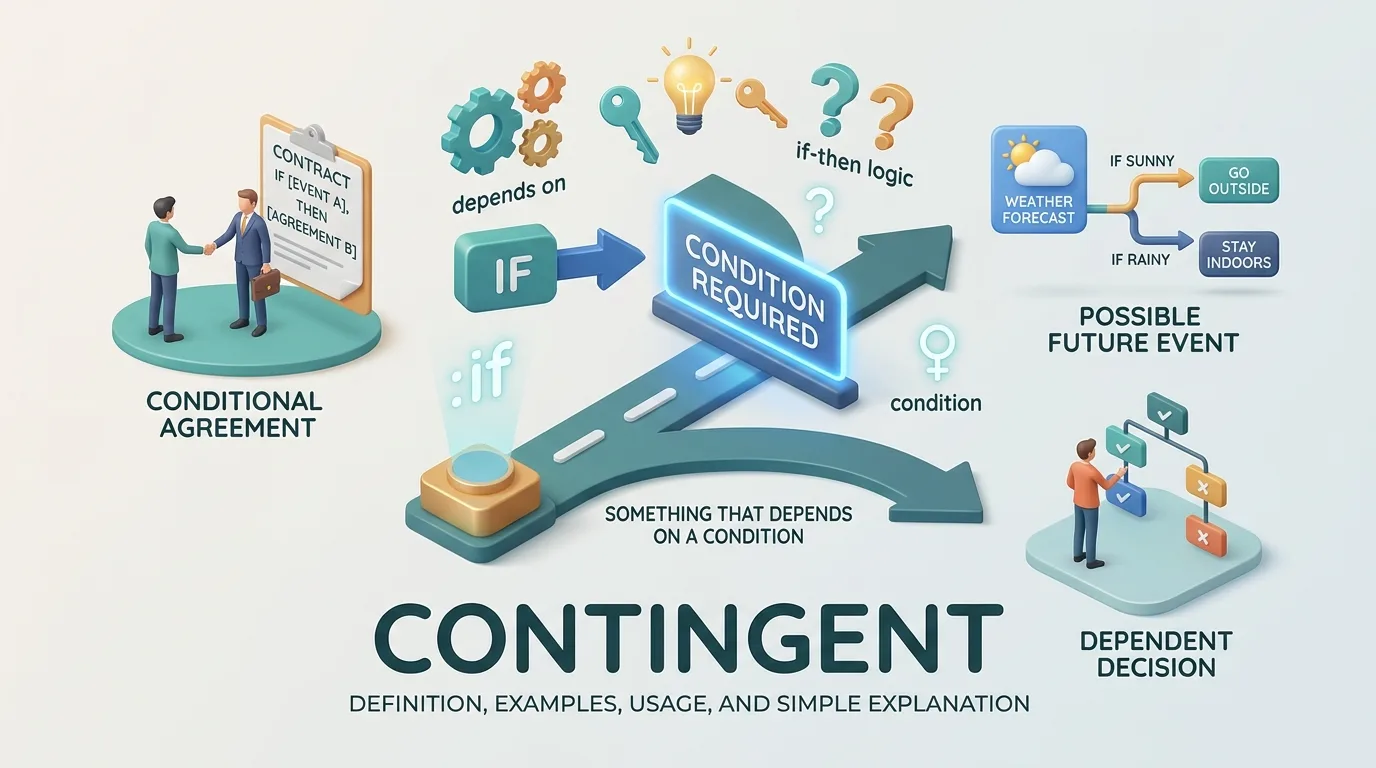
The word contingent usually means depending on something else that may or may not happen.
For example, “The trip is contingent on the weather” means the trip will happen only if the weather is good enough. Contingent can also be a noun meaning a group of people, especially a group representing an organization, country, or military force.
If you have seen the word contingent in a contract, news story, real estate listing, workplace message, or everyday conversation, its meaning can change slightly depending on the context.
This guide explains the most common meanings in simple American English, shows how to use the word correctly, and gives clear examples.
Quick Answer
Contingent meaning: something that depends on another event, condition, or situation before it can happen.
For example:
“The job offer is contingent on passing the background check.”
This means the job offer depends on the person passing the background check.
Contingent is also used as a noun:
“A large contingent of fans attended the game.”
Here, contingent means a group of people who share a connection or purpose.
The most common pattern is “contingent on” or “contingent upon.” Both mean that one thing depends on another.
| Word or phrase | Simple meaning | Example |
| Contingent | Depending on something | The plan is contingent on approval. |
| Contingent on | Depending on | The trip is contingent on the weather. |
| Contingent upon | Depending on | Payment is contingent upon completion. |
| Contingency | Something that might happen | We prepared for every contingency. |
| Contingently | In a way that depends on something | The money is paid contingently. |
Contingent Meaning and Definition
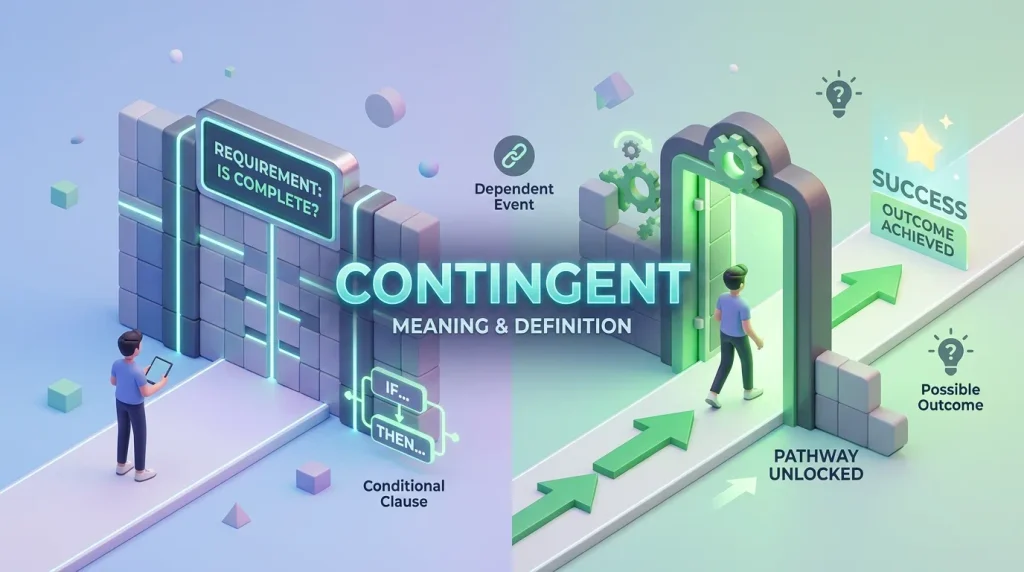
As an adjective, contingent describes something that depends on a condition or event. That condition may happen, or it may not happen.
Think of it as an “if” situation.
If A happens, B can happen.
If A does not happen, B may not happen.
For example, imagine someone wants to buy a house but needs to sell their current house first. You could say:
“The purchase is contingent on selling the current house.”
The purchase depends on the sale. If the current house is not sold, the purchase may not go forward.
Cambridge defines contingent on/upon as depending on something else in the future in order to happen. Oxford gives a similar definition: something contingent depends on something that may or may not happen.
This is why the word often appears in formal writing. It is useful when two events or decisions are connected by a condition.
Some simple synonyms include dependent, conditional, subject to, and based on. However, these words are not always perfect replacements in every sentence.
| Example | What “contingent” means |
| The event is contingent on good weather. | The event depends on good weather. |
| Approval is contingent upon the review. | Approval depends on the review. |
| The bonus is contingent on performance. | The bonus depends on performance. |
| The agreement is contingent on funding. | The agreement depends on funding. |
| The plan is contingent on available resources. | The plan depends on available resources. |
What Does Contingent Mean in Simple English?
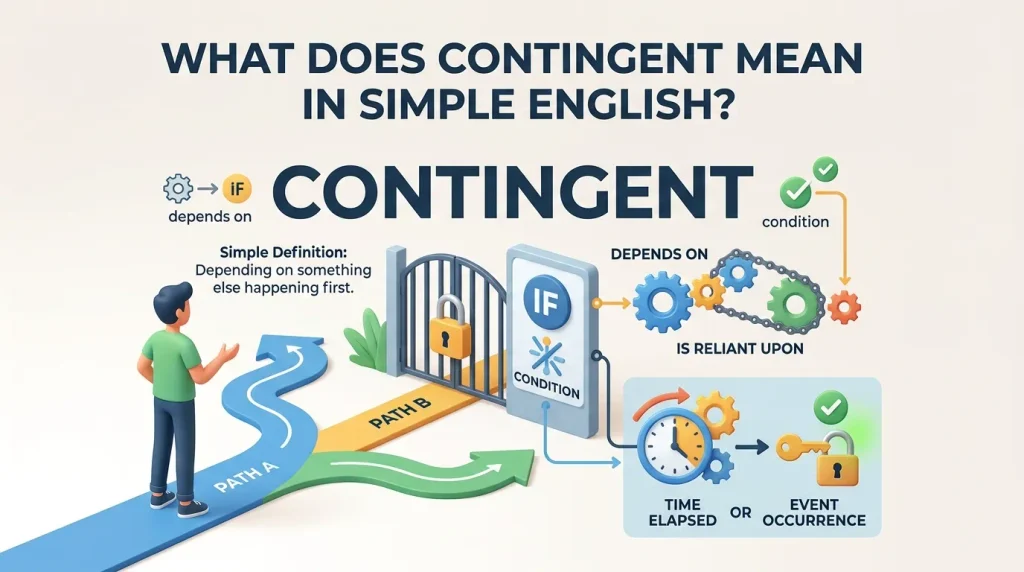
In very simple English, contingent means “dependent on something else.”
A useful way to remember it is:
Contingent = “It will happen if this other thing happens.”
For example:
“The picnic is contingent on the weather.”
Simple meaning:
“We will have the picnic if the weather is good.”
Another example is:
“Her admission is contingent on meeting the requirements.”
Simple meaning:
“She can be admitted if she meets the requirements.”
The word often suggests that the final result is not certain yet. Something still needs to happen before the result is known.
That makes contingent different from words such as certain or guaranteed.
If a payment is guaranteed, you expect it to happen without another condition. If a payment is contingent on completing a task, the payment depends on that task being completed.
Contingent as an Adjective
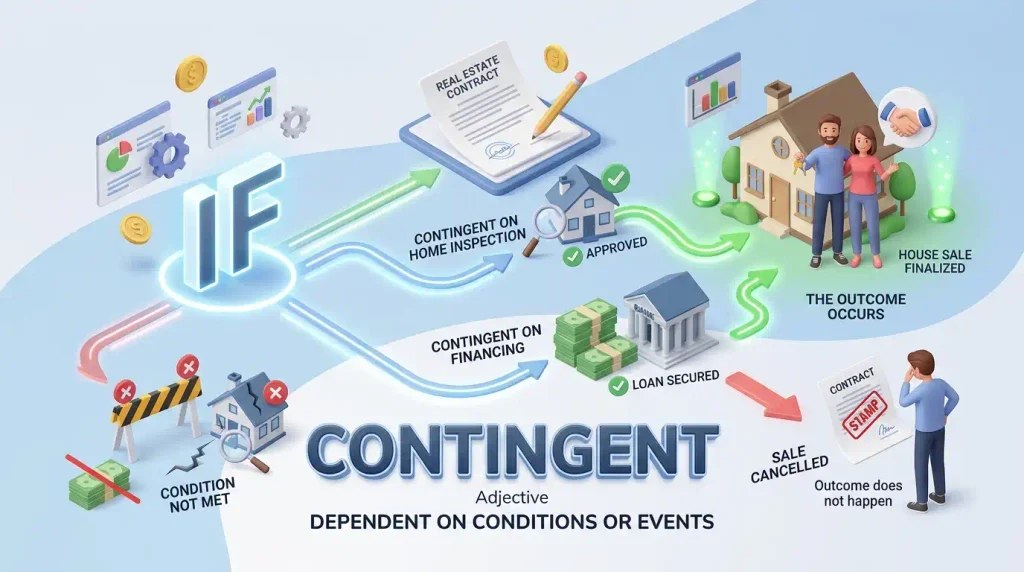
The most common use of contingent is as an adjective.
An adjective describes a person, place, thing, or situation. When contingent is used this way, it means dependent on a particular condition or future event.
The usual structure is:
contingent on + noun
or
contingent upon + noun
For example:
“The project is contingent on receiving funding.”
Here, the project depends on receiving funding.
You can also use a verb ending in -ing after “on”:
“The purchase is contingent on receiving approval.”
The basic idea remains the same: approval must happen before the purchase can move forward.
Contingent upon has the same basic meaning as contingent on, but it often sounds more formal. You may see it in contracts, business documents, official statements, and legal writing.
For everyday conversation, contingent on is usually simple and natural.
Contingent on vs. Contingent Upon

Both contingent on and contingent upon are correct.
The difference is mainly style.
Contingent on is common and straightforward:
“The trip is contingent on the weather.”
Contingent upon sounds more formal:
“The agreement is contingent upon final approval.”
You do not need to use upon just because the situation is serious. In many everyday sentences, on is easier to understand.
| Phrase | Meaning | Style |
| Contingent on | Depending on something | Common and clear |
| Contingent upon | Depending on something | More formal |
| Depends on | Needs something else to happen | Very common |
| Subject to | Controlled or affected by a condition | Formal |
For simple American English, contingent on is often the best choice.
Contingent Meaning in Real Estate

You may see contingent often when reading about homes for sale.
In real estate, a contingent offer usually means a buyer has made an offer, but the deal depends on one or more conditions being met.
For example, a buyer might make an offer that is contingent on:
- A home inspection
- Financing or mortgage approval
- The sale of the buyer’s current home
- A satisfactory appraisal
- Another agreed condition
A listing might therefore say that a property is contingent rather than fully available for an unconditional sale.
The exact meaning of a contingent status can vary by contract, listing service, and local real estate practice. So buyers and sellers should read the actual agreement instead of assuming that every “contingent” listing has the same conditions.
A simple example is:
“The buyer’s offer is contingent on a successful home inspection.”
This means the buyer may proceed with the purchase if the inspection meets the agreed conditions.
Contingent Meaning in Business and Work

In business, contingent is often used when a decision, payment, contract, or job depends on another condition.
For example:
“The contract is contingent on board approval.”
This means the contract depends on the board approving it.
You might also hear about contingent workers or contingent work. Oxford describes a contingent worker as someone who does not have a permanent contract with a company. This can include certain temporary or other non-permanent work arrangements.
For example:
“The company hired several contingent workers for the busy season.”
In this context, contingent is not simply saying that the workers are “dependent on something.” It is describing a type of work arrangement.
This is an important point: the meaning of contingent depends on how the word is being used.
Contingent Meaning in Contracts and Legal Language

The word contingent is common in contracts because contracts often contain conditions.
For example:
“Payment is contingent upon completion of the project.”
This means payment depends on the project being completed.
Another example:
“The agreement is contingent on regulatory approval.”
This means the agreement depends on receiving the required approval.
In legal or business documents, the exact condition matters. A sentence containing contingent may have important consequences because it can identify what must happen before an obligation takes effect.
For that reason, you should not rely only on the dictionary meaning when reading a real contract. Read the surrounding language carefully, and seek qualified legal advice when the agreement has significant legal or financial consequences.
Contingent Meaning as a Noun

Contingent can also be a noun.
As a noun, it means a group of people who have something in common or who are part of a larger group. Cambridge and Oxford both give this meaning.
For example:
“A large contingent of students attended the conference.”
Here, contingent means a group of students.
Another example:
“The American contingent arrived early.”
This means the group representing the United States arrived early.
The noun can also refer to soldiers who form part of a larger military force.
For example:
“A French contingent served as part of the international force.”
Oxford lists this military meaning as a group of soldiers that forms part of a larger force.
So, when you see a contingent of people, think:
“a group of people who are connected in some way.”
Contingent vs. Contingency
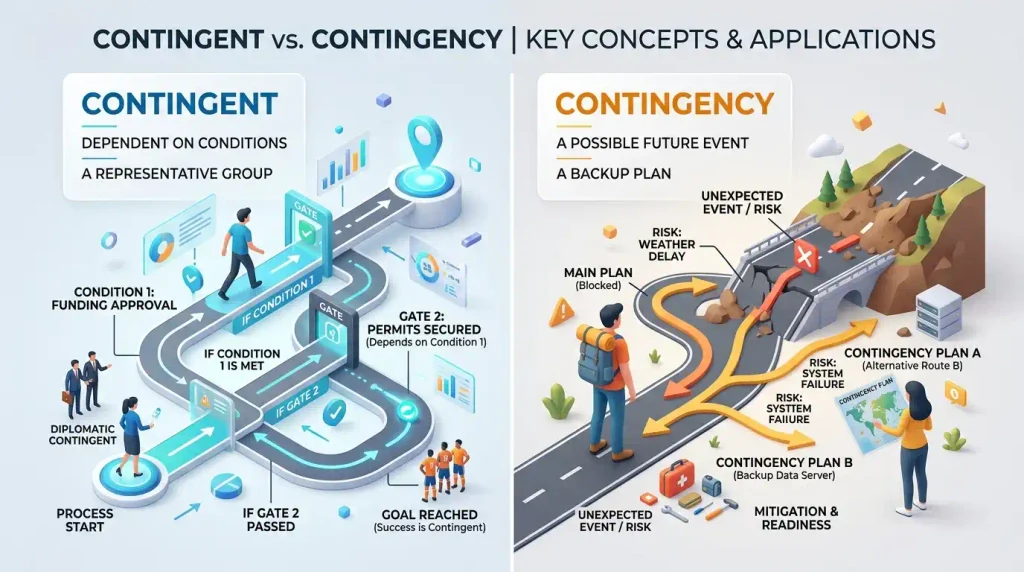
Top Contingent and contingency are related words, but they are not used in exactly the same way.
Contingent is commonly an adjective meaning dependent on something.
Contingency is a noun referring to a possible future event or situation, often one that could create a problem or require a different plan. Cambridge defines a contingency as something that might happen in the future, especially something that could require further arrangements.
For example:
“The trip is contingent on the weather.”
Here, the contingent describes the trip.
But:
“We have a plan for bad weather as a contingency.”
Here, contingency means the possible situation that may occur.
A contingency plan is a plan prepared for something that might happen.
| Word | Part of speech | Meaning | Example |
| Contingent | Adjective | Depending on something | The deal is contingent on approval. |
| Contingent | Noun | A group of people | A large contingent attended. |
| Contingency | Noun | A possible future event or problem | We prepared for every contingency. |
| Contingently | Adverb | In a dependent way | Payment was made contingently. |
Contingent vs. Conditional
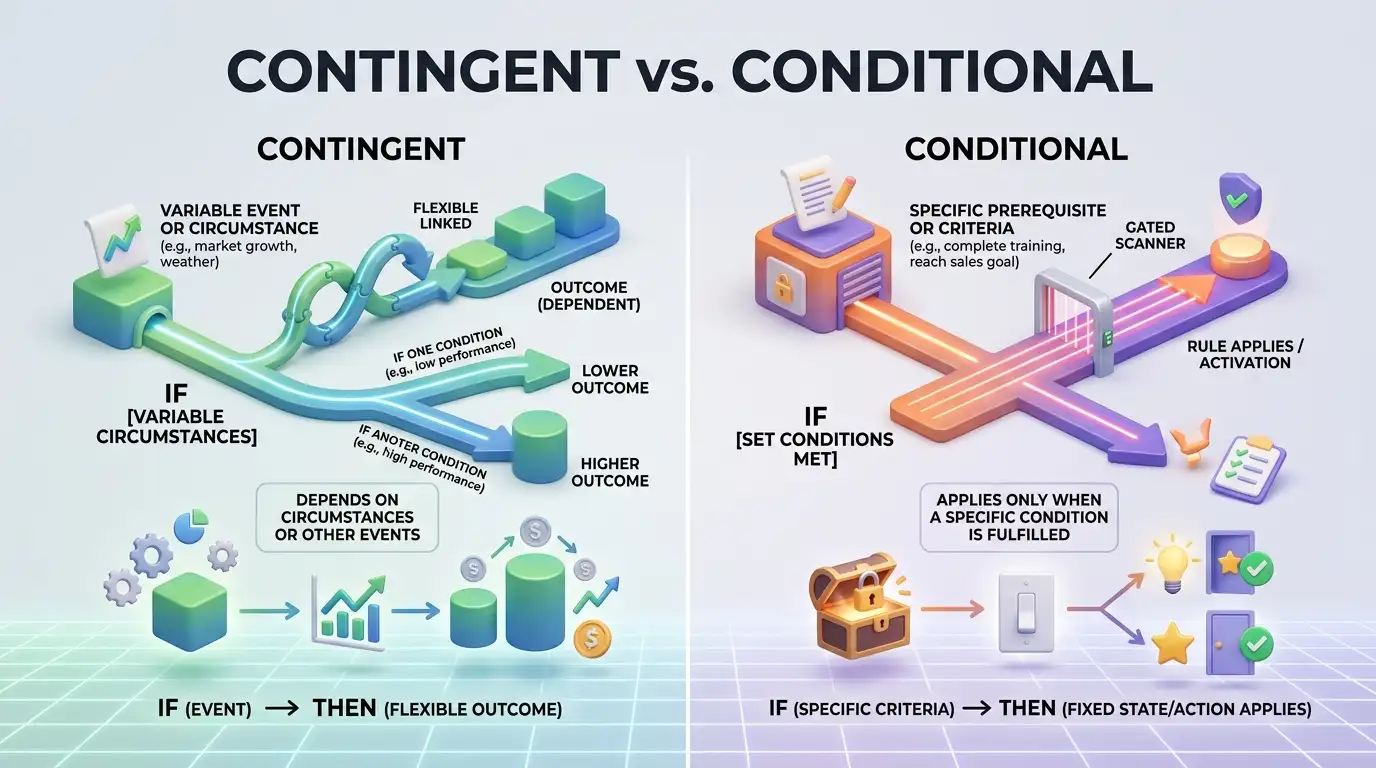
Contingent and conditional can be close in meaning, but they are not always interchangeable.
Something conditional depends on a condition.
Something contingent on something also depends on that thing happening.
For example:
“The offer is conditional on approval.”
and:
“The offer is contingent on approval.”
Both sentences communicate a similar idea.
However, contingent can emphasize that the outcome depends on an event that may or may not happen. Conditional is broader and can describe many types of conditions.
For everyday writing, choose the word that sounds most natural for your situation.
Contingent vs. Dependent
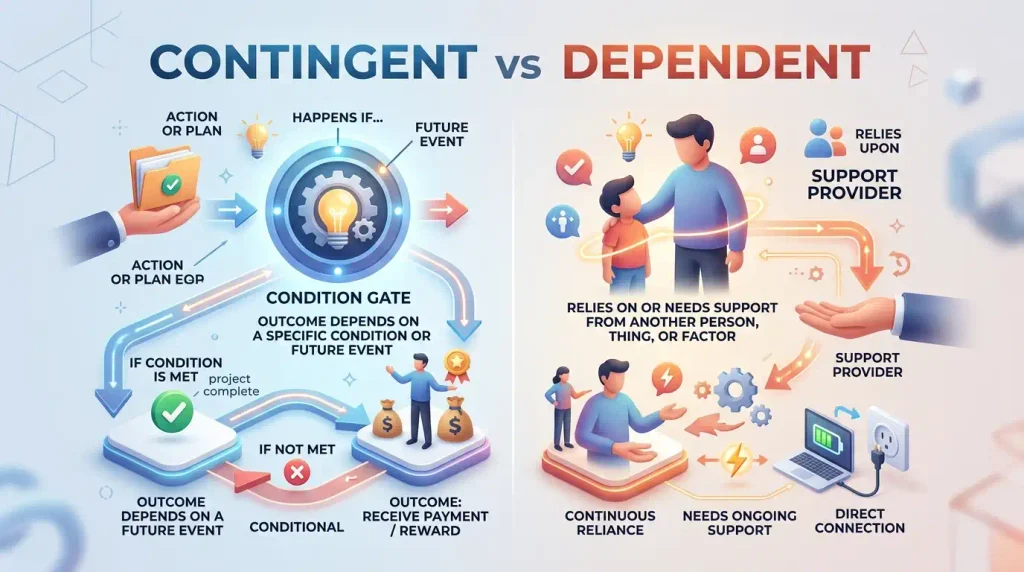
Dependent is usually the easiest synonym for contingent.
Compare these sentences:
“The decision is contingent on the results.”
“The decision is dependent on the results.”
Both mean that the results will affect the decision.
The difference is mostly tone. Dependent on is very common in everyday English. Contingent on often sounds more formal or precise.
If you are writing for a general audience, you can often replace contingent on with depends on.
For example:
“The event is contingent on the weather.”
Simple version:
“The event depends on the weather.”
The second sentence is easier for most readers.
Origin and History of the Word Contingent

The history of contingent helps explain why the word is connected to chance, events, and conditions.
Oxford traces the word to Late Middle English and says it came from Latin contingere, meaning “befall” or “happen to.” The Latin word was also connected with the idea of touching.
Etymonline traces the adjective to the late 14th century, with meanings related to circumstances that were not certain or predictable. It also records later meanings connected with chance and groups forming part of a larger group.
Over time, the word developed several related uses.
The basic idea stayed connected to something that happens because of circumstances rather than absolute necessity.
Today, the most useful meaning for everyday readers is still:
depending on something that may or may not happen.
How to Pronounce Contingent
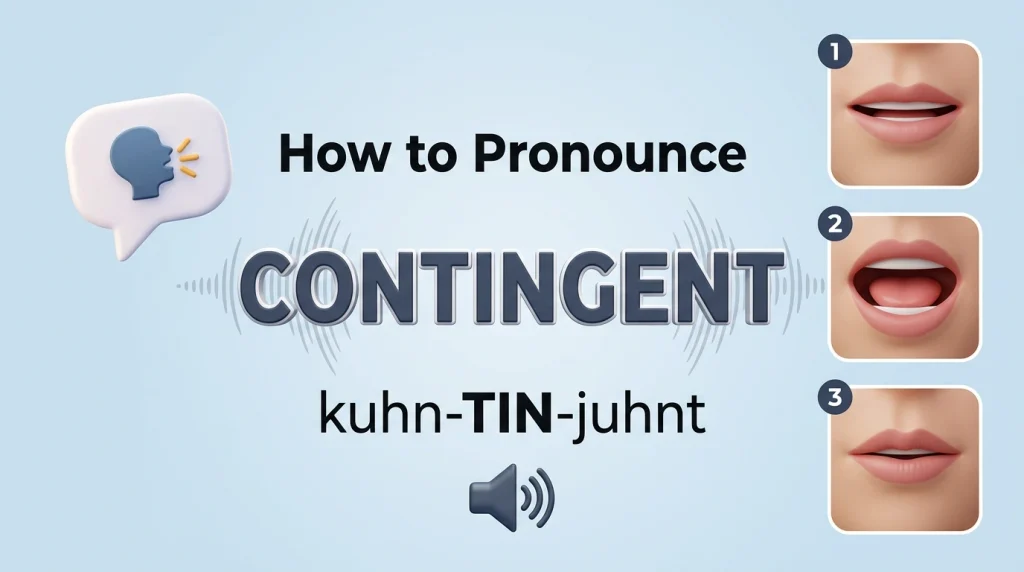
In American English, contingent is pronounced roughly like:
kuhn-TIN-jent
The stress falls on the middle syllable.
The word has three main syllables:
con – tin – gent
It can be helpful to say it slowly first:
kuhn-TIN-jent
Then say it naturally in a sentence:
“The plan is contingent on the weather.”
Learning pronunciation is useful because contingent is common in business, academic, and formal English but may be less familiar in casual conversation.
Common Mistakes With Contingent
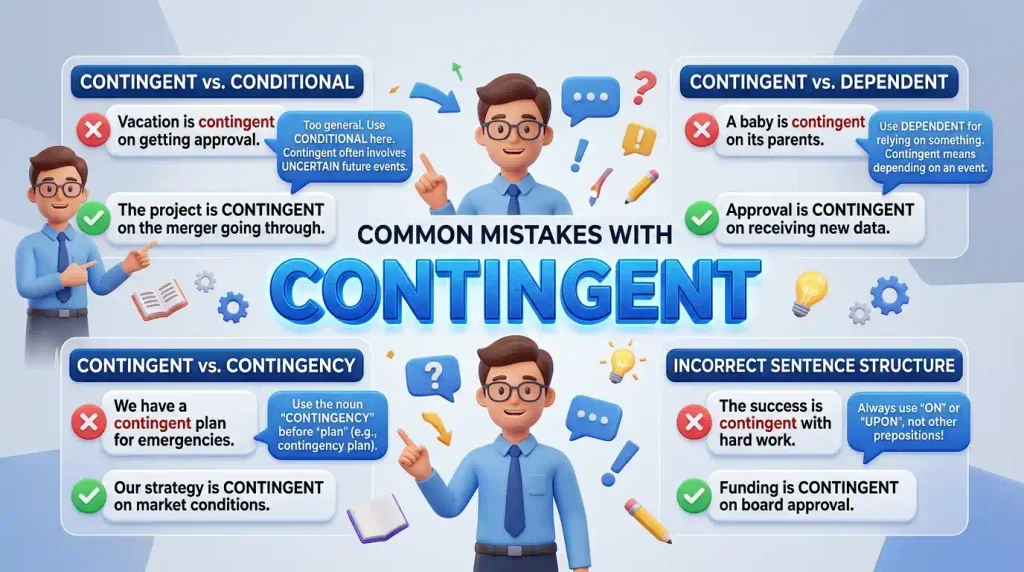
One common mistake is using contingent when you simply mean possible.
For example, saying:
“A contingent event may happen.”
does not clearly communicate the usual relationship between two conditions.
If you mean that something depends on another thing, contingent on is more precise.
Another common mistake is forgetting on or upon.
Instead of:
“The project is contingent funding.”
write:
“The project is contingent on funding.”
Another mistake is confusing the adjective and noun forms.
In:
“The project is contingent on funding.”
contingent is an adjective.
In:
“A large contingent attended the meeting.”
contingent is a noun.
The surrounding sentence usually makes the intended meaning clear.
Real-Life Examples of Contingent
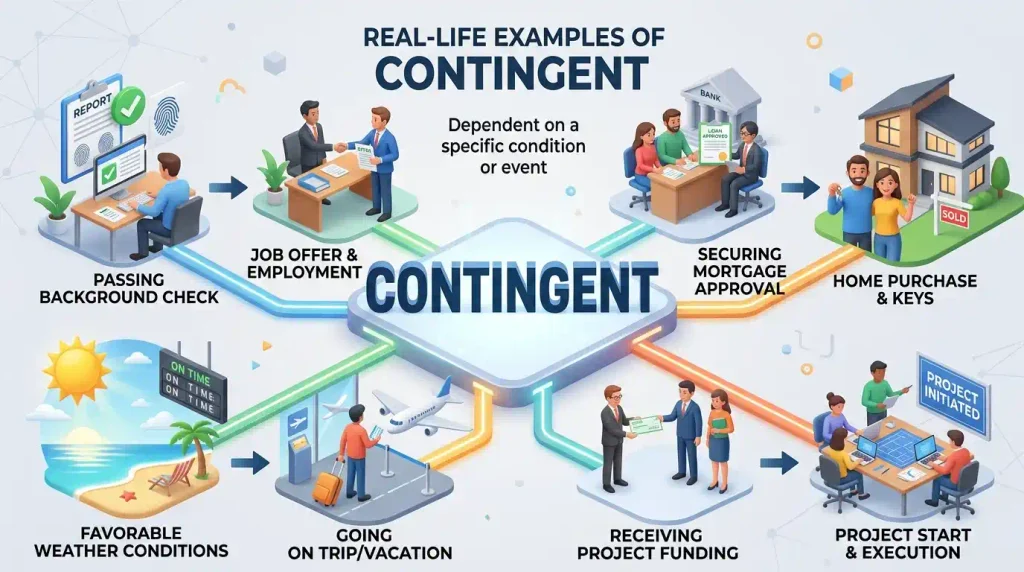
The easiest way to understand contingent is to see it in different situations.
In school:
“The field trip is contingent on permission from the school.”
This means the trip depends on getting permission.
At work:
“The promotion is contingent on meeting the required goals.”
This means meeting the goals is necessary for the promotion.
In business:
“The agreement is contingent on final approval.”
This means the agreement depends on approval.
In travel:
“Our outdoor plans are contingent on the weather.”
This means the plans may change if the weather is not suitable.
In real estate:
“The offer is contingent on the home inspection.”
This means the offer depends on the inspection condition.
In sports:
“The team’s participation is contingent on the final decision.”
This means participation depends on that decision.
As a noun:
“A large contingent of supporters arrived.”
Here, contingent means a group of supporters.
These examples show why context matters. The adjective and noun forms are spelled the same, but their meanings and grammar are different.
Synonyms for Contingent
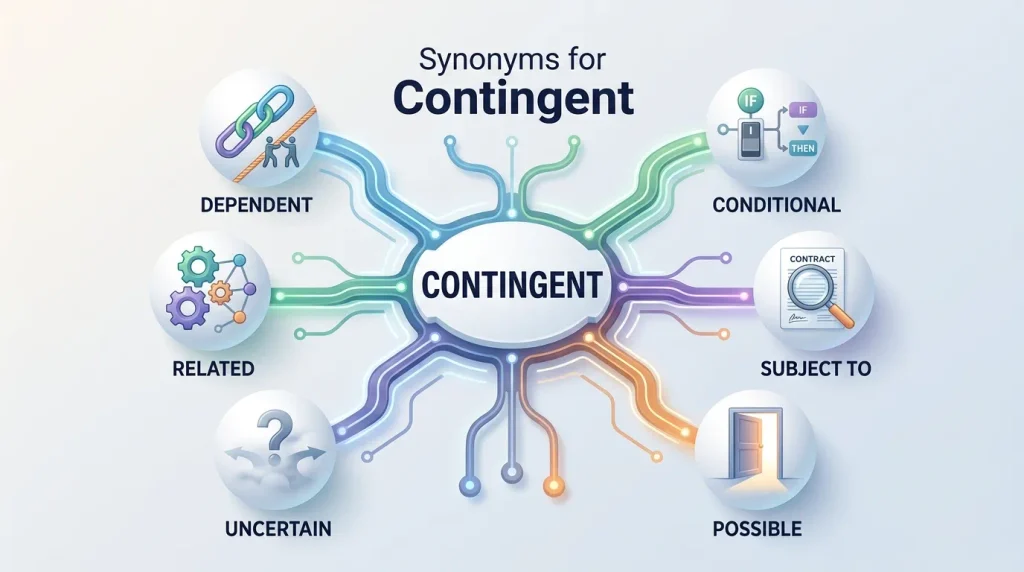
Depending on the sentence, useful synonyms for contingent include:
Dependent — needing something else to happen.
Conditional — based on a particular condition.
Subject to — affected or controlled by a condition.
Possible — able to happen, though this does not always show dependence.
Uncertain — not known or guaranteed.
Chance-based — influenced by chance or circumstances.
The best synonym depends on the sentence.
For example, dependent on is a strong replacement for contingent on:
“The result is dependent on the test.”
But possible would not always work:
“The result is possible on the test.”
That changes the meaning and sounds unnatural.
When Should You Use the Word Contingent?
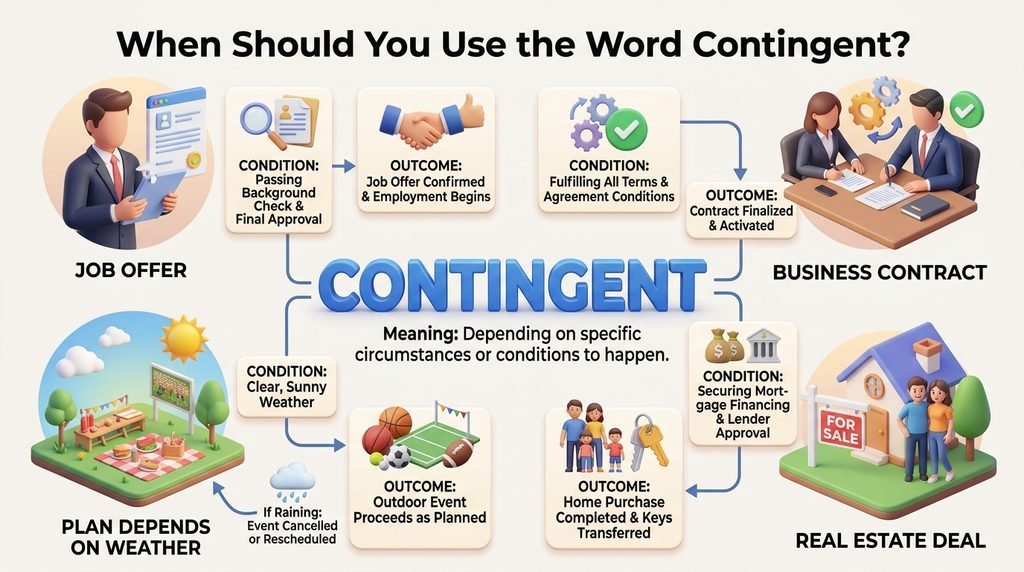
Use contingent when you want to clearly show that one thing depends on another.
It works especially well when writing about:
Plans: “The event is contingent on the weather.”
Contracts: “The agreement is contingent on approval.”
Money: “The payment is contingent upon completion.”
Jobs: “The offer is contingent on passing the required checks.”
Real estate: “The purchase is contingent on financing.”
Business decisions: “The launch is contingent on final testing.”
It is a useful word, but you do not need to use it everywhere. If depends on communicates the idea more clearly, especially for children or general readers, use the simpler phrase.
Good writing is not about choosing the most complicated word. It is about choosing the clearest word.
FAQs
What does contingent mean in simple words?
Contingent means depending on something else. If one event is contingent on another event, the first event depends on the second one happening.
What does “contingent on” mean?
“Contingent on” means depending on. For example, “The trip is contingent on the weather” means the trip depends on whether the weather is suitable.
What is an example of contingent?
An example is: “The job offer is contingent on passing the background check.” This means the job offer depends on passing the check.
What is the difference between contingent and contingency?
Contingent usually describes something that depends on a condition. Contingency is a noun for a possible future event or situation, often one that may require a backup plan.
Is contingent a positive or negative word?
Neither. Contingent is a neutral word. It simply explains that something depends on another condition or event. The situation around it determines whether the result is good or bad.
What is the difference between contingent and conditional?
They can have similar meanings. Both can describe something that depends on a condition. Contingent on is often used to show that an outcome depends on something that may happen, while conditional is a broader term for something based on a condition.
Conclusion
The simplest contingent meaning is “depending on something else.” When you see contingent on or contingent upon, look for the condition that must happen before the main event can happen.
For example, if a trip is contingent on good weather, the If affects whether the trip will take place.
The word can also be a noun. In that form, a contingent means a group of people connected by a shared organization, country, purpose, or role. It can also describe a group of soldiers within a larger military force.
Remember the simple rule: contingent = dependent on a condition, while contingency = a possible future event or situation. Once you understand that difference, you can recognize and use the word confidently in everyday, business, academic, and formal English.

Hi, I’m Benjamin Dreyer. I enjoy exploring words, phrases, slang, abbreviations, acronyms, and digital communication. At Linkquorax.com, I share simple and accurate explanations to help readers understand unfamiliar terms and popular internet expressions. My goal is to make every meaning clear, useful, and easy to understand. Whether you are curious about a new word or an online phrase, Linkquorax.com provides straightforward information to help you learn quickly and communicate with confidence in everyday conversations.