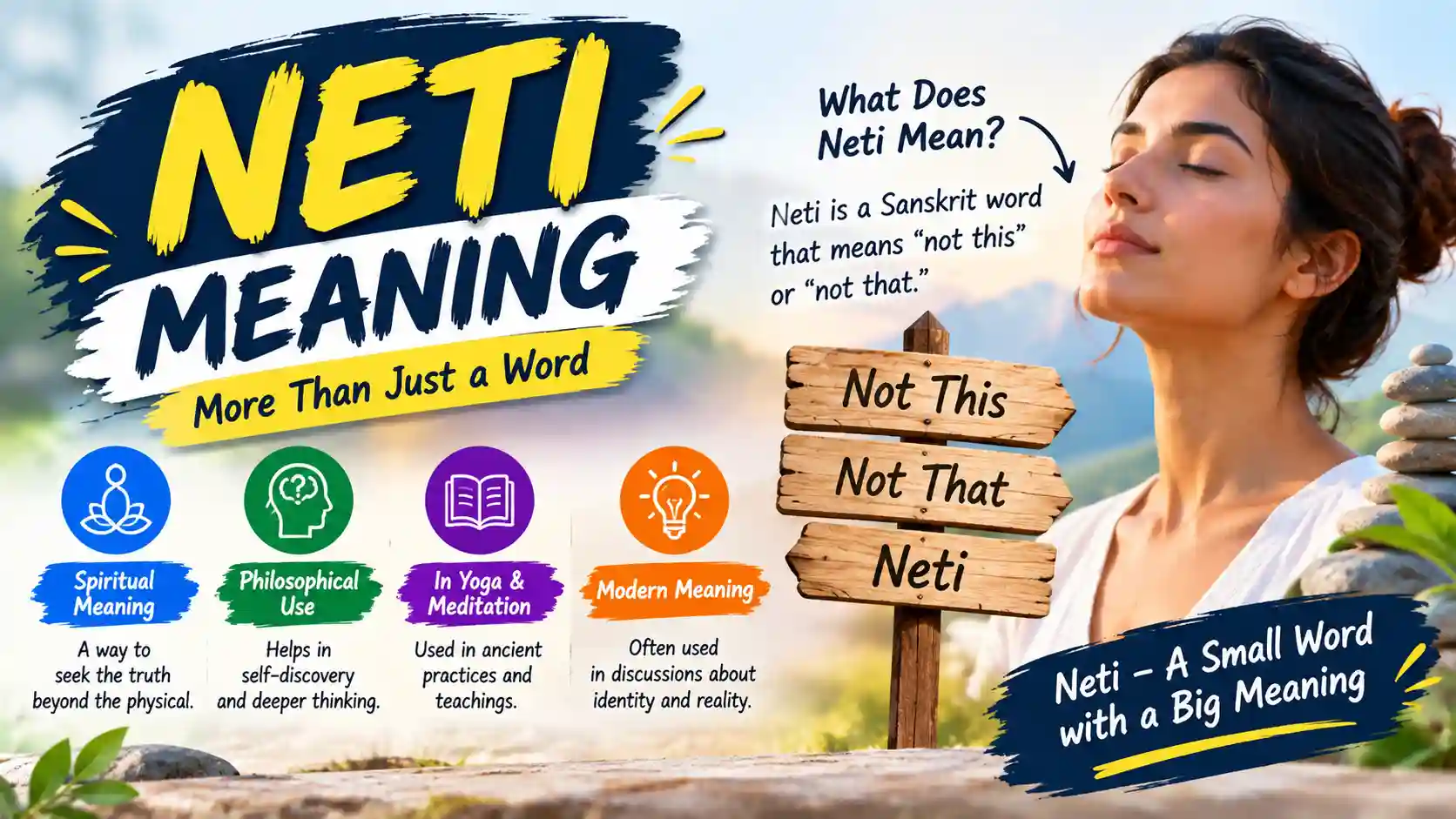
If you are searching for the neti meaning, the word usually refers to a yogic cleansing practice from Sanskrit traditions. In yoga, neti is a method used to cleanse the nasal passages, most commonly with a saline-water rinse called jala neti.
The word can also appear in philosophical contexts, especially in the Sanskrit phrase “neti neti,” meaning “not this, not this.” The exact meaning therefore depends on where you saw the word.
This guide explains the different meanings of neti, its Sanskrit background, how neti is used in yoga, what “neti neti” means, common examples, and mistakes people make when interpreting the term.
Quick Answer:
Neti is a Sanskrit term best known in yoga for a nasal cleansing practice. It is traditionally included among the shatkarma or shatkriya, a group of cleansing practices described in some traditional Hatha Yoga texts.
The most familiar form is jala neti, in which saline water is gently passed through one nostril and allowed to flow out through the other.
However, neti can have a different meaning in the philosophical expression neti neti, where it means “not this” or “not this, not that.”
| Term | Simple meaning | Common context |
| Neti | Nasal cleansing practice | Yoga |
| Jala neti | Water-based nasal cleansing | Hatha Yoga |
| Sutra neti | Traditional cleansing using a thread or catheter-like material | Yoga |
| Neti neti | “Not this, not this” | Hindu philosophy, Upanishadic thought |
So, if someone asks, “What does neti mean?”, the safest answer is: It usually refers to a traditional yogic nasal-cleansing practice, but “neti neti” has a separate philosophical meaning.
Neti Meaning in Yoga
In modern discussions about yoga, neti most often means a practice for cleansing the nasal passages.
The best-known version is jala neti. Jala is a Sanskrit word associated with water, so jala neti is commonly translated as water neti or water-based nasal cleansing.
Traditional Hatha Yoga sources describe neti as one of several cleansing practices. These practices were intended to prepare the body for other aspects of yoga, including breathing exercises and meditation.
Today, many people know neti through the neti pot, a small container designed to help rinse the nasal passages with saline solution.
It is important, however, to separate the traditional practice from modern health claims. Neti is not a cure for every sinus or breathing problem, and using unsafe water can create serious health risks.
The simple idea behind jala neti is straightforward: a saline solution is used to gently rinse the nasal passages.
What Is Jala Neti?
Jala neti is the water-based form of neti and is probably the meaning most people encounter when searching for “neti.”
A typical jala neti setup involves:
- A neti pot or similar nasal-rinsing device
- Properly prepared saline solution
- Safe water
- A gentle flow through the nasal passages
The saline solution matters because plain water can be uncomfortable in the nose. A properly prepared solution is designed to be closer to the salt concentration of body fluids.
The technique should also be gentle. Nasal rinsing is not meant to involve force or pressure.
For modern medical safety, the water used for nasal irrigation should be distilled, sterile, or previously boiled and cooled. Tap water should not be used directly for nasal rinsing because contaminated water can introduce dangerous organisms into the nasal passages.
| Traditional term | Meaning in simple English |
| Jala | Water |
| Neti | Yogic cleansing practice |
| Jala neti | Water-based nasal cleansing |
| Neti pot | Device commonly used for nasal irrigation |
What Is Sutra Neti?
Another traditional form is called sutra neti.
Unlike jala neti, which uses water, sutra neti involves passing a specially prepared flexible material through the nasal passage as part of a traditional cleansing technique.
This is considerably more advanced than ordinary nasal irrigation. It should not be treated like a casual home remedy or attempted without proper instruction from a qualified practitioner.
For most people who encounter the term neti online today, jala neti and ordinary saline nasal irrigation are much more relevant than sutra neti.
The distinction is useful because articles and videos sometimes use “neti” as if every form of the practice is identical. It is not.
What Does Neti Neti Mean?
The phrase neti neti has a completely different use.
In Sanskrit philosophical writing, neti neti is commonly translated as “not this, not this.” It is associated with the process of describing ultimate reality by saying what it is not.
The expression is especially associated with the Upanishadic tradition, including the Brihadaranyaka Upanishad.
Instead of defining ultimate reality by giving it a simple physical description, the phrase points away from limited concepts.
For example, the idea can be understood like this:
You may say that the deepest self is not merely the body. It is not simply a passing emotion. It is not one temporary thought. By removing these limited identifications, the seeker moves toward a deeper philosophical understanding.
This is why neti neti meaning is often explained as:
Not this. Not this.
It is not simply a negative statement. In its philosophical context, it is a method of inquiry.
| Expression | Meaning | Context |
| Neti | Yogic cleansing | Yoga |
| Neti neti | Not this, not this | Indian philosophy |
| Jala neti | Water cleansing | Hatha Yoga |
| Sutra neti | Traditional nasal-cleansing technique | Hatha Yoga |
Neti Meaning in Sanskrit
The word neti can be confusing because its meaning changes with context.
When people discuss yoga, neti refers to a cleansing practice. When they discuss Vedantic or Upanishadic philosophy, neti neti has a philosophical meaning.
This is a good example of why translating a Sanskrit term using only one English word can be misleading.
Sanskrit terms often carry meaning through their surrounding context. A person reading neti in a yoga manual is likely dealing with the cleansing practice, while someone reading neti neti in a philosophy book is dealing with a very different idea.
Therefore, the sentence or phrase where you found the word matters.
History and Traditional Background of Neti
Neti is associated with traditional Hatha Yoga.
Classical Hatha Yoga literature describes cleansing practices intended to support physical preparation for yoga. One important source is the Hatha Yoga Pradipika, a traditional text that discusses several cleansing actions.
Another important text is the Gheranda Samhita, which also describes cleansing practices.
The historical context is important because traditional yoga was much broader than the modern image of yoga as exercise. Classical systems included practices involving physical discipline, breath, concentration, meditation, and spiritual development.
Modern nasal irrigation is related to the practical cleansing aspect of neti, but it should not automatically be treated as identical to every traditional description.
That distinction helps avoid two common problems: presenting an ancient practice as if it were modern medical treatment, or dismissing its historical meaning because it does not fit modern definitions.
Neti Pot Meaning
A neti pot is a small container used for nasal irrigation.
It usually has a narrow spout that fits gently against one nostril. When the head is positioned correctly, saline solution can flow through one nasal passage and out through the other.
The neti pot itself is not the same thing as neti. Rather, it is a modern tool commonly used to perform jala neti-style nasal cleansing.
Today, similar nasal irrigation devices include squeeze bottles and other specially designed systems.
The important issue is not the shape of the device but proper technique, appropriate saline concentration, and safe water.
Is Neti Good for Sinuses?
Saline nasal irrigation can help remove mucus and allergens from the nasal passages and may provide relief for some people with nasal or sinus symptoms.
However, it should not be described as a cure for sinus disease.
People with frequent or severe sinus problems should speak with a healthcare professional rather than relying only on home nasal rinsing.
There are also important safety rules.
Never use untreated tap water for nasal irrigation. The FDA and other health authorities recommend using distilled, sterile, or appropriately boiled water for nasal rinsing.
The device should also be cleaned and dried properly after use.
If nasal irrigation causes significant pain, bleeding, severe irritation, or other unusual symptoms, stop using it and seek appropriate medical advice.
How Is Neti Different From Regular Nasal Spray?
Neti and nasal spray are not the same thing.
A saline nasal spray generally delivers a small amount of saline into the nose. Nasal irrigation uses a larger amount of saline solution to rinse the nasal passages.
Some people use saline irrigation as part of their personal nasal-care routine, while others prefer sprays because they are quicker and easier to use.
Neither should automatically be considered better for everyone. The right choice depends on the person’s symptoms, preferences, and medical situation.
| Feature | Neti-style nasal irrigation | Saline nasal spray |
| Main purpose | Rinses nasal passages | Moistens or delivers saline |
| Amount of liquid | Usually larger | Usually smaller |
| Common device | Neti pot or irrigation bottle | Spray bottle |
| Water safety | Very important | Product is usually prepared commercially |
| Technique | Requires proper positioning | Generally simpler |
Common Mistakes About the Meaning of Neti
One common mistake is assuming that neti always means “not this.” That interpretation usually comes from neti neti, not from the yoga cleansing practice.
Another mistake is assuming that every reference to neti means a neti pot. The traditional term is broader than one modern device.
People also sometimes confuse traditional yoga instructions with medical advice. A historical description of a practice does not automatically prove that every claimed health benefit is medically established.
Finally, people may treat nasal irrigation as completely risk-free. It is generally considered safe when performed correctly, but water quality and equipment hygiene matter greatly.
Understanding these differences makes it easier to discuss neti accurately.
Neti in Modern English
In American English, neti is most commonly seen in conversations about:
- Yoga
- Nasal irrigation
- Sinus care
- Neti pots
- Saline rinsing
- Meditation and Indian philosophy
- Sanskrit terminology
The word is not a common everyday English word like “water” or “cleaning.”
If you saw it on a health website, it probably refers to nasal irrigation. If you saw neti neti in a book about Hindu philosophy, spirituality, Vedanta, or the Upanishads, the philosophical meaning is more likely.
Real-Life Examples of Neti
Here are a few examples showing how the word can appear in different contexts.
Example 1:
“She uses a neti pot for saline nasal irrigation.”
Here, neti refers to the nasal-cleansing practice.
Example 2:
“Jala neti is a traditional yogic cleansing practice.”
Here, jala neti specifically refers to water-based nasal cleansing.
Example 3:
“The teacher explained the idea of neti neti.”
Here, the term has a philosophical meaning: “not this, not this.”
Example 4:
“I first heard about neti while learning about Hatha Yoga.”
Here, the word refers to the traditional yogic practice.
Example 5:
“The book discussed neti neti as a method of philosophical inquiry.”
Here, neti neti is not referring to nasal cleansing at all.
Why Context Matters When Understanding Neti
The biggest lesson about neti meaning is that context changes the answer.
If you only see the single word “neti,” you may not know whether the writer means yoga, nasal irrigation, or something connected to Sanskrit philosophy.
Look at the words around it.
If you see jala, neti pot, saline, nasal, or sinus, the topic is probably nasal cleansing.
If you see neti neti, Atman, Brahman, Vedanta, or Upanishads, the topic is probably philosophy.
This simple approach can prevent a lot of confusion.
Frequently Asked Questions
What is the simple meaning of neti?
In yoga, neti refers to a traditional cleansing practice, especially nasal cleansing. The best-known form is jala neti, which uses saline water to rinse the nasal passages.
What does neti neti mean?
Neti neti is commonly translated as “not this, not this.” It is a philosophical expression associated with the Upanishadic tradition and is used to point beyond limited descriptions of ultimate reality.
What does jala neti mean?
Jala neti means water-based neti. It is a traditional yogic nasal-cleansing practice involving saline water and is commonly performed with a neti pot or similar device.
Is neti the same as a neti pot?
Not exactly. Neti refers to the practice, while a neti pot is a tool commonly used to perform water-based nasal irrigation.
Is neti safe?
Saline nasal irrigation can be safe when performed correctly, but proper water safety and equipment hygiene are essential. Use distilled, sterile, or appropriately boiled water rather than untreated tap water.
Does neti help with sinus problems?
Saline nasal irrigation may help clear mucus and allergens and may relieve some nasal symptoms. However, it is not a cure for every sinus condition, and persistent or severe symptoms should be discussed with a healthcare professional.
Conclusion
The neti meaning depends on context, but in modern yoga discussions, it usually refers to a traditional nasal-cleansing practice. Jala neti is the water-based form most people know, while neti neti belongs to a different philosophical context and means “not this, not this.”
Understanding the difference is important because the same word can point to very different ideas. If you encounter neti alongside words such as saline, nasal, or neti pot, it is probably about nasal cleansing. If you see neti neti in a discussion of Vedanta or the Upanishads, it is philosophical.
For anyone interested in practicing nasal irrigation, learn the technique carefully and follow modern water-safety guidance. For philosophical uses, read the term within its broader Sanskrit and Upanishadic context rather than relying on a one-word translation.

Hi, I’m Benjamin Dreyer. I enjoy exploring words, phrases, slang, abbreviations, acronyms, and digital communication. At Linkquorax.com, I share simple and accurate explanations to help readers understand unfamiliar terms and popular internet expressions. My goal is to make every meaning clear, useful, and easy to understand. Whether you are curious about a new word or an online phrase, Linkquorax.com provides straightforward information to help you learn quickly and communicate with confidence in everyday conversations.