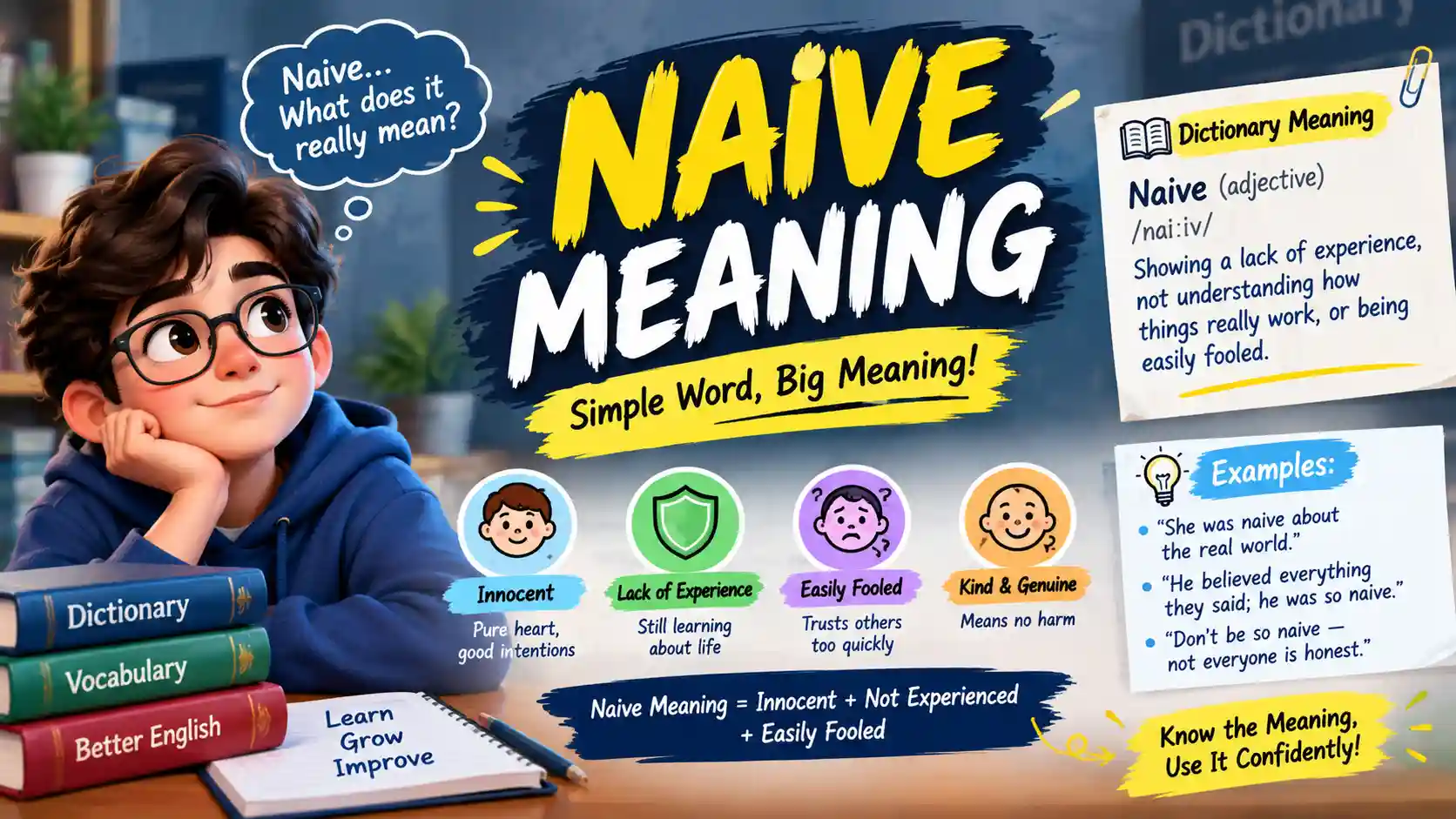
The naive meaning is simple: naive describes someone who lacks experience or knowledge about something and therefore may trust people or believe things too easily. A naive person is often innocent and inexperienced, but the word can sometimes suggest poor judgment or a lack of understanding.
For example, “She was naive to believe every promise he made” means she trusted him without realizing that his promises might not be true.
The word can describe a person, idea, decision, belief, or approach. It does not always mean someone is unintelligent. Often, it simply means they have not learned enough about a situation yet.
In this guide, you will learn the naive definition, pronunciation, synonyms, antonyms, examples, grammar, common mistakes, and the difference between being naive, innocent, gullible, and ignorant.
Quick Answer:
Naive means lacking experience, knowledge, or good judgment about a situation, often causing someone to trust too easily or expect things to be simpler than they really are.
For example:
“He was naive about how difficult starting a business would be.”
This means he did not have enough experience to understand the challenges involved.
The word can have a neutral, gentle, or negative meaning depending on the context. Calling a young child naive may simply describe their lack of life experience. Calling an adult naive can sound critical if it suggests that the person should know better.
| Word | Simple meaning | Example |
| Naive | Lacking experience or understanding | She was naive about the risks. |
| Innocent | Not guilty or not aware of wrongdoing | The child was innocent. |
| Gullible | Too quick to believe others | He is gullible and believes every story. |
| Ignorant | Lacking knowledge about something | She was ignorant of the rule. |
| Inexperienced | Not having much experience | He is inexperienced at driving. |
Naive Definition in Simple English
The naive definition can be understood through the idea of experience.
When someone is naive, they may see a situation in a simple way because they have not experienced enough similar situations. They may assume that people are honest, problems will be easy to solve, or things will happen exactly as planned.
For example, imagine someone receives a message saying they won a large prize and only needs to send personal information to claim it. A naive person might believe the message without checking whether it is real.
However, being naive does not automatically mean being inconsiderate.
Someone can be intelligent, educated, and talented while still being naive about a particular subject. A person who has never rented an apartment, for example, may be naive about hidden fees or lease rules.
The key idea is lack of experience or awareness, not lack of intelligence.
What Does Naive Mean When Describing a Person?
When naive describes a person, it usually means that the person has limited experience and may not recognize the risks or intentions involved in a situation.
For example:
“She is naive about relationships.”
This could mean she has little relationship experience and may not recognize unhealthy behavior.
Another example is:
“He was naive to think everyone would support his idea.”
Here, the speaker suggests that he expected people to agree with him because he did not understand how others might react.
Calling someone naive can be gentle or critical. Tone matters.
A parent might say:
“You are still young and a little naive.”
That may sound caring.
A coworker might say:
“That was a naive decision.”
That sounds more critical because it suggests the decision showed poor understanding.
What Does Naive Mean in a Sentence?
Here are some natural examples of naive in everyday English.
“I was naive when I first moved to the city.”
The speaker means they did not have enough experience with city life.
“It was naive to believe the job would be easy.”
This means the person had an unrealistic expectation.
“She has a naive view of the world.”
This means her understanding of the world may be too simple or idealistic.
“He was naive about online scams.”
This means he did not understand the risks of scams.
“The proposal sounds naive.”
Here, the idea itself—not necessarily the person—is being described as lacking practical understanding.
Notice that naive can describe more than people. It can describe opinions, plans, assumptions, expectations, approaches, and ideas.
Examples of Naive in Everyday Situations
The word becomes easier to understand when you see it in familiar situations.
A teenager may be naive about money because they have never paid rent, managed bills, or handled a budget.
A new employee may be naive about workplace politics because they have not yet learned how decisions are made.
A first-time traveler may be naive about how much planning a long international trip requires.
Someone new to online shopping may be naive if they assume every website offering a huge discount is trustworthy.
A new business owner may be naive if they believe having a good product automatically guarantees success.
These examples show why naive meaning is closely connected to experience.
A person may stop being naive as they learn, make mistakes, ask questions, and gain practical experience.
Naive vs Innocent: What Is the Difference?
Naive and innocent are related, but they do not mean exactly the same thing.
Innocent often means a person has no guilt or has not done anything wrong. It can also describe someone who is pure, inexperienced, or unaware of something unpleasant.
Naive focuses more strongly on a lack of experience, knowledge, or realistic judgment.
For example:
“The child was innocent.”
This usually means the child did nothing wrong.
“The child was naive about how dangerous the situation was.”
This means the child did not understand the danger.
| Word | Main idea | Usually positive or negative? |
| Naive | Lack of experience or realistic judgment | Depends on context |
| Innocent | Not guilty or unaware of wrongdoing | Often positive |
| Gullible | Easily persuaded or deceived | Usually negative |
| Trusting | Willing to believe or rely on others | Often positive or neutral |
A person can be innocent without being naive, and a person can be naive without being innocent.
Naive vs Gullible
These words are often confused because both can involve believing things too easily.
Naive means someone lacks experience or understanding.
Gullible means someone is easily tricked or persuaded because they believe what others tell them.
For example:
“He was naive about investing.”
This means he lacked experience with investing.
“He was gullible and believed the fake investment offer.”
This means he was easily deceived.
Someone may be naive but cautious. They may simply lack knowledge while still asking questions before making a decision.
A gullible person is more likely to accept information without checking it.
Naive vs Ignorant
Naive and ignorant also have different meanings.
If someone is ignorant of something, they simply do not know about it.
If someone is naive about something, they may not only lack knowledge but also have an unrealistic or overly simple view of it.
For example:
“I was ignorant of the local law.”
This means I did not know the law existed.
“I was naive to think the process would take only one day.”
This means I had an unrealistic expectation because I did not understand the process.
Also, calling someone “ignorant” can sound more insulting than calling them “naive,” depending on the situation.
Naive Synonyms and Related Words
There are several words that can be close to naive, but each has a slightly different meaning.
Inexperienced means someone has not had much practice or exposure to something.
Innocent can describe someone who lacks awareness of unpleasant or harmful things.
Trusting describes someone who tends to believe or rely on others.
Gullible describes someone who is too easily fooled.
Unsuspecting describes someone who does not expect danger or deception.
Unworldly can describe someone with little knowledge of real-world situations.
Unsophisticated can describe someone who lacks experience, refinement, or knowledge in a particular area.
| Synonym | Best used when you mean… |
| Inexperienced | Someone has little practical experience |
| Innocent | Someone lacks awareness of wrongdoing |
| Trusting | Someone naturally believes others |
| Gullible | Someone is easily fooled |
| Unsuspecting | Someone does not expect a problem |
| Unsophisticated | Someone lacks practical or social experience |
No synonym perfectly replaces naive in every sentence. The context determines which word sounds most natural.
Antonyms of Naive
The opposite of naive is not always one single word.
Common antonyms include experienced, knowledgeable, realistic, sophisticated, aware, cautious, worldly, and discerning.
For example:
“She was naive about business.”
A possible opposite would be:
“She is experienced and realistic about business.”
Someone who is discerning can recognize important differences and make thoughtful judgments.
Someone who is worldly has more knowledge of real-life situations.
Who is realistic understands that plans can have difficulties and that people may not always behave as expected.
Is Naive a Positive or Negative Word?
The answer depends on context.
In some situations, naive can sound gentle or even positive. It may suggest innocence, openness, optimism, or a lack of cynicism.
For example:
“There was something sweet and naive about his excitement.”
Here, the word may suggest innocence rather than inconsiderate.
In other situations, it is clearly negative:
“It was naive to ignore the warning signs.”
Here, the speaker believes the person should have understood the risks.
The word becomes more critical when it is connected with poor decisions, unrealistic expectations, or easily avoidable mistakes.
How to Use Naive Correctly in Grammar
Naive is an adjective.
It usually comes before a noun or after a linking verb.
Examples include:
“She has a naive attitude.”
“He made a naive assumption.”
“That idea sounds naive.”
“I was naive about the risks.”
You can also use naively, the adverb form:
“He naively believed the promise.”
Here, naively explains how he believed the promise.
Another related word is naivety or naiveté, a noun meaning the quality of being naive.
For example:
“Her naivety made her easy to persuade.”
Both naivety and naiveté are used in English. “Naivety” is common in British English, while “naiveté” is also widely recognized in American English.
How Do You Pronounce Naive?
In American English, naive is commonly pronounced approximately like:
nah-EEV
The two dots sometimes seen over the “i” in naïve show that the vowels are pronounced separately.
You may see both spellings:
- naive
- naïve
Both are correct.
The version naive is very common in modern English writing, especially in digital content.
Is Naive an Insult?
Calling someone naive is not automatically an insult.
It depends on your tone and why you are using the word.
If you say:
“You are naive because you have never dealt with this before.”
you may simply be describing their lack of experience.
But if you say:
“Only a naive person would believe that.”
The statement sounds insulting because it attacks the person’s judgment.
If you want to sound more polite, you can use phrases such as:
“You may not have much experience with this yet.”
“That assumption may be a little unrealistic.”
“This is an area where more experience could help.”
These alternatives are often better in professional or sensitive conversations.
Common Mistakes When Using Naive
One common mistake is using naive as if it means “inconsiderate.” That is too broad.
A naive person may be highly intelligent but inexperienced in one area.
Another mistake is assuming that naive always has a negative meaning. Context and tone can make the word gentle, neutral, or critical.
It is also incorrect to use naive when you simply mean “young.” Age and experience are not the same thing.
A young person may be very knowledgeable, while an older person can still be naive about a particular subject.
Finally, do not confuse naive with gullible. Gullibility is specifically about being easy to deceive, while naivety is broader and can involve unrealistic expectations or limited experience.
Why Do People Become Less Naive With Experience?
People often become less naive when they encounter new situations and learn how the real world works.
Experience teaches people to question assumptions, recognize warning signs, understand different viewpoints, and make better predictions.
For example, someone who has never dealt with a dishonest salesperson may initially trust a confident sales pitch. After learning how misleading sales tactics work, that person may become more cautious.
This does not mean becoming cynical is the goal.
A healthy balance is often better. You can remain kind and trusting while also checking facts, asking questions, and recognizing risks.
In other words, maturity does not require losing kindness; it often means combining kindness with better judgment.
Naive Meaning in Different Contexts
The meaning of naive can shift slightly depending on where it appears.
In relationships, it may describe someone who has little experience with dating or assumes everyone has good intentions.
In business, it often describes an unrealistic plan or expectation.
Politics and society, it can describe an overly simple understanding of a complex issue.
Technology, someone may be naive about cybersecurity if they do not understand online risks.
In everyday conversation, the word may simply mean inexperienced or innocent.
| Context | Example | Meaning |
| Relationships | “He was naive about dating.” | Lacked relationship experience |
| Business | “That is a naive plan.” | Too simple or unrealistic |
| Online safety | “She was naive about scams.” | Did not understand the risks |
| Social life | “He was naive about people.” | Had limited experience with people |
| General use | “I was naive at the time.” | I lacked experience then |
Frequently Asked Questions
What is the simple meaning of naive?
Naive means lacking experience, knowledge, or realistic judgment about something. A naive person may trust too easily or expect a situation to be simpler than it really is.
Does naive mean innocent?
Not exactly. Innocent often means not guilty or unaware of wrongdoing. Naive usually means lacking experience or realistic understanding. The two words can overlap in some situations.
Is being naive a bad thing?
Not always. Naivety can reflect innocence or openness, but it can become a problem when it causes someone to ignore risks, trust the wrong people, or make unrealistic decisions.
Is naive the same as gullible?
No. Naive means inexperienced or lacking understanding. Gullible means too willing to believe something and therefore easy to deceive. A person can be naive without being gullible.
What is the opposite of naive?
Common opposites include experienced, knowledgeable, realistic, aware, discerning, sophisticated, and worldly. The best opposite depends on the sentence.
Can an intelligent person be naive?
Yes. Intelligence and experience are different things. An intelligent person can be highly knowledgeable in one area while being naive about another area they have not experienced before.
Conclusion
The naive meaning is mainly about lack of experience, knowledge, or realistic judgment. A naive person is not necessarily unintelligent. They may simply have limited experience with a certain situation and therefore trust too easily or expect things to work differently than they actually do.
Understanding the difference between naive, innocent, gullible, ignorant, and inexperienced can help you choose the right word in everyday English. Remember that context matters: naive can sound gentle when it describes innocence, but it can sound critical when it describes poor judgment.

Hi, I’m Benjamin Dreyer. I enjoy exploring words, phrases, slang, abbreviations, acronyms, and digital communication. At Linkquorax.com, I share simple and accurate explanations to help readers understand unfamiliar terms and popular internet expressions. My goal is to make every meaning clear, useful, and easy to understand. Whether you are curious about a new word or an online phrase, Linkquorax.com provides straightforward information to help you learn quickly and communicate with confidence in everyday conversations.