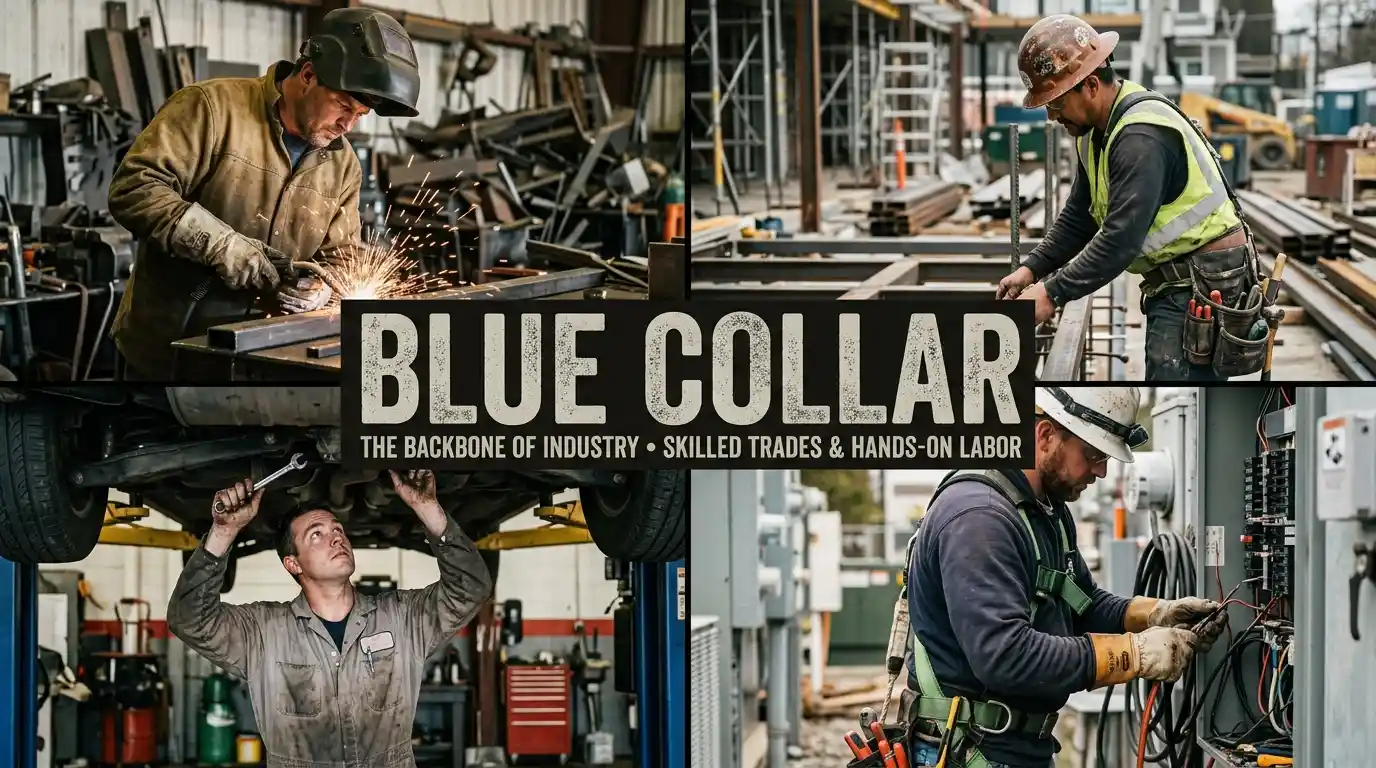
Have you ever heard someone say “blue collar job” and wondered what it actually means? The blue collar meaning refers to workers who do physical, hands-on jobs, often in factories, construction sites, or repair shops.
These jobs usually need skill with tools and machines instead of a desk and a computer. People search for this term because they want to understand job types, career paths, or comments they hear in the news.
In this article, you will learn where the phrase came from, how it is used today, and how it compares to other job labels like “white collar.”
Quick Answer
A blue collar job is work that involves physical labor. Think electricians, plumbers, welders, truck drivers, and factory workers.
The term comes from the blue work shirts these workers often wore because the color hid dirt and stains better than lighter colors.
Blue collar work does not always mean low pay or low skill. Many blue collar jobs pay very well and require years of training.
Meaning or Definition
The blue collar meaning points to a category of work built around using your hands and body. This includes jobs like carpentry, mechanics, plumbing, mining, and machine operating. Blue collar workers often work in warehouses, factories, construction zones, or out in the field rather than in offices.
This term is not just about the type of task. It also carries a cultural weight. When people say “blue collar,” they often picture someone tough, practical, and skilled with tools. It suggests a worker who builds, fixes, or moves things rather than one who plans, writes, or manages from behind a desk.
It’s worth noting that blue collar does not mean “unskilled.” A licensed electrician spends years learning wiring codes and safety rules. A skilled machinist reads blueprints and works with tight measurements. These jobs demand real expertise, even though they are physical.
Here is a simple way to picture the difference between blue collar and other job types:
| Job Type | Type of Work | Common Examples |
| Blue Collar | Physical, hands-on labor | Electrician, plumber, welder, mechanic |
| White Collar | Office, desk-based work | Accountant, lawyer, manager |
| Pink Collar | Service-based, often care roles | Nurse, teacher, receptionist |
| Gray Collar | Mix of physical and technical skill | Lab technician, police officer, IT support |
Grammar or Correct Usage
The phrase “blue collar” can act as two different parts of speech, and this trips people up more than you’d expect.
When it describes a noun, you write it with a hyphen, like this: “He works a blue-collar job.” When it stands alone as a noun phrase, like describing a group of people, you often drop the hyphen: “Blue collar workers built this bridge.” Style guides vary slightly here, but the safest rule is: hyphenate it when it comes before the noun it describes.
You should always write “blue collar” with a lowercase b and c unless it starts a sentence or is part of a title. It is not a proper noun, so it does not need capital letters in the middle of a sentence.
One common slip is treating “blue collar” as a single word, like “bluecollar.” This is incorrect in standard English. It is always two words, hyphenated or not depending on its placement in the sentence.
Origin or History
The phrase “blue collar” dates back to the early 1900s in the United States. Factory and manual laborers often wore blue work shirts made of tough fabric like denim or chambray. Blue hid stains from grease, dirt, and machine oil better than white or light-colored shirts, which is what office workers typically wore at the time.
By contrast, office employees wore white dress shirts, which led to the term “white collar” for professional, desk-based jobs. This color-based labeling stuck, and by the mid-20th century, “blue collar” was a common way to describe factory workers, tradespeople, and laborers across America.
The term grew alongside America’s industrial boom. As factories, railroads, and construction projects expanded rapidly, the workforce behind them needed a name, and “blue collar” fit naturally into everyday language. Labor unions, newspapers, and politicians picked up the phrase, and it has stayed part of American vocabulary ever since.
Real-Life Examples
Understanding the blue collar meaning is easier with real examples from daily life.
A plumber who fixes a broken pipe under your kitchen sink is doing blue collar work. So is the electrician who rewires a house, or the construction worker pouring concrete for a new road. Truck drivers hauling freight across states, welders building steel frames, and mechanics repairing car engines all fall under this label too.
Here’s a sentence you might hear in conversation: “My dad has worked a blue-collar job at the steel plant for twenty years.” Or in a news headline: “Blue collar workers are demanding better wages amid rising living costs.”
These examples show how the term applies across many industries, not just one type of factory work. It is a broad label that covers a wide range of skilled, physical trades.
Current Usage or Trends
The way people use “blue collar” has shifted a bit over the decades. Today, many blue collar jobs actually pay more than some entry-level office jobs. Skilled trades like electricians, plumbers, and HVAC technicians can earn strong salaries, especially as demand for skilled labor grows and fewer young people enter these trades.
There’s also been a cultural shift in how blue collar work is viewed. In recent years, more people talk about the value and dignity of trade work. Some parents now encourage kids to consider trade school instead of a four-year college degree, especially given rising tuition costs and steady demand for hands-on skills.
Social media has played a role here too. Videos showing welders, electricians, and mechanics doing their jobs have gained huge followings, helping reshape public perception. What was once seen as a “backup” career path is now often seen as a smart, practical choice.
Here’s a quick look at how blue collar and white collar roles are often compared today:
| Factor | Blue Collar | White Collar |
| Typical Setting | Factory, job site, outdoors | Office, remote desk |
| Training Path | Trade school, apprenticeship | College degree |
| Pay Range | Varies widely, can be high | Varies widely, can be high |
| Physical Demand | Often high | Often low |
Tips or Best Practices
If you’re exploring a blue collar career, or just want to understand the term better, here are a few useful pointers.
First, remember that blue collar work often requires certification or apprenticeship, not just willingness to do physical labor. Electricians, plumbers, and HVAC technicians usually need licenses. Skipping this step can limit job options and pay.
Second, don’t assume blue collar jobs are a “lesser” path. Many trades offer strong salaries, job security, and the satisfaction of building or fixing something tangible. Skilled trade shortages in many parts of the U.S. mean demand is often high.
Third, when writing or speaking about blue collar work, use the term respectfully and accurately. Avoid using it as a stereotype for someone’s intelligence or worth. It simply describes a category of labor, not a person’s capability or character.
Finally, if you’re researching career options, look into local trade schools or apprenticeship programs. They often cost far less than a four-year degree and can lead directly into steady, well-paying blue collar careers.
FAQs
What does blue collar mean in simple words?
It means a job that involves physical work, like fixing machines, building things, or working with your hands, instead of working at a desk.
Is blue collar a bad word to use?
No. It is a neutral term describing a type of job. It only becomes negative if someone uses it to judge a person’s worth or intelligence, which is not accurate or fair.
What is the difference between blue collar and white collar?
Blue collar jobs involve physical, hands-on labor like construction or mechanics. White collar jobs usually involve office work, like accounting or management.
Do blue collar jobs pay well?
Many do. Skilled trades like electricians, plumbers, and welders often earn strong wages, sometimes more than typical office jobs, especially with experience or specialized certification.
Why is it called “blue collar”?
The name comes from the blue work shirts many laborers wore in the early 1900s, since the color hid dirt and stains better than lighter fabrics.
Can someone move from a blue collar job to a white collar job?
Yes, plenty of people switch career paths. Education, training, or gaining new skills can help someone move between blue collar and white collar work.
Conclusion
At its core, the blue collar meaning describes hands-on, physical work like construction, mechanics, or factory labor, work that keeps holmes running, buildings standing, and machines working.
The term has deep roots in American history, tied to the simple blue work shirts laborers once wore. Today, it stands for a wide range of skilled trades, many of which offer strong pay and steady demand.
If you’re curious about the phrase’s meaning or thinking about a trade career yourself, understanding this term helps you see the real value behind the work that builds the world around us.

Hi, I’m Benjamin Dreyer. I enjoy exploring words, phrases, slang, abbreviations, acronyms, and digital communication. At Linkquorax.com, I share simple and accurate explanations to help readers understand unfamiliar terms and popular internet expressions. My goal is to make every meaning clear, useful, and easy to understand. Whether you are curious about a new word or an online phrase, Linkquorax.com provides straightforward information to help you learn quickly and communicate with confidence in everyday conversations.