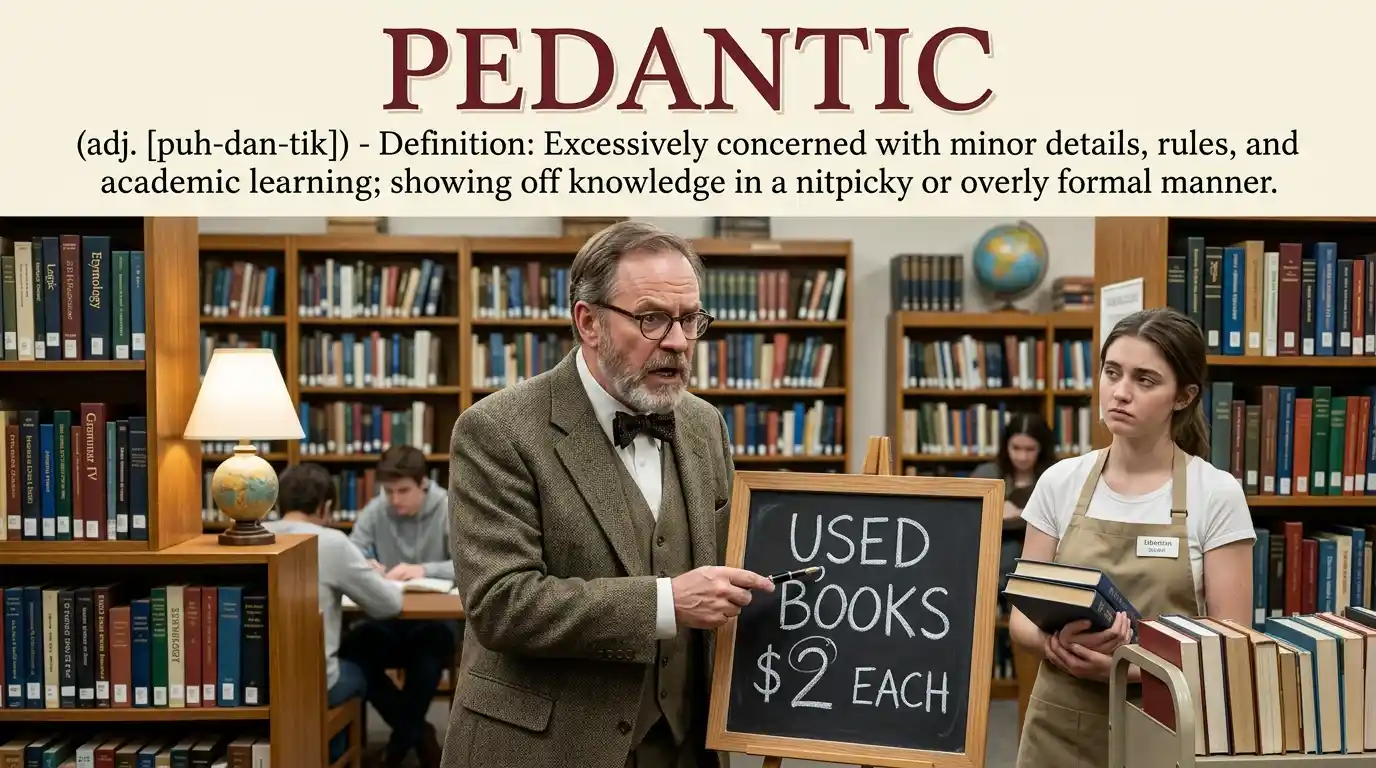
If you have ever heard someone say, “Don’t be so pedantic,” you may wonder what they mean. Pedantic means caring too much about small rules, details, or formal correctness, often in a way that seems unnecessary or annoying. It can describe a person, comment, argument, writing style, or approach.
The word is usually negative. A person may know a lot and still be called pedantic if they focus too much on tiny details or correct others when the correction does not really matter.
For example, correcting someone’s minor grammar mistake during a casual conversation may seem pedantic.
In this guide, you will learn the pedantic meaning, pronunciation, word history, common synonyms, real-life examples, correct grammar, and the difference between pedantic and similar words such as perfectionist, precise, picky, scholarly, and didactic.
Quick Answer: What Does Pedantic Mean?
Pedantic means overly concerned with small details, formal rules, or exact correctness, especially when those details are not very important.
In simple English, if someone is too focused on being technically correct, you might describe them as pedantic.
For example, imagine a friend says, “I watched a movie yesterday,” and another person interrupts to explain that the movie technically premiered two days earlier. If that correction does not matter to the conversation, it could be described as pedantic.
Cambridge defines pedantic as giving too much attention to formal rules or small details. Its American English definition also highlights caring too much about unimportant details instead of understanding or appreciating the larger subject.
Merriam-Webster similarly describes pedantic as being overly concerned with minor details and also uses it for a narrow or showy scholarly style.
| Word | Simple meaning |
| Pedantic | Too focused on small rules or details |
| Pedant | A person who behaves in a pedantic way |
| Pedantry | The habit or quality of being pedantic |
| Pedantically | In a pedantic manner |
The important idea is “too much attention to details that may not matter.” Being careful is not automatically pedantic. The negative meaning appears when the focus on correctness becomes unnecessary, annoying, rigid, or distracting.
Pedantic Meaning in Simple English

Think of a pedantic person as someone who sometimes misses the big picture because they are busy checking tiny details.
Suppose your friend says, “There were about 100 people at the party.” Someone responds, “Actually, there were 97 people because I counted them.”
That person may be correct. But if the exact number does not matter, the correction could sound pedantic.
Here are a few simple examples:
“She’s being pedantic about the spelling.”
“He gave a long, pedantic explanation.”
“His comments were technically correct but unnecessarily pedantic.”
“Don’t get pedantic about every little detail.”
“The discussion became too pedantic to be useful.”
The word does not simply mean “smart,” “educated,” or “careful.” A knowledgeable person can be helpful without being pedantic. The criticism comes from how that knowledge is used.
A teacher who carefully explains an important grammar rule is not necessarily pedantic. However, a teacher who interrupts every student to correct tiny wording choices that have no effect on the lesson might be seen as pedantic.
This distinction is important because accuracy and pedantry are not the same thing.
What Does It Mean to Call Someone Pedantic?
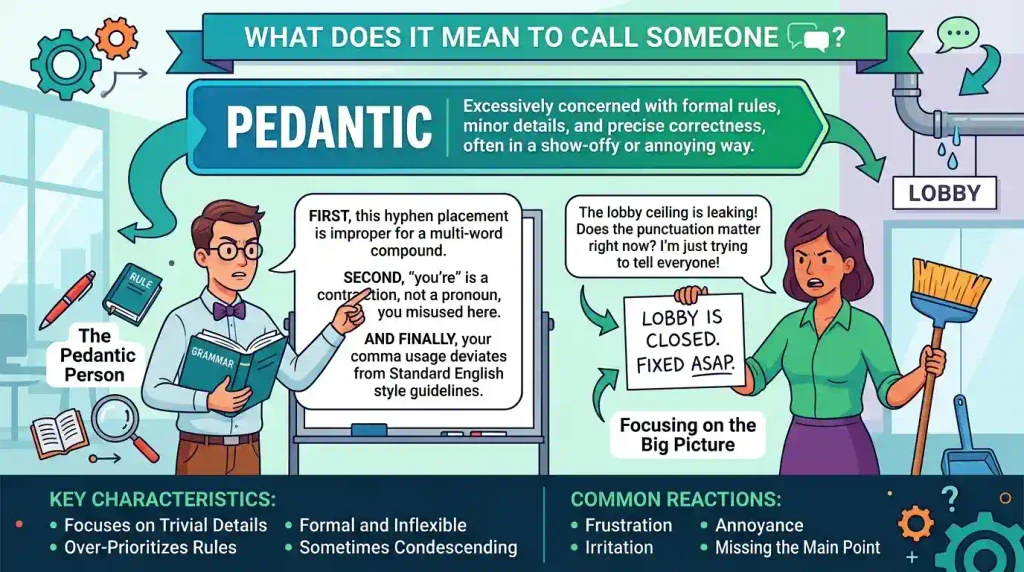
Calling someone pedantic usually means you think that person is paying too much attention to minor details or rules.
It can suggest that the person is:
- overly focused on technical correctness
- quick to correct other people
- very strict about rules
- interested in tiny details
- showing off their knowledge
- more concerned with being correct than being helpful
- focused on details instead of the main idea
For example, imagine two people discussing a book.
Person A says, “The story is about a young man trying to find his family.”
Person B replies, “Technically, he is 19 years old, so calling him a ‘young man’ is an inaccurate classification based on the author’s description.”
If the exact wording does not matter, Person B may sound pedantic.
The word can therefore describe behavior, not just intelligence.
Someone might be highly educated, intelligent, and correct but still behave pedantically.
Merriam-Webster notes that pedantic can also describe someone who is narrowly or stiffly scholarly, or who displays knowledge in a way that feels showy.
Is Pedantic a Negative Word?
Yes. Pedantic is usually a negative or disapproving word.
If you call someone pedantic, you are normally criticizing their behavior, writing, explanation, or attitude.
For example:
“Your explanation was detailed” sounds neutral.
“Your explanation was pedantic” suggests the explanation was too focused on minor details.
“You are knowledgeable” is usually a compliment.
“You are pedantic” can sound like an insult.
Merriam-Webster states that pedantic is almost always used negatively when describing a person or their behavior.
However, the word does not always mean that the person is completely wrong. In fact, a pedantic person may be technically correct. The problem is often that they are making an issue out of something that does not need so much attention.
That is why you may hear phrases such as:
“It may seem pedantic, but…”
“I don’t want to be pedantic, but…”
“Maybe I’m being pedantic here…”
These phrases often introduce a very precise correction or small distinction. The speaker may know that the detail is technically correct but not very important.
Pedantic Grammar and Correct Usage

Pedantic is an adjective. It is normally used to describe a noun, such as a person, explanation, argument, style, comment, or approach.
Common patterns include:
“a pedantic person”
“a pedantic teacher”
Top A pedantic argument
You can also use forms such as pedantically and pedantry.
“Pedantically” is an adverb. It describes an action done in a pedantic way.
For example:
“He corrected the sentence pedantically.”
“She explained the rule pedantically.”
“Pedantry” is a noun. It refers to the habit or quality of being overly concerned with small rules and details.
For example:
“His pedantry made the meeting longer.”
“The article avoids unnecessary pedantry.”
Here is a quick grammar guide:
| Form | Part of speech | Example |
| Pedantic | Adjective | His explanation was pedantic. |
| Pedantically | Adverb | She corrected him pedantically. |
| Pedantry | Noun | His pedantry annoyed the team. |
| Pedant | Noun | He is a pedant about grammar. |
One common mistake is using pedantic as if it directly means “perfect.” It does not. Someone can be imperfect but pedantic if they constantly focus on tiny rules.
Real-Life Examples of Pedantic

Seeing the word in different situations makes its meaning easier to understand.
Example 1: Grammar
“Mark corrected my text message because I used the wrong punctuation. That felt a little pedantic.”
The correction may have been technically correct, but it was not important in a casual text.
Example 2: School
“The teacher became pedantic about the exact format of the student’s title.”
Here, the teacher is focusing heavily on a small formatting detail.
Example 3: Work
“The manager’s pedantic comments about the font distracted everyone from the main problem.”
The font may matter in some situations, but the manager is giving it too much attention compared with the real issue.
Example 4: Conversation
“I don’t want to be pedantic, but that happened on Tuesday, not Wednesday.”
The speaker is correcting a small factual detail.
Example 5: Writing
“The book is informative, but some sections feel pedantic.”
This means the writing may contain too many small technical details or explanations.
Example 6: Rules
“He was pedantic about the dress code and complained about tiny differences.”
This suggests he was excessively strict about the rules.
Example 7: Technology
“The discussion became pedantic when everyone started arguing about the exact definition of a device.”
The conversation moved away from the useful topic and became overly focused on technical distinctions.
Example 8: Sports
“Fans had a pedantic argument about whether the player officially scored the point.”
The argument may be about a small technical detail rather than the larger result.
Example 9: Family
“My brother can be pedantic about how we organize the kitchen.”
The brother may care too much about small organizational rules.
Example 10: Online discussions
“Social media debates can become pedantic when people spend more time correcting wording than discussing the main issue.”
This is a common way the word can be used in modern conversation.
Pedantic vs. Precise: What Is the Difference?
Precise and pedantic are related, but they do not mean the same thing.
Being precise usually means being accurate, clear, and exact. This is often a positive quality.
Being pedantic means being too concerned with exact details, especially when those details are not important.
For example:
“A surgeon must be precise.”
That is positive because accuracy matters.
“He was pedantic about whether the meeting started at 9:00 or 9:01.”
That may be negative because the one-minute difference may not matter.
| Precise | Pedantic |
| Focuses on accuracy | Focuses too much on accuracy |
| Usually positive | Usually negative |
| Details are often important | Details may be unimportant |
| Helps improve understanding | Can distract from the main point |
| Can be practical | Can be unnecessarily strict |
So, precision is about getting important details right, while pedantry is often about giving too much importance to minor details.
Pedantic vs. Perfectionist
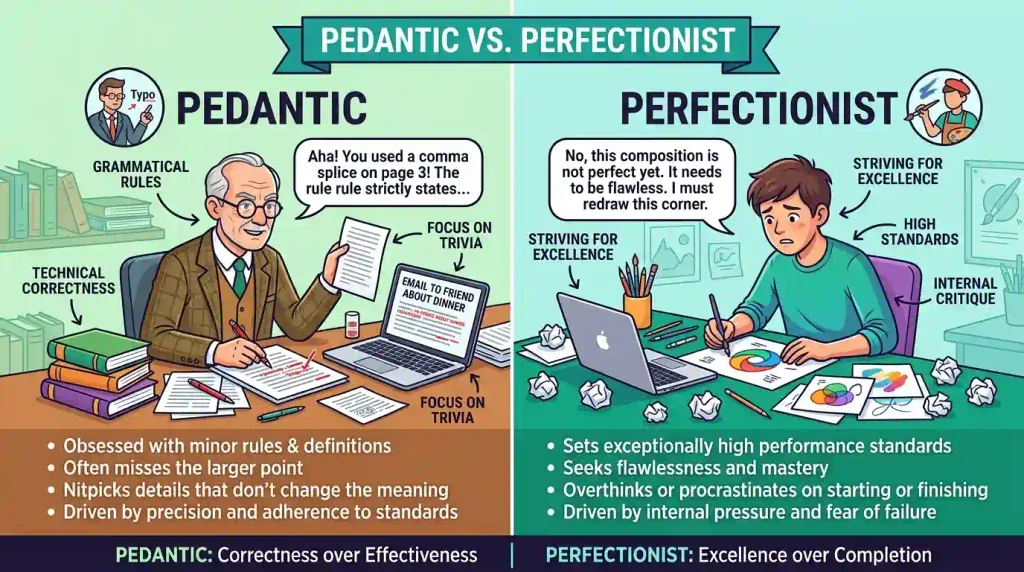
A perfectionist wants things to be as good or perfect as possible.
A pedantic person is overly concerned with rules, technical details, or exact correctness.
These traits can overlap, but they are not identical.
A perfectionist might rewrite a report several times because they want it to be excellent.
A pedantic person might spend ten minutes arguing about whether a particular word is technically the best choice.
A person can also be both.
For example:
“She is a perfectionist when designing presentations, but she becomes pedantic when discussing grammar.”
The difference is mainly about what the person is focused on.
Perfectionism often involves high standards for the final result. Pedantry often involves excessive attention to rules or small details.
Pedantic vs. Picky
Picky means having very strong preferences and being difficult to satisfy.
Pedantic usually relates to rules, knowledge, correctness, or details.
For example:
“She is picky about her food.”
This means she has strong food preferences.
“She is pedantic about grammar.”
This means she pays too much attention to grammar rules.
A picky person may reject a shirt because they dislike the color.
A pedantic person may criticize the description of the shirt because it uses an technically inaccurate term.
Both words can describe someone who is difficult, but they focus on different things.
Pedantic vs. Didactic
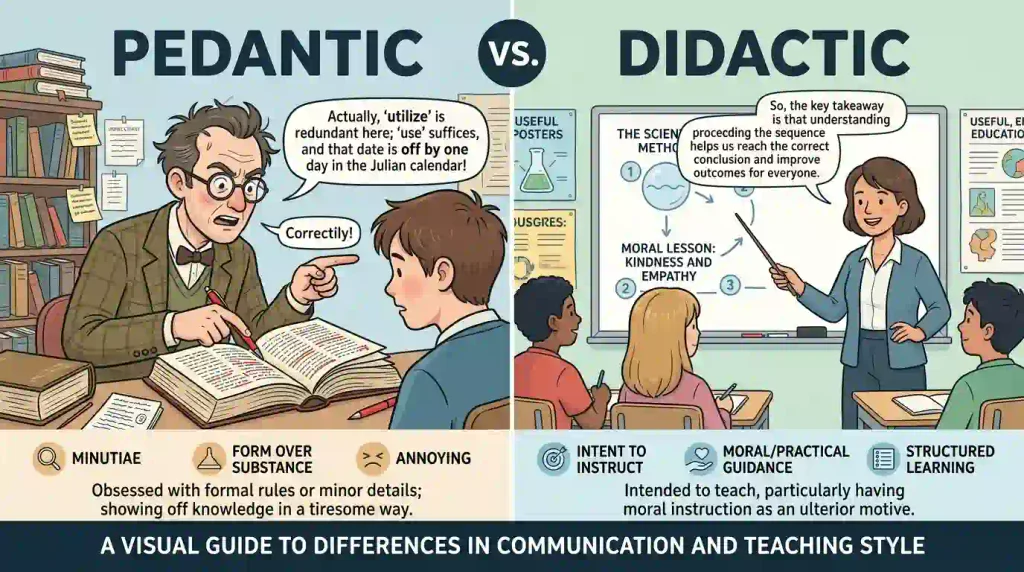
Didactic and pedantic can both relate to teaching, but they have different meanings.
Didactic generally means designed or intended to teach something. It can be neutral, although it can sometimes suggest that a lesson is too preachy or boring.
Pedantic is more strongly negative. It often suggests excessive concern with small details or an irritating display of knowledge.
For example:
“The book has a didactic purpose.”
This means the book is intended to teach.
“The book has a pedantic style.”
This suggests the book gives too much attention to technical details or displays knowledge in an irritating way.
So, something can be didactic without being pedantic.
Pedantic vs. Scholarly
Scholarly is usually positive or neutral. It suggests serious study, research, and knowledge.
Pedantic can describe a scholarly style when that style becomes narrow, rigid, overly technical, or showy.
For example:
“She wrote a scholarly article about American history.”
This is generally positive.
“She wrote a pedantic article that spent five pages discussing one tiny detail.”
This suggests the article may contain useful knowledge, but it gives too much attention to something minor.
Merriam-Webster includes the idea of being narrowly or ostentatiously scholarly in its definition of pedantic.
Pedantic Synonyms and Related Words
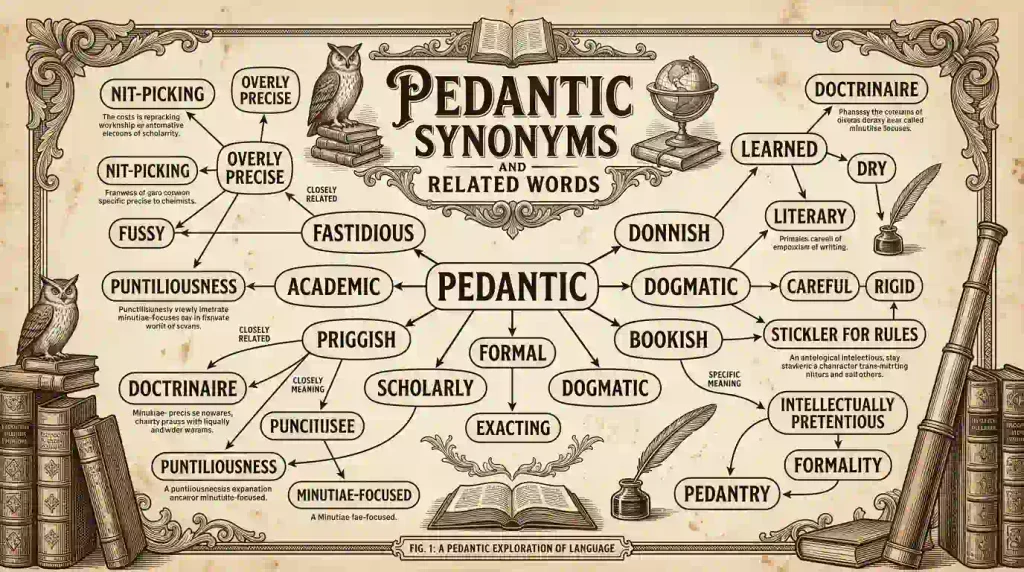
The best synonym depends on the situation. Some words are close to pedantic, but none means exactly the same thing in every sentence.
Possible related words include:
Picky can describe someone who is hard to please.
Fussy can describe someone who worries too much about small things.
Precise means exact, but it does not normally carry the negative meaning of pedantic.
Finicky describes someone who pays excessive attention to details or has very particular preferences.
Pompous describes someone who acts as if they are more important, intelligent, or impressive than others.
Scholarly describes someone or something connected with serious study and learning.
Perfectionist describes someone who wants extremely high standards or near-perfect results.
Purist can describe someone who insists on a strict or traditional form of something.
Nitpicky is an informal word for focusing too much on tiny faults or details.
This makes nitpicky one of the closest casual alternatives to pedantic in some situations, especially when someone keeps pointing out small mistakes.
Where Does the Word Pedantic Come From?
The history of pedantic is interesting because its older connection to teaching helps explain its modern meaning.
Merriam-Webster traces pedant through Middle French from the Italian pedante and gives 1588 as the first known use of pedant in English.
The older word referred to a teacher or schoolmaster. Over time, however, pedant developed a negative sense connected with someone who displayed learning or placed too much importance on small points of knowledge.
The adjective pedantic appeared around the early 1600s. The Online Etymology Dictionary describes it as being formed from pedant plus the suffix -ic.
Merriam-Webster gives 1628 as the first known use of pedantic in the sense listed in its dictionary.
So, the word’s history moved roughly from teacher → learned person → person who shows off knowledge or focuses excessively on minor details.
That history also explains why pedantic often has a connection with education, grammar, books, rules, and academic knowledge.
How to Use Pedantic in a Sentence

The easiest way to use pedantic correctly is to connect it to something that seems overly focused on small details or rules.
Here are natural sentence patterns:
“He is too pedantic about grammar.”
“Her explanation sounded pedantic.”
“Don’t be pedantic about the exact wording.”
“That argument is becoming pedantic.”
“The article is useful but sometimes pedantic.”
“He made a pedantic correction.”
“Her pedantic attitude slowed down the discussion.”
“I don’t mean to sound pedantic, but there is a small difference.”
“The professor’s lecture became overly pedantic.”
“The reviewer criticized the book for its pedantic style.”
Notice that pedantic can describe both people and things.
It can describe a person, but it can also describe an explanation, argument, style, approach, debate, correction, discussion, or tone.
Common Mistakes With the Word Pedantic
One common mistake is thinking that pedantic means intelligent.
It does not.
A person may be intelligent and pedantic, but intelligence itself is not pedantry.
Another mistake is thinking that pedantic always means wrong.
A pedantic correction may actually be correct. The problem is that the correction may be unnecessary or overly focused on a minor point.
Another mistake is using pedantic as a direct synonym for careful.
A careful person checks important details.
A pedantic person may continue checking or correcting details even when doing so is not useful.
It is also important not to use the word simply because someone disagrees with you. Someone who points out an important error is not necessarily being pedantic.
For example, if a doctor corrects a serious medical mistake, calling the doctor pedantic would not make sense simply because the correction is detailed. The detail may be important.
The key question is:
Does the detail actually matter to the situation?
If it matters, careful attention may be useful. If it does not matter and someone insists on discussing it anyway, pedantic may be a better description.
How to Tell if Something Is Pedantic

A simple test can help.
Ask yourself whether the person is:
Correcting a small mistake that does not affect the main idea?
Focusing on a technical distinction that does not matter?
Following a rule more strictly than the situation requires?
Showing off knowledge instead of helping?
Ignoring the larger point because of a tiny detail?
If several answers are yes, the behavior may be described as pedantic.
Still, context matters. In science, law, medicine, engineering, programming, finance, or other technical fields, small details can be extremely important. What looks pedantic to one person may be necessary precision to another.
That is why pedantic is partly about context.
FAQs
What does pedantic mean in simple words?
Pedantic means being too concerned with small details, formal rules, or exact correctness. It often describes someone who corrects minor mistakes or focuses on details that are not important to the main issue.
Is pedantic a bad word?
Usually, yes. Pedantic is generally disapproving. It can suggest that someone is annoying, overly strict, or too focused on minor details. However, saying “I may be pedantic, but…” can sometimes be a softer way to introduce a small correction.
What is an example of pedantic behavior?
Correcting a person’s tiny grammar mistake during a casual conversation can be pedantic if the correction does not affect the meaning. Spending too much time arguing about an unimportant technical detail can also be pedantic.
What is the difference between pedantic and picky?
Picky usually means difficult to satisfy or having very specific preferences. Pedantic usually means being overly concerned with rules, correctness, knowledge, or small details. For example, someone can be picky about food but pedantic about grammar.
What is the noun form of pedantic?
The noun connected with the quality or behavior is pedantry. A person who behaves this way can be called a pedant. For example, “His pedantry made the discussion longer.” Cambridge defines pedantry as being too interested in formal rules and small details that are not important.
Can pedantic be positive?
It is usually negative, but context can soften the meaning. In some technical situations, extreme attention to detail can be useful. Still, calling someone pedantic normally suggests that their attention to detail has become excessive or unhelpful.
Conclusion:
The simplest way to remember the pedantic meaning is this: pedantic describes too much concern with small rules, technical details, or exact correctness, especially when those details are not important.
The word is usually negative, but it does not necessarily mean that the person is wrong. A pedantic person may be completely correct while still being unhelpful because they are focusing on something that does not matter much.
Understanding this difference helps you use the word correctly. Precise can be positive, scholarly is usually positive or neutral, and picky is about strong preferences. Pedantic is more about unnecessary attention to rules, details, or knowledge.
When you see the word in a sentence, ask whether someone is being too exact about something small. If the answer is yes, pedantic is probably the right word.

Hi, I’m Benjamin Dreyer. I enjoy exploring words, phrases, slang, abbreviations, acronyms, and digital communication. At Linkquorax.com, I share simple and accurate explanations to help readers understand unfamiliar terms and popular internet expressions. My goal is to make every meaning clear, useful, and easy to understand. Whether you are curious about a new word or an online phrase, Linkquorax.com provides straightforward information to help you learn quickly and communicate with confidence in everyday conversations.