If you have ever read a research paper, a history book, or even a news article, you may have seen the phrase “et al” show up right after someone’s name. It looks a little strange at first. What does it mean? Why do writers use it instead of just listing every name?
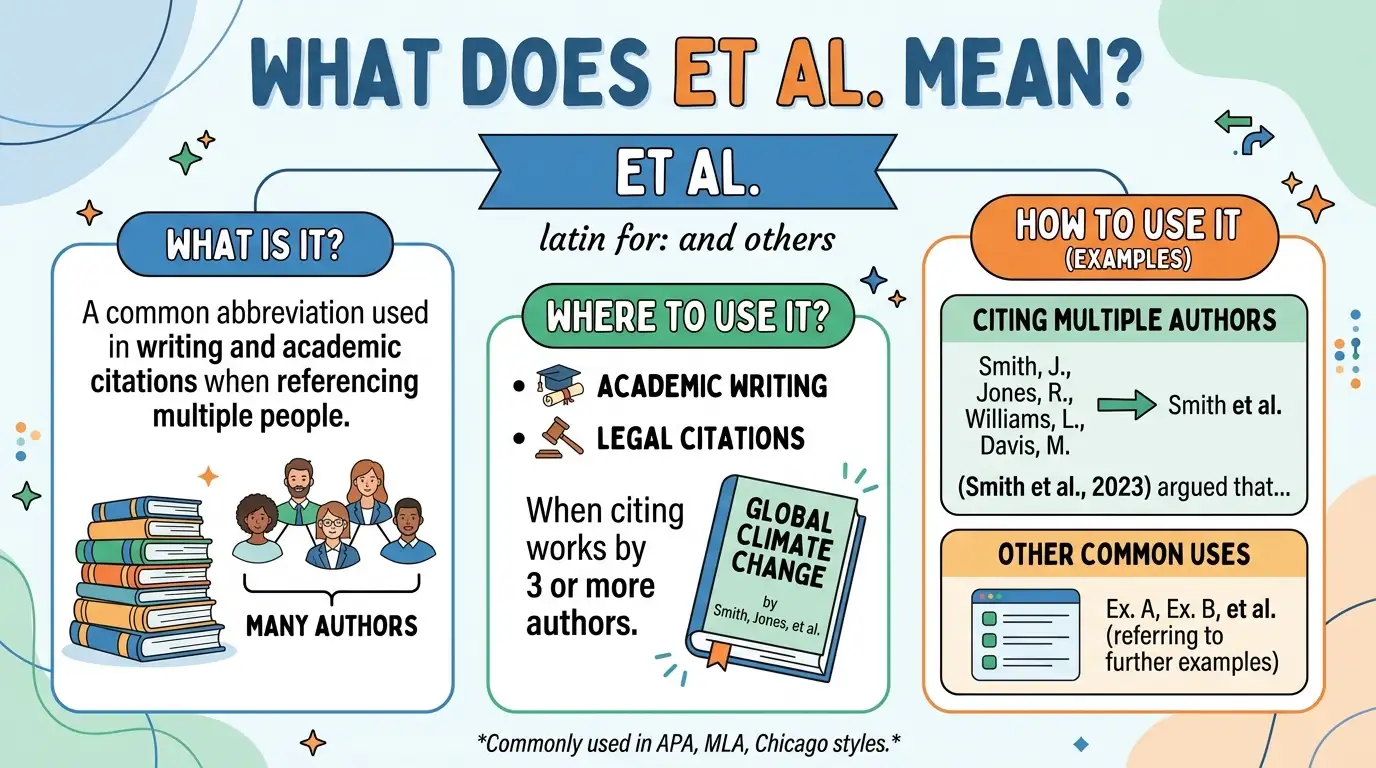
The short answer: et al is a Latin phrase that means “and others.” Writers use it to shorten a list of names, especially when a book, study, or article has more than two or three authors. Instead of writing out every single name every time, writers use “et al” to save space and keep the writing clean.
In this guide, you will learn exactly what et al means, how to use it correctly, where it comes from, and the most common mistakes people make with it. By the end, you will be able to use et al with confidence in your own writing.
Quick Answer
Et al means “and others.” It comes from the Latin phrase et alii (for males), et aliae (for females), or et alia (for mixed or neutral groups). Writers use it after the first author’s name when a source has three or more authors.
For example, instead of writing “Smith, Johnson, Lee, and Carter,” a writer might shorten it to “Smith et al.”
Meaning or Definition
Et al is a short form of a Latin phrase. The full phrase is et alii, and it means “and other people.” Over time, writers and scholars started shortening it to just “et al” because it was easier and quicker to write.
You will mostly see et al used in two situations:
- Academic writing, such as research papers, science journals, and college essays
- Legal writing, where lawyers list multiple people involved in a case
Here is a simple example. Imagine a science study was written by four people: Maria Gomez, David Kim, Sarah Patel, and James Wu. Instead of writing all four names every time the study is mentioned, a writer can simply write “Gomez et al.” This tells the reader that Maria Gomez was the first listed author, and there are other authors too.
The phrase always refers to people, not things. You would not use “et al” to mean “and other items” or “and other topics.” That job belongs to a different Latin phrase, “et cetera,” which most people know as “etc.”
Grammar or Correct Usage
Et al follows a few simple grammar rules. Once you learn them, you will never second-guess yourself again.
Rule 1: Put a period after “al,” but not after “et.”
The word “et” is a complete Latin word on its own, so it does not need a period. But “al” is short for “alii,” so it needs a period to show it has been shortened.
Correct: Johnson et al.
Incorrect: Johnson et. al.
Incorrect: Johnson et al
Rule 2: Do not italicize et al in most modern writing styles.
Some older style guides asked writers to italicize Latin phrases. Today, most major style guides, including APA and MLA, treat et al as a normal English phrase and do not require italics.
Rule 3: Use et al only when there are three or more authors (in most styles).
This rule can change slightly depending on which style guide you follow, which we will cover in the table below.
Rule 4: There is no comma before et al in APA style, but MLA style also skips the comma.
Many writers mistakenly add a comma, like this: “Johnson, et al.” This is incorrect in most modern style guides. The correct form is simply “Johnson et al.”
Here is a table that breaks down how different style guides handle et al:
| Style Guide | When to Use Et Al | Comma Before Et Al? | Italicized? |
| APA (7th edition) | 3 or more authors | No | No |
| MLA (9th edition) | 3 or more authors | No | No |
| Chicago Style | 4 or more authors (varies by edition) | No | No |
| Legal Writing | Varies by court and case type | Sometimes | No |
Because rules can shift slightly between style guides and even between editions of the same guide, it is always smart to double-check the most current edition if you are writing for school or a publication.
Origin or History
Et al comes from Latin, a language that shaped much of the vocabulary used in law, science, and academic writing today. The full Latin phrase, et alii, was commonly used in old legal documents and scholarly texts centuries ago.
Latin was once the standard language for education, law, and science across much of Europe. Because of this, many Latin phrases became permanent parts of English, especially in fields like law and academia. Other common Latin survivors include phrases like “e.g.” (meaning “for example”) and “i.e.” (meaning “that is”).
Et al survived because it was useful. Academic writing often involves citing sources with many authors, and constantly repeating long lists of names would make articles cluttered and hard to read. Shortening those lists with et al became a practical habit that stuck around for hundreds of years and is still standard practice today.
Common Mistakes
Even experienced writers slip up with et al sometimes. Here are the mistakes people make most often, along with the correct way to fix them.
Mistake 1: Adding an extra period after “et.”
Since “et” is a full word, it never needs a period. Only “al” needs one.
Mistake 2: Using et al for just one other person.
Et al means “and others,” which implies more than one additional person. If there are only two authors total, most style guides ask you to write both names in full, like “Smith and Lee,” instead of “Smith et al.”
Mistake 3: Using et al for things instead of people.
Remember, et al only refers to people. If you want to say “and other things,” use “etc.” instead.
Mistake 4: Adding a comma before et al.
Many writers assume a comma belongs before et al because it looks like a list. In most modern style guides, no comma is needed.
Mistake 5: Overusing et al in casual writing.
Et al is meant for academic, scientific, or legal writing. Using it in a casual text message or blog post might come across as overly formal or even a little confusing to readers who are not familiar with it.
Real-Life Examples
Seeing et al used in real sentences can make the concept click much faster. Here are a few examples across different contexts.
Academic citation example:
“According to Thompson et al. (2021), the new teaching method improved student test scores by 15 percent.”
Science journal example:
“The vaccine trial results were first published by Nguyen et al. in a peer-reviewed medical journal.”
Legal document example:
“The case of Rodriguez et al. v. Sunrise Corporation was settled outside of court.”
Reference list example (APA style):
“Patel, R., Kim, S., Brown, T., & Alvarez, M. (2020)” in the reference list becomes “Patel et al., 2020” when mentioned in the body of the paper.
Notice that even though et al shortens the in-text mention, the full reference list at the end of a paper usually still includes every author’s name. Et al is meant to simplify repeated mentions within the text, not to hide information from readers who want the complete source details.
Current Usage or Trends
Et al remains extremely common today, especially in academic and scientific writing. As research papers increasingly involve large teams of scientists, sometimes with ten or more contributors, et al has become even more useful for keeping citations readable.
You will also see et al used more casually in emails and workplace writing when referring to a group of collaborators, such as “the report by Marketing et al.” While this is not a formal or traditional use, it shows how the phrase has slowly moved beyond strictly academic settings and into everyday professional language.
Search engines and citation tools, like Google Scholar and reference management software such as Zotero or EndNote, automatically apply et all formatting based on the style guide selected by the user. This shows just how standardized and expected this phrase has become in modern research and publishing.
Tips or Best Practices
Here are a few simple tips to help you use et al correctly and confidently.
- Always check your required style guide, since rules can vary slightly between APA, MLA, and Chicago.
- Remember the period only goes after “al,” never after “et.”
- Use et al only for groups of people, never for objects, ideas, or lists of items.
- Avoid using et al in casual conversation or informal writing unless you are intentionally being playful or brief.
- When in doubt, list all names the first time you mention a source, then switch to et al for repeated mentions later in the same document.
FAQs
What does et al mean in simple terms?
Et al means “and others.” It is used after a name to show that there are more people involved who are not individually named.
Is et al Latin or English?
Et al is Latin. It comes from the phrase et alii, which means “and other people.”
Do you need a period after et al?
Yes, but only after “al.” The word “et” does not need a period because it is already a complete word.
Can et al be used for things instead of people?
No. Et al only refers to people. For things or items, use “etc.” instead.
How many authors do you need before using et al?
Most style guides, including APA and MLA, recommend using et al once there are three or more authors.
Is there a comma before et al?
No. In most modern style guides, including APA and MLA, no comma is placed before et al.
Conclusion
Et al might look intimidating the first time you see it, but it is really a simple and practical shortcut.
It means “and others,” and its main job is to save space when a source has multiple authors. Remember the key rules: only a period after “al,” no comma before it, and it should only ever refer to people.
If you are writing a research paper, reading a legal document, or just curious about a phrase you spotted online, you now know exactly what et al means and how to use it the right way. Keep these simple rules in mind, and you will never feel unsure about et al again.

Hi, I’m Benjamin Dreyer. I enjoy exploring words, phrases, slang, abbreviations, acronyms, and digital communication. At Linkquorax.com, I share simple and accurate explanations to help readers understand unfamiliar terms and popular internet expressions. My goal is to make every meaning clear, useful, and easy to understand. Whether you are curious about a new word or an online phrase, Linkquorax.com provides straightforward information to help you learn quickly and communicate with confidence in everyday conversations.