Have you ever heard someone use the word “facetious” and wondered what it really means? You are not alone.
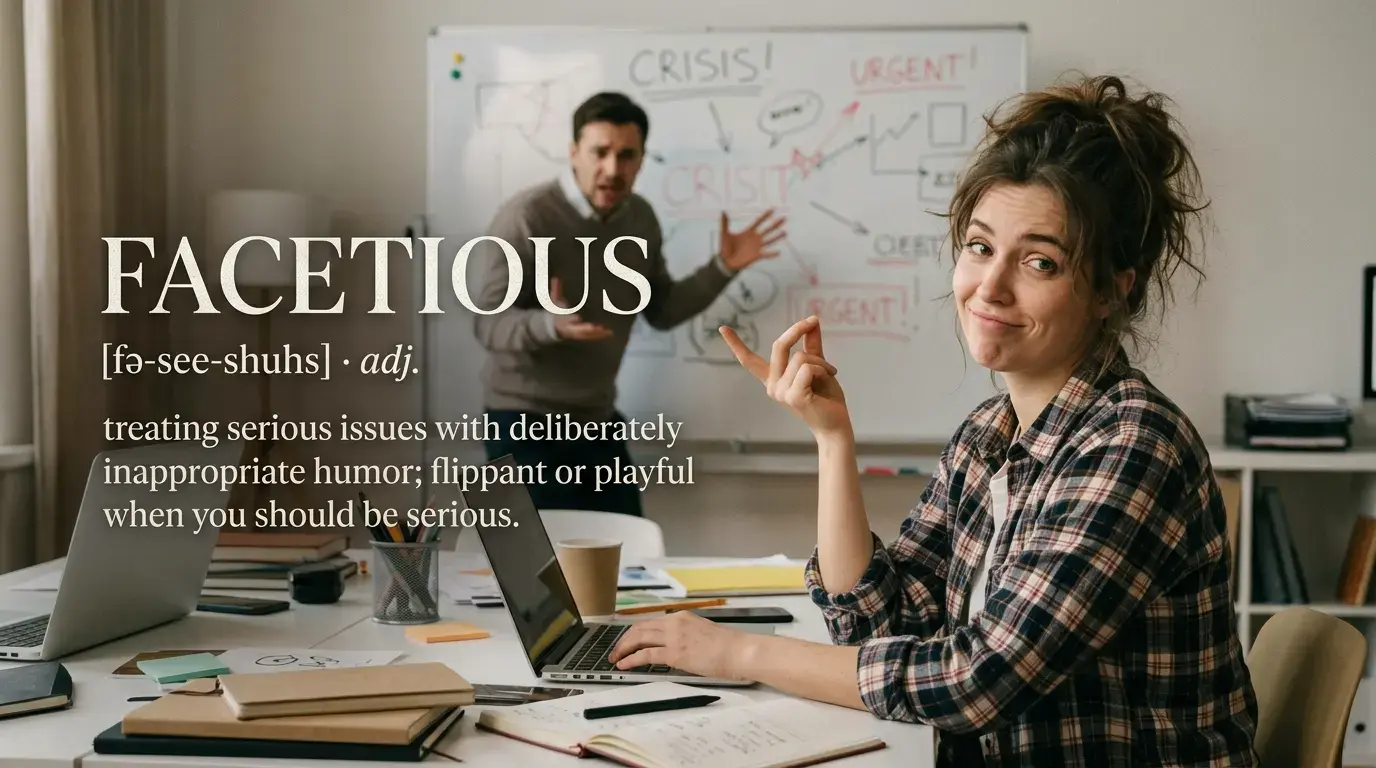
Many people mix it up with words like “sarcastic” or “funny,” but it has its own special meaning. Facetious means treating a serious topic with humor instead of the respect it deserves, often in a joking or silly way that isn’t meant to be taken seriously.
This word shows up in books, workplace chats, and everyday conversations more than you might think.
In this article, you will learn exactly what facetious means, how to use it correctly, where it came from, and how it differs from similar words. By the end, you will feel confident using this word the right way.
Quick Answer
If someone is being facetious, they are joking around about something, especially something that should be taken seriously. It’s not always mean-spirited. Sometimes it’s just playful.
But the key idea is this: a facetious comment is not meant to be believed or taken at face value. It’s a joke dressed up as a real statement, and the person saying it usually knows it will confuse or amuse the listener.
Meaning or Definition
The word facetious is an adjective. That means it describes a person, a comment, or a tone. When someone is facetious, they are being playful or joking, often at a moment when people expect them to be serious.
Here’s a simple way to think about it. Imagine your friend asks, “What time is it?” and you say, “It’s time for you to get a watch.” That’s a facetious answer. It doesn’t really answer the question. Instead, it pokes fun at the question itself.
Dictionaries generally agree on this meaning. Merriam-Webster defines facetious as joking or jesting, often inappropriately. Cambridge Dictionary describes it as trying to be funny about a subject that other people do not think is a suitable subject for humor. Both definitions point to the same idea: facetious behavior involves humor used in a moment or about a topic where humor feels out of place.
This word can describe:
- A comment (“That was a facetious remark.”)
- A person (“He’s being facetious again.”)
- A tone of voice (“She said it in a facetious tone.”)
It’s important to know that facetious usually carries a slightly negative or teasing tone. It’s rarely used as a compliment. If someone calls your comment facetious, they are often telling you, politely or not, that your joke landed at the wrong time.
Grammar or Correct Usage
Facetious is an adjective, so it works the same way as words like “silly,” “funny,” or “serious.” It usually comes before a noun or after a linking verb like “is,” “was,” or “seem.”
Here are some grammar patterns to help you use it naturally:
- Before a noun: “That was a facetious comment.”
- After a linking verb: “He seemed facetious during the meeting.”
- With an adverb: “She spoke facetiously about the deadline.” (Note: facetiously is the adverb form.)
One fun fact about this word: it contains all five main vowels in order — a, e, i, o, u. This makes it a favorite in spelling bees and word trivia games. Just remember, that clever detail doesn’t help with meaning, only spelling.
A common grammar mistake is confusing facetious with “factious,” which is a totally different word meaning divided into competing groups. They look alike but mean very different things, so it helps to double check spelling before you hit send on an email or text.
Origin or History
The word facetious comes from the French word “facétieux,” which itself traces back to the Latin word “facetia,” meaning jest or witticism. This root eventually connects to “facetus,” a Latin word meaning elegant or witty. Over time, English speakers borrowed the word and shaped its meaning into what we use today: joking in a way that may not fit the moment.
The word has been part of English since at least the late 1500s, based on historical dictionary records. Its meaning has stayed fairly stable over the centuries. It has always pointed to humor, but often humor that feels misplaced, silly, or not fully welcome given the circumstances.
Facetious vs Sarcastic vs Ironic
People often confuse facetious with sarcastic or ironic. While these words share some overlap, they are not the same. Here’s a table to make the differences clear.
| Word | Meaning | Example |
| Facetious | Joking about something serious, often flippantly | “Sure, I’ll finish the whole project by tomorrow morning.” (said jokingly about an impossible task) |
| Sarcastic | Saying the opposite of what you mean, usually to mock or criticize | “Oh great, another Monday. Just what I needed.” |
| Ironic | A situation or statement where the result is opposite of what was expected | A fire station burns down. |
Facetious humor tends to feel light and playful, even if it annoys people. Sarcasm often has a sharper, more critical edge. Irony, on the other hand, isn’t always about humor at all — it’s about contrast between expectation and reality. Knowing these differences helps you pick the right word when describing someone’s tone or attitude.
Common Mistakes
Many people misuse facetiousness in a few predictable ways. Let’s clear up the most common ones.
Mistake 1: Using it as a compliment.
Facetious is rarely a positive word. Saying “You’re so facetious!” as praise can confuse listeners, since the word usually points to poorly timed or inappropriate humor.
Mistake 2: Confusing it with “factious.”
As mentioned earlier, factious refers to conflict or division, like political factions fighting each other. Facetious refers to humor. These words are easy to mix up because they look almost identical.
Mistake 3: Overusing it in casual writing.
Because it’s a slightly formal or literary word, using it too often in everyday texts or chats can sound stiff. Save it for moments where it truly fits, like describing someone who jokes at an inappropriate time.
Mistake 4: Mispronouncing it.
The correct pronunciation is fuh-SEE-shus. Some people accidentally stress the wrong syllable, which can make the word harder to understand in conversation.
Real-Life Examples
Seeing the word in action can make its meaning click faster. Here are some everyday examples.
At work, imagine a manager announces bad news about budget cuts, and an employee jokes, “Great, guess I’ll just live in my office now.” That’s a facetious response to serious news.
In a classroom, a teacher asks a student why their homework is late, and the student replies, “My dog ate the Wi-Fi.” That’s a facetious excuse, since it’s clearly not meant to be believed.
In writing, an author might use a facetious narrator, someone who describes serious events with a joking, almost mocking tone, to add humor or critique to the story.
Here’s a table showing facetious phrases alongside their more “serious” counterparts, to highlight the tone shift.
| Facetious Statement | Serious Equivalent |
| “Oh sure, I love doing taxes. It’s my favorite hobby.” | “I dislike doing taxes.” |
| “Yeah, I definitely remembered your birthday… totally.” | “I forgot your birthday.” |
| “No worries, I’ll just work 30 hours today.” | “I have too much work today.” |
Current Usage or Trends
Today, facetious is still used often in journalism, workplace communication, and casual conversation, especially when someone wants to point out that a remark wasn’t meant seriously. It also appears frequently in online debates and social media comments, where people clarify, “I was being facetious,” after a joke gets misunderstood.
This happens a lot in text-based communication, where tone can be hard to read. Without facial expressions or vocal tone, a facetious joke can easily be mistaken for a real statement. Because of this, many people now add tone indicators or simply state, “That was facetious,” to avoid confusion.
Tips or Best Practices
If you want to use facetious correctly and naturally, keep these tips in mind.
- Use it to describe humor that feels out of place, not just any joke.
- Avoid using it as a compliment; it usually carries a mild criticism.
- Double check spelling, since “factious” is a common mix-up.
- Save it for slightly formal writing, like essays, articles, or workplace notes.
- When speaking, remember the correct pronunciation: fuh-SEE-shus.
- If you’re being facetious yourself, consider clarifying your tone, especially in text or email, to avoid misunderstandings.
FAQs
What does it mean when someone is being facetious?
It means they are joking about something, often something serious, in a way that isn’t meant to be taken literally.
Is facetious a compliment or an insult?
It’s usually neither a strong compliment nor a harsh insult, but it does carry a slightly negative tone, suggesting the humor was poorly timed or not appreciated.
How do you use facetious words in a sentence?
You can say, “He made a facetious comment about quitting his job,” meaning he joked about it without really meaning it.
What is the difference between facetious and sarcastic?
Facetious means joking about something, often flippantly, while sarcastic usually means saying the opposite of what you mean to mock or criticize someone or something.
How do you pronounce facetious?
It’s pronounced fuh-SEE-shus, with the stress on the second syllable.
What is a simple synonym for facetious?
Common synonyms include “flippant,” “joking,” “playful,” or “glib,” though each has slightly different shades of meaning.
Conclusion
Understanding the word facetious helps you read tone more clearly, whether you’re chatting with friends, reading a novel, or writing a workplace email.
At its core, facetious describes humor used at a moment or about a topic that usually calls for seriousness. It’s different from sarcasm, which mocks by saying the opposite of the truth, and different from irony, which points to unexpected outcomes.
Next time you hear someone joke around when the moment feels serious, you’ll know exactly the right word to describe it. And if your own joke gets misunderstood, you can simply say, “I was being facetious,” to clear things up.

Hassan is a content writer at LinkQuorax, sharing simple and clear meanings of words, slang, phrases, and everyday expressions to help readers understand language easily.