When people hear the word “elope,” they usually picture a couple sneaking off to get married without telling anyone. That picture is pretty close to the truth. Elope means to run away secretly to get married, often without a big wedding, without guests, and sometimes without even telling family beforehand.
People search for this word for many reasons: some just heard it in a movie or a news story, some are planning their own small wedding and want to know if “eloping” fits what they have in mind, and some are simply curious about where such an unusual word came from.
In this article, you will learn the full meaning of elope, its surprising history, how it is actually used today, and the honest differences between eloping and having a traditional wedding.
Quick Answer
To elope means to leave home secretly to get married, usually without a large ceremony, without inviting family and friends, and often in a different location than where the couple normally lives.
Today, the word has grown a little softer than it once was. Many couples now use “elope” simply to describe a small, private wedding, even if their parents already know about it and everyone is on good terms.
Meaning or Definition
At its core, elope describes a very specific action: a couple leaving quietly, often suddenly, to get married without the usual big wedding events. The key ideas packed into this one word are secrecy, simplicity, and speed.
In the past, eloping almost always meant sneaking away in secret, often because a couple’s families disapproved of the marriage. Think of it like a dramatic old movie scene: two young lovers climbing out a window at night, driving off, and getting married by a small-town judge before anyone can stop them.
Today, the meaning has relaxed quite a bit. Modern couples often say they are “eloping” even when their parents fully support the decision. In this newer sense, elope simply means choosing a small, private wedding over a large, expensive one. The couple might invite zero guests, or maybe just one or two very close family members, and skip most of the traditional wedding planning altogether.
So elope can mean two slightly different things depending on the context: the old, dramatic meaning of secretly running away against a family’s wishes, or the newer, more common meaning of simply having a small, intimate wedding by choice.
Grammar or Correct Usage
Elope is a verb, and it follows regular English verb rules, so it changes form the same way many other verbs do. The table below shows how elope changes depending on the tense of the sentence.
| Form | Example Sentence |
| Elope (present) | Many couples elope to save money on a big wedding. |
| Elopes (present, singular) | She elopes with her boyfriend this weekend. |
| Eloped (past) | They eloped last summer in Las Vegas. |
| Eloping (present participle) | We are eloping next month to Hawaii. |
| Elopement (noun form) | Their elopement surprised the whole family. |
A common grammar question is whether elope needs an object, like “elope someone.” It does not. Elope is what grammar teachers call an intransitive verb, meaning it does not take a direct object. You would say “They eloped,” not “They eloped her” or “He eloped Sarah.” Instead, you use the word “with” to include the other person, as in “He eloped with Sarah.”
Another useful form is the noun “elopement,” which describes the event itself. You might say, “Their elopement was small but beautiful,” using the noun form to describe the wedding as a whole event rather than describing the action of running off.
Origin or History
The word elope actually has a longer and more interesting history than most people expect. It comes from an old legal term used in English courts hundreds of years ago. Early versions of the word appeared in English law during the medieval period, originally describing a married woman who ran away from her husband with another man.
Over time, the word’s meaning shifted. By the 1700s and 1800s, elope had moved away from its older, narrower legal meaning and had settled into something closer to how we use it today: running away, usually with a romantic partner, to get married without permission or without a formal ceremony.
Historically, eloping was often tied to social rules that no longer apply in most of the United States today. In earlier centuries, families sometimes arranged marriages, or they strongly controlled who their children were allowed to marry. If two young people wanted to marry someone their families disapproved of, running away together to marry secretly was sometimes their only real option. This history is part of why the word elope still carries a hint of rebellion and romance, even though modern couples usually elope simply because they prefer something small and stress-free.
Real-Life Examples
Seeing elope used in everyday situations makes the meaning much easier to picture. Below are a few realistic examples covering both the traditional and modern uses of the word.
In the traditional sense, imagine two college students whose families strongly disapprove of their relationship. Instead of waiting for approval that may never come, they drive to another state, get married at a courthouse, and call their families afterward to share the news. This fits the classic, dramatic version of eloping.
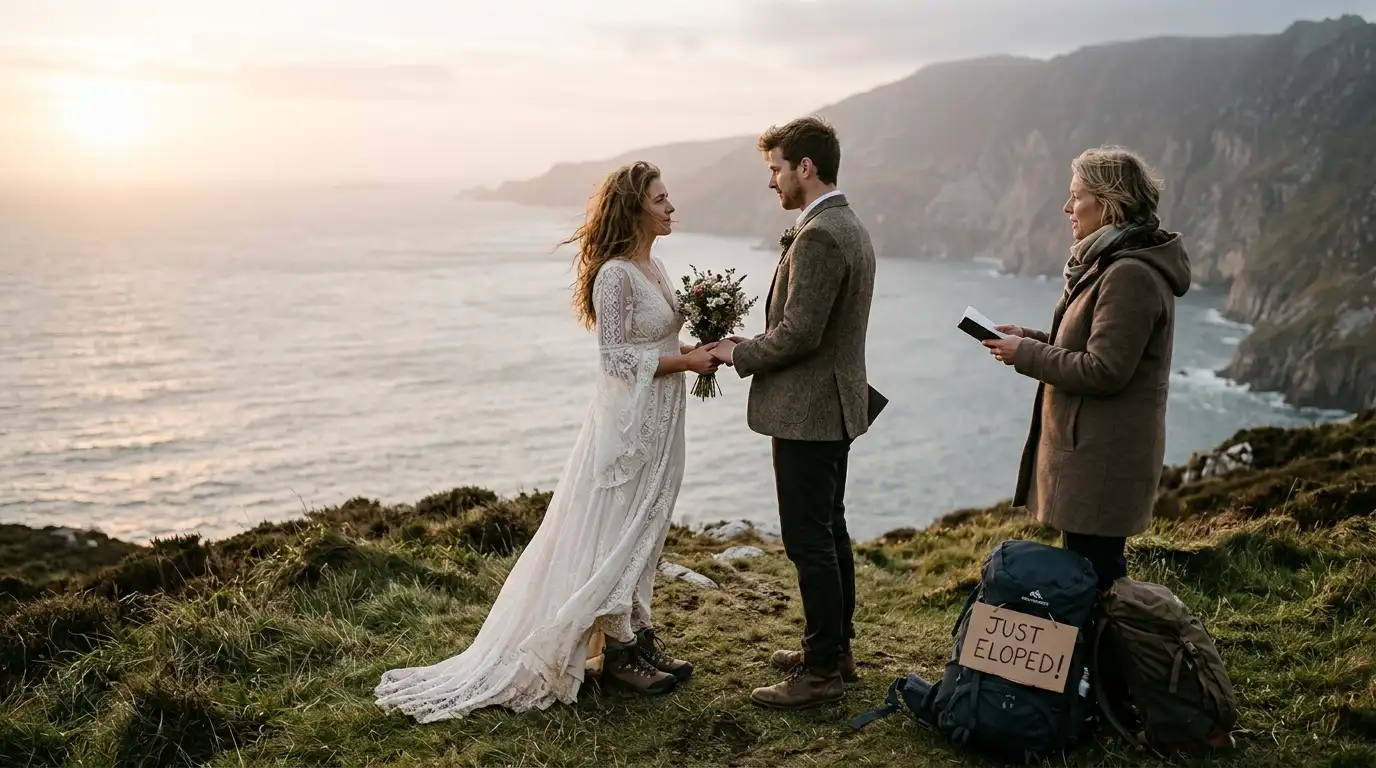
In the modern sense, imagine a couple who simply dislikes the idea of a large wedding with hundreds of guests, expensive catering, and months of planning. Instead, they fly to a beautiful location, like a beach in Hawaii or a mountain town in Colorado, and get married with just a photographer and an officiant present. Afterward, they post photos and tell family the happy news. This is also correctly called eloping, even though nobody was upset and nothing was truly a secret.
Another common modern example involves cost. A couple planning a wedding gets a quote for a traditional venue and realizes it would cost more than they can comfortably spend. They decide instead to elope to a nearby scenic spot with a marriage license and two witnesses, saving thousands of dollars while still making their marriage official and meaningful.
Current Usage or Trends
The meaning of elope has genuinely shifted over the last few decades, and this shift shows up clearly in how wedding businesses talk about it today. Many wedding photographers, planners, and venues now advertise “elopement packages,” a phrase that would have sounded strange a hundred years ago, since elopements were once private events that nobody planned around a package deal.
This modern version of eloping has grown especially popular for a few clear reasons. Weddings in the United States have become expensive, and many couples want to avoid that cost. Others simply prefer a more personal, low-stress event instead of managing a guest list, seating charts, and a large budget. Scenic elopements, where couples marry outdoors in places like national parks, beaches, or mountains, have become especially popular on social media, which has helped normalize the word even further.
Because of this shift, elope no longer automatically implies family conflict or secrecy the way it once did. Today, when someone says they eloped, most people assume they chose a small, intimate wedding, not that they ran away against their family’s wishes. Context still matters, though, so if someone says “we eloped because our parents didn’t approve,” that older, more dramatic meaning is still very much alive and understood.
Common Mistakes
One common mistake is assuming elope always means the couple’s families were angry or unaware. While that was the traditional meaning, it is often not true anymore, so this assumption can lead to awkward conversations or wrong guesses about someone’s family situation.
Another mistake is confusing eloping with having no legal marriage at all. Eloping is still a real, legal marriage. Couples who elope still need a marriage license, still need witnesses in most states, and still need to follow their state’s marriage laws, exactly like couples who have large weddings.
People also sometimes mix up “elope” with “engagement,” probably because both words involve romance and marriage. These words mean completely different things. An engagement is the promise to get married in the future, while eloping is the act of actually getting married, usually quickly and privately.
A grammar mistake worth mentioning again is treating elope as if it needs a direct object, saying something like “elope her” instead of the correct “elope with her.” Since elope is intransitive, it always needs the word “with” to connect it to the other person involved.
The table below compares elope with two words people often confuse it with.
| Word | Meaning | Key Difference |
| Elope | To marry secretly or privately, often quickly | Focuses on getting married |
| Engagement | A promise to marry in the future | Happens before the wedding, not during it |
| Runaway | Someone who leaves home, not necessarily to marry | No connection to marriage at all |
Tips or Best Practices
If you are considering eloping yourself, start by checking your state’s marriage license requirements, since rules can vary quite a bit. Some states require a waiting period between applying for a license and getting married, while others allow you to marry the very same day.
Think carefully about your family before you elope, especially if you want to avoid hurt feelings. Even a short phone call or message beforehand, letting loved ones know your plans, can prevent a lot of confusion or sadness after the fact, even if you are not asking permission.
If you like the idea of a scenic or memorable elopement, research your location ahead of time. Popular elopement spots, like national parks, often require special permits for ceremonies or photography, so check the rules well before your planned date.
Finally, remember that eloping does not mean skipping celebration altogether. Many couples who elope still host a casual party or dinner afterward with family and friends, allowing them to enjoy a small wedding while still sharing the moment with people they love.
FAQs
What does it mean when someone says they eloped?
It means they got married in a small, private, often quick way, usually without a large wedding ceremony or many guests. It may or may not have involved keeping the marriage a secret from family.
Is eloping the same as running away to get married?
Traditionally, yes, that was the exact meaning. Today, though, elope is often used more loosely to describe any small, private wedding, even one that family members know about and support.
Do you need a marriage license to elope?
Yes. Eloping is still a real legal marriage, so couples need a valid marriage license and must follow their state’s marriage laws, just like couples who have a large, traditional wedding.
Why do couples choose to elope today?
Most modern couples elope to save money, avoid wedding stress, or enjoy a more private, personal experience, rather than because of family disapproval, which was the more common reason in the past.
Can you elope and still have a wedding celebration later?
Absolutely. Many couples elope first to make their marriage official in a small, quiet setting, then host a larger party or celebration afterward so friends and family can still celebrate with them.
Is “elopement” a formal legal term?
No, elopement is not a special legal category of marriage. Legally, an eloped marriage is treated exactly the same as any other marriage, as long as the couple follows their state’s normal marriage requirements.
Conclusion
Elope simply means getting married in a small, private, and often quick way, usually without a big traditional wedding.
While the word once carried a strong sense of secrecy and family conflict, its meaning has softened over time, and today it mostly describes couples who prefer something simple and personal over something large and expensive.
If you are curious about the word’s history or thinking about eloping yourself, the most important thing to remember is this: eloping is still a completely real and legal marriage, so be sure to check your state’s requirements before you go.
A short, thoughtful conversation with family beforehand can also go a long way toward keeping the moment joyful for everyone involved.

Hi, I’m Benjamin Dreyer. I enjoy exploring words, phrases, slang, abbreviations, acronyms, and digital communication. At Linkquorax.com, I share simple and accurate explanations to help readers understand unfamiliar terms and popular internet expressions. My goal is to make every meaning clear, useful, and easy to understand. Whether you are curious about a new word or an online phrase, Linkquorax.com provides straightforward information to help you learn quickly and communicate with confidence in everyday conversations.