The esoteric meaning of something is information, knowledge, or an idea that is understood by only a small group of people, usually because it requires special knowledge or interest.
In simple words, esoteric means “known or understood by only a few people.” It can describe a rare subject, unusual hobby, difficult idea, or specialized type of knowledge.
You may see the word esoteric in books, articles, academic writing, philosophy, art, technology, and everyday conversations about unusual interests.
For example, someone might say, “He has an esoteric knowledge of ancient coins.” This means he knows a lot about a narrow subject that most people do not know much about.
The word can sound complicated, but its basic idea is easy. In this guide, you will learn the esoteric meaning, pronunciation, origin, grammar, examples, synonyms, common mistakes, and the difference between esoteric and similar words such as obscure, arcane, and exoteric.
Quick Answer
Esoteric means understood, known, or enjoyed by only a small number of people with special knowledge or interest. It often describes something rare, highly specialized, unusual, or not familiar to the general public.
For example:
“She has an esoteric interest in medieval manuscripts.”
This means her interest is very specific and unusual, and only a small number of people may share or understand it.
The word does not always mean secret. Something can be esoteric simply because it is specialized or unfamiliar to most people.
| Word | Simple meaning |
| Esoteric | Known or understood by a small, specialized group |
| Obscure | Not well known or difficult to find |
| Arcane | Known by very few people, often because it involves specialized knowledge |
| Unusual | Different from what is common |
| Exoteric | Intended for or understood by the general public |
The easiest way to remember esoteric is: “for the few, not the many.”
Esoteric Meaning and Definition

The main esoteric meaning refers to knowledge or ideas that are limited to a small group of people. These people may have special training, experience, education, or a strong interest in a particular subject.
Cambridge defines esoteric as something very unusual and understood or liked by only a small number of people, especially people with special knowledge. Its American English definition also focuses on information intended for or understood by only a few people with special knowledge.
Oxford gives a similar meaning: something likely to be understood or enjoyed by only a few people who have special knowledge or interest.
Here are a few simple examples:
“Quantum physics can seem esoteric to someone who has never studied physics.”
“His collection of rare stamps is quite esoteric.”
“She enjoys esoteric films that most people have never heard of.”
“The professor discussed an esoteric part of ancient history.”
In each example, esoteric points to something that is not widely understood, known, or enjoyed.
It is important to notice that esoteric does not automatically mean bad, strange, secret, or supernatural. A subject may be esoteric simply because it is narrow and specialized.
For example, professional knowledge about repairing a rare type of aircraft could be esoteric. So could knowledge about a little-known musical instrument, an unusual programming language, or a very specific area of history.
What Does Esoteric Mean in Simple English?

In very simple English, esoteric means “something only a small number of people know about or understand.”
Imagine that 10,000 people know about basketball, but only 20 people know the detailed history of one small basketball club from the 1950s. That very specific knowledge could be called esoteric.
The same idea works with hobbies.
A person who enjoys popular movies has a common interest. A person who knows the production history, rare editions, forgotten actors, and technical details of a very obscure film series may have an esoteric interest.
You can think about the word this way:
Common knowledge → many people understand it.
Specialized knowledge → fewer people understand it.
Esoteric knowledge → only a small or specialized group understands it well.
This is why esoteric words often appear with words such as knowledge, subject, interest, language, theory, art, music, and information.
| Phrase | What it means |
| Esoteric knowledge | Specialized knowledge known by relatively few people |
| Esoteric subject | A narrow or specialized topic |
| Esoteric interest | An unusual or highly specific interest |
| Esoteric language | Language that may be understood mainly by a specialized group |
| Esoteric theory | A theory that may require special knowledge to understand |
| Esoteric art | Art with unusual or specialized ideas that may appeal to a small audience |
Esoteric Pronunciation
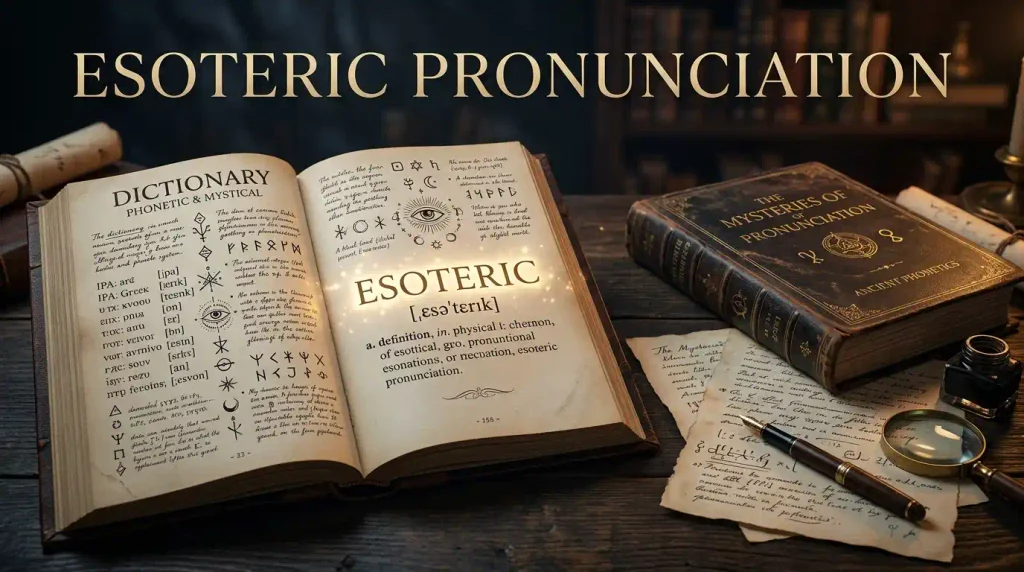
In American English, esoteric is commonly pronounced approximately like:
es-uh-TER-ik
The main stress falls on the third syllable: TER.
A common pronunciation guide is:
/ˌes.əˈter.ɪk/
Oxford lists American pronunciation as /ˌesəˈterɪk/.
Try saying it slowly:
es — uh — TER — ik
Then say it naturally:
esoteric
The word may look harder than it sounds. Once you hear it a few times, the pronunciation becomes much easier.
Esoteric Word Origin and History
The word esoteric has a long history. Oxford traces the English word to the mid-17th century and connects it to the Greek esōterikos, meaning something like “inner.” The Greek word is related to esōterō, meaning “more within.”
The idea behind the word is therefore connected to being inside or belonging to an inner group.
Etymology sources also trace esoteric to Greek esoterikos, with the sense of belonging to an inner circle. The English adjective began appearing in the 1650s with meanings connected to secret, inner, or specialized knowledge.
Historically, the word became associated with distinctions between teachings meant for a wider audience and teachings connected with a more limited or specialized group. However, it is important not to oversimplify ancient philosophy by saying that every philosopher had a strict system of secret teachings. Historical sources show that the term has been used in different ways over time.
Today, the meaning is much broader. You do not need to be talking about ancient philosophy, religion, or secret societies to use esoteric correctly.
Someone can have an esoteric knowledge of baseball statistics, an esoteric interest in vintage cameras, or an esoteric understanding of computer programming.
Esoteric vs. Exoteric

One of the most useful comparisons is between esoteric and exoteric.
These words are related but have almost opposite meanings.
Esoteric refers to something intended for or understood by a small group with special knowledge.
Exoteric refers to something intended or suitable for people generally. Cambridge defines exoteric as something intended for or suitable for people generally, rather than only for a particular group.
For example:
“His research is esoteric.”
This suggests that the research is specialized and may be understood mainly by experts.
“The museum created an exoteric explanation for visitors.”
This suggests the explanation was made for a general audience.
| Esoteric | Exoteric |
| For a small or specialized group | For the general public |
| Requires special knowledge | Easier for most people to understand |
| Narrow or specialized | Broad or public |
| Inner or specialized knowledge | Public or general knowledge |
A simple memory trick is:
Esoteric = inside
Exoteric = outside
The two words are especially useful when talking about knowledge, teaching, philosophy, religion, or specialized subjects.
How to Use Esoteric in a Sentence
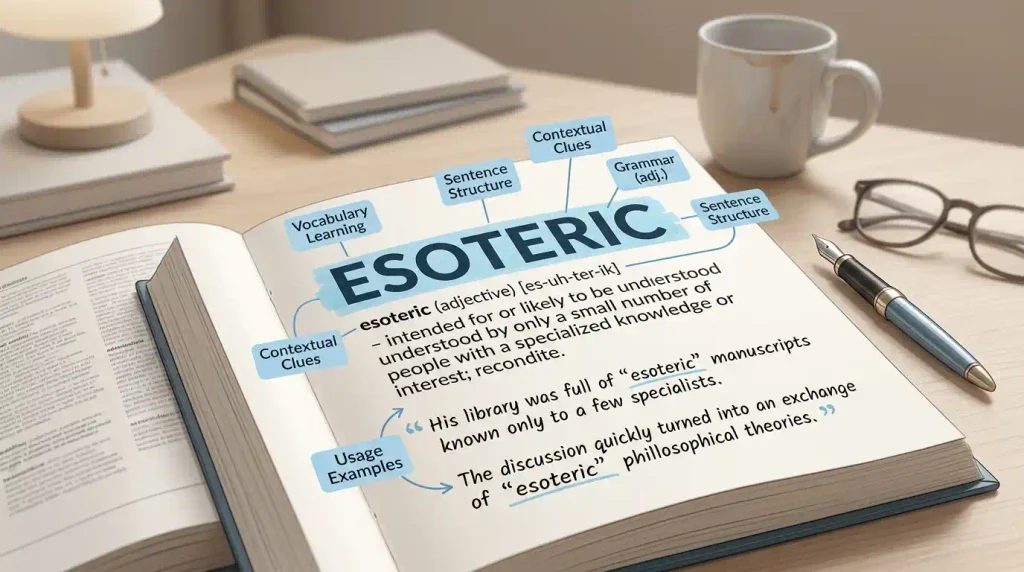
Esoteric is an adjective, so it normally describes a noun.
You can say:
“She studies esoteric philosophy.”
“He has an esoteric hobby.”
“That book contains esoteric information.”
“They discussed an esoteric theory.”
“The museum has an esoteric collection of historical objects.”
The word often appears before nouns such as knowledge, subject, topic, interest, theory, practice, art, and information.
Here are more natural examples:
“The professor explained an esoteric idea in simple language.”
“His esoteric taste in music makes his playlists very unusual.”
“She has an esoteric interest in old maps.”
“The article discusses an esoteric area of computer science.”
“I enjoy learning about esoteric subjects.”
Notice that esoteric does not have to describe something impossible to understand. It can describe something that simply requires more background knowledge than most people have.
Esoteric Examples in Real Life
The word becomes much easier when you see it in everyday situations.
Imagine a person who knows everything about a small brand of cameras that stopped being made 70 years ago. Most people have never heard of the brand. Their knowledge could be called esoteric.
Now imagine a programmer who enjoys writing code in a strange programming language that very few developers use. That interest could also be described as esoteric.
A music fan may know the complete history of a tiny underground music scene. Again, that knowledge could be esoteric.
Here are some more examples:
Education: “The professor wrote a paper about an esoteric area of mathematics.”
History: “She enjoys reading about esoteric details of medieval trade.”
Technology: “The conference included a talk about an esoteric programming language.”
Art: “The gallery displayed several esoteric works that appealed to a small audience.”
Hobbies: “His esoteric hobby is collecting unusual mechanical toys.”
Books: “The novel contains esoteric references that some readers may miss.”
Music: “He has an esoteric taste in experimental music.”
Science: “The article explains an esoteric scientific concept.”
These examples show why the word is useful. It can describe many different kinds of specialized interests.
Is Esoteric the Same as Secret?

Not exactly.
This is one of the most common misunderstandings about the word.
Something secret is deliberately hidden or kept from other people.
Something esoteric is usually understood by only a small number of people because it is specialized, unusual, complex, or limited to a particular group.
For example, a password is secret. It is not normally called esoteric.
On the other hand, an advanced subject in theoretical mathematics may be esoteric. The information may be completely public, but only people with the right background can understand it easily.
Consider these examples:
“The company kept the password secret.”
“The researcher wrote about an esoteric mathematical problem.”
The first sentence is about something hidden.
The second is about specialized knowledge.
There can be some overlap in older or specialized uses of esoteric, especially when discussing traditions or teachings associated with restricted groups. But in modern everyday English, specialized or limited knowledge is usually the safer way to understand the word.
Esoteric Synonyms and Similar Words
Several words are close to esoteric, but they are not always perfect replacements.
Obscure means something is not well known or not easy to find. An obscure historical event may simply be unknown to most people.
Arcane often describes knowledge that is understood by only a few people, especially knowledge that is old, specialized, or mysterious.
Abstruse usually describes an idea that is very difficult to understand.
Rare means uncommon or unusual, but it does not necessarily involve special knowledge.
Niche describes something focused on a small, specific group or interest.
Here is a useful comparison:
| Word | Main idea | Example |
| Esoteric | Known by a small, specialized group | Esoteric philosophy |
| Obscure | Not widely known | An obscure historical event |
| Arcane | Specialized, mysterious, or little-known knowledge | Arcane legal rules |
| Abstruse | Very difficult to understand | An abstruse theory |
| Niche | Designed for a small, specific interest | A niche hobby |
| Rare | Uncommon | A rare book |
The best synonym depends on the sentence.
If you want to emphasize specialized knowledge, esoteric is often a strong choice.
With at you want to emphasize difficulty, abstruse may be better.
If you want to emphasize lack of popularity, obscure may fit better.
Common Mistakes With the Word Esoteric
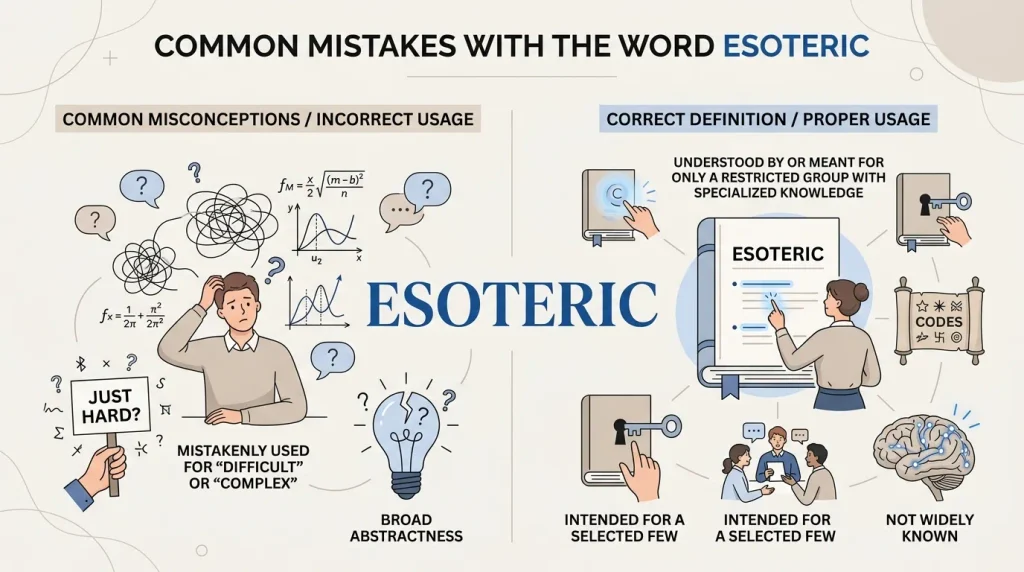
One mistake is assuming that esoteric always means secret. As explained above, something can be esoteric without being hidden.
Another mistake is using esoteric simply to mean hard.
A difficult subject can be esoteric, but difficulty alone does not make something esoteric. The key idea is that it is understood, known, or enjoyed by a relatively small or specialized group.
For example:
“The instructions were esoteric.”
This could mean the instructions were specialized or difficult for outsiders to understand, but the exact meaning depends on context.
Another common mistake is using esoteric as a noun in normal sentences. Usually, you should use it as an adjective.
Correct:
“She studies esoteric subjects.”
Less natural:
“She studies esoteric.”
If you want a noun, words such as esotericism or esoterica may be appropriate in specific contexts. Esoterica can refer to things related to esoteric subjects.
Is Esoteric a Positive or Negative Word?
Esoteric is generally neutral. Its meaning depends on context.
It can sound positive when someone wants to praise a person for having deep or unusual knowledge.
For example:
“She has an impressive esoteric knowledge of classical music.”
Here, the word suggests that she knows a specialized subject very well.
But it can sound slightly negative when the writer thinks something is too specialized for ordinary people.
For example:
“The article became too esoteric for new readers.”
Here, the writer suggests that the article became so specialized that many readers could not follow it.
So the word itself is not automatically positive or negative. The surrounding sentence gives it its tone.
Esoteric in Modern English

In modern English, esoteric is used in many areas beyond its historical and philosophical associations.
You may see it in writing about technology, art, literature, science, music, gaming, hobbies, history, and online communities.
A person might describe a very specific internet community as having an esoteric interest. A programmer may talk about an esoteric programming language. A music reviewer may describe an album as having an esoteric sound.
The word is also useful because the internet has made it easier for people with highly specific interests to find each other.
For example, a hobby that once had only a few followers in one town can now have a worldwide online community. The subject may still be esoteric because it remains highly specialized, even though information about it is easy to find.
This shows an important point: esoteric does not always mean unavailable.
Information can be public and searchable while still being esoteric because only a small group has enough interest or background to understand it deeply.
Esoteric Meaning in Different Contexts
The exact meaning of esoteric can change slightly depending on the subject.
In philosophy, it may describe specialized ideas that require background knowledge.
In religion or spirituality, it may describe teachings or traditions associated with specialized or inner knowledge. This is one area where the word can overlap with terms such as mystical or occult, but the words are not identical.
In technology, it can describe unusual tools, systems, or programming languages that only a small group uses.
Art, it may describe work with highly unusual ideas or references that appeal to a limited audience.
In hobbies, it often describes a very specific interest that most people do not share.
In academic writing, it can describe a narrow subject that requires expert knowledge.
The basic meaning stays the same: the subject is not common knowledge or common interest and is mainly understood or appreciated by a smaller group.
Esoteric vs. Obscure vs. Arcane
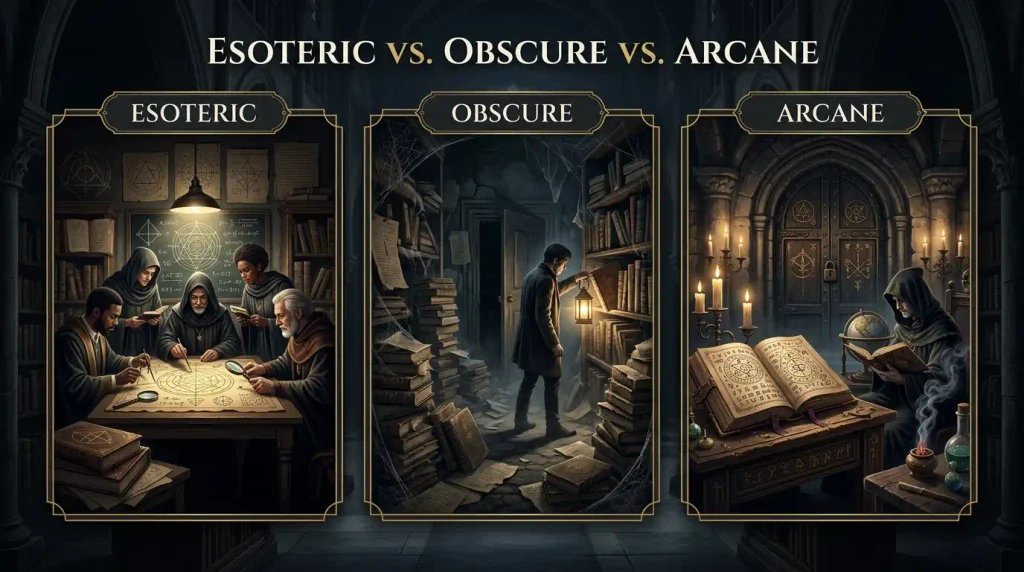
These three words are often confused.
An obscure subject is simply not well known.
An arcane subject involves knowledge that is often specialized, old, technical, or mysterious.
An esoteric subject is generally intended for or understood by a small group with special knowledge or interest.
For example:
“An obscure author” means the author is not widely known.
“Arcane rules” means the rules are specialized and perhaps difficult for ordinary people to know.
“Esoteric knowledge” means the knowledge is mainly understood by a small or specialized group.
The words can overlap, so context matters.
Frequently Asked Questions
What does esoteric mean in simple words?
Esoteric means something known, understood, or enjoyed by only a small number of people, especially people with special knowledge or interest.
Does esoteric mean secret?
Not always. Esoteric can describe specialized knowledge that is completely public. The main idea is that relatively few people understand or know much about it.
Is esoteric a positive word?
It can be positive, negative, or neutral depending on context. It may praise someone’s specialized knowledge, or it may suggest that something is too specialized for a general audience.
What is an example of something esoteric?
A very specific area of historical research, an unusual programming language, or a rare hobby can be esoteric if only a small group has strong knowledge or interest in it.
What is the opposite of esoteric?
A useful opposite is exoteric, which refers to something intended for or suitable for the general public.
What are common synonyms for esoteric?
Depending on the sentence, related words include arcane, obscure, abstruse, and niche.
Conclusion
The word does not always mean secret, mysterious, or difficult. A subject can be esoteric simply because it is very specific and not familiar to most people. You can use it to describe specialized knowledge in science, technology, philosophy, art, history, music, hobbies, and many other areas.
Remember the easiest definition: “esoteric = for the few, not the many.”
When using the word, pay attention to context. If you mean something that is little known, obscure may be better.

Hi, I’m Benjamin Dreyer. I enjoy exploring words, phrases, slang, abbreviations, acronyms, and digital communication. At Linkquorax.com, I share simple and accurate explanations to help readers understand unfamiliar terms and popular internet expressions. My goal is to make every meaning clear, useful, and easy to understand. Whether you are curious about a new word or an online phrase, Linkquorax.com provides straightforward information to help you learn quickly and communicate with confidence in everyday conversations.