Have you ever heard someone say, “I’m feeling so jaded about dating,” or “He’s grown jaded after years in that job”? If you weren’t sure exactly what that meant, you’re not alone.
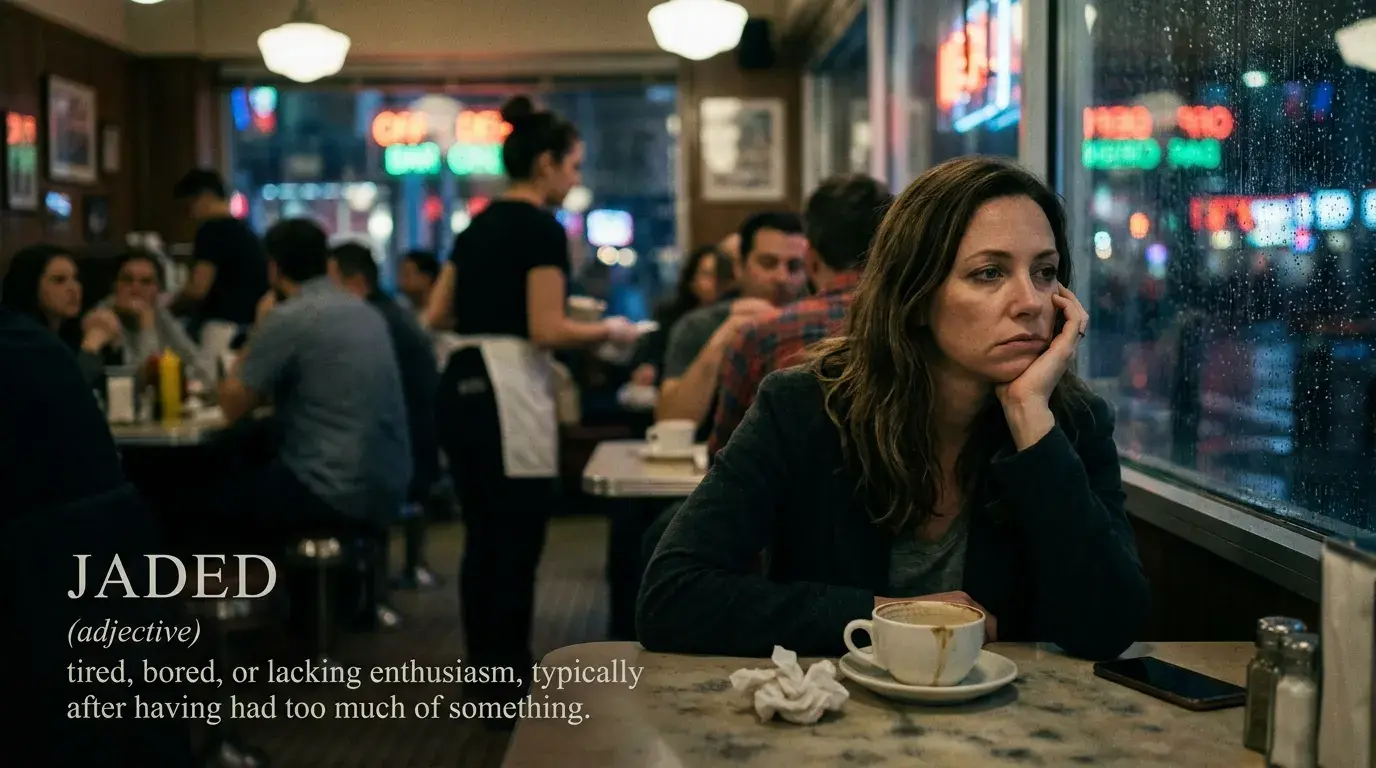
The jaded meaning points to a tired, worn-out feeling that comes from doing or seeing too much of the same thing. It’s not just being bored, it’s a deeper kind of emotional fatigue that changes how a person sees the world around them.
In this article, you’ll learn the full meaning of “jaded,” how to use it correctly in a sentence, where the word came from, and how it shows up in everyday conversations.
By the end, you’ll be able to use “jaded” with confidence, If you’re writing an email, chatting with friends, or just trying to understand a word you keep running into online.
Quick Answer
The jaded meaning is simple: to be jaded means to feel tired, bored, or emotionally worn out because of too much experience with something. A jaded person has often seen so much of one thing, good or bad, that they no longer feel excited, surprised, or hopeful about it.
The word usually describes a mood or an attitude, not a permanent personality trait, though it can last a long time if nothing changes.
For example, a nurse who has worked in a busy hospital for twenty years might feel jaded about emergency room drama.
A music fan who has been to hundreds of concerts might feel jaded about seeing “just another show.” The feeling is real, common, and something almost everyone experiences at some point in life.
Meaning and Definition
Let’s slow down and look at the word “jaded” a little closer. As an adjective, “jaded” describes someone who feels dulled, tired, or unenthusiastic because they have experienced too much of something over time.
It often carries a sense of disappointment too, as if too many letdowns have made a person stop expecting good things.
Here’s a simple way to think about it: imagine eating your favorite food every single day for a year. At first, it’s exciting. After a while, though, you stop tasting the joy in it. You might even start to dislike it a little.
That flat, unimpressed feeling is close to what “jaded” describes, except it usually applies to people, relationships, jobs, or life experiences rather than food.
Dictionaries generally agree on this definition. Merriam-Webster describes “jaded” as being worn out or dulled, especially by overwork or excess. Cambridge Dictionary explains it as feeling tired or bored because you have done or experienced too much of something.
Both definitions point to the same idea: too much exposure has worn down a person’s enthusiasm or trust.
It helps to notice that “jaded” is not the same as simply “tired.” You can be tired after a long day and still feel hopeful about tomorrow. Being jaded is more emotional and long-lasting. It affects how you see people, situations, or even life itself.
A jaded employee doesn’t just want a nap they’ve lost some of their belief that things will get better.
Grammar and Correct Usage
“Jaded” works as an adjective, which means it describes a noun. You’ll usually see it placed either before a noun or after a linking verb like “is,” “seems,” or “feels.”
Here are some common sentence patterns:
- Before a noun: “She has a jaded outlook on relationships.”
- After a linking verb: “He seems jaded after so many job rejections.”
- With “about” or “toward”: “They grew jaded about politics after the election.”
- With “by”: “The critic was jaded by years of mediocre films.”
Notice that “jaded” often pairs with prepositions like “about,” “toward,” or “by” to explain the cause of the feeling. This helps make your sentence clearer, since “jaded” alone doesn’t always explain what caused the tired, worn-down feeling.
The word also has a verb form, “jade,” which is rarely used today outside of older or more formal writing. “To jade” means to make someone tired or dull through overuse or excess. You might see this in classic literature, but in everyday American English, people almost always use “jaded” as an adjective instead.
Below is a quick reference table to help you use the word correctly.
| Usage Pattern | Example Sentence | Notes |
| Jaded + about | “I’m jaded about online dating.” | Most common pattern |
| Jaded + by | “She was jaded by constant criticism.” | Shows the cause |
| Jaded + toward | “He became jaded toward his coworkers.” | Slightly more formal |
| Grow/become + jaded | “They grew jaded over the years.” | Shows a gradual change |
| Jaded + noun | “a jaded traveler,” “a jaded fan” | Describes a person directly |
Origin and History
The word “jaded” has an interesting backstory. It comes from the older English word “jade,” which was once used to describe a worn-out or worthless horse, especially one that was old, tired, or poorly cared for. This usage goes back several centuries in English writing.
Over time, English speakers began using “jaded” more broadly to describe people instead of horses. If a horse could become worn out from overwork, then so could a person’s emotions, patience, or enthusiasm.
By the 1600s and 1700s, writers were already using “jaded” to describe people who felt exhausted or dulled by too much experience, much like we use it today.
This shift from describing tired animals to describing tired feelings is a common pattern in English. Many emotional words started out as physical descriptions before people applied them to feelings and attitudes.
Knowing this history can help you remember the word’s meaning: just like an overworked horse loses its energy and spark, a jaded person loses their emotional spark after too much repeated experience.
Common Mistakes
Even though “jaded” is a fairly common word, people sometimes misuse it. Here are a few mistakes to watch out for.
Mistake 1: Confusing “jaded” with “bored.”
Boredom is usually short-term and caused by a lack of stimulation. Being jaded is longer-lasting and comes from too much stimulation or experience, often paired with disappointment. You can be bored on a slow afternoon, but you become jaded after years of repeated letdowns.
Mistake 2: Using “jaded” to mean simply “sad.”
While jaded feelings can include sadness, the word specifically points to a loss of enthusiasm, trust, or excitement not general sadness. Someone can be jaded without being sad at all; they might just feel numb or unimpressed.
Mistake 3: Forgetting the preposition.
Saying “I’m jaded dating” sounds incomplete. The correct form needs a preposition, such as “I’m jaded about dating” or “I’m jaded by dating.” Leaving it out makes the sentence feel unfinished to most English speakers.
Mistake 4: Overusing it in casual speech.
Some people use “jaded” for every small annoyance, which can weaken its meaning. Save it for situations that truly involve long-term emotional wear, not just a single bad day.
Real-Life Examples
Seeing “jaded” in real situations makes the meaning easier to remember. Here are a few everyday examples.
A teacher who has dealt with difficult parents for fifteen years might say, “I used to get excited about parent-teacher conferences. Now I just feel jaded.” This shows how repeated stress over time can wear down someone’s original enthusiasm.
A moviegoer who watches hundreds of films a year might tell a friend, “I’m too jaded to enjoy superhero movies anymore. They all feel the same.” Here, the word points to a loss of excitement caused by repetition.
In relationships, someone might say, “After two bad breakups, I became jaded about love.” This shows how disappointment can build up and change a person’s outlook on future relationships, even ones that haven’t happened yet.
In the workplace, an employee might explain, “I was so passionate about this company when I started. Five years later, with no raises or recognition, I feel completely jaded.” This example shows how unmet expectations over a long period lead to that dulled, tired feeling.
Even public figures use the word. News reporters, critics, and comedians often describe themselves as “jaded” after years of covering the same topics or watching the same patterns repeat in politics, entertainment, or business.
Current Usage and Trends
The jaded meaning has found a strong place in modern conversations, especially online. On social media, people often describe themselves as “jaded” about topics like dating apps, social media itself, celebrity culture, or current events.
This makes sense, since constant exposure to repetitive or disappointing content can easily create that worn-out feeling the word describes.
Mental health conversations have also brought new attention to the word. Some writers and therapists connect feeling “jaded” to burnout, a related but slightly different concept.
Burnout usually involves physical and mental exhaustion from stress, while being jaded focuses more on losing hope, trust, or enthusiasm after repeated disappointment.
The two often overlap, which is part of why “jaded” shows up so often in discussions about work-life balance and emotional wellbeing.
You’ll also notice “jaded” used a lot in reviews and criticism. Movie critics, book reviewers, and gamers frequently describe becoming jaded after reviewing too many similar products.
This usage fits the original meaning well, since it reflects dulled enthusiasm from repeated exposure to the same patterns.
Tips for Using “Jaded” Naturally
If you want to use this word like a native English speaker, keep a few simple tips in mind.
First, always try to explain the cause. Instead of just saying “I’m jaded,” add context: “I’m jaded about customer service jobs because of how I was treated.” This makes your meaning clear and your writing more specific.
Second, remember that “jaded” usually implies a process, not a sudden event. People don’t become jaded overnight from one bad experience. It usually builds up gradually, so phrases like “grew jaded” or “became jaded over time” often sound more natural than “suddenly jaded.”
Third, pair “jaded” with specific details when writing or speaking. Saying “She seems jaded” is fine, but “She seems jaded after years of unanswered job applications” paints a clearer picture and helps your reader or listener understand exactly what you mean.
Finally, don’t be afraid to pair “jaded” with softer follow-up statements when speaking about yourself, especially in professional settings. For example, “I’ve become a bit jaded, but I’m working on staying open-minded” shows self-awareness and balance.
| Tip | Example |
| Explain the cause | “I’m jaded about politics because of broken promises.” |
| Show it built up over time | “I slowly grew jaded after years in sales.” |
| Add specific details | “He’s jaded from working nights for a decade.” |
| Balance it with hope | “I’m jaded, but I still believe things can change.” |
FAQs
What does it mean when someone says they are jaded?
It means they feel tired, unenthusiastic, or emotionally worn out because they have had too much experience with something, often involving disappointment.
Is being jaded a bad thing?
It’s not necessarily bad, but it usually reflects a difficult emotional state. Being jaded can be a normal response to repeated stress or letdowns, though it may benefit from self-reflection or a change in environment.
What is the difference between jaded and cynical?
Jaded describes a tired, worn-out feeling from too much experience. Cynical describes a belief that people or situations are generally selfish or dishonest. A jaded person can become cynical, but the two words aren’t exactly the same.
Can you use “jaded” in a positive sentence?
Yes, sometimes people use it lightly or humorously, such as “I’m a little jaded about pizza after working at a pizza shop.” In most cases, though, it carries a slightly negative or tired tone.
What is a synonym for jaded?
Common synonyms include “burned out,” “worn out,” “disillusioned,” “weary,” and “unimpressed.” Each has a slightly different shade of meaning, so choose based on context.
How do you stop feeling jaded?
While this depends on the situation, many people find that taking breaks, trying new experiences, and reconnecting with the original reasons they cared about something can help reduce jaded feelings over time.
Conclusion
At its core, the jaded meaning describes a very human experience: feeling tired, dulled, or disappointed after too much exposure to the same thing, especially when that exposure includes repeated letdowns.
If it’s a job, a relationship, or something as simple as a hobby, most people feel jaded about something at some point in their lives.
Now that you understand the definition, grammar, history, and real-world use of “jaded,” you can use it accurately in your own writing and conversations.
Remember to explain the cause when you use it, and don’t be afraid to admit when you’re feeling this way recognizing it is often the first step toward feeling more hopeful again.

Hi, I’m Benjamin Dreyer. I enjoy exploring words, phrases, slang, abbreviations, acronyms, and digital communication. At Linkquorax.com, I share simple and accurate explanations to help readers understand unfamiliar terms and popular internet expressions. My goal is to make every meaning clear, useful, and easy to understand. Whether you are curious about a new word or an online phrase, Linkquorax.com provides straightforward information to help you learn quickly and communicate with confidence in everyday conversations.