If you have ever watched a movie where a ship is sinking or heard someone yell for help in an emergency, you have probably seen or heard the word “SOS.”
But what does SOS actually mean? Many people think it stands for words like “Save Our Ship” or “Save Our Souls,” but the real answer is more interesting than that.
In this article, you will learn the true SOS meaning, where it came from, how people use it today, and why it became the most famous distress signal in the world. By the end, you will understand this simple three-letter signal like never before.
Quick Answer
SOS does not actually stand for any words at all. It is not an abbreviation or acronym in the traditional sense.
SOS is simply a Morse code signal that is easy to send and easy to recognize, even under pressure. The pattern is three dots, three dashes, and three dots again, which spells out “SOS” in Morse code.
People later created phrases like “Save Our Souls” to help remember it, but those phrases came after the signal was already in use, not before.
What Does SOS Mean?
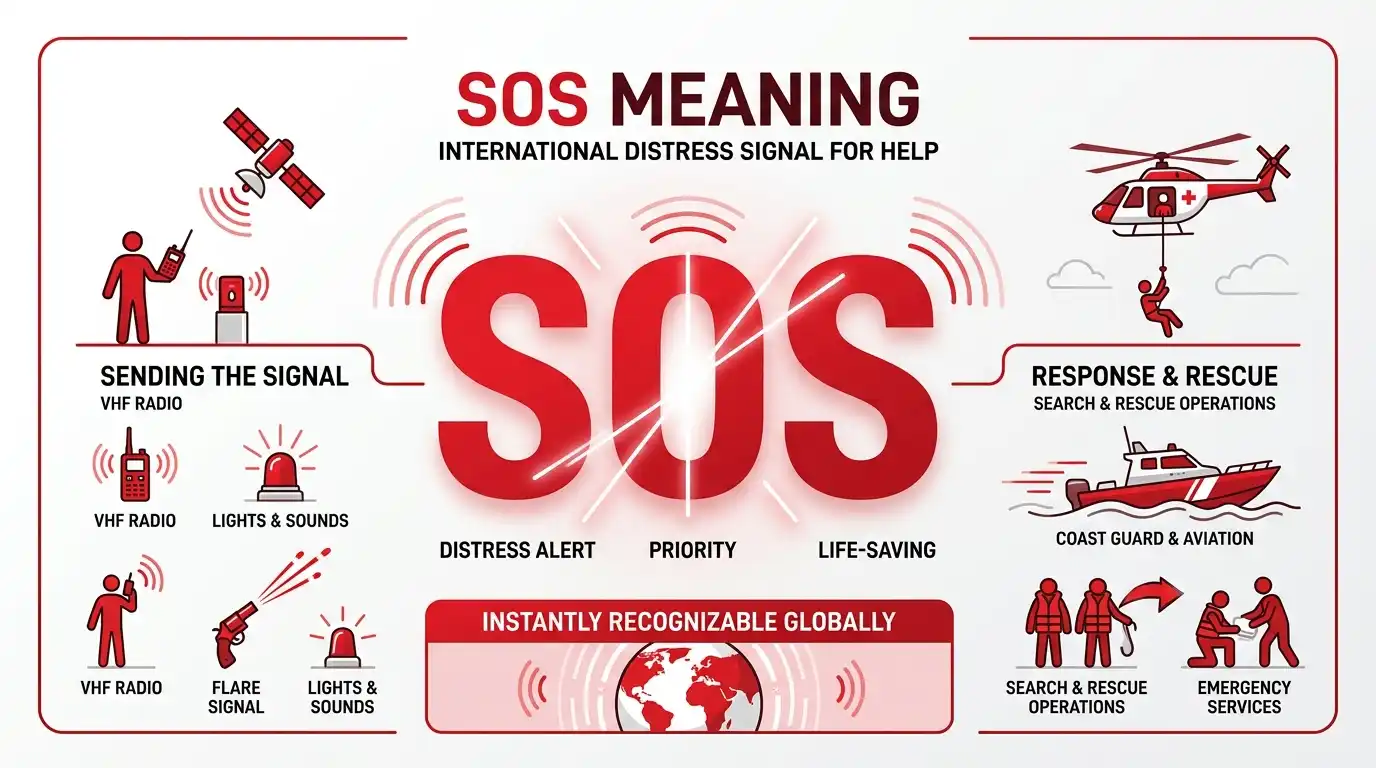
SOS is a universal distress signal used to request immediate help. It is commonly used during emergencies or dangerous situations when someone needs urgent assistance. In texting and social media, “SOS” can also be used casually to mean “help me” or “I need help.”
What Does SOS Stand For?
SOS is a well-known international distress signal used to request immediate help in an emergency. Although it is often explained as “Save Our Souls” or “Save Our Ship,” SOS does not officially stand for any specific words. It was chosen because its Morse code pattern, … — …, is simple and easy to recognize.
Meaning SOS or SOS Definition
At its core, the S.O.S meaning is simple: it is an international call for help during an emergency. When someone sends SOS, whether by radio, light, sound, or text, they are saying “I am in serious danger and need immediate assistance.” It is used all over the world, no matter what language a person speaks, which is exactly why it works so well.
The reason SOS became so popular is because of its pattern in Morse code. Morse code uses short signals called dots and long signals called dashes to represent letters. The letter S is three dots, and the letter O is three dashes. So SOS looks like this: dot-dot-dot, dash-dash-dash, dot-dot-dot. This pattern is easy to remember, easy to send quickly, and easy to recognize even if the signal is weak or the person sending it is panicked.
Today, the SOS.meaning has grown beyond ships and radios. People use it in daily conversation to describe any urgent situation. For example, someone might text a friend “SOS, I need help right now” if they are stuck somewhere or facing a small crisis. It no longer only applies to life-threatening emergencies at sea.
S.O.S. Meaning
S.O.S. is an internationally recognized distress signal that means a person or group urgently needs help. It is commonly associated with emergencies, danger, or situations where immediate assistance is required. Although people often say it stands for “Save Our Souls” or “Save Our Ship,” S.O.S. does not officially stand for any particular phrase.
Origin or History

The history of SOS is closely tied to the early days of radio communication. Before SOS became the standard, sailors used other distress signals. In the United States, ships often used “CQD,” which was a general call meaning “all stations, distress.” However, different countries used different codes, which caused confusion when ships from different nations tried to communicate during emergencies.
In 1906, a group of countries met at the International Radiotelegraph Convention in Berlin to solve this problem. They wanted one single signal that every country could recognize, no matter the language barrier. The group chose the pattern of three dots, three dashes, and three dots because it was simple, clear, and hard to mistake for anything else. This pattern officially became the international distress signal in 1908.
Interestingly, the letters S-O-S were chosen because of the Morse code pattern, not because someone thought of the words first. The phrases “Save Our Souls” and “Save Our Ship” were created afterward by everyday people who wanted an easy way to remember what the letters stood for. Language experts call this a “backronym,” which means an abbreviation that gets a meaning added to it after it already exists.
One of the most famous uses of SOS in history happened in 1912, when the RMS Titanic sank in the North Atlantic Ocean. The ship’s radio operators sent both CQD and SOS signals as they called for help. This tragic event helped make SOS widely known around the world, since news reports at the time explained the signal to millions of people who had never heard of it before.
| Time Period | Distress Signal Used | Notes |
| Before 1906 | CQD (mostly in the US and UK) | Different countries used different codes |
| 1906 | SOS proposed at Berlin Convention | Chosen for its simple Morse pattern |
| 1908 | SOS officially adopted | Became the global standard |
| 1912 | SOS used during Titanic disaster | Helped make the signal famous worldwide |
How SOS Is Used Today
Even though radio operators no longer rely on Morse code as much as they used to, the SOS meaning has stayed alive in many new ways. Modern technology has actually given SOS a second life, even though the original tapping-key radios are mostly gone.
Many smartphones now include an SOS feature built right into the settings. If someone is in danger, they can press a button several times, and the phone will automatically call emergency services and send their location to chosen contacts. This shows how the idea behind SOS, a fast and simple call for help, still matters today, even with all our modern technology.
Hikers and outdoor adventurers also use SOS in creative ways. If someone gets lost in the wilderness without a phone signal, they might spell out “SOS” using large rocks, logs, or even footprints in the snow so that it can be seen from an airplane or helicopter. Search and rescue teams are trained to look for this exact pattern because it is universally recognized.
Beyond emergencies, the word SOS has also become part of everyday language and pop culture. People use it casually to describe non-life-threatening situations, such as running low on time before a deadline or needing quick advice from a friend. Businesses and brands have also borrowed the term, using “SOS” in product names or ad campaigns to suggest quick help or rescue, such as stain-removing products or customer service hotlines.
Common Mistakes People Make
Many people mistakenly believe that SOS stands for specific words, and this misunderstanding is extremely common. Here are a few of the most frequent mistakes people make when talking about S O S meaning.
| Common Mistake | Why It’s Incorrect |
| Thinking SOS stands for “Save Our Souls” | This phrase was added after SOS was already chosen as a signal |
| Thinking SOS stands for “Save Our Ship” | This is also a backronym, not the original meaning |
| Believing SOS is only used at sea | SOS is now used in phones, hiking, and daily conversation |
| Confusing SOS with CQD | CQD came first but was replaced by SOS internationally |
| Thinking SOS must be spoken aloud | SOS can be sent through light, sound, radio, or text |
Another mistake people make is assuming SOS is only for extreme emergencies like sinking ships or plane crashes. While it started that way, everyday use of the term has expanded quite a bit, and that is perfectly fine and accurate in modern English.
Real-Life Examples

Understanding the SOS meaning becomes much easier when you see it used in real situations. Below are a few examples of how SOS shows up in daily life and in history.
During World War II, soldiers and ships used SOS signals constantly to call for rescue or backup when under attack. Radio operators were trained specifically to recognize this pattern instantly, since even a few seconds of delay could cost lives.
In more recent years, apps and smartwatches have added SOS buttons for personal safety. For example, someone walking alone at night who feels unsafe might quietly press their phone’s SOS feature, which can alert authorities without the person needing to make a phone call out loud.
In everyday texting, a teenager might send a message to their parents saying, “SOS, can you pick me up early?” This is a lighthearted, modern use of the term, showing just how flexible the SOS meaning has become over the past century.
Tips or Best Practices

If you want to use the term SOS correctly, whether in writing, conversation, or an actual emergency, keep these simple tips in mind.
First, remember that SOS should generally signal something urgent, even if it is not life-threatening. Using it too casually, like for something as small as forgetting your homework, can weaken its meaning over time.
Second, if you are ever in a real emergency and need to use Morse code SOS, remember the rhythm: three short signals, three long signals, three short signals again. Practicing this pattern ahead of time, even just once, can help you remember it if you are ever in a stressful situation.
Third, if you are writing content, a text message, or even a school report, it helps to know that SOS is always written in capital letters, since it functions like an internationally recognized symbol rather than a normal word.
Finally, if you are ever outdoors and worried about getting lost, consider learning how to create a visual SOS signal using rocks, sticks, or even by stomping in the snow. This simple skill could genuinely help rescuers find you faster in a real survival situation.
FAQs
What does SOS actually stand for?
SOS does not officially stand for any specific words. It was chosen because the Morse code pattern for the letters S and O is simple and easy to recognize, not because of a phrase.
Is “Save Our Souls” the real meaning of SOS?
No, that phrase was created after SOS became the standard distress signal. It is a helpful way to remember the letters, but it is not the original or official meaning.
When was SOS first used as a distress signal?
SOS was officially adopted as the international distress signal in 1908, after being proposed at a global conference in Berlin in 1906.
Can SOS be used for non-emergency situations?
Yes, in modern everyday language, people often use SOS casually to describe any urgent need for help, even if it is not a true emergency.
How do you send an SOS signal without a phone?
You can use Morse code with a flashlight or whistle, or create a visual signal using large rocks, sticks, or marks in sand or snow that spell out “SOS” so it can be seen from far away or from the air.
Do modern phones still use SOS?
Yes, many smartphones have a built-in SOS feature that can automatically contact emergency services and share your location when activated, keeping the spirit of the original signal alive.
Conclusion
So, what is the true SOS meaning? At its heart, SOS is simply a universal call for help, built from a Morse code pattern that is easy to send and impossible to misunderstand.
It does not stand for “Save Our Souls” or “Save Our Ship,” even though those phrases have become popular ways to remember it.
From its official beginning in 1908 to its use during the Titanic disaster, and now its presence in smartphones and hiking safety, SOS has remained one of the most recognized symbols of urgency in the entire world.
If you see it in a movie, hear it in conversation, or ever need to use it yourself, you now know exactly where it came from and why it still matters today.
Discover More Article

Hi, I’m Benjamin Dreyer. I enjoy exploring words, phrases, slang, abbreviations, acronyms, and digital communication. At Linkquorax.com, I share simple and accurate explanations to help readers understand unfamiliar terms and popular internet expressions. My goal is to make every meaning clear, useful, and easy to understand. Whether you are curious about a new word or an online phrase, Linkquorax.com provides straightforward information to help you learn quickly and communicate with confidence in everyday conversations.