If you have ever read a property deed, a news story about construction, or a legal notice, you may have run into the word “abut.” It looks a little strange the first time you see it, and many people are not sure how to say it or use it.
The meaning is actually very simple once you break it down. In plain terms, it means to touch or be next to something, usually referring to land, buildings, or borders.
This article will walk you through the exact meaning, how to use the word correctly, where it came from, and how people use it in real life today. By the end, you will be able to use “abut” with confidence in writing and conversation.
Quick Answer
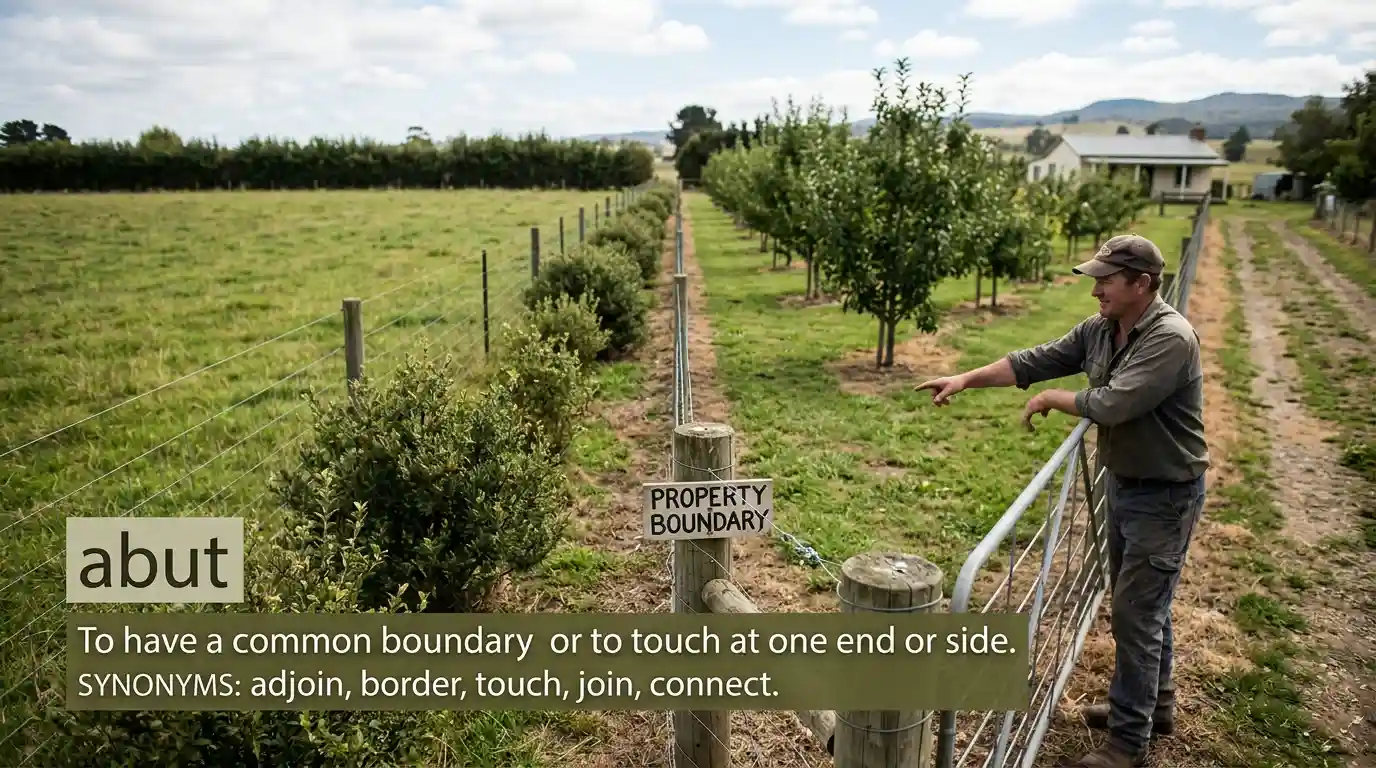
“Abut” means to touch or share a border with something else. It is most often used to describe two pieces of land, two buildings, or two objects that sit right next to each other with no gap between them. For example, “Our backyard abuts the park.” This means the backyard and the park share a border, and there is nothing between them.
Meaning or Definition
The word “abut” is a verb. It describes a situation where one thing physically touches or borders another thing. Most dictionaries define it as “to be next to or touching something, usually a piece of land or a building.”
Here are the main points that make up the abut meaning:
- It almost always talks about physical closeness, not emotional or personal closeness.
- It is most commonly used with land, property, buildings, walls, or roads.
- It shows that two things share a common edge or line, with no space in between.
- It is a slightly formal word, so you will see it more often in legal papers, real estate listings, and news articles than in casual chat.
Think of two houses that sit side by side with their fences touching. You could say, “The two properties abut each other.” This tells you the land lines up directly, edge to edge, without any gap.
The word can also describe synthetic structures. A bridge might abut a hillside. A parking lot might abut a busy street. In every case, the core idea stays the same: two things are touching, right next to one another, sharing a border.
Grammar or Correct Usage
Knowing the meaning is only half the job. You also need to know how to use “abut” correctly in a sentence. Here are the basic grammar rules.
“Abut” is a verb, and like most verbs, it changes form depending on the tense you need.
| Form | Word | Example Sentence |
| Base form | abut | Their land will abut the new highway. |
| Present tense (he/she/it) | abuts | The garage abuts the main house. |
| Past tense | abutted | The old fence abutted the neighbor’s yard. |
| Present participle | abutting | The abutting properties were sold together. |
| Past participle | abutted | The lot has always abutted the river. |
Notice that when you add “-ed” or “-ing” to “abut,” the final “t” doubles. This follows a common spelling rule in English for short words ending in a single vowel plus a single consonant. So it becomes “abutted” and “abutting,” not “abuted” or “abuting.”
Another important grammar point: “abut” is normally used without the word “on” or “with,” even though many people feel tempted to add it. The correct way to say it is “The garden abuts the fence,” not “The garden abuts on the fence” or “abuts with the fence.” Some older or British writing styles do use “abut on,” but in modern American English, it is best to skip the extra word and go straight from the verb to the object.
You will also often see the related noun form, “abutment.” An abutment is the actual point, structure, or support where two things meet. In construction, an abutment is the part of a bridge that supports the end of it and connects it to the ground. So while “abut” is the action of touching or bordering, “abutment” is the physical spot or support where that touching happens.
Origin or History
The word “abut” has roots going back several hundred years. It comes from the Old French word “abouter,” which meant to touch at one end or to border something. That word itself is connected to “bout,” meaning “end” or “tip.” So at its heart, “abut” always carried the idea of one thing meeting the end or edge of another thing.
English speakers borrowed the word centuries ago, mainly to describe land and property boundaries. This is likely why the word still shows up so often in legal writing, surveys, and real estate documents today. Old land records used “abut” and “abutting” to describe exactly where one piece of property ended and another began. That tradition has carried forward into modern law and construction language.
Common Mistakes
Even though “abut” is not a difficult word, people do make a few common errors when using it. Here are the mistakes to watch for.
- Adding an unnecessary preposition. Many writers say “abuts to” or “abuts with,” but the correct modern usage is simply “abuts” followed directly by the object, as in “The yard abuts the school.”
- Confusing it with “about.” Since the words look similar, some people accidentally type “about” when they mean “abut,” or the other way around. These two words have completely different meanings, so it helps to slow down and double check.
- Misspelling the past tense. Writers sometimes write “abuted” instead of “abutted.” Remember the doubled “t” rule.
- Using it for things that are not actually touching. “Abut” specifically means direct contact or a shared border. If two properties are simply close but have a road or another lot between them, they do not abut each other; they are just nearby.
- Overusing it in casual writing. Because “abut” is a formal word, using it too often in everyday conversation can sound stiff. It fits best in legal, real estate, or technical writing.
Real-Life Examples
Seeing the word in different situations can help make the meaning stick. Below are some everyday examples that show how “abut” is used in real sentences.
| Situation | Example Sentence |
| Real estate | The two-acre lot abuts a quiet nature preserve. |
| Construction | The new parking garage will abut the office tower. |
| City planning | Several homes abut the railway line downtown. |
| Legal document | The seller confirms that the property does not abut any wetlands. |
| Everyday conversation | Our driveway abuts the neighbor’s fence, so we share the same edge. |
These examples show that “abut” almost always appears when someone is describing land, buildings, or fixed structures that are physically touching. You will rarely, if ever, see it used for people, feelings, or abstract ideas.
Current Usage or Trends
Today, “abut” is most common in three main areas: real estate, law, and construction or engineering. Realtors use it in property listings to describe boundaries, such as a home that abuts a golf course or a forest. Lawyers and city planners use it in zoning documents and land surveys to clearly state where one piece of property ends and another begins. Engineers and architects use it, along with “abutment,” to describe how structures like bridges, retaining walls, and buildings connect to the ground or to other structures.
Outside of these fields, the word shows up less often in casual speech, but it has not disappeared. News articles about new developments, highway projects, or neighborhood disputes often use “abut” because it is precise and leaves no doubt about what is touching what. As more people search online for simple explanations of formal words like this one, “abut” continues to appear in guides, glossaries, and educational content aimed at making legal and real estate language easier to understand.
Tips or Best Practices
If you want to use “abut” correctly and naturally, keep these simple tips in mind.
- Use it when you want to be precise about two things physically touching, especially land or structures.
- Avoid adding extra words like “on,” “to,” or “with” after it.
- Remember the doubled “t” when writing “abutted” or “abutting.”
- Save it for formal or semi-formal writing, such as real estate descriptions, legal notes, or technical reports.
- If you are not describing land, buildings, or physical borders, a simpler word like “next to,” “touching,” or “borders” may sound more natural in everyday writing.
- Double check your spelling so you do not accidentally write “about” instead.
FAQs
What does “abut” mean in simple words?
It means to touch or sit right next to something, with no space in between. It usually describes land, buildings, or structures.
How do you use “abut” in a sentence?
You use it as a verb, directly followed by what it touches. For example, “The garden abuts the sidewalk.”
Is “abut” the same as “adjacent”?
They are similar but not exactly the same. “Abut” means the two things are directly touching, while “adjacent” can mean nearby or close, even with a small gap between them.
What is the past tense of “abut”?
The past tense is “abutted.” Note the doubled “t” before adding “-ed.”
What is the difference between “abut” and “abutment”?
“Abut” is the verb describing the action of touching or bordering. “Abutment” is the noun for the actual point, spot, or support structure where that touching happens, often used in construction.
Can “abut” be used for people or relationships?
No. “Abut” is almost always used for physical things like land, buildings, walls, or roads. It is not used to describe people, feelings, or relationships.
Conclusion
The abut meaning comes down to one clear idea: two things, usually land or buildings, are touching or sharing a direct border with no gap between them.
It is a precise, slightly formal word that shows up most often in real estate listings, legal documents, and construction or engineering writing. Now that you know how it is spelled, how it changes form, and how it is used in real sentences, you can spot it confidently whenever you come across it.
The next time you read a property description or a zoning notice, you will know exactly what it means when something is said to abut another piece of land.

Hassan is a content writer at LinkQuorax, sharing simple and clear meanings of words, slang, phrases, and everyday expressions to help readers understand language easily.