Have you ever tried to say “bird chirping” but it came out “chird birping”? Or maybe you called your breakfast “belly jeans” instead of “jelly beans”? If so, you have made a spoonerism .
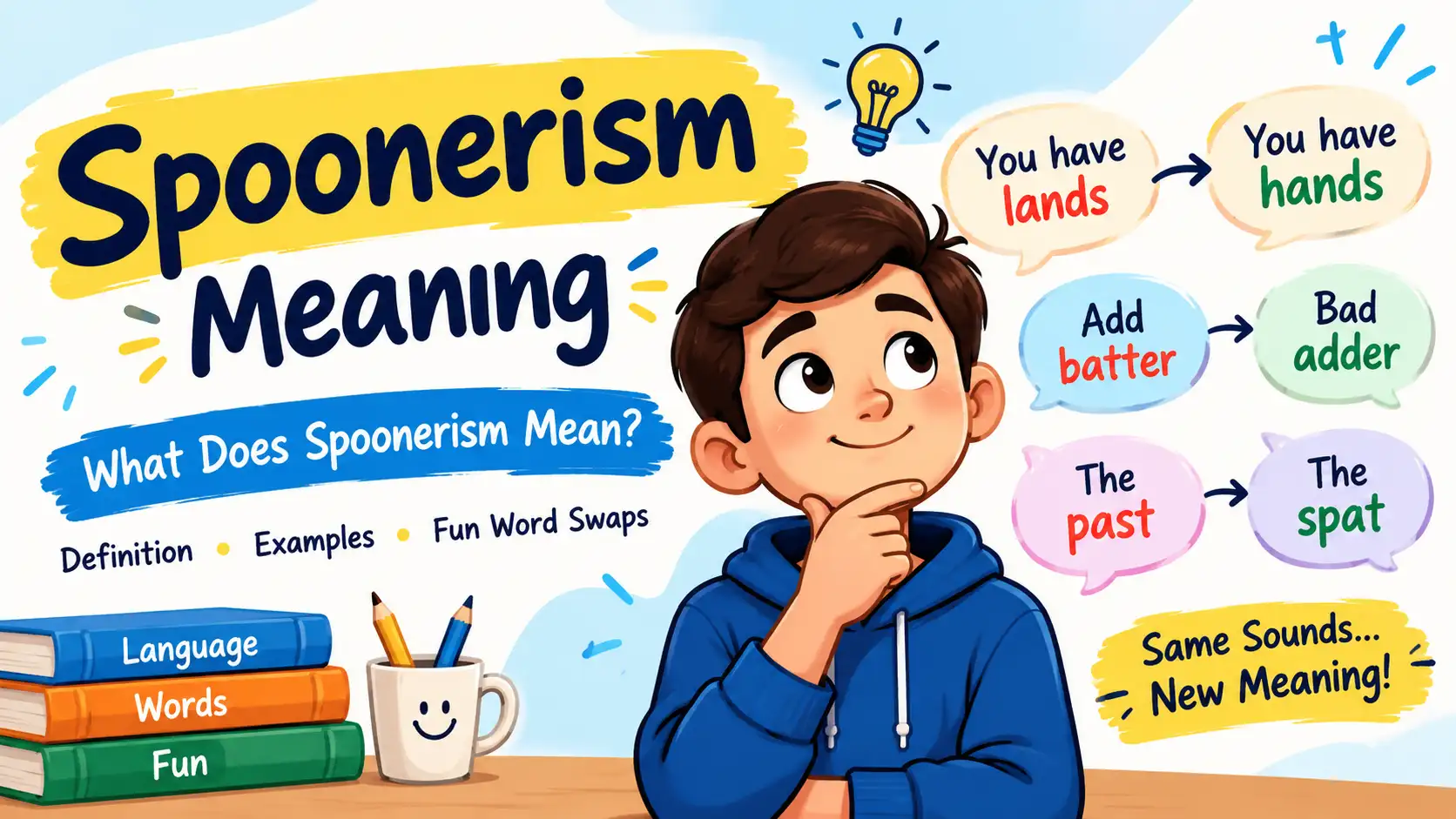
That sounds like a funny word because it is! A spoonerism (say: SPOON-uh-riz-um) is a playful mistake we make when we accidentally switch the first sounds of two or more words.
Keep reading to find out exactly what a spoonerism is, where this goofy word came from, and how people use it to make jokes. You will also see lots of fun examples that will make you laugh and maybe even try a few yourself.
Quick Answer
The meaning of spoonerism is simple. It happens when you switch the first sounds or letters of two words.
For example, “a blushing crow” instead of “a crushing blow” . People do this by accident when talking fast or feeling tired.
But it can also be done on purpose to be silly. The switch usually happens with the first consonants (the first letter sounds) of two words. The result is often a funny new phrase that might not make sense but will make people smile.
A Clear Definition
The spoonerism meaning is all about a mix-up. The dictionary says a spoonerism is a humorous mistake. A speaker switches the first sounds of two or more words . Think of it as a sound swap. You take the first sound of one word and trade it with the first sound of another word. This creates two new, and often silly, words.
A great example is saying “tons of soil” when you meant to say “sons of toil” . See the swap? The “t” from “toil” went to “sons.” And the “s” from “sons” went to “toil.” The new sentence sounds funny and is a classic spoonerism.
Where Did the Name Come From?
The word “spoonerism” comes from a real person! His name was Reverend William Archibald Spooner . He was a professor at Oxford University in England. With He lived from 1844 to 1930 . He was a very smart man, but he was famous for mixing up his words. He made many speech errors just like the ones we are talking about. People noticed this habit and started calling these word mix-ups “spoonerisms” after him . The term was first used around 1900 . Some say the Oxford students were using the word as early as 1885 .
While Mr. Spooner did make some of these slips, many of the funny phrases attributed to him were probably made up by students and friends . They wanted to have fun at his expense. But the name stuck, and now we use his name to describe this funny way we all mess up our words sometimes .
Famous Spoonerism Examples
The best way to understand the meaning of spoonerism is through examples. Many famous spoonerisms are linked to Reverend Spooner himself . Here are a few of the most well-known ones. These show how a simple mix-up can create a hilarious new sentence.
| What They Meant to Say | What Came Out (The Spoonerism) |
| “The Lord is a loving shepherd.” | “The Lord is a shoving leopard.” |
| “May I show you to another seat?” | “May I sew you to another sheet?” |
| “A crushing blow.” | “A blushing crow.” |
| “Well-oiled bicycle.” | “Well-boiled icicle.” |
| “It is customary to kiss the bride.” | “It is kisstomary to cuss the bride.” |
As you can see, the results are often very silly. “Sew you to another sheet” sounds a bit scary! And a “blushing crow” is a funny image that makes no sense. These are the hallmarks of a good spoonerism.
Why Do People Make This Mistake?
People make spoonerisms for a few simple reasons. The main one is that our brains work faster than our mouths. We are thinking about what we want to say, and our mouth is trying to keep up. Sometimes the sounds get crossed in the process. It is a type of “slip of the tongue” . These little mistakes can happen when you are:
- Tired
- Nervous
- Talking really fast
- Distracted
When your brain is busy, it can accidentally send the wrong sound to the wrong word. The result is a funny and unexpected spoonerism.
Fun and Modern Examples
Even if you have never heard the word before, you have probably made a spoonerism. Kids often do this while learning to talk. Here are some fun and easy examples you might recognize. These use simple words to show the spoonerism meaning clearly.
| What They Meant to Say | What Came Out (The Spoonerism) |
| “Funny bone.” | “Bunny phone.” |
| “Jelly beans.” | “Belly jeans.” |
| “Long road.” | “Wrong load.” |
| “Down train.” | “Town drain.” |
| “History lectures.” | “Mystery lectures.” |
A “bunny phone” sounds like a cute toy! And “belly jeans” makes you think of pants that are too tight. You can see why these are a popular way to make people laugh.
Using Spoonerisms on Purpose
While spoonerisms often happen by accident, people also use them on purpose. They are used to being funny and clever. Comedians might use a spoonerism to get a laugh. Writers might use one to show that a character is nervous or silly.
Sometimes people use them as a code or a joke between friends. It is a way to play with language. When you use a spoonerism on purpose, you are showing a good understanding of how sounds and words work. It takes a bit of skill to swap the sounds and still make a complete phrase. Even famous people use them! President George W. Bush was known for making these kinds of funny verbal slips . They are sometimes called “Bushisms.” These playful word swaps show that even important people can mix up their words.
Intentional vs. Unintentional Spoonerisms
You can choose to make a spoonerism on purpose, or they can just slip out. Both are fine. The main difference is the reason. An intentional spoonerism is a joke. You might say, “You are a shiny hark” to a friend instead of “You are a hark (hard) shiny (time).” It is a playful way to talk. An unintentional spoonerism is an accident. Maybe you are tired, and you call your favorite meal “pish and fhips” instead of “fish and chips.” Everyone will probably chuckle, and you can correct yourself. Both types fall under the same spoonerism meaning.
Other Kinds of Word Mistakes
It is easy to confuse a spoonerism with other types of word errors. Here is how they are different. A malapropism is when you use a similar-sounding word that has a different meaning. For example, saying “He is a pineapple of success” instead of “He is a pinnacle of success” . A Goldwynism is a similar word mistake, named after movie producer Samuel Goldwyn. A Yogi-ism is a confusing or silly phrase, often said by baseball player Yogi Berra, like “It’s deja vu all over again” . A spoonerism is special because it is specifically a swap of sounds. The others are about using the wrong word or creating a confusing statement.
Common Questions About Spoonerisms
This is a simple guide to help you understand the meaning of spoonerism meaning. It breaks down the definition and shows plenty of examples . It shows that while the name comes from Reverend Spooner, most of the famous quotes were likely made up by others . The guide also explains the difference between accidental and intentional use . This understanding lets you spot them and even try to make some yourself.
Can You Teach Yourself to Make Spoonerisms?
You can try! It takes practice. The first step is to think of a common phrase with two words. Good examples are “fish and chips” or “big bear.” Next, look at the first letters. For “fish and chips,” the first letters are “f” and “c.” Then, just swap them. “Fish” starts with “f.” “Chips” starts with “c.” If you swap them, you get “cish and fhips.” Say it out loud! It is a bit tricky at first. The more you practice, the easier it gets. You will be making them on purpose in no time.
Why We Love Spoonerisms
There is a reason we find spoonerisms so funny. They are surprising. When we hear a silly mix-up, it catches us off guard . It also shows that our brains are working in a playful way. We see the connection between the sounds. When you hear “belly jeans,” your brain knows it should be “jelly beans.” The surprise of the mistake is what makes you laugh. They also make us feel better about our own little mistakes. Seeing that even a famous Oxford professor mixed up his words makes our own slips seem less embarrassing .
FAQs
What is a spoonerism in simple words?
A spoonerism is a mistake where you switch the first sounds of two words. For example, saying “bunny phone” instead of “funny bone.” It is a funny word swap .
What is an example of a spoonerism?
A classic example is “a blushing crow.” The speaker meant to say “a crushing blow” but swapped the first sounds of “crushing” and “blow” .
Who is a spoonerism named after?
It is named after Reverend William Archibald Spooner . He was a professor at Oxford University who was famous for making these types of speech mistakes .
What is the difference between a spoonerism and a malapropism?
A spoonerism is a swap of sounds between two words, like “tons of soil” for “sons of toil.” A malapropism is using a wrong word that sounds similar, like saying “pineapple of success” instead of “pinnacle of success” .
Can you use spoonerisms on purpose?
Yes! People use them on purpose all the time to be funny. It is a fun way to play with language. Comedians and friends use them to get a laugh .
Is making a spoonerism bad?
Not at all! It is just a common speech error. Everyone does it sometimes. It usually just makes people laugh. If you do it by accident, just correct yourself and move on .
Conclusion
Now you know the meaning of spoonerism. It is a funny and common mistake that we all make. It happens when we swap the first sounds of two or more words.
The result is often a silly phrase that makes people smile. We learned the name comes from Reverend William Archibald Spooner, a professor who made these slips often.
From “belly jeans” to “a blushing crow,” these word mix-ups are a fun part of our language. They show how our brains work and how we can play with sounds.
So, the next time you accidentally call your pet a “tog and dad,” you will know exactly what you did! It is just a classic spoonerism.

Hassan is a content writer at LinkQuorax, sharing simple and clear meanings of words, slang, phrases, and everyday expressions to help readers understand language easily.