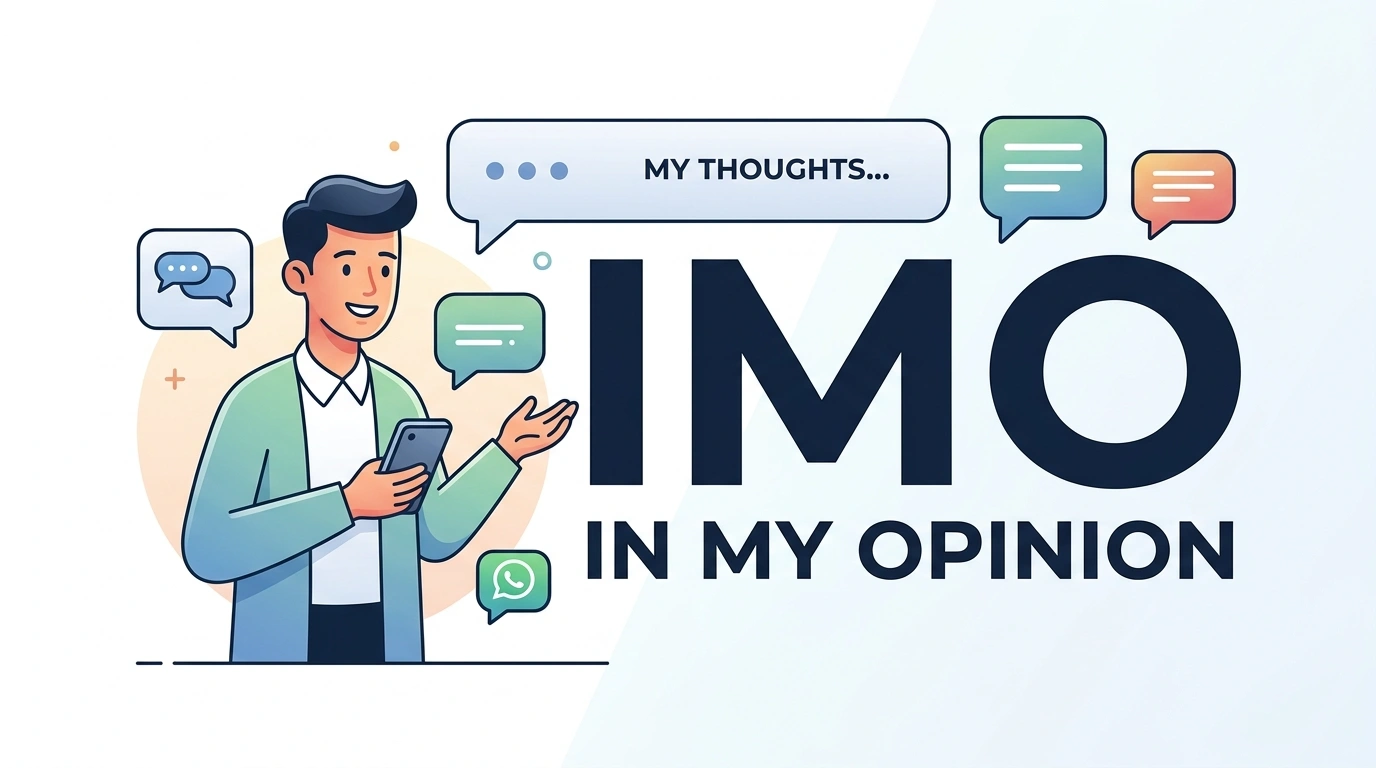
IMO means “in my opinion.” It is a common internet and texting abbreviation people use when they want to share a personal view, thought, or judgment.
You may see IMO in text messages, group chats, comments, Reddit posts, social media, gaming conversations, and online discussions. It usually tells the reader that what follows is the writer’s personal opinion, not a proven fact.
If someone texts, “IMO, this is the best movie of the year,” they are simply saying, “In my opinion, this is the best movie of the year.” The expression is casual, short, and easy to use.
Quick Answer: What Does IMO Mean?
IMO stands for “in my opinion.” It is used in digital communication to introduce or soften a personal opinion.
For example:
“IMO, pizza is better than burgers.”
This means:
“In my opinion, pizza is better than burgers.”
IMO is common in texts, social media, online forums, emails, gaming chats, and casual conversations.
| Term | Meaning | Common Use |
| IMO | In my opinion | Sharing a personal view |
| IMHO | In my humble opinion | Sharing an opinion in a softer way |
| IIRC | If I recall correctly | Showing uncertainty about a memory |
| TBH | To be honest | Introducing an honest thought |
| IME | In my experience | Sharing personal experience |
The key point is simple: IMO signals that the statement is the writer’s opinion.
IMO Meaning in Text and Chat
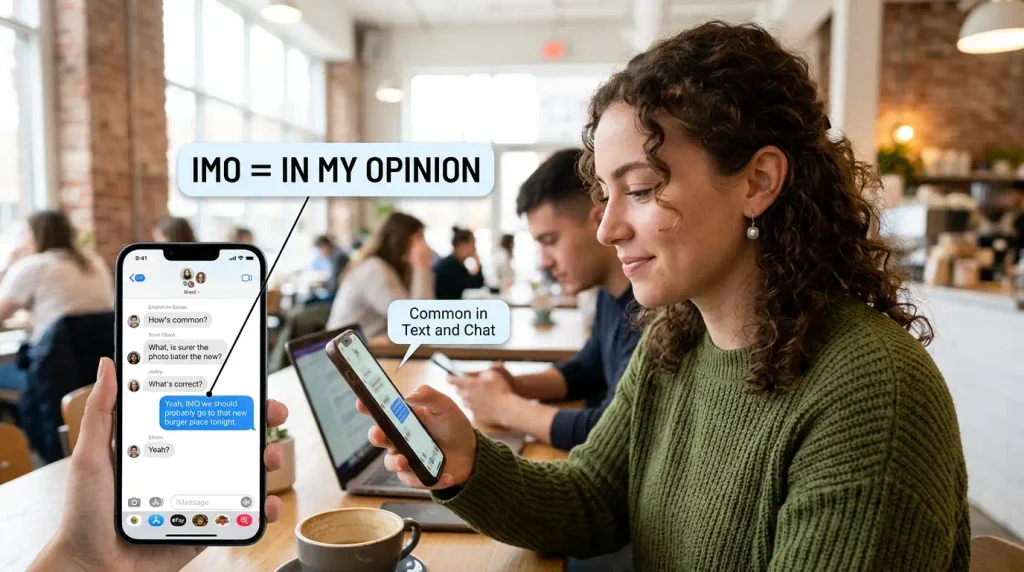
In texting, IMO is mainly used to save time and space. Instead of typing “in my opinion” every time, people can simply write three letters.
For example:
Person A: Which phone do you think is better?
Person B: IMO, the first one has a better camera.
Here, IMO tells Person A that the answer is based on Person B’s personal judgment.
You may also see IMO at the beginning, middle, or end of a sentence:
- “IMO, that was the best episode.”
- “That was, IMO, the best episode.”
- “That was the best episode, IMO.”
All three forms can communicate the same basic idea.
In casual digital communication, lowercase imo is also very common. There is no major difference between “IMO” and “imo” in meaning. The choice usually depends on a person’s typing style.
What Does IMO Stand for?
IMO stands for “in my opinion.”
The phrase has three parts:
| Word | Meaning |
| In | Introduces the point being discussed |
| My | Shows that the opinion belongs to the speaker or writer |
| Opinion | A personal belief, judgment, or view |
An opinion is different from a fact. For example, “Water freezes at 32°F at standard atmospheric pressure” is a factual statement under specified conditions. “IMO, winter is the best season” is a personal preference.
That distinction is important because IMO is often used to make it clear that someone is sharing a viewpoint rather than claiming universal truth.
How to Use IMO Correctly
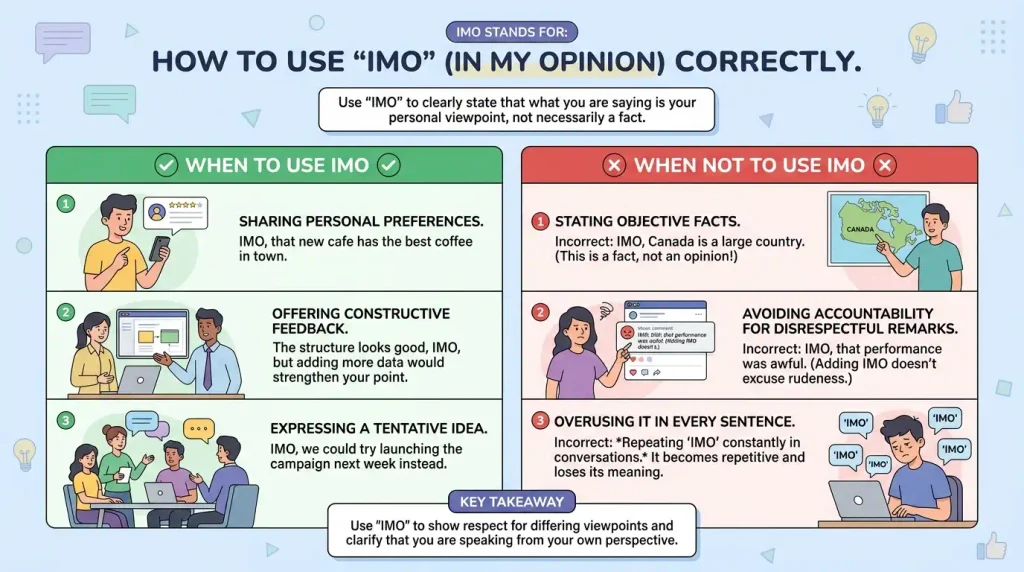
Using IMO is simple. Put it before the opinion you want to share.
For example:
“IMO, this restaurant has the best breakfast in town.”
Or:
“IMO, you should watch the original version first.”
You can use IMO when discussing movies, food, sports, technology, music, school, work, hobbies, fashion, or almost any everyday subject.
Here are more natural examples:
- “IMO, this book is easier to understand than the first one.”
- “IMO, the blue design looks cleaner.”
- “IMO, we should leave earlier.”
- “That game was too long, IMO.”
- “IMO, her explanation was very clear.”
- “This is the best option, IMO.”
- “IMO, the second season was stronger.”
- “I think, IMO, we need more time.”
The last example sounds somewhat repetitive because “I think” already introduces an opinion. In natural writing, it would usually be better to say either “I think we need more time” or “IMO, we need more time.”
IMO Examples in Real-Life Conversations
Seeing IMO in context makes the meaning much easier to understand.
Imagine two friends discussing a new movie:
Alex: Did you like the new movie?
Sam: IMO, it was better than the first one.
Sam is not saying everyone must agree. If Sam is simply giving a personal opinion.
Here is another example involving food:
Friend: Should we order pizza or tacos?
You: IMO, tacos sound better tonight.
In a group chat, someone might write:
“IMO, we should meet on Saturday instead.”
Again, the writer is presenting a suggestion based on personal judgment.
IMO can also appear in online discussions:
“IMO, the older version was easier to use.”
This wording makes the statement sound like a personal assessment rather than an absolute fact.
IMO in Social Media and Online Discussions

IMO is especially common on social media because online conversations often involve opinions.
Someone might comment:
“IMO, this is one of the most underrated shows on Netflix.”
Or:
“IMO, the new design looks much better.”
On platforms where people discuss movies, games, technology, sports, books, or current events, IMO can quickly signal that a comment reflects an individual’s perspective.
It can also help prevent confusion. Without IMO, a sentence such as “This is the best phone” may sound like a factual claim. Adding IMO changes the tone:
“IMO, this is the best phone.”
Now it is clearly presented as a personal judgment.
That does not automatically make the opinion correct or incorrect. It simply tells readers how the writer intends the statement to be understood.
IMO vs. IMHO: What Is the Difference?
IMO means “in my opinion,” while IMHO usually means “in my humble opinion.”
Both are used to introduce a personal view.
| Abbreviation | Full Form | Tone |
| IMO | In my opinion | Neutral and casual |
| IMHO | In my humble opinion | Often softer or more modest |
| TBH | To be honest | Direct and informal |
| IME | In my experience | Based on personal experience |
For example:
IMO: “IMO, the first option is better.”
IMHO: “IMHO, the first option is better.”
The difference is mostly about tone. IMHO contains the extra word “humble,” although people do not always use it literally. In online communication, both abbreviations can be used casually.
IMO vs. I Think
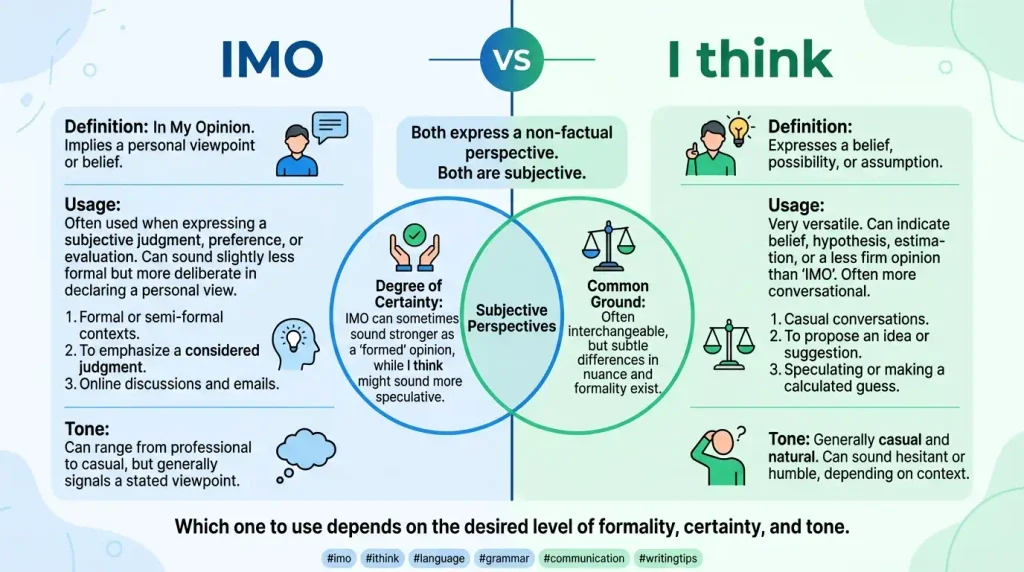
The IMO and “I think” can often serve the same purpose, but they have different styles.
IMO is shorter and more associated with internet communication.
I think it sounds more natural in ordinary spoken English.
Compare:
“IMO, this is a good idea.”
and:
“I think this is a good idea.”
Both communicate a personal opinion.
In a casual text, IMO may feel natural. In a formal school paper, business report, or professional document, writing the full phrase or using more direct language is usually better.
Is IMO Formal or Informal?
IMO is informal.
It is perfectly normal in texts, social media posts, online forums, casual emails, gaming chats, and messages between friends.
It is generally not the best choice for highly formal writing.
For example, this is natural in a group chat:
“IMO, we should go on Friday.”
But in a formal business report, you might write:
“In my assessment, Friday appears to be the most suitable option.”
The right choice depends on the audience and setting.
Can You Use IMO in Professional Messages?
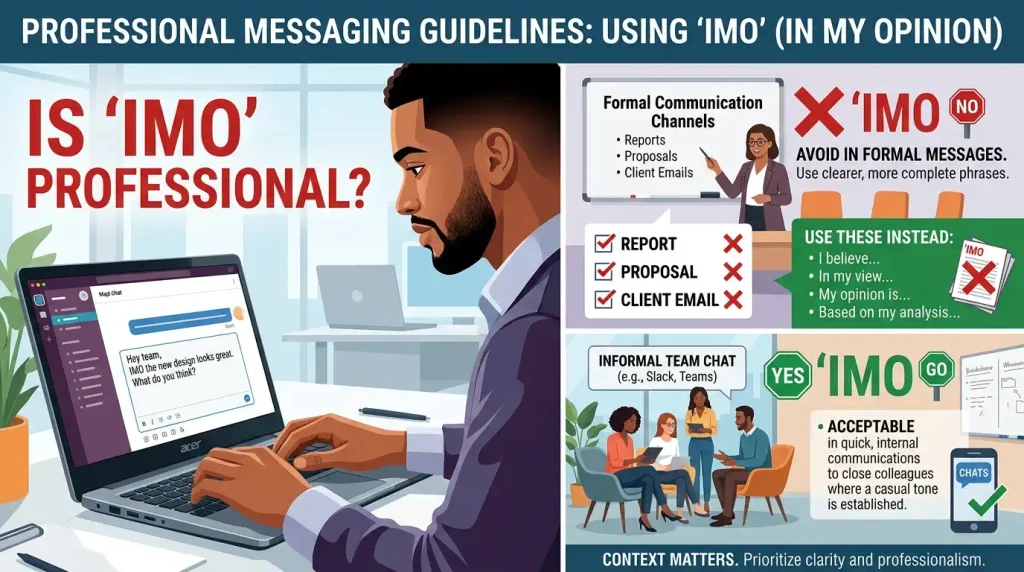
You can, but context matters.
If you work with a team that regularly uses casual chat language, IMO may be perfectly acceptable in a workplace messaging app.
For example:
“IMO, the second layout is easier for customers to use.”
However, professional communication often benefits from clear, direct wording. If you are writing a formal proposal, report, academic paper, legal document, or official announcement, spelling out the phrase—or choosing more precise professional language—is usually preferable.
A useful rule is simple:
Use IMO when the communication is casual and the audience understands internet abbreviations. Avoid it when the writing needs a formal tone.
Is IMO Rude or Disrespectful?
No. IMO is not rude by itself.
The tone depends on the words around it.
For example:
“IMO, that could be improved.”
This is relatively polite.
But:
“IMO, your idea makes no sense.”
The second sentence may sound harsh even though IMO itself is neutral.
If you are discussing a sensitive subject, your choice of words matters more than the abbreviation. You can make an opinion softer by using respectful language.
For example:
“IMO, there may be a better way to approach this.”
This sounds less confrontational than:
“IMO, you did this completely wrong.”
So, IMO does not automatically make a message polite or impolite.
Common Mistakes When Using IMO
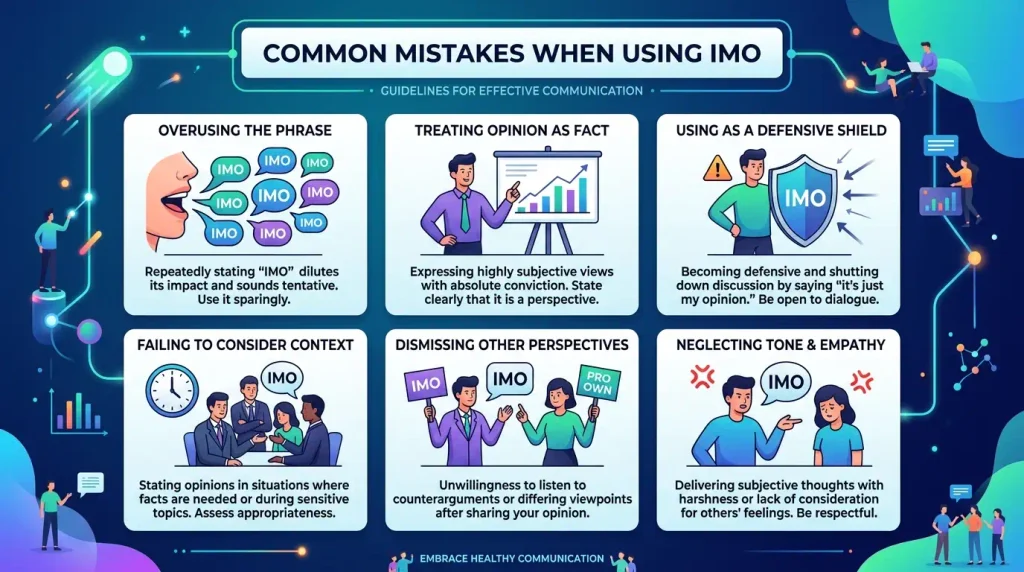
People usually understand IMO easily, but a few usage mistakes are worth avoiding.
One common mistake is using it when the statement is actually a fact. IMO is meant to signal a personal opinion.
For example:
“IMO, Paris is the capital of France.”
There is no real reason to use IMO because the statement is a factual claim, not a personal opinion.
Another issue is overusing the abbreviation. If every sentence begins with IMO, the writing can become repetitive.
For example:
If IMO, this movie is good. IMO, the acting is good. IMO, the ending is good.”
A more natural version would be:
“IMO, this movie is good. The acting is strong, and I especially liked the ending.”
The abbreviation is most useful when it adds clarity rather than appearing in every sentence.
IMO in Different Types of Conversations
The meaning stays the same across different online settings, but the way people use it can change.
In friend-to-friend texting, IMO may introduce a quick recommendation.
“IMO, you should try the new restaurant.”
In gaming, it may introduce an opinion about a character, weapon, map, or strategy.
“IMO, that character is easier to play.”
In social media comments, it can make a strong personal statement sound more clearly subjective.
“IMO, the original design was better.”
In group chats, it may introduce a suggestion.
“IMO, Sunday works best for everyone.”
In online forums, IMO is often used during longer discussions where several people have different views.
The abbreviation does not change meaning just because the platform changes.
IMO Meaning on Instagram, TikTok, Reddit, and Other Platforms
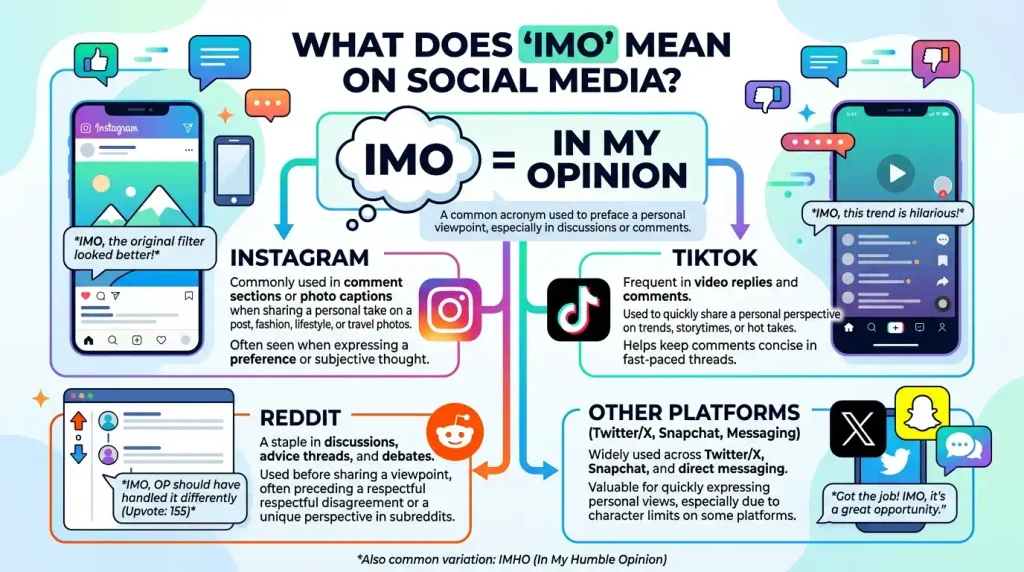
You may encounter IMO across many social platforms and online communities.
On Instagram or TikTok, users may use it in comments or captions when sharing an opinion about a trend, video, creator, product, or topic.
On Reddit and discussion forums, IMO can appear when users explain their personal view during a debate.
For example:
“IMO, the older version had a better interface.”
The important thing to remember is that internet slang changes over time. Some abbreviations become less popular, while others become common. IMO, however, remains a widely understood expression in English-language digital communication.
How to Reply When Someone Says IMO
You do not need a special response to IMO. Simply respond to the opinion.
For example:
Person A: “IMO, the first option is better.”
You can say:
“I agree. I liked the first one too.”
Or:
“I see your point, but I prefer the second option.”
Or:
“That makes sense. I had not thought about it that way.”
If you disagree, you can still be respectful. IMO introduces a personal viewpoint, so there is room for other people to have different opinions.
Related Internet Abbreviations You Should Know
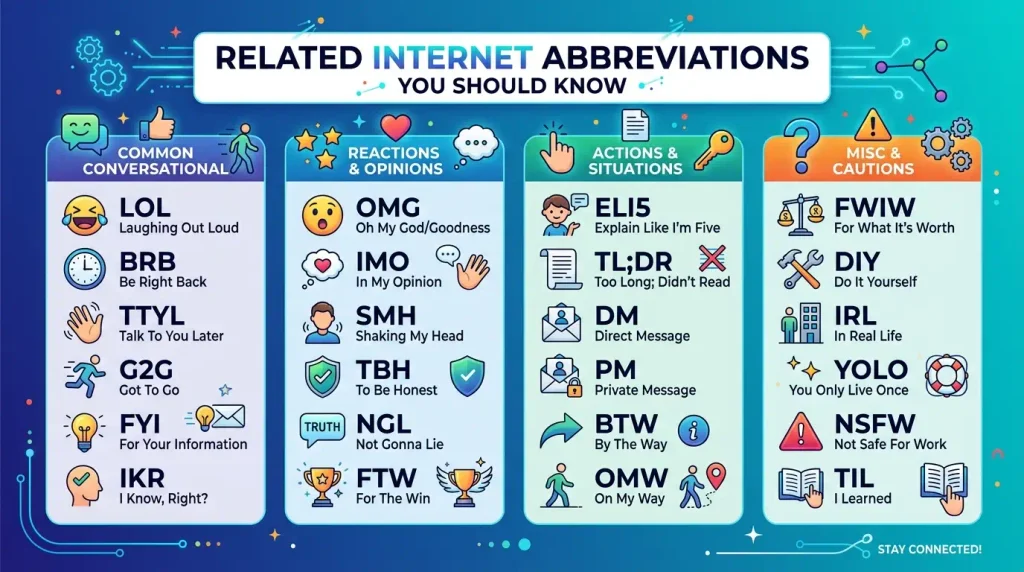
If you are learning texting slang, IMO is only one of many common abbreviations.
| Abbreviation | Meaning | Example |
| IMO | In my opinion | “IMO, it looks better.” |
| IMHO | In my humble opinion | “IMHO, this is the best choice.” |
| TBH | To be honest | “TBH, I expected more.” |
| IIRC | If I recall correctly | “IIRC, the meeting starts at 9.” |
| FYI | For your information | “FYI, the time changed.” |
| IDK | I don’t know | “IDK what happened.” |
| BTW | By the way | “BTW, did you call Sam?” |
| AFAIK | As far as I know | “AFAIK, it is still open.” |
| TBF | To be fair | “TBF, they gave us plenty of time.” |
| IRL | In real life | “We know each other IRL.” |
Learning these abbreviations can make texts and online conversations much easier to understand.
When Should You Use IMO?
Use IMO when you want to make it clear that you are sharing your own view.
It works especially well when:
- You are giving a recommendation.
- You are comparing two choices.
- You are discussing a movie, book, game, or product.
- You are sharing a personal judgment.
- You want to make a strong statement sound clearly subjective.
- You are chatting casually with friends or online communities.
You do not need IMO every time you express an opinion. Words such as “I think,” “I believe,” and “I feel” can work just as well.
The best choice depends on your audience and writing style.
Is IMO Still Used Today?
Yes. IMO is still used in modern digital communication, especially in informal English-language texting and online discussions.
People use it because it is short, familiar, and easy to understand. However, not every person uses internet abbreviations regularly. If you are communicating with someone who may not know online slang, writing “in my opinion” is clearer.
This is especially useful when communicating across age groups or with people who speak English as an additional language.
Language changes constantly, but common abbreviations can remain useful for many years because they are convenient and widely understood.
Frequently Asked Questions
What does IMO mean in texting?
IMO means “in my opinion.” It is used in texting to introduce a personal thought, belief, judgment, or recommendation.
What does IMO mean on social media?
On social media, IMO means “in my opinion.” People use it before or after a statement to show that they are sharing their personal view rather than stating an objective fact.
Is IMO the same as “I think”?
In many situations, yes. Both can introduce a personal opinion. IMO is more common in casual internet communication, while “I think” is natural in both spoken and written English.
What is the difference between IMO and IMHO?
IMO means “in my opinion.” IMHO usually means “in my humble opinion.” Both introduce an opinion, but IMHO can sound slightly more modest or playful.
Is IMO formal or informal?
IMO is mainly informal. It works well in texts, chats, social media, forums, and casual emails. For formal documents, academic writing, or official communication, writing the full phrase or using more formal wording is usually better.
Can IMO be used at the end of a sentence?
Yes. For example: “The second option is better, IMO.” It can also appear at the beginning or within a sentence. The meaning stays the same.
Conclusion
The IMO meaning is simple: “in my opinion.” It is a common internet abbreviation used to tell readers that a statement represents someone’s personal view. You will often see IMO in texts, group chats, social media comments, forums, gaming conversations, and other casual online spaces.
The abbreviation can make communication faster and can also help separate an opinion from a fact. For formal writing, however, it is usually better to write the phrase in full or use more professional wording.
If you see someone write “IMO, this is the best option,” they are simply saying, “In my opinion, this is the best option.” Once you know that, the abbreviation is easy to understand and use.

Hi, I’m Benjamin Dreyer. I enjoy exploring words, phrases, slang, abbreviations, acronyms, and digital communication. At Linkquorax.com, I share simple and accurate explanations to help readers understand unfamiliar terms and popular internet expressions. My goal is to make every meaning clear, useful, and easy to understand. Whether you are curious about a new word or an online phrase, Linkquorax.com provides straightforward information to help you learn quickly and communicate with confidence in everyday conversations.