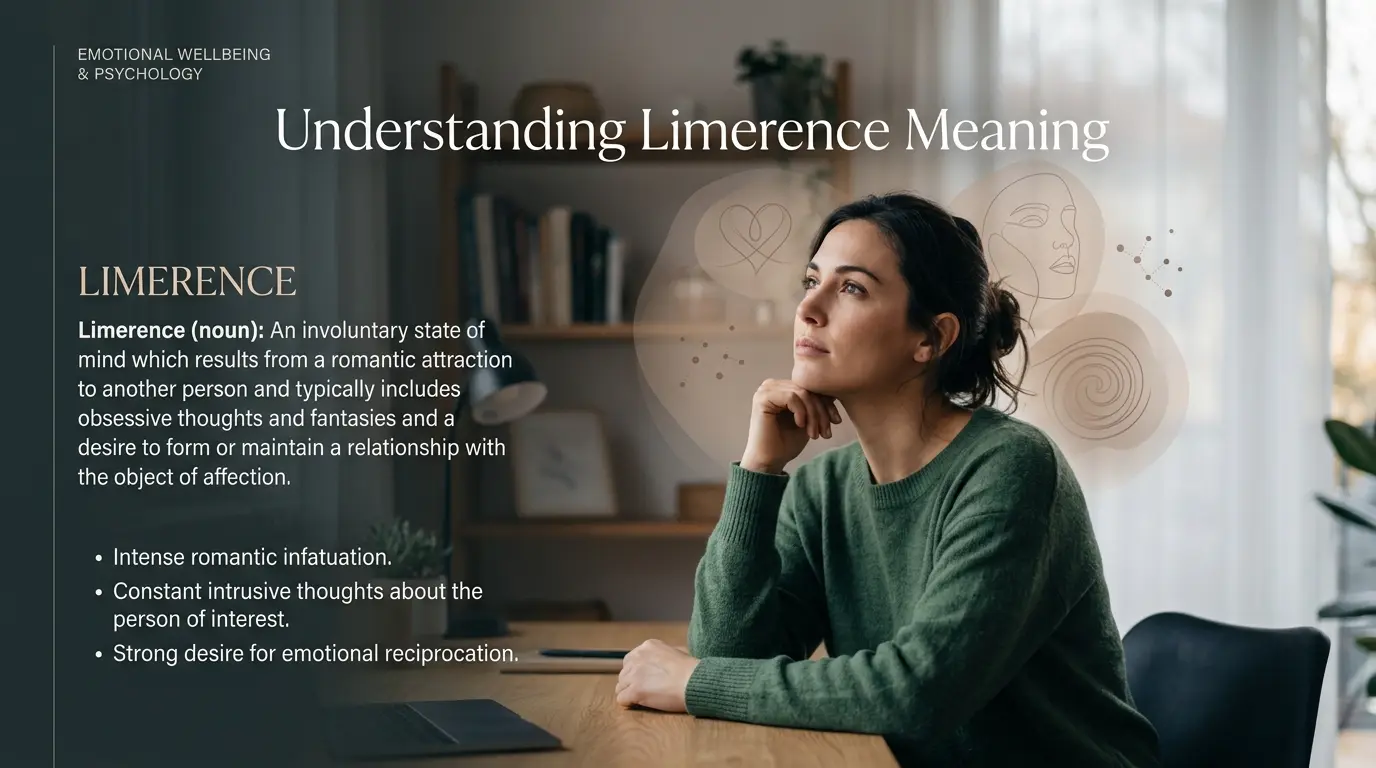
Limerence meaning is a strong, often unwanted state of romantic attraction where a person becomes deeply focused on someone and strongly wants that person to return their feelings.
It can feel exciting, hopeful, and joyful, but it can also cause anxiety, overthinking, and emotional ups and downs. The term was introduced by psychologist Dorothy Tennov in her 1979 book Love and Limerence.
If you have ever thought about one person again and again, replayed small conversations in your mind, searched for signs that they like you, or felt unusually happy when they gave you attention, you may wonder whether those feelings are simply a crush or something more intense.
This guide explains the limerence meaning in simple USA English. You will learn what limerence is, what it feels like, common signs, its stages, how it differs from love and infatuation, real-life examples, and what you can do if these feelings begin to affect your daily life.
Quick Answer: What Does Limerence Mean?
Limerence means an intense and involuntary romantic attraction toward another person, often involving obsessive thoughts, idealization, and a strong desire for emotional reciprocation.
In simple words, limerence is when liking someone becomes so powerful that your thoughts and emotions start revolving around them.
A person experiencing limerence may constantly wonder:
“Do they like me?”
“Why did they text me that way?”
“Was that smile a sign?”
“Will we eventually be together?”
The key part is not simply having strong feelings. Limerence often includes a powerful need for the other person’s feelings to be returned. Uncertainty can make the feelings even stronger.
Psychology Today describes limerence as an intense state involving preoccupation with another person and heightened emotional reactions to possible signs of reciprocation.
Limerence is also not the same thing as a clinical mental disorder. It is a psychological concept, not a diagnosis listed in the DSM. However, intense romantic preoccupation can become a serious concern when it disrupts sleep, work, relationships, or everyday functioning.
Limerence Meaning and Definition
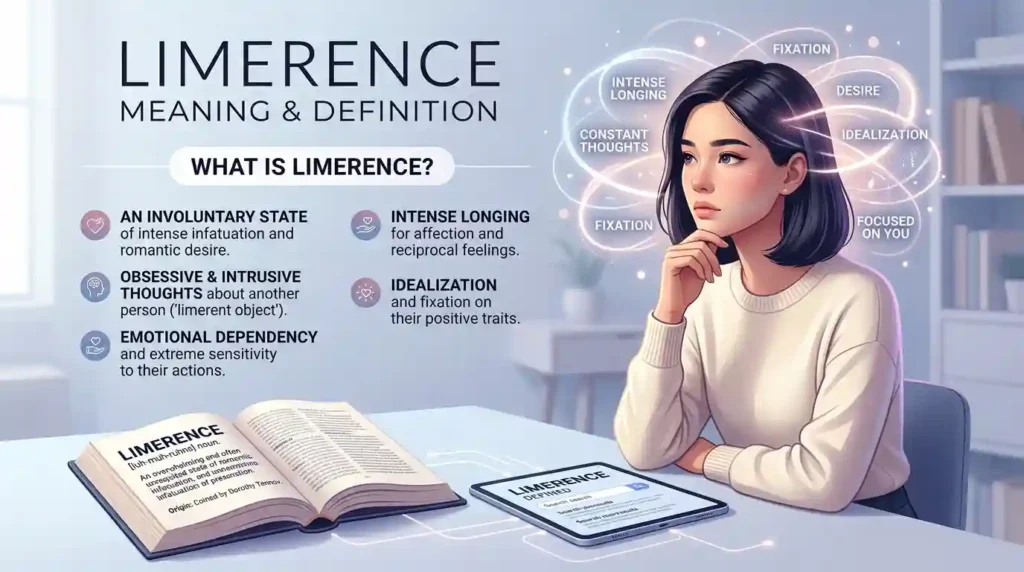
The word limerence describes a distinct emotional and mental state linked to romantic attraction.
Psychologist Dorothy Tennov introduced the term after studying people’s experiences of being intensely in love. Her work focused on the unusual combination of romantic longing, intrusive thoughts, emotional highs and lows, and the hope that the other person would return the feelings.
Limerence can happen when you know someone well, but it can also develop when you know very little about them. In some cases, the person may be unavailable, distant, or someone you barely interact with.
This is one reason limerence can feel confusing. You may feel that you know someone deeply even though much of your image of them comes from your imagination.
For example, imagine that a coworker is friendly toward you. They remember your birthday, smile when they see you, and sometimes send you messages about work. You begin thinking about them constantly. You start reading meaning into every interaction and imagining what a relationship with them might be like.
Those feelings could be ordinary attractions. But if the thoughts become intense, repetitive, and strongly tied to your need for their romantic interest, the experience may resemble limerence.
| Limerence often involves | What it can feel like |
| Intense attraction | “I cannot stop thinking about them.” |
| Idealization | “They seem perfect for me.” |
| Uncertainty | “I don’t know how they really feel.” |
| Hope for reciprocation | “Maybe they secretly like me.” |
| Intrusive thoughts | “They keep popping into my mind.” |
| Emotional highs and lows | “One message can make my whole day.” |
It is important not to use the word as a self-diagnosis. Having a crush, feeling excited about someone, or thinking about a new partner does not automatically mean you are experiencing limerence.
What Does Limerence Feel Like?
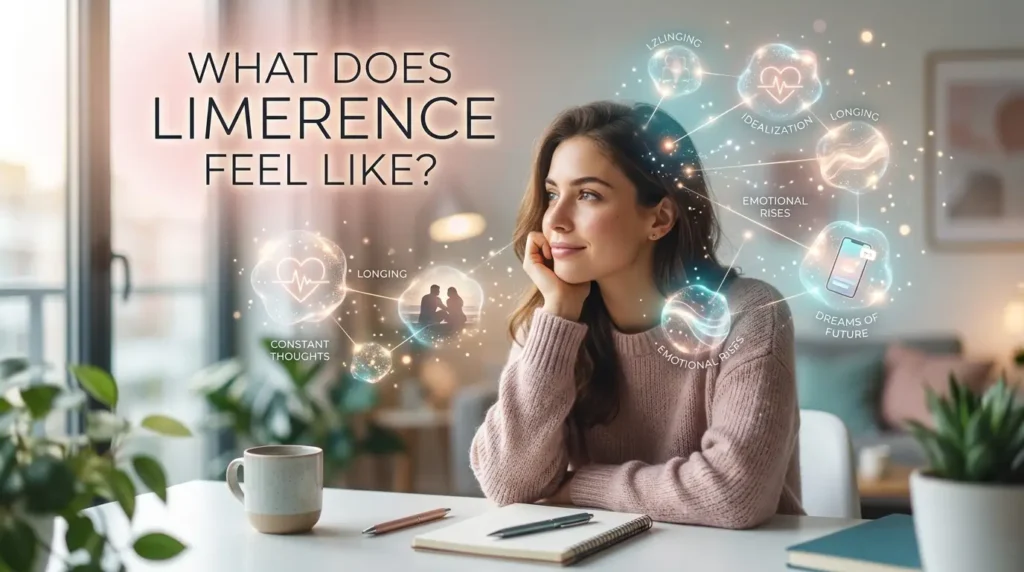
Limerence can feel almost like an emotional roller coaster.
When the person gives you attention, you may feel extremely happy. A text message, compliment, phone call, or small act of kindness can feel much more important than it normally would.
When the person becomes distant, your mood may suddenly change. You might feel worried, rejected, confused, or sad.
The uncertainty can create a powerful cycle. You notice something positive, feel hopeful, and then begin looking for more evidence. If the next interaction is unclear, you may analyze it for hours.
This can lead to a pattern such as:
Attention → hope → overthinking → uncertainty → anxiety → more searching for signs → temporary relief.
The person may also become idealized. Their good qualities stand out while their flaws seem small or easy to explain away.
Another common feature is mental replay. You may remember a conversation from days ago and examine the person’s exact words, facial expression, tone, or body language.
Tennov’s original concept emphasized that limerence is strongly connected to the possibility of reciprocation. Psychology Today notes that even a small perceived sign of mutual interest can intensify the emotional experience.
That does not mean every intense crush is limerence. Human attraction varies widely, and there is no simple checklist that can diagnose the experience.
Common Signs of Limerence
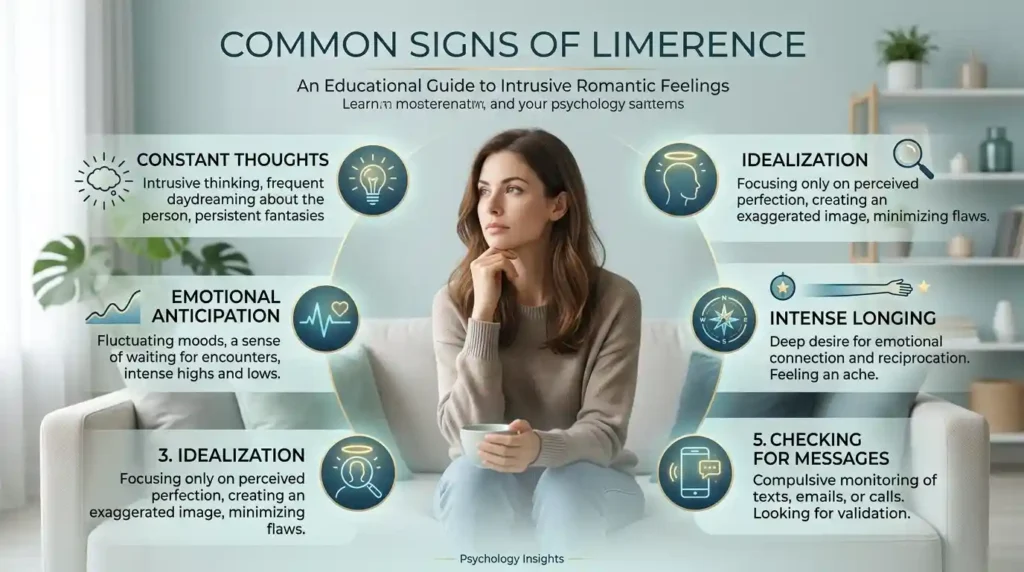
The signs of limerence can look different from person to person. Still, several patterns are commonly discussed.
One major sign is persistent thinking about the person. You may think about them while working, eating, driving, studying, or trying to sleep.
Another sign is idealization. Instead of seeing the person as a complete human being with strengths and weaknesses, you may focus heavily on the qualities you admire.
You may also become very sensitive to their behavior. A delayed text could feel like rejection, while a friendly message could create intense excitement.
Some people constantly look for evidence that their feelings are returned. They may reread messages, check social media activity, or replay conversations.
Limerence can also involve fantasies about the future. You might imagine dating, marriage, trips, conversations, or other situations that have not actually happened.
| Possible sign | Example |
| Constant thoughts | Thinking about the person throughout the day |
| Idealization | Seeing mostly their best qualities |
| Need for reciprocation | Feeling desperate to know whether they like you |
| Reading into small actions | Treating a short text as a major romantic signal |
| Emotional dependence | Your mood changes based on their attention |
| Fantasy | Imagining a future relationship in detail |
| Replaying interactions | Thinking repeatedly about what they said |
| Fear of rejection | Feeling intense anxiety when they seem distant |
These signs are clues, not a medical test. A strong attraction can include some of these behaviors without becoming limerence.
Limerence vs. Love: What Is the Difference?
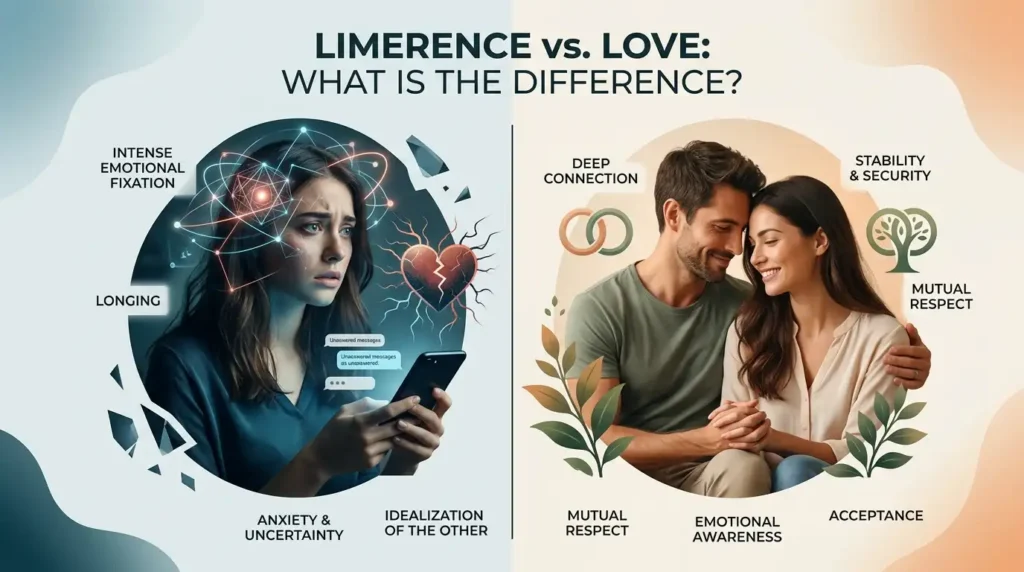
Limerence and love can feel similar, especially at the beginning of a relationship, but they are not identical concepts.
Limerence tends to focus heavily on longing, uncertainty, idealization, and the desire to have feelings returned. Love, especially mature romantic love, can involve trust, care, respect, commitment, shared responsibility, and a realistic understanding of another person.
With limerence, you may focus strongly on what the relationship could become. With mature love, you generally have more information about who the other person actually is.
Love does not require constant emotional excitement. A healthy relationship can include ordinary days, disagreements, compromise, and calm moments.
Limerence may feel intense because uncertainty keeps your attention locked on the person. Love can become less dramatic while becoming deeper and more stable.
The two experiences can overlap. A person may begin a relationship while experiencing limerence and later develop a more stable form of love and attachment.
| Limerence | Mature romantic love |
| Strong focus on reciprocation | Focus on mutual care and connection |
| Can involve idealization | Includes realistic understanding |
| Uncertainty may increase intensity | Trust can reduce uncertainty |
| Often emotionally intense | Can feel calm and secure |
| Fantasies may be strong | Shared experiences shape the bond |
| Attention may center on one person | Both people’s needs matter |
The difference is not simply that limerence is “bad” and love is “good.” Limerence is a particular emotional state, while love is a broader concept with many forms.
The APA Dictionary of Psychology describes romantic love as involving prominent intimacy and passion and notes that the loved person may be idealized.
Limerence vs. Infatuation and a Crush
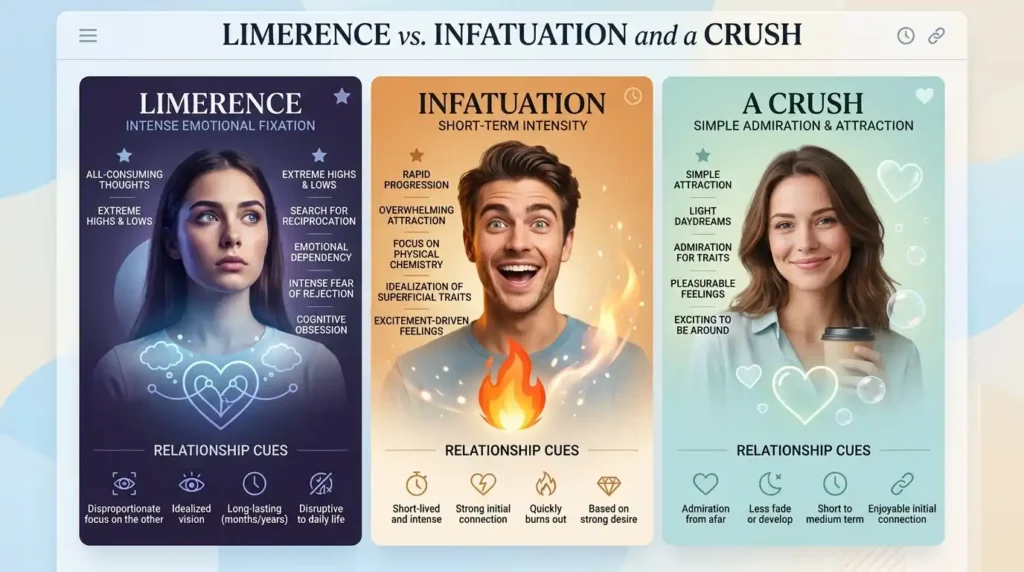
A crush is a common term for strong romantic or physical interest in someone. It can be brief and relatively light, or it can become much more intense.
Infatuation usually refers to powerful but sometimes short-lived attraction, often involving idealized views of another person.
Limerence is more specific. The concept centers on involuntary preoccupation and a strong desire for emotional reciprocation.
For example, you might have a crush on someone from your class and enjoy seeing them. You may think they are attractive and hope they ask you out.
That does not necessarily mean limerence.
If your thoughts become difficult to control, your emotional state depends heavily on their attention, and you constantly search for evidence that they return your feelings, the experience may be closer to limerence.
| Term | Simple meaning |
| Crush | Strong interest in someone |
| Infatuation | Intense romantic attraction, often with idealization |
| Limerence | Intense, involuntary romantic preoccupation tied strongly to reciprocation |
| Love | A broad experience involving care, intimacy, attachment, and/or commitment |
These words overlap in everyday conversation, so their boundaries are not always perfectly clear.
The Stages of Limerence
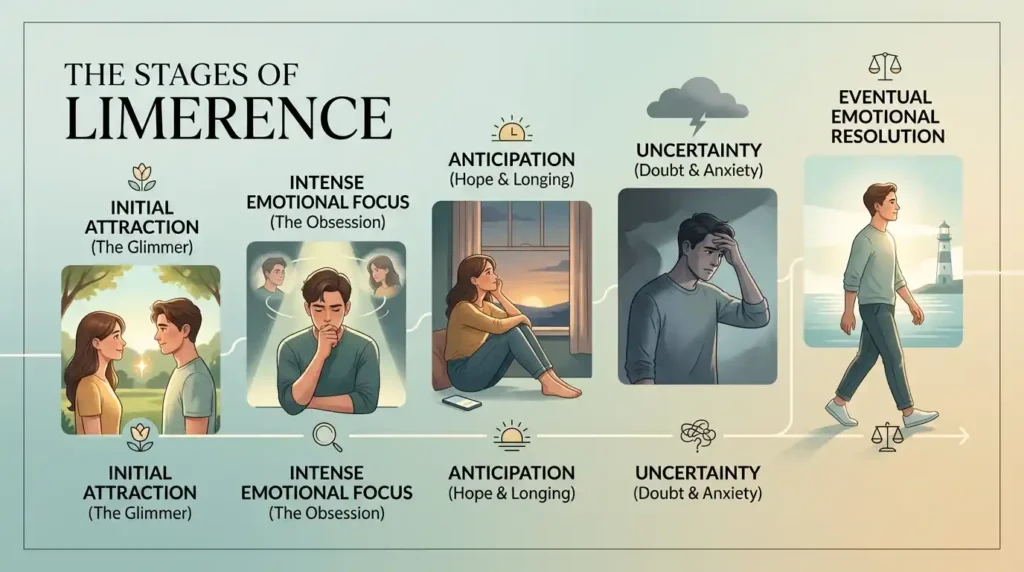
Some explanations of limerence describe three broad stages: infatuation, crystallization, and deterioration. Psychology Today uses these three stages when explaining Tennov’s concept.
During infatuation, you first become strongly interested in the person. Their appearance, personality, behavior, or attention captures your focus.
During crystallization, your feelings become stronger and your image of the person may become increasingly idealized. You may notice their positive qualities more than their negative ones. Small signs of attention can feel highly meaningful.
During deterioration, the emotional intensity may begin to weaken. This can happen when the relationship does not develop as hoped, when rejection becomes clear, or when the idealized image no longer matches reality.
Not everyone experiences these stages in the same way. Limerence is not a fixed process with a guaranteed timeline.
It is also important to avoid popular claims that limerence always lasts a specific number of months or years. There is no universally accepted timetable that applies to everyone.
Why Does Limerence Happen?
There is no single proven cause of limerence.
Romantic attraction is influenced by many factors, including personal experiences, expectations, emotions, social circumstances, and the specific relationship.
Uncertainty can play an important role. When you do not know whether someone likes you, your mind may keep searching for an answer.
Limited information can also encourage idealization. If you do not know someone very well, your imagination has more space to fill in the gaps.
For some people, attention from another person may feel especially powerful because it provides excitement, validation, or hope. But it would be inaccurate to say that everyone who experiences limerence has low self-esteem, attachment problems, childhood trauma, or another underlying issue.
Those explanations are sometimes discussed online, but they should not be treated as universal facts.
Modern technology can also make preoccupation easier to maintain. Social media, messaging apps, and online profiles can provide a steady stream of small pieces of information about another person. Instead of wondering about someone once a day, you may have dozens of opportunities to check their activity.
The important point is that limerence is complex. One simple explanation does not fit every person.
Real-Life Examples of Limerence
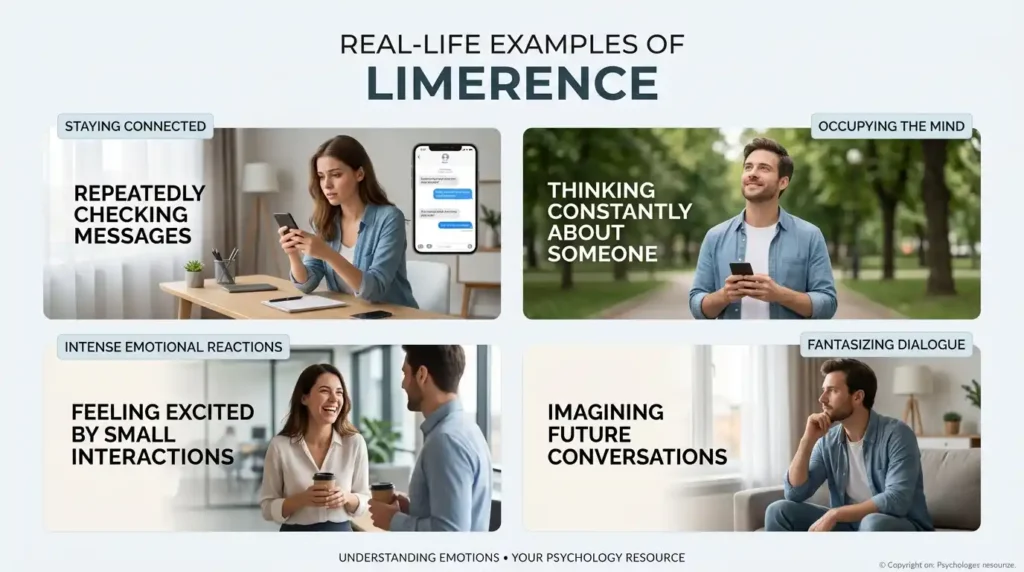
Consider a person named Alex who meets Jordan through work.
Jordan is friendly and sometimes asks Alex about their weekend. One afternoon, Jordan sends a message saying, “Hope you have a good weekend!”
Alex starts wondering whether the message means something more.
Over the next few weeks, Alex begins thinking about Jordan frequently. Alex rereads their messages, checks whether Jordan is online, remembers small details from conversations, and imagines what dating Jordan would be like.
When Jordan responds quickly, Alex feels excited. When Jordan takes longer to respond, Alex feels anxious.
Nothing has clearly happened between them. That uncertainty is part of what keeps Alex thinking about Jordan.
Another example could involve an old friend.
Taylor reconnects with someone from high school through social media. They exchange a few friendly messages. Taylor begins imagining that the friendship could become romantic and starts interpreting ordinary posts as hidden signs of interest.
The important lesson in both examples is that feelings do not prove facts.
Thinking that someone likes you does not mean they do. A smile, a text, or a social media reaction can have many explanations.
Healthy relationships depend on clear communication and respect for boundaries, not on trying to decode every small signal.
How to Use the Word “Limerence” Correctly
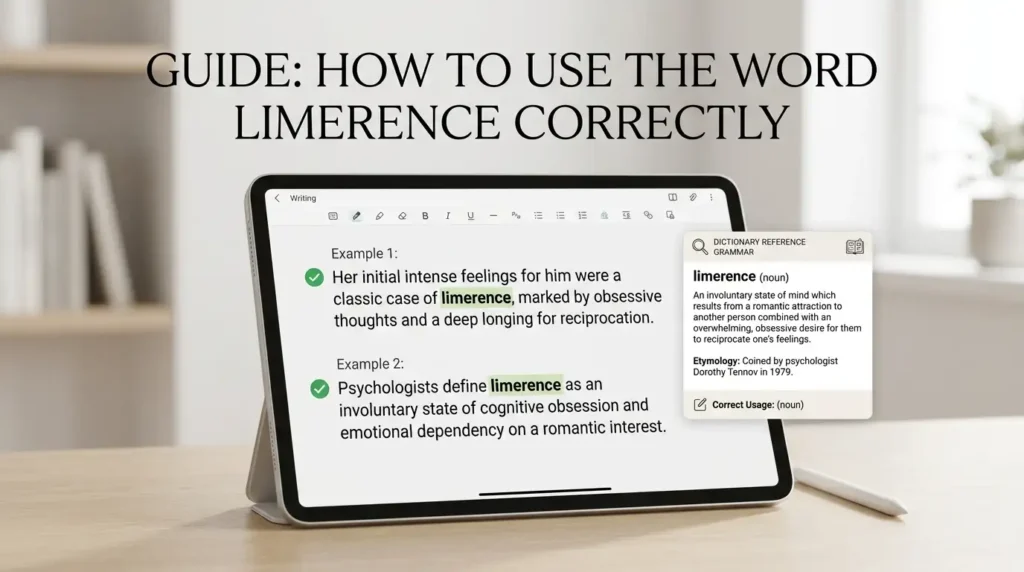
The word limerence is a noun.
You can use it when talking about an intense state of romantic preoccupation.
For example:
“After reading about limerence, she understood why she could not stop thinking about him.”
“He wondered whether what he felt was love or limerence.”
“Limerence can make small signs of attention feel extremely important.”
You can also use limerent as an adjective or noun in discussions about the concept.
For example:
“She described the experience as a limerent attachment.”
“The limerent person may focus heavily on signs of reciprocation.”
Because limerence is a specialized psychology-related term, it is more common in discussions about relationships, psychology, romantic attraction, and emotional behavior than in casual everyday conversation.
Is Limerence a Mental Disorder?
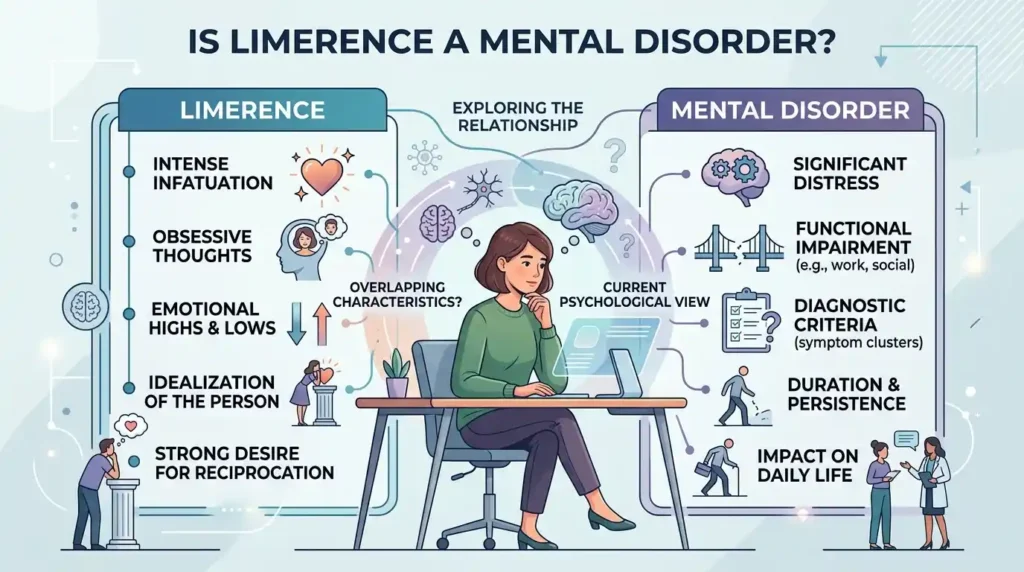
No. Limerence is not currently recognized as a formal psychiatric diagnosis in the DSM.
This distinction matters because online articles sometimes describe limerence as a disorder, addiction, or illness without making the difference clear.
The concept describes a particular emotional and psychological experience. That experience can be uncomfortable or disruptive, but the word itself does not automatically mean that someone has a mental illness. Psychology Today notes that limerence has been discussed as a possible clinical concern when it interferes with daily functioning, but it is not a DSM diagnosis.
At the same time, severe emotional distress should not be ignored.
If thoughts about another person are interfering with sleep, work, school, relationships, or your ability to function normally, talking with a qualified mental health professional can be a useful step.
The goal is not to label yourself. The goal is to understand what is happening and find healthy ways to respond.
What Can You Do If You Think You Are Experiencing Limerence?
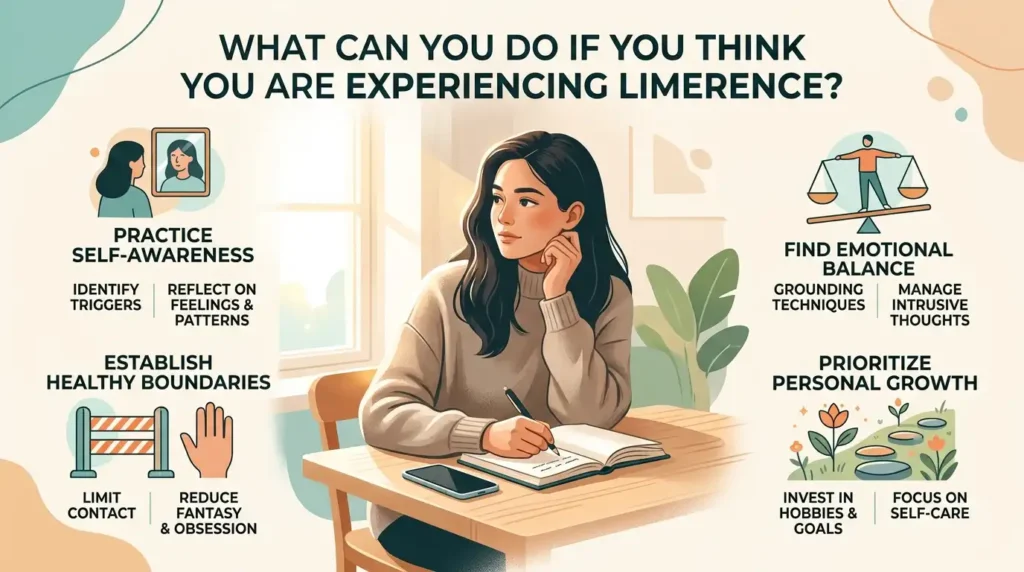
The first step is to recognize the difference between feelings and facts.
You may feel certain that another person is your perfect match. That feeling is real, but it does not prove that the relationship would work.
Try to notice how often you are checking messages, social media, old conversations, or other reminders of the person. If these habits keep the cycle going, creating some distance may help.
It can also help to focus on the person’s complete reality rather than an idealized image. Ask yourself what you actually know about them compared with what you imagine about them.
Keep your normal routines. Spend time with friends and family. Work toward personal goals. Exercise, hobbies, sleep, and daily responsibilities can give your attention other places to go.
Most importantly, respect the other person’s boundaries. Strong feelings do not create a right to someone’s attention, affection, or relationship.
If the experience feels overwhelming or seriously affects your life, a mental health professional can help you explore the pattern without judgment.
Common Misunderstandings About Limerence
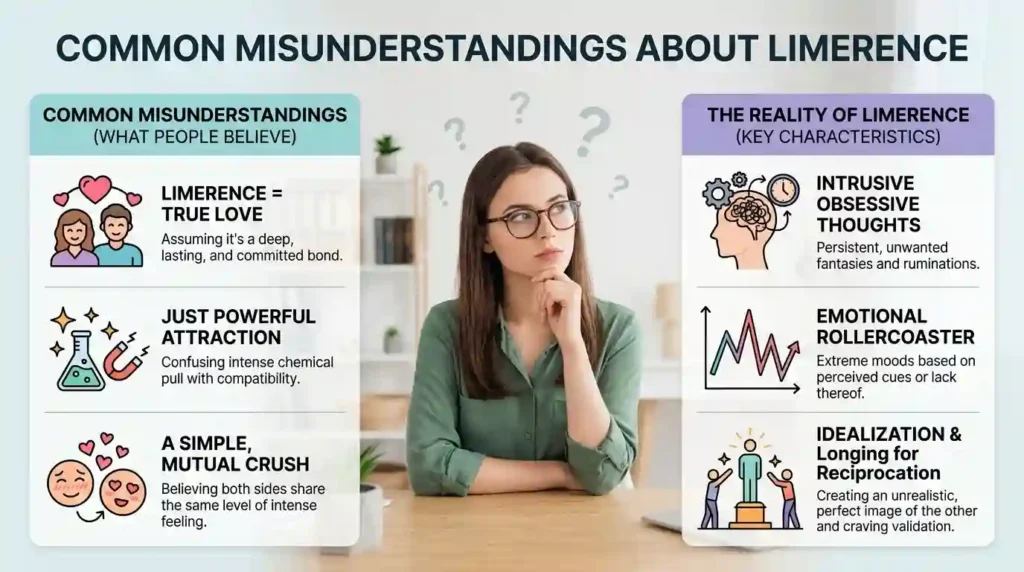
One common misunderstanding is that limerence always means true love. It does not. Intense feelings can happen before two people truly know each other.
Another mistake is believing that limerence always means the other person is your “soulmate.” Limerence can actually make people idealize someone and overlook information that does not fit the fantasy.
Some people also assume that limerence always happens because of trauma or insecure attachment. That is too broad. Human attraction is complex, and there is no single cause that explains every person’s experience.
It is also incorrect to assume that every crush is limerence. Most people experience attraction without becoming intensely preoccupied.
Finally, limerence should not be used to excuse unhealthy behavior. Feelings can be involuntary, but actions still matter. Respect, consent, personal boundaries, and healthy communication remain important.
Limerence in Modern Culture and Online Conversations

The word limerence has become more visible in modern conversations about dating, relationships, and mental health.
Recent media coverage has helped bring the term into mainstream discussions. A 2026 Washington Post article, for example, examined limerence as an intense form of romantic infatuation and discussed how modern technology can make obsessive attention easier to maintain.
Social media has also changed how people experience attraction. You can see someone’s photos, stories, likes, comments, and online status without having a real conversation with them.
That constant access can blur the line between knowing someone and knowing their online image.
Still, popularity on social media does not make every claim about limerence scientifically established. Some online definitions are broader than Tennov’s original concept, and research on limerence remains much smaller than research on broader topics such as romantic love and attachment.
For that reason, it is best to treat limerence as a useful concept for understanding certain experiences rather than as a universal explanation for romantic feelings.
FAQs
What is the simple meaning of limerence?
Limerence means an intense and involuntary romantic attraction that often includes obsessive thoughts, idealization, and a strong desire for the other person to return your feelings.
Is limerence the same as being in love?
Not exactly. Limerence and romantic love can overlap, especially early in a relationship. Limerence places strong emphasis on longing, uncertainty, preoccupation, and reciprocation, while mature love can involve trust, care, realistic understanding, and commitment.
Is limerence a crush?
Limerence can begin with something that feels like a crush, but the concept is more specific. It usually involves a much stronger level of mental preoccupation and emotional dependence on signs of reciprocation.
Can you experience limerence with someone you barely know?
Yes. Limerence can develop even when you have limited information about someone. In that situation, imagination and idealization may become a larger part of the experience.
Is limerence a mental illness?
No. Limerence is not a formal psychiatric diagnosis. However, intense preoccupation can cause real distress or interfere with everyday life. If that happens, professional support may be helpful.
How can I tell if my feelings are becoming unhealthy?
Pay attention to whether your thoughts are difficult to control or are interfering with sleep, work, school, friendships, or daily responsibilities. Constant checking, ignoring boundaries, or feeling that your entire mood depends on another person’s attention can also be warning signs.
Conclusion:
Understanding limerence meaning can make intense romantic feelings easier to describe. The term refers to a powerful state of attraction marked by strong preoccupation, idealization, uncertainty, and a deep desire for reciprocation. Psychologist Dorothy Tennov introduced the concept in her 1979 work on romantic love.
Limerence can feel exciting when you believe someone likes you and painful when their feelings seem uncertain. It is different from an ordinary crush, although the experiences can overlap. It is also different from mature love, which can grow through trust, shared experiences, realistic understanding, and mutual care.
If you recognize yourself in these descriptions, do not rush to label yourself. Look at your thoughts and behaviors honestly, respect the other person’s boundaries, and keep your own life balanced. When intense romantic thoughts begin to interfere with everyday life, professional support can help you understand the pattern and regain a healthier sense of control.

Hi, I’m Benjamin Dreyer. I enjoy exploring words, phrases, slang, abbreviations, acronyms, and digital communication. At Linkquorax.com, I share simple and accurate explanations to help readers understand unfamiliar terms and popular internet expressions. My goal is to make every meaning clear, useful, and easy to understand. Whether you are curious about a new word or an online phrase, Linkquorax.com provides straightforward information to help you learn quickly and communicate with confidence in everyday conversations.