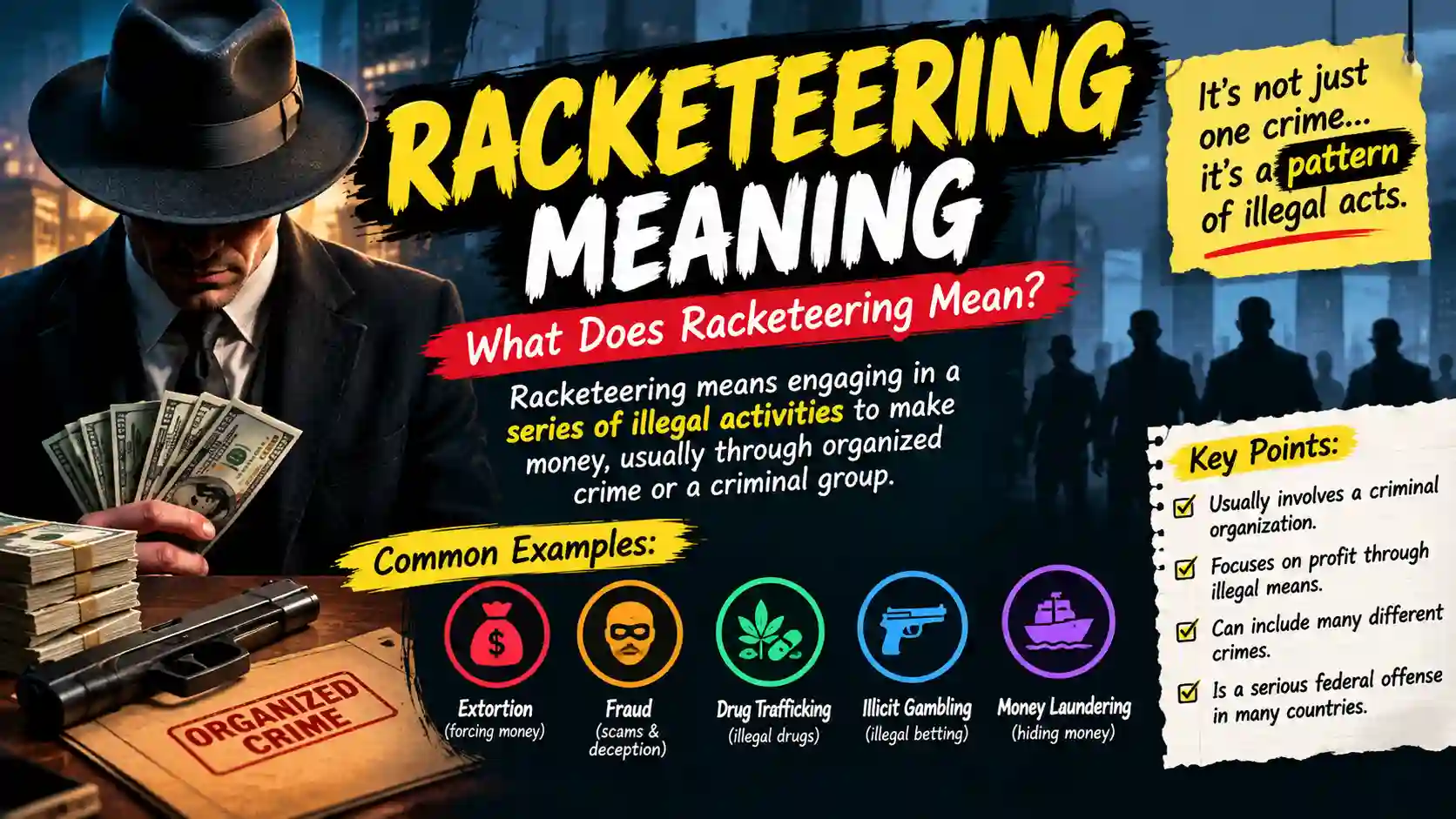
If you have ever heard the word “racketeering” on the news or in a crime show, you may have wondered what it actually means.
In simple terms, racketeering means running an illegal business or scheme to make money, often through fraud, threats, or organized crime. People search for the racketeering meaning because it sounds serious and confusing, especially when it shows up in legal cases involving big organizations or famous people.
In this article, you will learn what racketeering means, how it works, real examples, and how it differs from other crimes. By the end, you will understand this term clearly, even if you have never studied law.
Quick Answer
Racketeering means committing crimes as part of an ongoing illegal business or organized group, usually to make money unfairly. It often involves things like fraud, bribery, extortion, or illegal gambling done again and again as a pattern, not just a single bad act. The word is closely tied to organized crime and to a U.S. law called RICO, which stands for the Racketeer Influenced and Corrupt Organizations Act.
Meaning or Definition
At its core, racketeering is not just one crime. It is a pattern of criminal activity connected to a business or group. Think of it like this: if one person cheats someone one time, that is fraud. But if a group of people repeatedly cheats others as part of how they run their “business,” that pattern can be called racketeering.
The word comes from “racket,” which is old slang for a dishonest way of making money, usually through trickery or force. A racketeer is someone who runs or takes part in this kind of illegal scheme.
Racketeering usually involves at least two crimes from a list of serious offenses, done within a certain time period, and connected to the same organization or purpose. These crimes can include things like extortion, bribery, illegal gambling, loan sharking, drug trafficking, or fraud. What ties them together is that they are not random. They are part of a repeated pattern that helps an organization gain money or power unfairly.
It is also important to know that racketeering does not always involve violence. Some racketeering cases involve white-collar crimes, like insurance fraud or money laundering, done again and again by a company or group of people working together.
Origin or History
The term “racketeering” became widely known in the United States during the early 1900s, especially during the Prohibition era in the 1920s and 1930s. During this time, organized crime groups made large amounts of money through illegal alcohol sales, gambling, and extortion. These groups often forced businesses to pay “protection money,” which was really just a threat disguised as a service.
The word “racket” was slang used to describe these dishonest money-making schemes. Over time, “racketeering” became the formal term used by law enforcement and courts to describe organized criminal business activity.
In 1970, the U.S. Congress passed a powerful law called the Racketeer Influenced and Corrupt Organizations Act, known as RICO. This law was created to help prosecutors go after organized crime groups, not just individual criminals. RICO made it possible to charge an entire organization, including its leaders, even if they did not personally commit every crime themselves. This was a major shift because before RICO, it was often hard to prove that leaders of criminal organizations were responsible for crimes carried out by other members.
Since then, RICO has been used in many types of cases, not just traditional organized crime. It has been applied to corporate fraud, political corruption, gang activity, and even some sports and entertainment industry cases.
Racketeering vs Related Crimes
Many people confuse racketeering with other crimes because the terms overlap. The table below breaks down the differences in simple language.
| Term | Simple Meaning | Key Difference |
| Racketeering | Repeated illegal acts done as part of an organized scheme or business | Focuses on a pattern of crimes tied to an organization |
| Extortion | Getting money or property through threats | Racketeering can include extortion as one part of the pattern |
| Fraud | Lying or tricking someone for financial gain | Fraud can be a single act; racketeering requires a pattern |
| Money Laundering | Hiding the true source of illegally earned money | Often used to support ongoing racketeering activity |
| Organized Crime | A general term for criminal groups working together | Racketeering is often the legal charge used against organized crime |
Understanding these differences helps explain why racketeering charges are often more serious. Prosecutors are not just proving one bad act. They are proving an entire pattern of criminal behavior connected to a group or enterprise.
Real-Life Examples
Racketeering charges have appeared in many well-known cases over the decades, which is one reason people search for the meaning of the word.
One common example involves organized crime families that ran illegal gambling operations, loan sharking businesses, and extortion schemes targeting local businesses. Members of these groups were often charged under RICO because their crimes were not isolated incidents. They were part of a long-running, organized system.
Racketeering charges have also been used in corporate settings. For example, some large corporations have faced RICO lawsuits when executives were accused of running fraudulent schemes that harmed customers or investors over a long period of time.
In more recent years, RICO has been used in cases involving street gangs, political corruption schemes, and even cases involving public figures accused of running long-term criminal enterprises. These cases often involve multiple defendants because RICO allows prosecutors to charge everyone connected to the pattern of crimes, not just one person.
It is worth noting that being charged with racketeering does not automatically mean someone is guilty. Like any criminal charge, it must be proven in court beyond a reasonable doubt.
How Racketeering Charges Work
Racketeering cases are usually more complex than typical criminal cases because prosecutors must prove several things at once.
First, they need to show that an “enterprise” existed. This could be a business, a criminal organization, or even a loosely connected group of people working toward a shared illegal goal. Second, prosecutors must prove a pattern of criminal activity, meaning at least two related crimes happened within a certain time frame, usually within ten years of each other. Third, they must connect the accused person to that enterprise and show they knowingly took part in the pattern of crimes.
Because RICO cases involve so much evidence, they often take a long time to investigate and prosecute. Prosecutors may use wiretaps, financial records, and testimony from witnesses or former members of the organization to build their case. Penalties for racketeering can be severe, including lengthy prison sentences and large fines. Courts can also order the seizure of money or property gained through the illegal activity.
Common Mistakes People Make With This Term
Many people misuse the word “racketeering” because it sounds dramatic. Here are a few common mistakes.
Some people think racketeering only applies to the mafia or traditional organized crime. In reality, RICO laws have been applied to many types of organizations, including businesses, political groups, and even some non-profit organizations accused of fraud.
Another mistake is assuming that a single crime counts as racketeering. As explained earlier, racketeering requires a pattern of related crimes, not just one bad act.
People also sometimes confuse racketeering with simple bribery or fraud. While those crimes can be part of a racketeering case, racketeering specifically refers to the broader pattern connected to an organization.
Tips for Understanding Racketeering in the News
When you see the word racketeering in a news story, it helps to ask a few simple questions. Who is the organization or group involved? What repeated crimes are they accused of? And how are these crimes connected to each other over time?
If a news story mentions RICO charges, that usually signals a large, complex case involving multiple people or a long pattern of illegal activity, rather than a single crime committed by one person.
It also helps to remember that racketeering charges are serious legal accusations, not proof of guilt. Understanding this distinction can help you read news coverage more accurately and avoid drawing conclusions before a case is resolved in court.
FAQs
What does racketeering mean in simple words?
Racketeering means committing repeated crimes as part of an organized scheme to make money illegally, usually connected to a business or group.
Is racketeering the same as organized crime?
Not exactly. Organized crime is a general term for criminal groups, while racketeering is often the specific legal charge used to prosecute members of those groups.
What is RICO, and how is it connected to racketeering?
RICO stands for the Racketeer Influenced and Corrupt Organizations Act. It is a U.S. law that allows prosecutors to charge people involved in a pattern of organized criminal activity.
Can a company be charged with racketeering?
Yes. Businesses and their leaders can face racketeering charges if they are found to have engaged in a repeated pattern of fraud or other qualifying crimes.
Does racketeering always involve violence?
No. While some racketeering cases involve violence or threats, others involve white-collar crimes like fraud or money laundering with no physical violence at all.
What is the punishment for racketeering?
Punishments can include long prison sentences, heavy fines, and the loss of money or property gained through the illegal activity, depending on the severity of the case.
Conclusion
Understanding the racketeering meaning helps make sense of many news stories involving organized crime, corporate fraud, and major legal cases. At its heart, racketeering is about a repeated pattern of illegal activity connected to a business or group, not just a single crime. Laws like RICO were created to give prosecutors the tools to target entire criminal organizations, not just individual offenders. The next time you hear this word in the news, you will now know it points to something bigger than one bad decision. It reflects an ongoing, organized effort to profit from illegal activity, which is exactly why the law treats it so seriously.

Hi, I’m Benjamin Dreyer. I enjoy exploring words, phrases, slang, abbreviations, acronyms, and digital communication. At Linkquorax.com, I share simple and accurate explanations to help readers understand unfamiliar terms and popular internet expressions. My goal is to make every meaning clear, useful, and easy to understand. Whether you are curious about a new word or an online phrase, Linkquorax.com provides straightforward information to help you learn quickly and communicate with confidence in everyday conversations.