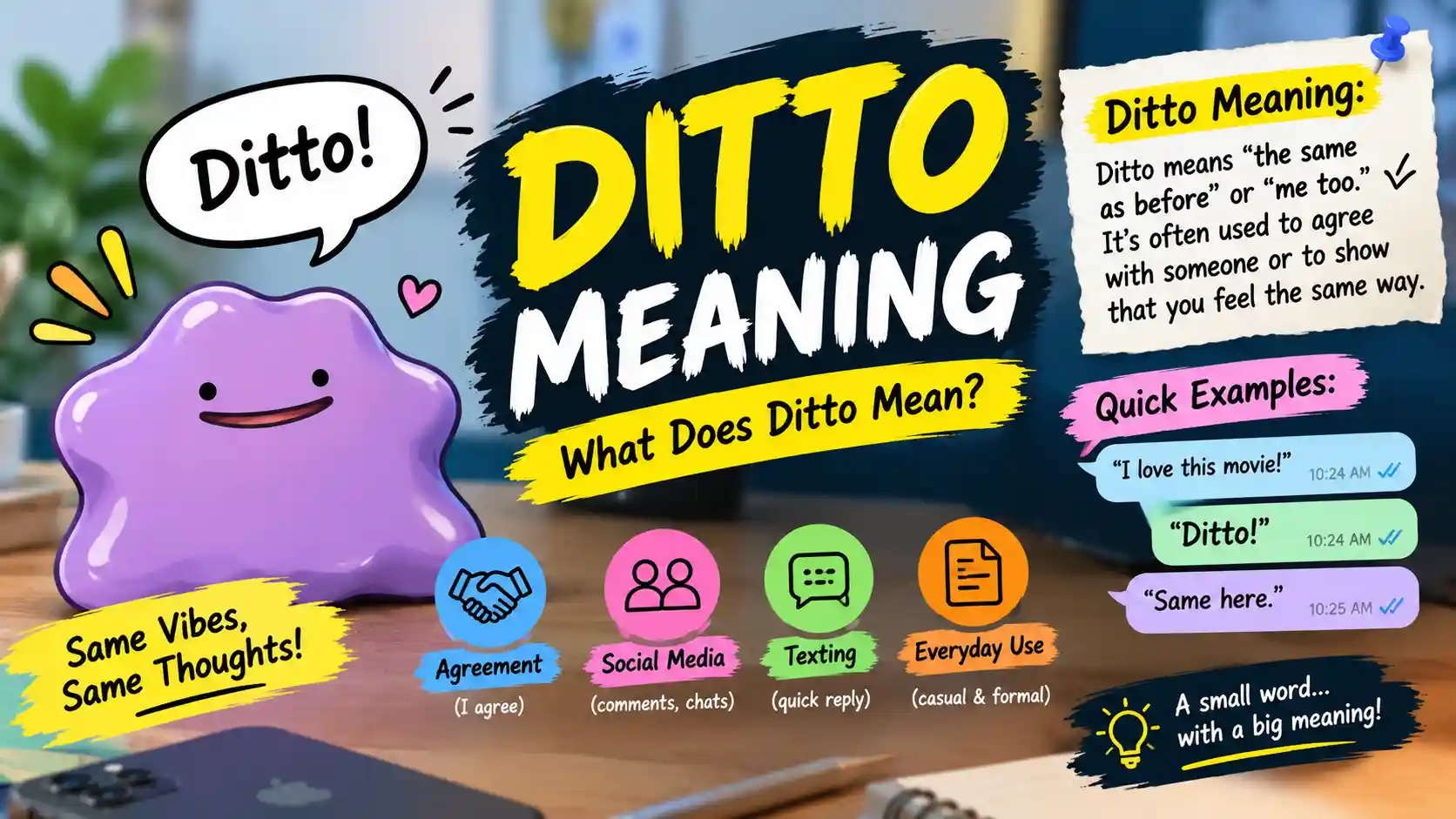
“Ditto” means “the same thing” or “I agree.” People use this fun little word instead of repeating something that was already said.
If your friend says, “I love pizza,” and you feel the same way, you can just say, “Ditto!” instead of saying the whole sentence again.
This word shows up in everyday talk, in movies, in text messages, and even in old paperwork. But a lot of people only know it from casual conversation and don’t know where it came from or how to use it the right way.
In this article, you will learn the full ditto meaning, how to use it in a sentence, where the word came from, and how people use it today. By the end, you’ll be able to use “ditto” like a pro, and you’ll understand why this short word has stuck around for hundreds of years.
Quick Answer
“Ditto” is a word that means “the same” or “already said.” People say it to agree with something without repeating the whole sentence. It can be used alone, like “Ditto!” or inside a sentence, like “She ordered the same meal, ditto for her sister.” It works as an adverb, a noun, and sometimes even a verb.
Meaning or Definition
At its core, “ditto” is a shortcut word. It stands in for something that was already said or done, so nobody has to repeat it. Think of it as a verbal copy-and-paste button.
Here are the main ways people use the word:
- As an agreement word: “I think we should leave early.” “Ditto.” This means “I agree” or “I think the same thing.”
- As an adverb: “Ditto” can describe something that matches what came before, such as “The first house was painted blue, ditto the garage.”
- As a noun: A “ditto” can refer to the mark (“) used to show repeated words in a list, or it can mean a copy of something, like an old “ditto machine” that printed copies of pages.
- As a casual reply: In texting and talking, people say “ditto” the same way they might say “same” or “me too.”
The word carries a friendly, informal tone. You won’t often see it in a formal business report, but you will hear it in daily conversations, casual emails, and pop culture all the time.
Grammar or Correct Usage
Understanding how “ditto” works in a sentence makes it much easier to use correctly. Here is a simple breakdown.
| Usage Type | Example Sentence | What It Means |
| Standalone reply | “I’m starving.” “Ditto.” | “Me too” or “I agree” |
| Adverb in a list | “Add sugar, ditto for flour.” | “The same applies here” |
| Noun (copy) | “He made a ditto of the report.” | A duplicate or copy |
| Noun (symbol) | Use ditto marks (“) under repeated words | Shows the same word repeats |
| Repeating agreement | “Ditto what she said.” | “I agree with what was said” |
A helpful tip: “ditto” almost always replaces a full statement that came right before it. It needs context to make sense. If you say “Ditto” out of nowhere, without anything said first, people won’t know what you mean.
Also, “ditto” does not change form. You don’t add “-ing,” “-ed,” or “-s” to it in normal speech. It stays the same no matter who is speaking or when the action happened, which makes it one of the easier words in English to use correctly once you understand the idea behind it.
Origin or History
The word “ditto” has a longer history than most people expect. It comes from the Italian word “detto,” which means “said” or “the aforementioned.” This word came from the Latin word “dictus,” which also means “said.” Italian merchants and record keepers used “ditto” in the 1600s to avoid rewriting the same month or item over and over again in long lists and ledgers.
By the 1620s, English speakers had borrowed the word and were using it the same way, mostly in written records, business documents, and legal papers, where the same word or date needed to be repeated many times.
Later, in the 20th century, the word took on a second life. A “ditto machine,” officially called a spirit duplicator, became a common office tool. Teachers and offices used it to print copies of worksheets and papers using a special purple or blue ink. Many adults still remember the smell of freshly printed “ditto sheets” from school. Even though these machines disappeared once photocopiers took over, the word “ditto machine” stuck in American memory for decades.
Over time, “ditto” moved from paperwork into everyday talk. People started saying it casually to mean “I agree” or “same here,” and that casual, friendly use is the most common way people use the word today.
Real-Life Examples
Seeing the word in action makes the meaning much clearer. Here are several examples from different situations.
In conversation: “This coffee shop has the best cinnamon rolls.” “Ditto, I could eat five of them.”
In texting: Friend 1: “I’m so tired today.” Friend 2: “Ditto.”
In writing or lists: “Monday: Team meeting at 9 a.m. Tuesday: ditto.” (This means the same meeting happens on Tuesday too.)
In pop culture: The movie Ghost (1990) made the phrase “Ditto” famous when a character used it instead of saying “I love you too.” This use became so well known that many people today connect the word with that emotional, romantic moment, even if they’ve never seen the film.
In business or records: “Invoice #1: Office chairs, $200. Invoice #2: ditto.” This means invoice #2 is also for office chairs at $200.
In agreement during arguments or debates: “I really think we need a longer lunch break.” “Ditto, one hundred percent.”
As you can see, the word flexes to fit casual talk, written lists, and even emotional movie scenes. That flexibility is part of why it has lasted so long.
Common Mistakes
Even a small word like “ditto” trips people up sometimes. Here are mistakes to watch out for.
| Mistake | Why It’s Wrong | Correct Version |
| Using “ditto” with no context | The listener won’t know what you’re agreeing with | Say it right after the original statement |
| Adding “-ing” or “-ed” | “Ditto” doesn’t change form | Just use “ditto” as is |
| Confusing it with “same” in formal writing | “Ditto” is too casual for formal papers | Use “the same applies” or “likewise” instead |
| Using ditto marks incorrectly | Ditto marks (“) only replace exact repeated words, not similar ones | Only use them when the word above is identical |
| Overusing it in professional emails | It can sound too informal for work messages | Save it for casual chats with coworkers you know well |
A common mix-up also happens between “ditto” and “vice versa.” They are not the same. “Vice versa” means the situation reverses (if A likes B, then B likes A too, in reverse order). “Ditto” simply means “the same thing applies,” with no reversal involved.
Current Usage or Trends
Today, “ditto” is alive and well, especially in casual and digital conversations. It shows up often in texting, social media comments, and group chats, where short, quick replies are popular. Saying “ditto” is a fast way to agree with someone without typing out a whole new sentence.
It has also stayed popular in pop culture. Beyond the famous line from Ghost, the word appears in songs, TV shows, and internet memes as a quick, catchy way to say “I feel the same.” Younger generations often use “ditto” the same way they’d use “same,” “facts,” or “mood,” showing that this centuries-old word has smoothly adapted to modern slang culture.
In professional settings, “ditto” still appears in printed forms and lists, mostly through ditto marks, when the same entry repeats across multiple rows. This traditional use has stuck around in accounting, scheduling, and record-keeping, even though the word feels casual almost everywhere else.
Tips or Best Practices
If you want to use “ditto” naturally and correctly, keep these simple tips in mind.
- Use it right after someone else’s statement so your meaning is clear.
- Save it for casual conversations, texting, or informal writing.
- Avoid it in formal essays, cover letters, or business reports.
- Use ditto marks only when the exact same word or number repeats directly below.
- Don’t add any extra endings to the word; it always stays “ditto.”
- If you want a slightly more formal way to say the same thing, try “likewise,” “same here,” or “I agree” instead.
Following these small habits will help you sound natural and confident every time you use the word, if you’re chatting with friends or filling out a written list.
FAQs
What does “ditto” mean in simple words?
“Ditto” means “the same” or “I agree.” People say it instead of repeating something that was already said.
Is “ditto” a formal word?
No, “ditto” is casual and informal. It’s great for everyday talk but not the best choice for formal writing like essays or business reports.
Where does the word “ditto” come from?
It comes from the Italian word “detto,” meaning “said,” which came from the Latin word “dictus.” It was first used in the 1600s to avoid repeating words in written lists.
What is a ditto mark?
A ditto mark looks like two small quotation marks (“) placed under a word or number to show that it repeats from the line above.
What is a ditto machine?
A ditto machine, also called a spirit duplicator, was an old office and school machine used to print copies of documents. It was common in the 1900s before photocopiers became popular.
Can “ditto” replace “vice versa”?
No. “Ditto” means the same thing applies again, while “vice versa” means the situation flips or reverses between two people or things.
Conclusion
So, what does “ditto” mean? In short, it means “the same” or “I agree,” and it’s a handy word that saves you from repeating yourself. From its roots in old Italian record-keeping to its famous movie moment in Ghost, and now its place in everyday texting, “ditto” has traveled a long way while staying simple and useful.
If you’re agreeing with a friend, filling out a form, or just want a quick and friendly reply, “ditto” gets the job done in one short word.
Next time someone shares an opinion you agree with, skip the long response and just say “ditto” instead. It’s short, it’s clear, and now you know exactly where it comes from.

Hi, I’m Benjamin Dreyer. I enjoy exploring words, phrases, slang, abbreviations, acronyms, and digital communication. At Linkquorax.com, I share simple and accurate explanations to help readers understand unfamiliar terms and popular internet expressions. My goal is to make every meaning clear, useful, and easy to understand. Whether you are curious about a new word or an online phrase, Linkquorax.com provides straightforward information to help you learn quickly and communicate with confidence in everyday conversations.